
UCLA backs off firing politically incorrect professor
Good news for science: UCLA has backed off from its plan to fire a politically incorrect professor, giving Dr. James Enstrom an eight month reprieve as it reviews his case.
Good news for science: UCLA has backed off from its plan to fire a politically incorrect professor, giving Dr. James Enstrom an eight month reprieve as it reviews his case.
Don’t bet the bank on this: In a preprint paper posted tonight on the astro-ph website, scientists predict the discovery of the first Earthlike extrasolar planet — using statistical analysis alone! Fun quote:
Using a bootstrap analysis of currently discovered exoplanets, we predict the discovery of the first Earth-like planet to be announced in the first half of 2011, with the likeliest date being early May 2011.
Back to the climate-theory drawing board: A paper published today in Nature Geoscience suggests that the ocean conveyor belt that brings warm water to the northern Atlantic is far more complex than the original theories proposed. These results strengthen earlier reports that also questioned the conveyor belt theory.
Using archival Hubble Space Telescope images astronomers have discovered 14 objects orbiting the Sun beyond Neptune. Key quote:
The newfound objects range from 25 to 60 miles across (40 to 100 kilometers), said the researchers.
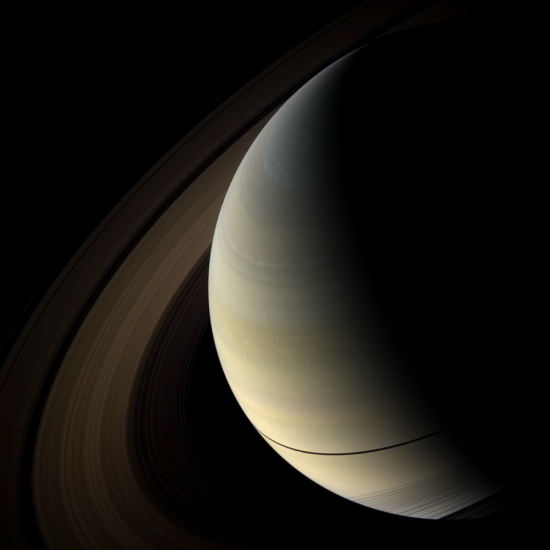
This breath-taking image of Saturn and its rings was taken by Cassini on July 19, 2009 and posted on the Cassini image gallery on August 27, 2010.
All systems go! The project engineer of the Dawn mission has posted a very detailed update (as of August 30), describing the spacecraft’s status in its journey to the asteroid Vesta.
Paul Spudis at Air and Space magazine has some more thoughts about the origins of that natural bridge on the Moon that Lunar Reconnaissance Orbiter photographed recently.
More data from Kepler! In a paper [pdf] published today on the astro-ph website, scientists outline Kepler’s census of the variability of stars. Key quote from the abstract:
We have separated the sample in 129,000 dwarfs and 17,000 giants, and further sub-divided, the luminosity classes into temperature bins corresponding approximately to the spectral classes A, F, G, K, and M. G-dwarfs are found to be the most stable with < 20% being variable. The variability fraction increases to 30% for the K dwarfs, 40% for the M and F dwarfs, and 70% for the A-dwarfs. At the precision of Kepler, > 95% of K and G giants are variable.
The detection in June by two different amateur astronomers of an impact on Jupiter bodes well for asteroid/comet research. You can read the actual paper here. [pdf] Key quote from the abstract:
A systematic study of the impact rate and size of these bolides can enable an empirical determination of the flux of meteoroids in Jupiter with implications for the populations of small bodies in the outer Solar System and may allow a better quantification of the threat of impacting bodies to Earth. The serendipitous recording of this optical flash opens a new window in the observation of Jupiter with small telescopes.
The mapping of the atmospheres and surfaces of some extrasolar planets, even at distances of many light years, is now possible.
Set to launch before year’s end, construction of China’s next lunar probe, Chang’e 2, appears to be on schedule, at least according to Chinese news sources.