Something is recycling the methane on Mars

Research results posted today [pdf] at the European Planetary Science Congress show that the methane in Mars’s atmosphere is seasonally variable and far more short-lived than predicted, disappearing in less than a year. Some process, therefore, must be both using it and replenishing it. On Earth, that’s almost always done by some form of life process. Key quote by one of the scientists, from the press release:

“Only small amounts of methane are present in the martian atmosphere, coming from very localised sources. We’ve looked at changes in concentrations of the gas and found that there are seasonal and also annual variations. The source of the methane could be geological activity or it could be biological Β­ we can’t tell at this point.”

The image below shows the three regions (in yellow) where the methane is concentrated.
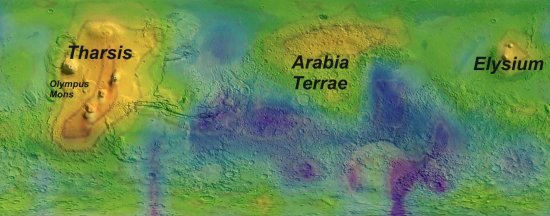
Mars methane locations

0 comments

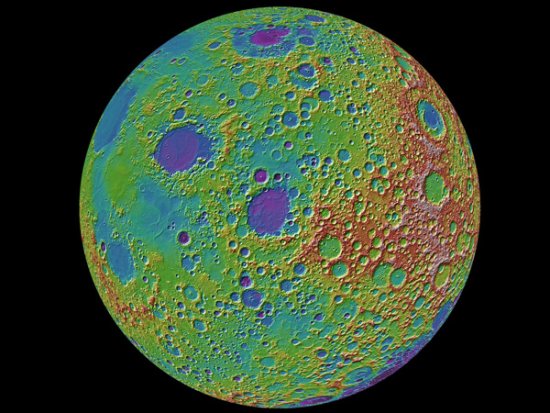
Global topography of the Moon

New results from Lunar Reconnaissance Orbiter, including a new global topographic map.

Global topography of the Moon

From the caption: A lunar topographic map showing the Moon from the vantage point of the eastern limb. On the left side of the Moon seen in this view is part of the familiar part of the Moon observed from Earth (the eastern part of the nearside). In the middle left-most part of the globe is Mare Tranquillitatis (light blue) the site of the Apollo 11 landing, and above this an oval-appearing region (Mare Serenitatis; dark blue) the site of the Apollo 17 landing. Most of the dark blue areas are lunar maria, low lying regions composed of volcanic lava flows that formed after the heavily cratered lunar highlands (and are thus much less cratered).

0 comments

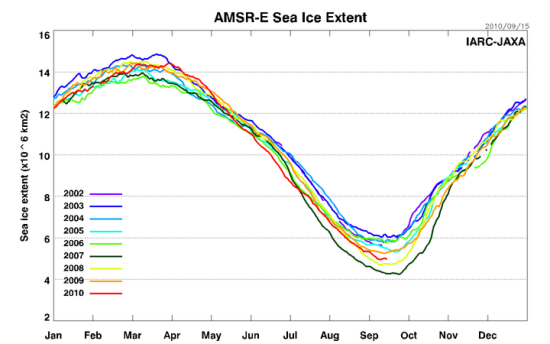
Arctic icecap reaches 2010 minimum

It appears that the Arctic icecap has reached its 2010 minimum. Though the icecap extent in the spring was the largest since 2002 (see image below), the melt was fast and the minimum appears to be the third lowest since 1979.

Icecap extent

Does this mean the icecap is melting and will disappear shortly, as some politicians like to believe? Hardly. Though the data suggests a long term decline in ice extent, recent trends also show evidence that the icecap might be recovering. What will actually happen is still anyone’s guess.

0 comments

How blind cave fish find food

How blind cave fish find food. Key quote:

“Vibration Attraction Behavior” (or VAB) is the ability of fish to swim toward the source of a water disturbance in darkness. Postdoctoral associate Masato Yoshizawa measured this behavioral response in both wild caught and laboratory raised cave and surface-dwelling fish using a vibrating rod at different frequencies as a stimulus. Most cavefish displayed VAB and would swim toward the vibrating rod and poke at it, while few surface fish did.

0 comments
1 714 715 716 717 718 729