The crumbling cliffs of Mars

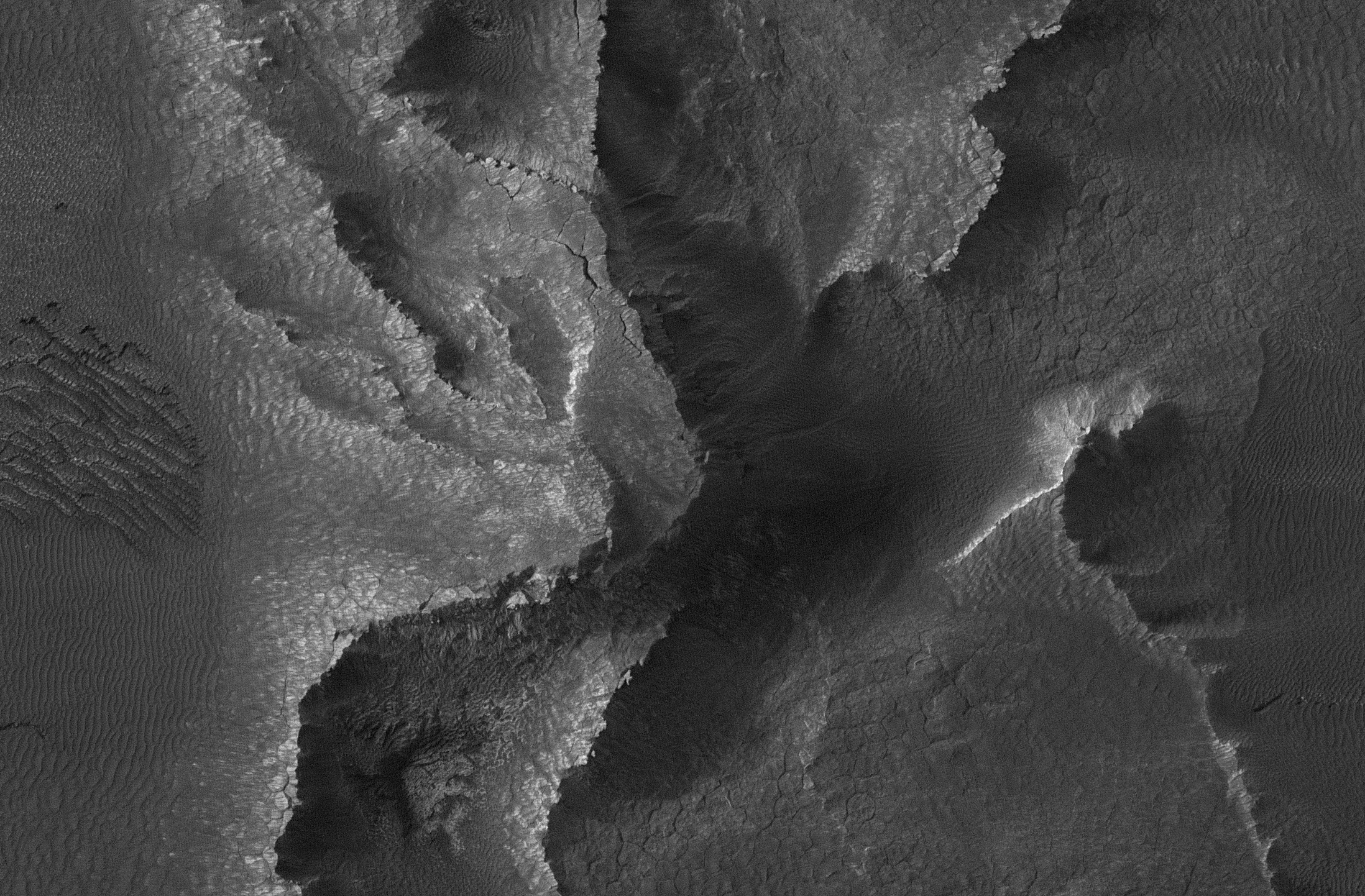
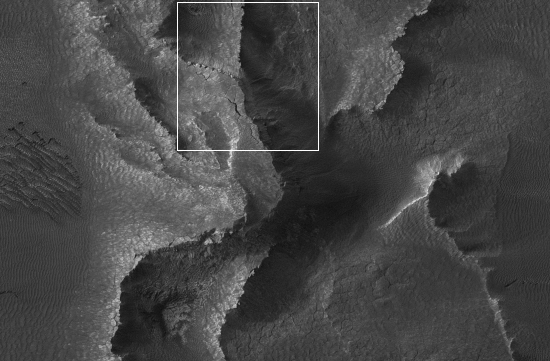
Among the new images posted last week by the HiRise camera on Mars Reconnaissance Orbiter is a picture showing the layered and looping ridgelines within Galle Crater. A close-up of these ridgelines revealed the precarious nature of those crumbling cliff tops.

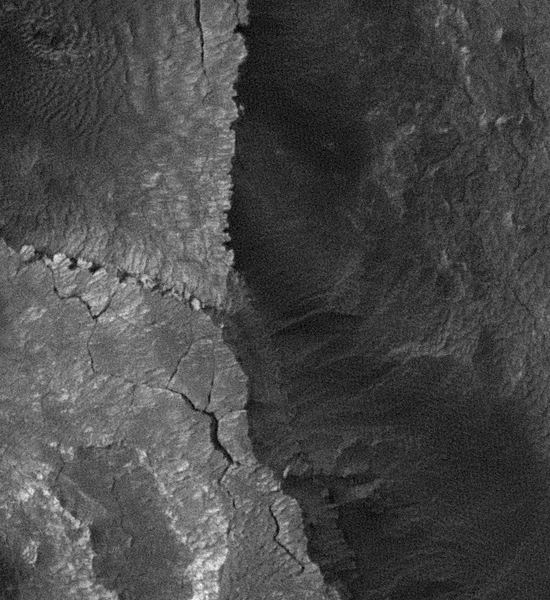
Below is a low resolution version of the image, with a high resolution cropped inset below that, showing a close-up of the most interesting looking area. In the inset you can see that the top of the cliff has separated away. It almost looks as if several large pieces are about to break off. You can also see that the top of the cliff to the north is made up of hanging rocks that appear to almost float in the air. They too look as if they are about to break off.

What makes this even more intriguing is that there are no boulder piles at the bottom of any cliff. All we can see on the valley floor is a pattern of polygonal fractures, possibly “due to ground ice, or regional tectonic stresses.” If large pieces of these ridge lines are breaking off periodically, as they surely appear to be doing, where has the debris gone?
Martian cliffs

crumbling cliffs

0 comments

A scientist’s ten commandments

Published today on the astro-ph website, this preprint by Ignacio FerrΓ­n of the Center for Fundamental Physics at the University of the Andes, Merida, Venezuala, is probably the shortest paper I have ever seen. I think that Dr. Ferrin will forgive me if I reprint it here in its entirety:

1. Go to your laboratory or your instrument without any pre-conceived ideas. Just register what you saw faithfully.

2. Report promptly and scientifically. Check your numbers twice before submitting.

3. Forget about predictions. They are maybe wrong.

4. Do not try to conform or find agreement with others. You may be the first to be observing a new phenomenon and you may risk missing credit for the discovery.

5. Criticism must be scientific, respectful, constructive, positive, and unbiased. Otherwise it must be done privately.

6. If you want to be respected, respect others first. Do not use insulting or humiliating words when referring to others. It is not in accord with scientific ethics.

7. Do not cheat. Cheating in science is silly. When others repeat your experiment or observation, they will find that you were wrong.

8. If you do not know or have made a mistake, admit it immediately. You may say, “I do not know but I will find out.” or “I will correct it immediately.” No scientist knows the answer to everything. By admitting it you are being honest about your knowledge and your abilities.

9. Do not appropriate or ignore other people’s work or results. Always give credit to others, however small their contribution may have been. Do not do unto others what you would not like to be done unto you.

10. Do not stray from scientific ethics.

It seems that some scientists in the climate field (Phil Jones of East Anglia University and Michael Mann of Pennsylvania State University are two that come to mind immediately) would benefit by reading and following these rules.

1 comment

Birthplace of the Sun?

In a preprint [pdf] posted today on the astro-ph website, astronomers outline the discovery of a star more like a twin of the Sun than any previously discovered. The star is located in the galactic star cluster M67, 3000 light years away. The similarity is so close that the scientists even speculate that the Sun itself might have formed in this same cluster, 4.5 billion years ago. Key quote from paper:

The similarity of the age and overall composition of the Sun with the corresponding data of M67, and in particular the agreement of the detailed chemical composition of the Sun with that of M67-1194, could suggest that the Sun has formed in this very cluster. According to the numerical simulations by Hurley et al. (2005) the cluster has lost more than 80% of its stars by tidal interaction with the Galaxy, in particular when passing the Galactic plane, and the Sun might be one of those. We note that the orbit of the cluster encloses, within its apocentre and pericentre, the solar orbit. However, the cluster has an orbit extending to much higher Galactic latitudes, presently it is close to its vertical apex at z = 0.41 kpc (Davenport & Sandquist 2010), while the Sun does not reach beyond z = 80 pc (Innanen, Patrick & Duley 1978). Thus, in order for this hypothesis of an M67 origin of the Sun to be valid, it must have been dispersed from the cluster into an orbit precisely in the plane of the Galactic disk, which seems improbable.

The last sentences above refer to the different orbital inclinations of the galactic orbits of both the Sun and M67. M67’s orbital inclination is far steeper. While M67 is presently about 1350 light years (410 parsecs) above the galactic plane, the Sun’s orbit never takes it more than 261 light years above the plane.

One more point of interest: M67 is a well known object to amateur astronomers, located in the constellation Cancer.

0 comments

The double vortex at Venus’s south pole is gone

Using data accumulated over the past four years by Venus Express, scientists have shown that the giant double vortex storm at Venus’s south pole was only a temporary phenomenon. You can download the actual paper here [pdf]. Key quote from the paper:

The polar region of Venus shows a dynamics regime quite different than the rest of the planet, with a separation region delimited by the cold collar zone. Average wind speeds presents an almost solid body rotation, while instantaneous view highlights the complex dynamic structure with air flowing almost toward all directions. The so called dipole shape is not a stable feature and the morphology of the vortex is significantly variable on both short and long timescales.

The “cold collar” is an atmospheric ring of colder temperatures that encircles the planet’s poles.

0 comments

The moons of Saturn

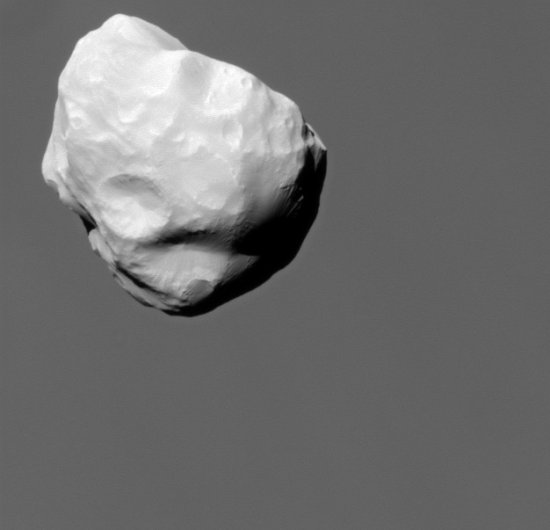
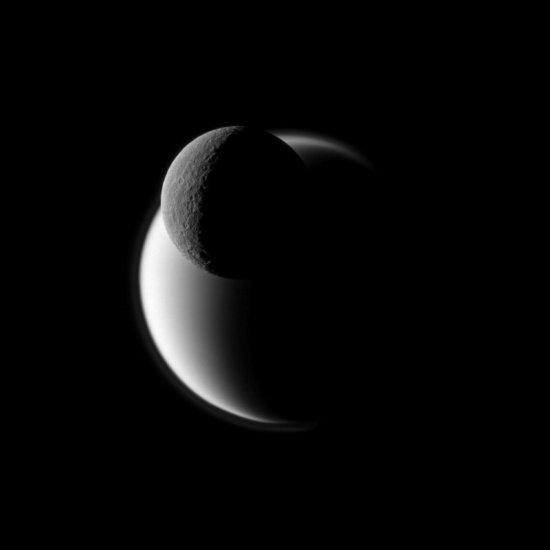
The Cassini spacecraft orbiting Saturn continues to send back a wealth of data, and some gob-smacking wonderful images. Below are two of the more recent examples. The first is not a computer-generated graphic: it shows the small moon Helene (21 miles across) during a fly-by on March 3, 2010, with Saturn’s atmosphere providing the background. The second captures Saturn’s two largest moons, with the smaller Rhea crossing in front of the larger Titan.

Saturn's moon Helene

Rhea eclipses Titan

0 comments

Opossums overrun Brooklyn

We’re here to help you! The New York city government, in an effort to control its rat population (the small rodent kind), decided to release opossums in Brooklyn to eat rats. Instead, the opossums have ignored the rats, and now Brooklyn is overrun with both rats and opossums. More here. Key quote:

“Didn’t any of those brain surgeons realize that the opossums were going to multiply?”

2 comments

More caves on the Moon

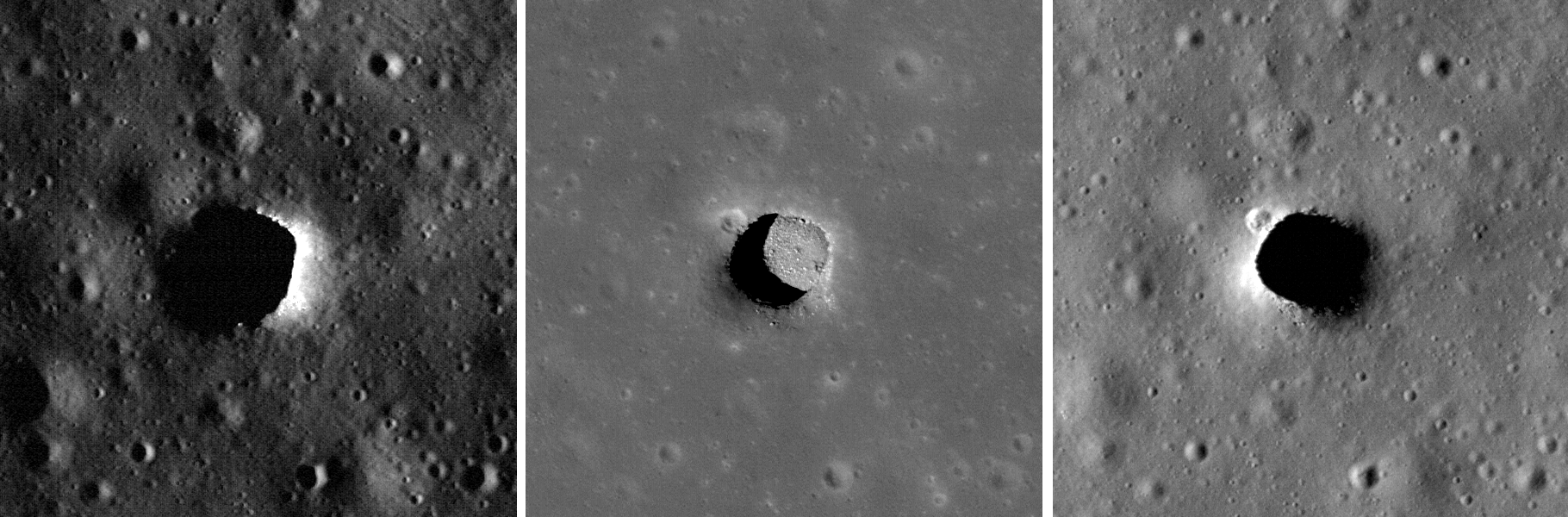
Check out these newly posted images of lunar cave pits, taken by Lunar Reconnaissance Orbiter. The depth estimates range from 100 to 300 plus feet.

[Ed. I should note that some of these images have already been posted on behindtheblack. For example, the center image found here) was first discovered by reader James Fincannon and posted by me on July 15 and July 26, when I discussed the challenges of accessing the bottom of these pits. I also posted an image of the Mare Ingenii pit on July 13.]

0 comments

The United States, as seen from the Moon

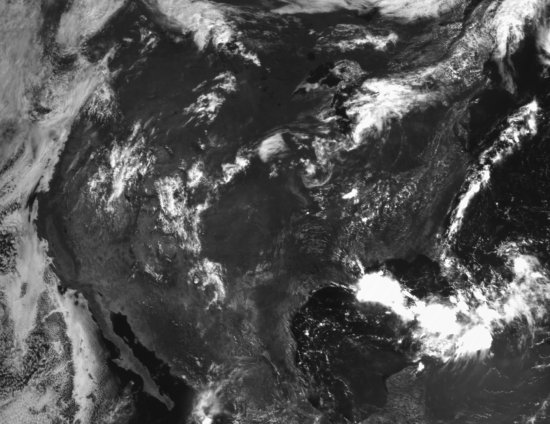
On August 9, 2010 the camera on Lunar Reconnaissance Orbiter took some routine calibration images and captured the Earth from lunar orbit, showing the western hemisphere with relatively little cloud cover. The picture below is a tiny piece from that global image, cropped to show the United States. The details are pretty remarkable, considering the distance. You can explore the full global image in detail here.

The U.S. from the Moon

1 comment
1 713 714 715 716 717 729