
The U.S. military is developing plans to recycle orbiting space junk into workable satellites.
The U.S. military is developing plans to recycle orbiting space junk into workable satellites.
The U.S. military is developing plans to recycle orbiting space junk into workable satellites.
Last night a piece of space junk missed ISS, but not by much.
The debris was only 8.7 miles from the station when it zipped by at about 16,000 miles per hour. That is very close, and had it hit, it would have done very significant damage.
The fragment was from an old Russian satellite, Cosmos 2251, that collided with an Iridium satellite in 2009, producing hundreds of fragments more than two inches across.
The six astronauts on ISS will take shelter in the two Soyuz capsules tonight because a piece of space junk will to pass close to the station at around 2:30 am (Eastern).
A prototype of a new space junk radar system has successfully demonstrated it can track objects smaller than an inch across.
This resolution is considered ten times better than previous designs. The cost to build the fully operational system is estimated to be $3.5 billion.
I wonder where we will get the money.
Updated and bumped: I will be discussing this story on the the John Batchelor Show tonight, February 17, Friday, 12:50 am (Eastern), and then re-aired on Sunday, February 19, 12:50 am (Eastern).
———————————————————————-
Someday, humans will be traveling far from Earth in large interplanetary spaceships not very different than the International Space Station (ISS). Isolated and dependent on these ships for survival, these travelers will have no choice but to know how to maintain and repair their vessels whenever something on them should break.
And things will break. Entropy rules, and with time all things deteriorate and fail.
Each failure, however, is also a precious opportunity to learn something about the environment of space. Why did an item break? What caused it to fail? Can we do something to prevent the failure in the future? Finding answers to these questions will make it possible to build better and more reliable interplanetary spaceships.
ISS is presently our only testbed for studying these kinds of engineering questions. And in 2007, a spectacular failure, combined with an epic spacewalk, gave engineers at the Johnson Space Center a marvelous opportunity to study these very issues.
» Read more
The fall of Rosat last October, which ended up in the Bay of Bengal, might have instead landed on Beijing had the spacecraft remained aloft a mere seven minutes longer.
No harm done: Phobos-Grunt has crashed into the Pacific Ocean, west of Chile.
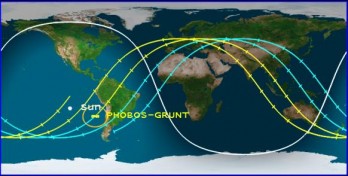
Updated and bumped. An updated prediction from Aerospace now calls for Phobos-Grunt to come down sometime between 9 and 3 pm (Eastern). This puts the U.S. now out of danger, though Europe, South America, Africa, Australia, and the southern half of Asia all remain in the spacecraft’s path.
Watch your heads! Phobos-Grunt is due to crash to Earth anytime in the next ten hours. And unfortunately, this new prediction has it flying over both North America and much of Europe and Africa during that time period.
Engineers say the mysterious sphere that crashed in Africa is a hydrazine tank from a rocket.
Chicken Little report: A mysterious metal sphere fell out of the sky in Namibia.
Junk from space? A mysterious three pound metal object crashed through the roof of a Massachusetts warehouse yesterday.
China attacks! Debris from a satellite that China destroyed in an anti-satellite test in 2007 may force ISS astronauts to take shelter tonight.
It now looks like the stranded and toxic Russian Mars probe, Phobos-Grunt, is likely aimed at Earth.
We are looking at an uncontrolled toxic reentry scenario. Phobos-Grunt . . . is fully-laden with unsymmetrical dimethylhydrazine and nitrogen tetroxide; that’s ten tons of fuel and oxidizer. The probe itself weighs-in at only three tons. . . . Phobos-Grunt’s batteries are draining and its orbit is degrading. It looks as if the probe will reenter later this month/early December. NORAD is putting a Nov. 26 reentry date on Phobos-Grunt.
It looks bad for Phobos-Grunt.
“Overnight, several attempts were made to obtain telemetric information from the probe. They all ended with zero result,” Interfax quoted a source in the Russian space sector as saying. “The probability of saving the probe is very, very small,” added the source, who was not identified.
ROSAT has crashed to Earth, but no one knows where as yet.
UARS has come to Earth, re-entering the atmosphere at 11:23 pm (Eastern) last night over the Pacific Ocean.
Aerospace Corporation has further refined its prediction for the deorbit of UARS. The window now goes from 11 pm to 3 am tonight, with the only land areas at risk being Canada, Africa, and Australia.
NASA now says re-entry will be between 11:45 and 12:45 am (Eastern), putting only Canada and Africa in the satellite’s path.
The most recent prediction now says that the UARS satellite will come down tonight between 9 pm and 3 am Eastern time, during one of four orbits, all of which pass over North America, Europe, and Africa. One orbit also passes over Australia.
The crash time of the UARS climate satellite has now been updated to a window lasting from 6 pm (Eastern) to 4 am (Eastern) tonight.
According to the map at the link, the U.S., Europe, Africa, and Middle East are all potential crash sites.
Even if UARS misses you today, don’t relax! A second large satellite, the 2.4 ton ROSAT X-Ray space telescope, is going to rain debris down late in October or early November.
On its ROSAT website, DLR estimates that “up to 30 individual debris items with a total mass of up to 1.6 tonnes might reach the surface of the Earth. The X-ray optical system, with its mirrors and a mechanical support structure made of carbon-fibre reinforced composite – or at least a part of it – could be the heaviest single component to reach the ground.”