The hidden glaciers of Mars

The glaciers belts of Mars

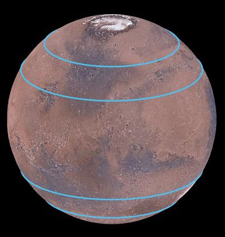
Scientists, using computer models and radar data obtained in orbit, have detected large belts of glaciers in Mars’ upper middle latitudes, buried beneath a layer of dust.

Several satellites orbit Mars and on satellite images, researchers have been able to observe the shape of glaciers just below the surface. For a long time scientists did not know if the ice was made of frozen water (H2O) or of carbon dioxide (CO2) or whether it was mud.

Using radar measurements from the NASA satellite, Mars Reconnaissance Orbiter, researchers have been able to determine that is water ice. But how thick was the ice and do they resemble glaciers on Earth? A group of researchers at the Niels Bohr Institute have now calculated this using radar observations combined with ice flow modelling.

The press release has one typo that is important. The belts appear to be located between 30-50 degrees latitude, not 300-500 (the degree sign became a 0 by mistake).

It is important to recognize the uncertainty of this discovery. Orbital images have seen features that suggest glaciers. The evidence that it is water-ice and that the water-ice is still largely present comes from the computer models. Computer models are notorious for seeing things that end up not being there.

Nonetheless, this result is important. It is further strong evidence that Mars still contains a lot of water locked in its immediate subsurface, where future colonists can mine it and use it to survive and build their homes.

2 comments

3D printed items made in space come back to Earth

NASA today released a video of engineers unpacking a box of 3D parts that had been printed on ISS and then returned to Earth for testing.

Some more details here.

The goal, Bean continued, is for NASA to develop a database of mechanical properties to see if there’s any difference in mechanical strength between identical items made in space and on Earth. During the interview last month, Bean said that while NASA didn’t yet have any hard data, there had been initial indications from videos made on the space station, that the plastics used in the 3D printing there had “adhered differently” than those in the terrestrial test. “The astronauts trying to get the parts off the plate,” Bean said, found that the plastic “seemed to be a little more stuck than on the ground.” He said that while it was too early to tell if that was actually true, his guess was that if so, “it may be due to a lack of convection in zero-gravity.”

Understanding the engineering issues of 3D printing in space will make it possible for crews to carry far less cargo on long interplanetary journeys. Instead, they would carry a much smaller amount of raw material, which they could use to manufacture items as needed, then recycled.

1 comment

Congress moves to require NOAA to use private weather satellites

The competition heats up: The House Science Committee has approved a bill that would require NOAA to begin using private satellites to gather weather data.

NOAA officials, most recently at a Feb. 12 hearing of the House Science environment subcommittee, have long said the agency is open to buying space-based weather data from aspiring commercial providers, so long as the companies can certify their data are up to NOAA standards. Currently this is impossible because NOAA has published no standards.

That would change if the Weather Research and Forecast Innovation Act of 2015 (H.R. 1561) becomes law. The measure sets a legal timetable for NOAA to publish the standards and competitively select at least one provider to sell the agency data to determine whether it can be easily folded into the National Weather Service’s forecasting models.

Watch what they do, not what they say. NOAA might claim it would use private providers, but without providing those standards it has given itself an easy way to reject everyone, which is exactly what they have done for years. This bill would force the issue.

3 comments

Blue Origin to begin flight tests of new rocket engine

The competition heats up: The rocket engine that Jeff Bezos’ Blue Origin company has been building is now ready for suborbital flight tests.

Blue Origin says the BE-3 is the first new hydrogen-fueled engine to be developed in the United States in more than a decade. It can be continuously throttled between 20,000 and 110,000 pounds of thrust. “Liquid hydrogen is challenging, deep throttling is challenging, and reusability is challenging,” Bezos said. “This engine has all three. The rewards are highest performance, vertical landing even with a single-engine vehicle, and low cost. And as a future upper-stage engine, hydrogen greatly increases payload capabilities.”

They hope to begin flight tests by the end of the year. Even as they develop this suborbital hydrogen engine, they are also developing an bigger engine for orbital flights in ULA’S next generation rocket that will replace the Atlas 5 and Delta.

0 comments

Build a satellite of your own for less than $30K

The competition heats up: An industry of new cubesat builders can now build satellites for anyone for any reason for very little money.

The miniaturisation of technology allows people to do more with less hardware, said Chad Anderson, the managing director of Space Angels Network, an investment house specialising in the space industry. That industry, he said, was worth $300bn (£200bn) last year. Constellations of smaller satellites, like those suggested as tracking devices for planes over oceans, are now a possibility. “The launch costs are coming down and people leveraging today’s technology are able to do more with less and launch less mass to orbit. The price point has come down to where start-ups and entrepreneurs can really make an impact on the scene for the first time,” he said.

When the first tiny satellite launch companies arrive, expect this industry to blossom at an astonishing rate.

9 comments

Unpaid Russian workers at Vostochny go on hunger strike

Because they haven’t been paid in months, 26 workers at Russia’s new spaceport in Vostochny have started a hunger strike.

This sure indicates that Russia isn’t going to get this spaceport ready for its first launch this year. And even if that launch does go off as planned, it does indicate some deeper problems that are going to haunt Russia’s space efforts in future years.

1 comment

ESA and Airbus Safran in budget dispute over Ariane 6

The competition heats up: The deal between ESA and Airbus Safran to build Europe’s next generation rocket, Ariane 6, to compete with SpaceX for the launch market is now threatened because Europe wants the company to pay more for development than the company expected.

[ESA launch director Gaele] Winters acknowledged that Airbus Safran Launchers has not agreed with ESA’s assessment that industry’s share of the development cost is around 400 million euros. “They told us they have not signed off on the 400 million [euros], and this is correct,” Winters said. “It is an assumption we made, which we will look at next during the full Program Implementation review scheduled for mid-2016. Industry is prepared to invest in the program, and one important condition is that we need to be sure they have a fair rate of return on their investment.”

Winters said ESA is sensitive to the fact that additional costs borne by industry will find their way into the Ariane 6 pricing structure, which would undermine the vehicle’s competitiveness on the international commercial market.

If Airbus Safran wants to own the rocket, they must be willing to pay for some of its development, as have SpaceX and the other new American commercial space companies. This is the price for having the right to make money from the rocket outside of its European government customers. It seems, however, that Airbus Safran is balking at that reality. They are used to having everything covered by ESA, and are now unhappy they might have to lay out some bucks themselves.

0 comments

The GAO discovers another out-of-control NASA project

Government marches on! A new GAO report has found that NASA’s effort to upgrade the ground-based portion of its satellite communications system, used by both military satellites and manned spacecraft, is more than 30 percent over budget, with its completion now delayed two years to 2019.

Worse, the GAO found that this problem program was actually one of three that have had budget problems. And that doesn’t include the disastrously overbudget James Webb Space Telescope.

In its latest assessment of NASA’s biggest programs, the U.S. Government Accountability Office identified the Space Network Ground Segment Sustainment (SGSS) as one of three — not counting the notoriously overbudget James Webb Space Telescope — that account for most of the projected cumulative cost growth this year. The others are the Magnetospheric Multiscale Mission, which launched March 12, and the Ice, Cloud, and Land Elevation Satellite-2, or ICESat-2, mission, the congressional watchdog agency said.

The last two projects are part of the climate focus that Obama imposed on NASA.

0 comments

Dawn’s chief engineer gives us a detailed update

Link here. Chief engineer Marc Rayman loves to write about Dawn, and his posts on the Dawn blog are probably the most information-packed of any spacecraft blog I have ever read. Key quote this time:

Dawn’s extensive photographic coverage of the sunlit terrain in early May will include these bright spots. They will not be in view, however, when Dawn spies the thin crescent of Ceres in its next optical navigation session, scheduled for April 10.

The orientation of the spacecraft and asteroid now are such that there is no point taking pictures, as most of the asteroid is in darkness.

Read it all, however. He gives a masterful overview of what is going to happen in the coming months.

1 comment

Problems for Rosetta during its most recent fly-by of Comet 67P/C-G

During its most recent close fly-by of Comet 67P/C-G Rosetta had a number of issues that caused the spacecraft to go into safe mode.

During the most recent flyby, a number of issues were reported, starting with the primary star tracker encountering difficulties in locking on to stars on the way in towards closest approach. Attempts were made to regain tracking capabilities, but there was too much background noise due to activity close to the comet nucleus: hundreds of ‘false stars’ [from comet debris] were registered and it took almost 24 hours before tracking was properly re-established.

In the meantime, a spacecraft attitude error had built up, resulting in the high gain antenna off-pointing from the Earth. Indeed, a significant drop in the radio signal received by ground stations on Earth was registered. Following recovery of the star tracker system, the off-pointing was immediately automatically corrected and the operations team subsequently saw a return to a full strength signal from the spacecraft.

However, issues with false stars were still occurring. Cross comparisons with other navigation mechanisms showed inconsistencies with the star trackers and some on board reconfigurations occurred. While attempting to reconfigure those, the same error occurred again leading this time to an automatic safe mode on Sunday afternoon. Safe modes occur when certain spacecraft parameters fall out of their normal operating ranges and the spacecraft automatically takes measures to preserve its safety. This also includes switching off the science instruments to protect them.

Rosetta is operating nominally now, but these issues are going to get more serious in the coming months, as the comet gets more active. Rosetta’s engineering team is going to have to come up with a method for the spacecraft’s star trackers to distinguish between stars and the debris in the comet’s coma. If they don’t it is likely that they will have to reduce the close fly-bys significantly.

2 comments
1 1,068 1,069 1,070 1,071 1,072 1,329