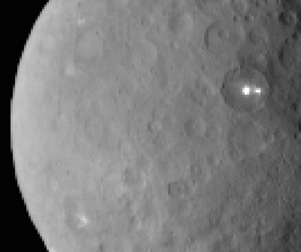
The brightest spot on Ceres has a partner

Ceres' double bright spots

Cool images! Dawn’s newest images have revealed that the brightest spot on Ceres, shown on the right in a cropped version of the full image, has a dimmer companion.

“Ceres’ bright spot can now be seen to have a companion of lesser brightness, but apparently in the same basin. This may be pointing to a volcano-like origin of the spots, but we will have to wait for better resolution before we can make such geologic interpretations,” said Chris Russell, principal investigator for the Dawn mission, based at the University of California, Los Angeles.

The spots are still too small for Dawn’s camera to resolve. That they are inside what looks like a crater is very puzzling. If they are water-ice, why are they so bright and distinct? One one think the ice would pile up along the crater wall, but then, that’s what we think based on our experience here on Earth with wind, rain, and our heavy gravity. Ceres is cold, has no atmosphere, and a tiny gravitational field. Every geological process will proceed in a different manner.

6 comments

Russians confirm plan to leave ISS in 2024

The competition heats up: Russian space managers have confirmed that they have endorsed a plan to leave ISS in 2024, when they will assemble their own space station using new modules as well as a significant number of the modules attached to ISS.

On February 24, 2015, the Scientific and Technical Council, NTS, at Roskosmos, the main planning body at the agency led by a newly appointed chairman and the former head of the agency Yuri Koptev, formally endorsed the Russian participation in the ISS program until 2024. It would be followed by the separation of Russia’s newest modules from the ISS to form the new national space station. As previously reported on this site, the initial configuration of the station would include the Multi-purpose Module, MLM, the Node Module, UM, and the Science and Power Module, NEM. Notably, the original Russian ISS component — the Zvezda Service Module, SM — was not included in the plan, thus ensuring that its propulsion capabilities would be available for deorbiting of the outpost at the end of its operational life.

Whether ISS will be functional with just the Russian Zvezda module is not clear. NASA engineers now have about a decade to figure this out and to fix it.

In general the break up of the partnership running ISS will be good for space exploration. The competition between nations will spur development and innovation. It will also free each nation from the shackles of the partnership. The Russians in particular have wanted to utilize ISS for more daring and longer expeditions to research interplanetary travel, and were stymied by NASA’s bureaucracy. Once they start doing this sort of thing on their own station NASA will feel obliged to follow.

Obviously, competition between nations carries risk. As long as there is some agreed to framework for claiming territory on other planets (something that the U.N. treaty does not allow), the nations will be able to compete peacefully. Without that framework, however, will leave room for disagreement and conflict.

It is thus essential that the space-faring nations sit down and work out this framework, and do it as soon as possible before each nation has vested interests in space that are already in conflict with each other. Above all, this new framework has got to abandon the U.N. space treaty with its rules that forbid the claiming and controlling of territory by nations in space. Those rules were never realistic, and literally guarantee that nations will eventually end up at war with each other as they fight to determine who owns what in space.

6 comments

Next Angara launch delayed

The competition heats up? Industry sources in Russia noted today that the next launch of Angara will be delayed until 2016.

Previously the next Angara launch was scheduled for late 2015. This delay is not a disaster for Russia, as Angara is designed to work in conjunction with the country’s new spaceport in Vostochny, and that facility won’t really be operational until 2016 either.

0 comments

X-Prize contestants team-up to create head-to-head lunar race

The competition heats up: Two Google Lunar X-Prize contestants have teamed up to use the same rocket to get to the Moon together, where they will literally race head to head to see who travels the 500 meter distance first to win the prize.

At a press conference in Tokyo on Monday, the leaders of two Lunar X PRIZE teamsโ€”Astrobotic and HAKUTOโ€”announced a plan in which the two teams’ robotic rovers will travel to the moon together and touch down on the lunar surface at the same time. They will then race each other to cover the 500 meters required to win the first place prize of $20 million.

John Thornton, head of Pittsburgh-based Astrobotic (a Carnegie Mellon University spin-off), said in a call with reporters that the partnership with HAKUTO (a spin-off from Tokyo University) represented the first step in realizing his team’s goal of turning robotic moon missions into a viable business. That mission won’t stop with this single partnership. He said the team was in talks with more than half of the other 16 GLXP competitors to carry their rovers to the moon, too, in exchange for sharing the cost of getting there and splitting prize money.

If this happens as they propose, we could be watching as many as ten rovers line up for the race.

3 comments

Spacewalk to begin the reconfiguration of ISS successful

Saturday’s first spacewalk in a yearlong project to reconfigure ISS so that it can accomodate two commercial cargo capsules and two commercial ferries, all at the same time, completed all tasks with no problems.

The article also provides a very clear explanation of the entire planned reconfiguration of ISS, including the reasons why these changes are necessary.

1 comment

How to drill rocks on Mars

Engineers have found that to properly drill on Mars, Curiosity need only use its lowest power settings.

The new drilling procedures essentially call for the rover to use its lowest energy setting right from the beginning, rather than starting with a setting a few levels up. Curiosity has six settings on its drill that have a nearly 20-fold range in energy. The drill has only been used three times before Curiosity reached Mount Sharp (Aeolis Mons), its ultimate science goal, late last year.

On those three occasions and when the drill was used once at Mount Sharp, Curiosity began its investigations at the drill’s Level 4. The first rock probed at Mount Sharp broke under this pressure. The new algorithm instead starts at Level 1 and only progresses upwards if drilling proves too slow.

The engineers have found that the rocks they have drilled into on Mars have been more fragile that expected, which actually shouldn’t be a surprise, due to the lower gravity. In fact, this one simple fact probably reveals a great deal of important information to geologists about the geology of Mars and how it formed.

5 comments

New Mexico legislature advances spaceport sale bill

A state bill to sell Spaceport America, New Mexico’s spaceport built to service Virgin Galactic’s oft-delayed space tourism business, has advanced out of its first committee.

The bill still needs to clear two more committees before it gets a floor vote, but considering the lack of progress at Virgin Galactic, I would not be surprised if it passes. The high hopes that created this spaceport a decade ago have now faded into a boondoggle that New Mexico probably can no longer afford.

3 comments
1 1,076 1,077 1,078 1,079 1,080 1,329