Falcon 9 launch scrubbed

Due to a variety of unresolved but apparently relatively minor issues SpaceX has decided to scrub today’s Falcon 9 launch.

They will try again tomorrow.

More details about the scrub here. The main problem was apparently a failure at an Air Force radar facility for tracking the rocket during launch.

0 comments

Weather 90% go for Falcon 9 launch today

The weather looks almost perfect for tonight’s Falcon 9 launch.

The Falcon 9 will put a solar observation satellite into orbit. While many left wing media outlets will wax poetic about this is Al Gore’s satellite, it is hardly that. It might have been built initially under his misguided idea of creating a propaganda satellite to take daily images of the Earth (images that are essentially of little use for climate studies), DSCOVR has been very carefully redesigned to give it a real purpose, monitoring the solar activity of the Sun and providing a replacement/back-up for ACE, which is now more than a decade overdue for replacement.

The Falcon 9 launch will also attempt again to land intact its first stage on a floating barge. If this attempt succeeds the entire future of space travel will be reshaped.

0 comments

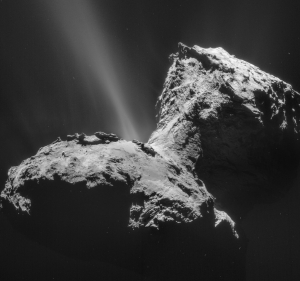
Plumes and dust surrounding Comet 67P/C-G

Plumes and dust

Cool image time! A new navigation camera mosaic from Rosetta shows both a clear plume rising out of Comet 67P/C-G as well as a “large number of small white blobs and streaks in the image are likely specks of dust or other small objects in the vicinity of the comet.”

The fact that, unlike previously, they did not have to significantly overexpose the image to bring out the plume and dust illustrates the increasing activity at the comet.

0 comments

NASA safety panel questions safety of SLS

NASA’s safety panel has issued a report questioning the safety of the early launches of the Space Launch System (SLS), partly due to the very low launch rate and the lack of any planned unmanned test flights for the rocket’s upper stage engine.

โ€œThe ASAP and the Agency remain concerned about risks introduced in the currently scheduled frequency of SLS/Orion launches, โ€ according to ASAPโ€™s 2014 Annual Report. โ€œThe plan indicates a launch about every 2 to 4 years. This would challenge ground crew competency. The skills, procedures, and knowledge of conducting the launch, mission, and recovery are perish-able. The ASAP believes that an extended interval requires the relearning of many lessons and skills, in contrast to Apollo and Shuttle, which had a relatively steady cadence.โ€

No space project can accomplish anything with launch rate this slow. Not only does this increase the risk that inexperience will cause errors, the long time gaps make it difficult for the project to get anything done.

And then there is NASA’s idea that it can put humans on this rocket without any previous launch testing of the rocket’s upper stage or the capsule’s life support systems. Why should NASA’s rocket get a pass on this kind of testing when the agency is demanding that the private companies do it?

2 comments

Rocket tank lands on Brazil farm

Chicken Little report: A propellent tank from an as-yet unidentified rocket landed near a house on a Brazilian farm on December 28.

The pictures at the link are neat, especially since the man in the selfie showing the farmer’s family and the tank in the background looks so much like New Jersey governor Chris Christie.

2 comments

OSIRIS-REx to get more fuel for its asteroid mission

In what might be a first for the planetary science/engineering community, an unmanned probe, being built to bring samples back from the asteroid Bennu, is turning out to be lighter than expected, thus allowing engineers to stuff its tanks with extra fuel to extend its mission.

The OSIRIS-REx spacecraft, being built at a Lockheed Martin facility in Denver, is coming in lighter than the lift capability of the Atlas 5 rocket, which will lift off in its โ€œ411โ€ configuration with a four-meter payload fairing, a single-engine Centaur upper stage, and one strap-on solid rocket booster.

The proposal โ€” described as a โ€œheavy launch optionโ€ โ€” would add an extra 341 pounds of fuel to the spacecraftโ€™s fuel tank.

Planetary probes never end up lighter than planned, at least until now. During construction scientists have always found it impossible to resist adding more instruments or capabilities, and thus engineers always struggle to get the spacecraft built within its weight budget. For OSIRIS-REx to have this wonderful problem is surely astonishing.

0 comments

Five years later a second attempt to put a Japanese spacecraft into Venus orbit

If at first: After failing to place its Akatsuki spacecraft into orbit around Venus in 2010 because of a cracked engine nozzle, Japan has announced its plans for a new attempt later this year.

The attempt will be made on December 7. If successful, the spacecraft will begin studying Venus’s climate and atmosphere only a short time after the end of Europe’s very success Venus Express mission.

0 comments

The Russian spaceport construction still behind schedule

In a detailed update on the status of Russia’s new Vostochny spaceport, russianspaceweb reports that the construction continues to be behind schedule.

Whether they can meet the government imposed deadline of first Soyuz rocket launch by the end of 2015 seems very doubtful. More significant is this interesting quote:

In the meantime, various sensitive systems, which arrived to Vostochny for installation into unfinished facilities, were rusting inside their containers along railway sidings.

Obviously, without enough qualified personnel at the remote construction site, Spetsstroi had little choice but to focus on facilities with the highest profile for visiting Moscow officials. Moreover, the work had to be done in a great haste, increasing the chances for mistakes and leading to a low quality of construction.

Boy, does that sound like the Soviet Union all over again. It also reminds me of how most government agencies operate in the U.S.

0 comments
1 1,079 1,080 1,081 1,082 1,083 1,329