Comet 67P/C-G’s plumes

plumes from Comet 67P/C-G

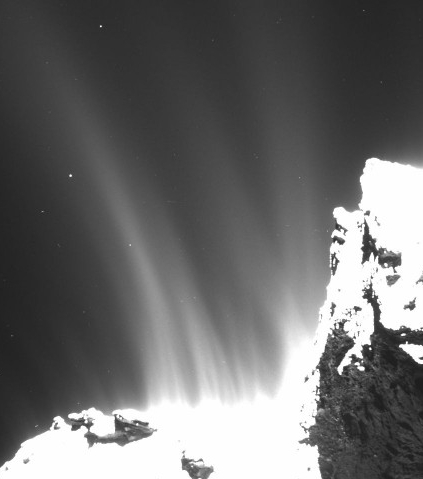
The science team running Rosetta has released an image (cropped by me on the right) from the probe’s high resolution camera showing the fine structure of Comet 67P/C-G’s plumes.

I call them plumes rather than jets, which is the word the scientists use as well as everyone else, because it appears to me that they really aren’t jets, tightly confined flows of material coming from a nozzle-like opening. Instead, the image makes me think of very fast-rising plumes of smoke rising from an extinguished fire.

This image was taken in November, and is one of only a very tiny handful of images released from the high resolution camera. Rosetta’s science team has been very possessive of images from this camera, holding them back for their own research papers to follow in the future. Even here, the image is not very detailed. I wonder what cool stuff this camera has snapped close in that they have not yet shown us.

0 comments

More Earthlike exoplanets found

Worlds without end: Using Kepler astronomers have discovered a red dwarf star 150 light years away with three Earth-like exoplanets, one of which is in the habitable zone.

The three planets are 2.1, 1.7 and 1.5 times the size of Earth. The outermost planet, at 1.5 Earth radii, is the smallest of the bunch and orbits far enough from its host star that it receives levels of light from its star similar to those received by Earth from the sun, said UC Berkeley graduate student Erik Petigura, who discovered the planets Jan. 6 while conducting a computer analysis of the Kepler data NASA has made available to astronomers. He calculated that the three planets receive 10.5, 3.2, and 1.4 times the light intensity of Earth. “Most planets we have found to date are scorched. This system is the closest star with lukewarm transiting planets,” Petigura said. “There is a very real possibility that the outermost planet is rocky like Earth, which means this planet could have the right temperature to support liquid water oceans.”

These planets were found by Kepler in its present reconfigured mission, which once again illustrates the incredible effectiveness of an optical telescope in space. If only we were building some.

0 comments

Funding obtained for 648-satellite internet constellation

The competition heats up: A commercial effort to build a 648 constellation of satellites to provide worldwide intenet access has secured funding from Richard Branson’s Virgin Group and Qualcom.

Not surprisingly, Branson was immediately saying that his LauncherOne concept will be launching many of these satellites, though I think he’s got to get it built and tested first.

2 comments

New Horizons to begin observations of Pluto

In preparing for its July 14 fly-by of Pluto, New Horizons will take its first images of the planet on January 25.

Snapped by New Horizons’ telescopic Long-Range Reconnaissance Imager, known as LORRI, those pictures will give mission scientists a continually improving look at the dynamics of those moons. And they’ll play a critical role in navigating the spacecraft as it covers the remaining 135 million miles (220 million kilometers) to Pluto. “We’ve completed the longest journey any craft has flown from Earth to reach its primary target, and we are ready to begin exploring!” said Alan Stern, New Horizons principal investigator from Southwest Research Institute in Boulder, Colorado.

Over the next few months, LORRI will take hundreds of pictures of Pluto against star fields to refine the team’s estimates of New Horizons’ distance to Pluto. Though the Pluto system will resemble little more than bright dots in the camera’s view until May, mission navigators will use those data to design course-correction maneuvers that aim the spacecraft toward its flyby target point this summer. The first such maneuver could occur as early as March.

0 comments

SpaceX to open satellite-building operation in Washington state

The competition heats up: Within three years SpaceX hopes to establish a new satellite operation in Seattle, Washington, employing 1,000 people and focused on the design of smaller, cheaper satellites.

The key quote from the article perhaps is this: “Musk said the office would focus on developing satellites but could also be a base for rocket-design talent uninterested in moving to SpaceX’s base in the Los Angeles area.” To put it another way, California’s socialist and highly restrictive state government has forced Musk to consider an alternative location for the expansion of his company.

His effort should also strike fear into the established satellite makers, who have done relatively little innovative design changes in the past four decades. As SpaceX has done with the launch industry, I expect SpaceX will do with the satellite industry: force them to lower costs while developing new technologies.

1 comment
1 1,083 1,084 1,085 1,086 1,087 1,329