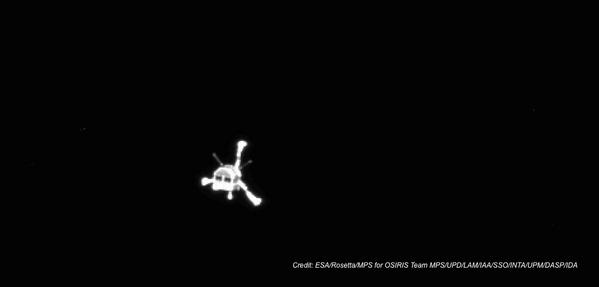
Philae might have bounced

Data from the Philae lander suggests that, when the spacecraft’s harpoons failed to fire, the probe might have bounced and then settled to the surface.

[T]elemetry from the craft suggested it might have drifted off the surface after landing and started to turn. This subsequently came to an end, which the German Space Agency official interpreted as a possible “second landing” on Comet 67P. This “bounce” was always a possibility, but had been made more likely by the failure of the harpoons to deploy, and the failure of a thruster intended to push the robot into the surface.
1 comment

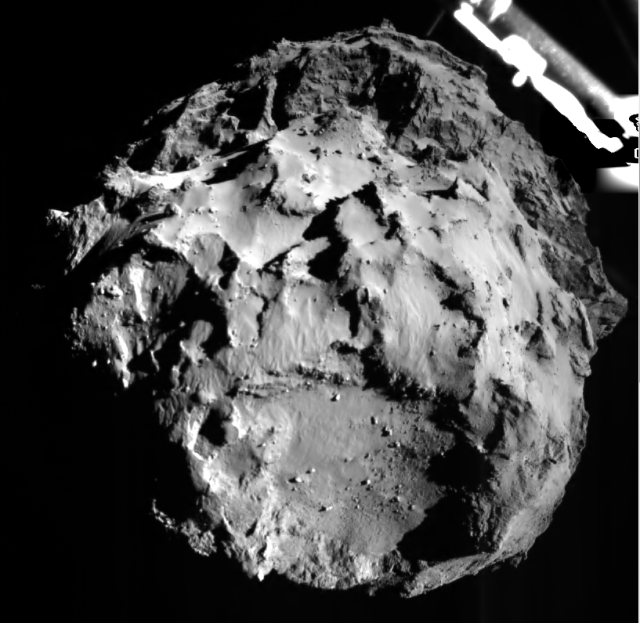
A comet picture taken by Philae on the way down

Comet 67P/C-G as seen by Philae during its descent

I am not sure if the actual landing site is visible in this image. I don’t think so as nothing seems to match what was on the earlier close-up. Moreover, the Rosetta website does not say.

No images on the surface have yet been released. There are also issues that could prevent a full success.

However, while the lander has touched down on the comet using its harpoons, scientists said that it had not yet deployed its anchors which meant that it was not completely attached to the surface. The surface was much softer than they expected, so there were some concerns that it was not securely fixed on the comet โ€“ although from a software point of view things seemed to be fine. Engineers will attempt to fire the anchors again soon in order to keep Philae attached to the surface of the comet.

3 comments

Philae has landed successfully!

Philae has landed successfully on Comet 67P/C-G.

Philae is on the surface, its harpoons have fired and the landing gear has been moved inside, and Philae is in contact. It’s incredible! Massive smiles on everyone’s faces. The room went mad. Twice — when we first had the hint, and then when Stephan Ulamec and Andrea Accomazzo confirmed it. Unbelievable.

More information and data will be coming in a few hours. Stay tuned.

3 comments

Philae is go for separation, despite problem

Engineers have given a go for the separation of the Philae lander from Rosetta, despite the failure of a thruster to operate.

During checks on the landerโ€™s health, it was discovered that the active descent system, which provides a thrust upwards to avoid rebound at the moment of touchdown, cannot be activated.

At touchdown, landing gear will absorb the forces of the landing while ice screws in each of the probeโ€™s feet and a harpoon system will lock Philae to the surface. At the same time, the thruster on top of the lander is supposed to push it down to counteract the impulse of the harpoon imparted in the opposite direction. โ€œThe cold gas thruster on top of the lander does not appear to be working so we will have to rely fully on the harpoons at touchdown,โ€says Stephan Ulamec, Philae Lander Manager at the DLR German Aerospace Center. โ€œWeโ€™ll need some luck not to land on a boulder or a steep slope.โ€

Update: Separation has occurred and signal reacquired from Philae. We wait for landing.

0 comments

Musk hints at a team-up with space-based internet provider

The competition heats up: Elon Musk yesterday revealed that he is in negotiations to team-up with a venture that would put in orbit a constellation of 700 satellites to provide low-cost internet access.

The venture was originally linked with Google, but that partnership has faded. Musk meanwhile said that his deal will be announced within the next three months.

0 comments

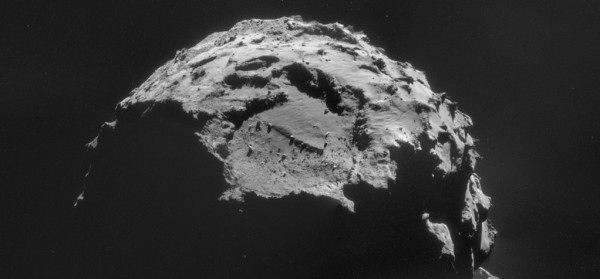
Close-up image of Philae’s landing site


Agilkia landing site for Philae

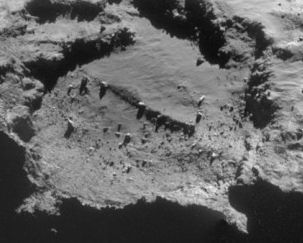
Inset of landing site

In the preparation to Wednesday’s landing of Philae on Comet 67P/C-G, Rosetta’s science team has released a great image of the landing site, shown above. To the right is a higher resolution inset of the site itself, with the smallest object visible about 8.5 feet across.

Looking at this inset, there are some obvious worries that we all should be aware of prior to the landing attempt. Though the Agilkia landing site is generally more smooth than most of the comet’s surface, it still has significant hazards. The lower part is strewn with boulders and rocks, many of which are quite large. Any one of these could do serious harm to Philae should it land on them.

Even more interesting is the upper part of the landing site. Though very smooth, the image suggests to me that this is a very thick pile of softly packed material. Philae might land there and quickly sink below the surface, where its cameras will be able to see nothing.

Nonetheless, the science team has also released this outline of Philae’s science timeline after landing. The lander will also be taking images of both Rosetta and the comet during its descent, so even if the landing is a failure we will still get some worthwhile data.

1 comment
1 1,093 1,094 1,095 1,096 1,097 1,329