
An update on the status of NASA manned commercial competition

Jason Davis at the Planetary Society blog has put together an excellent summary of the status for all three companies competing for NASA’s contract to ferry astronauts to and from ISS.

Key paragraph:

From a quantitative standpoint, Boeing is the leader. Since the first quarter of 2013, the company has been ahead in percentage of milestones completed and percentage of funding awarded. Plus, there’s the simple fact that they’ve finished all of their milestones, while SpaceX and Sierra Nevada asked for extensions. But from a qualitative standpoint, things are less straightforward. SpaceX has already proven they can fly missions to the ISS. And they’re the only CCiCap participant with a pad abort test and an in-flight abort test among their milestones.

It is very clear just looking at the actual milestones that what Boeing has done so far is not that impressive. Almost everything on their list is a paperwork review, not construction or testing of actual hardware. Meanwhile, SpaceX and Sierra Nevada are building and testing spacecraft. That they have not yet completed their milestones is hardly a big deal in this context.
4 comments

Playing with today’s Rosetta image of Comet 67P/C-G

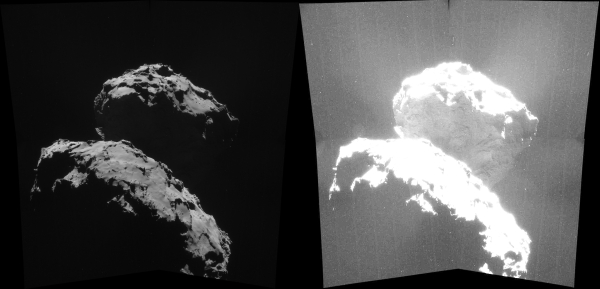
Adjusted comet image

In releasing Wednesday’s image of Comet 67P/C-G, the Rosetta science team suggested that readers download it and play with the brightness and contrast settings to bring out some interesting details.

[I]f you adjust the contrast of the image you will see that there is a lot of โ€˜noiseโ€™ in the background. Some of this is simply detector noise and cosmic rays, but there seem to be a few bright objects that may be dust/ice particles between Rosetta and the comet.

In previous NAVCAM and OSIRIS images, weโ€™ve already seen jets of gas laced with dust streaming away from the comet, and the instruments COSIMA and GIADA have started detecting dust, so it would be no surprise if these objects were also found to originate from the comet. In any case, it is a phenomenon that will clearly be studied in great detail at 67P/C-G over the coming weeks and months.

Another nice observation you might like to make while playing around with the contrast settings is that faint details can be brought out in the โ€˜neckโ€™ region of 67P/C-G, which on first look is seemingly obscured by shadows. It appears as though the neck is being illuminated by the reflection of sunlight off the main body of the comet below.

The image on the left above is the image as released. The image on the right I have brightened considerably to bring out additional details. As they noted, you can see topographical details in the shadowed neck area. Also, the entire nucleus seems to be surrounded by faint dust streaming away in all directions.

It is going to be a great deal of fun to watch this comet change over the next year as it makes its journey around the Sun.

1 comment

Russia to match SpaceX launch prices

The competition heats up: The head of Russia’s United Rocket and Space Corporation (URSC), which now controls that country’s entire space industry, said today that they intend to compete with SpaceX’s Falcon 9 much cheaper launch prices.

They intend to do it with both the Proton rocket as well as their new family of Angara rockets. The heavy version of Angara will allow them to compete with SpaceX’s Falcon Heavy, and in fact might even put more payload into orbit for less.

7 comments

Curiosity to begin climbing

Scientists have decided to begin Curiosity’s climb of Mount Sharp immediately rather than continue a planned traverse along the base of the mountain prior to heading uphill.

Curiosity’s trek up the mountain will begin with an examination of the mountain’s lower slopes. The rover is starting this process at an entry point near an outcrop called Pahrump Hills, rather than continuing on to the previously-planned, further entry point known as Murray Buttes. Both entry points lay along a boundary where the southern base layer of the mountain meets crater-floor deposits washed down from the crater’s northern rim.

The issues with Curiosity’s wheels also played a part in this decision.

0 comments

Putin threatens management at Vostochny with criminal prosecution

In a statement today in the Russian press Vladimir Putin proposed initiating a criminal investigation into the management of the new Vostochny spaceport.

[Putin] admitted that โ€œalthough the project is in the focus of our special attention, problems abound. … I will have to hand over some issues to law enforcement agencies to get them sorted out and clarified,โ€ Putin said. Funding is provided regularly but the funding procedure itself needs special attention, he said, referring to โ€œquasi and semi-criminal schemesโ€.

It appears that funds have not been used as efficiently as he likes and his solution is to threaten prosecution of those involved. This is becoming a standard Putin technique. He used it to guarantee his control over the Russian aerospace company Energia, and now he is using it here to guarantee the Vostochny project moves forward fast and efficiently.

Its use also illustrates the limitations of Russia’s top down approach to everything. Such threats can prevent corruption in a specific project, but that such treats are necessary so frequently points out how easily such corruption grows in a government-run centralized bureaucracy. We see it here in the U.S. as well. Take away the profit motive and private ownership and there remains nothing to naturally focus the efforts of management towards success and efficiency.

5 comments

The first chemical analysis of Comet 67P/C-G’s coma

The Rosetta science team today released their first analysis of the chemical make-up of Comet 67P/C-G’s coma, finding that not surprisingly it is made up mostly of water, carbon monoxide, and carbon dioxide.

However, ROSINA [the instrument on Rosetta for doing this analysis] has made the surprising observation that the ratio between these species varies quite significantly, depending on where in the coma Rosetta is. Sometimes carbon monoxide is almost as abundant as water; sometimes itโ€™s only around 10%. In addition, ROSINA has not only detected these main species already, but many of the expected minor ones, such as ammonia, methane, and methanol.

1 comment

Europe’s satellite makers want Ariane 6

Europe’s six biggest satellite makers have written Arianespace to demand that the company build its next generation Ariane 6 rocket by 2019 or face a significant loss of business.

Given the advent of electric propulsion and the dramatic launch-cost reduction offered by Space Exploration Technologies Corp., the operators say, the new Ariane 6 needs to be in service by 2019 or face the risk that Europeโ€™s Arianespace launch consortium will be permanently sidelined. The letter was signed by six members of the European Satellite Operators Association. Signatories included the chief executives of Intelsat, SES, Eutelsat, Inmarsat, Hispasat and HellasSat.

This letter is clearly intended to help prod Arianespace into making a decision on whether to build a new rocket, Ariane 6, or upgrade Ariane 5. Right now the company’s partners have been unable to come to an agreement about what to do.

4 comments

Another delay at Virgin Galactic

In an interview with David Letterman this week, Richard Branson admitted that his first flight on SpaceShipTwo will not be in December 2014 but early next year.

Watch the interview at the link. It is very clear that Branson is getting uncomfortable with the situation. He has made these claims too many times without showing any results. Also note the incredible ignorance exhibited by Letterman. A good interviewer has to ask some basic questions, but a good interviewer also needs to have a basic understanding of the subject. Letterman shows us here that he doesn’t know squat.

4 comments

Rosetta gets closer

If all goes well with maneuvers today, Rosetta will creep inward to an orbit only 16 miles from Comet 67P/C-G.

From this position the probe will begin gathering a global map of the comet nucleus. Nor is this the closest they will get. Over the next month they will move in again and again in weekly increments.

0 comments

The Russian takeover of Crimea once again threatens American access to space

A decision by the Russians to possibly shift astronaut training back to a base in the Crimea, now under their control, could lock American astronauts from future Soyuz flights.

Shifting the survival training to Russian-occupied Crimea will require foreign cosmonauts to accept travel there without Ukrainian visas, an explicit acquiescence to the new diplomatic status of the province. Refusal to attend survival training is equivalent to failing the training, which by existing training regulations is an automatic disqualification for flight certification. No Crimea trip, no space trip.

The Russians have not yet made this shift official, so it is possible it will not become a problem. However, the article outlines many reasons why it makes good sense for the Russians to do it.

6 comments
1 1,106 1,107 1,108 1,109 1,110 1,328