
Dawn’s arrival at Ceres delayed one month

Though engineers have solved the problems caused when a radiation blast disabled Dawn’s ion engine and put it into safe mode for a week, the fix will cause a one month delay in its arrival at the asteroid Ceres.

Controllers discovered Dawn was in safe mode Sept. 11 after radiation disabled its ion engine, which uses electrical fields to “push” the spacecraft along. The radiation stopped all engine thrusting activities. The thrusting resumed Monday (Sept. 15) after controllers identified and fixed the problem, but then they found another anomaly troubling the spacecraft.

Dawn’s main antenna was also disabled, forcing the spacecraft to send signals to Earth (a 53-minute roundtrip by light speed) through a weaker secondary antenna and slowing communications. The cause of this problem hasn’t been figured out yet, but controllers suspect radiation affected the computer’s software. A computer reset has solved the issue, NASA added. The spacecraft is now functioning normally.
1 comment

Blue Origin to build rocket engine for Atlas 5

The competition heats up: Jeff Bezos’s company Blue Origin has signed a contract with the United Launch Alliance to build a rocket engine for the Atlas 5 rocket so that it will no longer have to depend on Russian engines.

Neither executive [of either company] would discuss a dollar figure, although it’s likely somewhat less than $1 billion. Bruno said a typical liquid-fueled rocket engine takes seven years and $1 billion to develop, but Blue Origin is already several years along on the BE-4. Bruno said the engine could be ready within four years to serve as the main engine on the company’s Atlas V rockets.

This is excellent news, because it shows that ULA is being pro-active in solving this problem, rather then waiting for Congress to act.

3 comments

Another contest where you can win a ticket to space

Spaceship Earth Grants (SEG) has launched a contest where it will give away one space flight ticket to fly on any available launch service for every 50,000 applications it receives.

The winner (or winners) will receive a trip aboard a spaceflight provider flight available at the time of the award announcement. In other words, should the likes of space tourism companies like Virgin Galactic or Space Adventures be capable of offering trips into space at the time, then the winning candidate would be booked aboard one of their flights. Subject, of course, to availability and the various restrictions one or all of these companies may impose, along with the rider that no promise is made to be able to fly on a particular carrier.

Be warned however, the application is not free. SEG will charge you from $15 to $90, the amount “dependent upon the relative wealth of the nation in which you live.”

0 comments

NASA has chosen Boeing and SpaceX to build manned spacecraft to ferry crews to ISS

The competition heats up: NASA has made a decision and has chosen two companies to ferry astronauts to and from ISS, and those companies are Boeing and SpaceX.

I am watching the press conference on NASA television. Some quick details from NASA here.

This is a reasonable political and economic decision. It confirms that SpaceX is ready to go and gives the company the opportunity to finish the job, while also giving Boeing the chance to show that it can compete while also giving that pork to congressional districts.

Some details: After NASA has certified that each company has successfully built its spacecraft they will have then fly anywhere from four to six missions. The certification process will be step-by-step, similar to the methods used in the cargo contracts, and will involve five milestones. They will be paid incrementally as they meet these milestones.

One milestone will be a manned flight to ISS, with one NASA astronaut on board.

One more detail. Boeing will receive $4.2 billion while SpaceX will get $2.6 billion. These awards were based on what the companies proposed and requested.

I will have more to say about this tonight on Coast to Coast, as well as on the John Batchelor show.

13 comments

Air Force to decide SpaceX certification on December 1

The competition heats up: The Air Force has set December 1 for its deadline for certifying SpaceX as qualified to launch military satellites.

“I root for SpaceX to come into the competition,” Gen. John Hyten, head of Air Force Space Command, said during a speech Tuesday at the Air Force Association’s annual conference. But he warned that the company may not be ready in time. “The most important thing for this nation is assured access to space that works all the time,” he said. “That’s why the certification for SpaceX, hopefully by Dec. 1, is a big event. But if they’re not ready on Dec. 1, we have to stand up and say that, and that’s going to be difficult because I want competition.”

It sounds like the Air Force is setting this date as when it will decide one way or the other, regardless of anything SpaceX has done. I also suspect that, because of politics, this decision will hinge on what NASA decides today concerning its commercial crew contract.

0 comments

Russia reiterates that it has no intention to stop selling the U.S. its rocket engines

Russia officials today repeated that they will continue to sell Russian rocket engines to American companies, despite the sanctions imposed on their country because of the Ukrainian situation.

Meanwhile, there’s this story about the budget squeeze in the U.S. that makes it difficult to produce an American-made engine for the Atlas 5 rocket.

1 comment

Management problems at NASA’s asteroid hunting program

An inspector general report today criticized NASA’s program to find potentially hazardous asteroids, finding it disorganized and poorly managed.

The report faulted the NEO Program’s lack of structure, and said its resources are inadequate for handling its growing agenda. In addition to the program’s Washington-based executive, Lindley Johnson, NASA funding goes to support six employees at the Minor Planet Center in Massachusetts and six more at the Jet Propulsion Laboratory in California, the inspector general’s office said.

The report said the program’s executive fell short when it came to overseeing progress in the asteroid-tracking effort. What’s more, there were no formal partnerships with the Defense Department or the National Science Foundation, or with international space agencies. Those groups could make significant contributions to the effort, the report said.

I do not doubt that this program has management problems. What government agency today doesn’t? And any that are managed well are the exception to the rule. However, the report’s conclusion that “resources are inadequate for handling its growing agenda” is typical Washington-speak for “Give us more money!” which almost never solves the management problems that made the program a failure in the first place.

6 comments

No first stage landing attempt on next Falcon 9/Dragon launch

SpaceX has decided not to attempt a soft splashdown of the Falcon 9 first stage during Saturday’s launch of the Dragon capsule to ISS.

In a change of plans, the Falcon 9 booster stage set to launch Saturday will not carry landing legs, according to Hannah Post, a SpaceX spokesperson. She said SpaceX does not plan to attempt a water landing of the first stage after its job during launch is completed.

SpaceX initially planned to program the rocket’s first stage to fly back to Earth after completing its work to boost the Dragon spacecraft off the launch pad, but engineers swapped out the Falcon 9 booster with a first stage originally assigned to another flight, officials said.

The reason for the changeout was not disclosed.

I suspect this decision is in connection with the Falcon 9R failure last month, but admit I am speculating with no inside knowledge.

I should also note that if Saturday’s launch goes as planned, it will set a new SpaceX record for the fastest turn-around between launches, less than two weeks. If they succeed, I think they will prove once and for all to most of their remaining naysayers that they are a serious, reliable, and well-run launch company.

0 comments

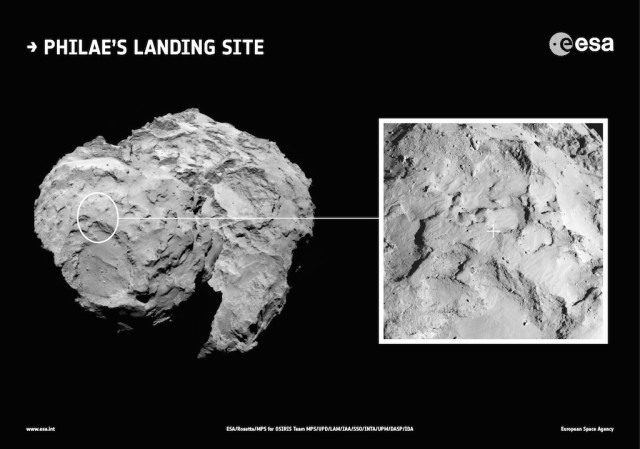
Philae’s landing site chosen

Philae's primary landing site

The Rosetta science team has chosen the primary landing site on Comet 67P/C-G for its Philae probe.

Site J is on the ‘head’ of the comet, an irregular shaped world that is just over 4 km across at its widest point. The decision to select Site J as the primary site was unanimous. The backup, Site C, is located on the ‘body’ of the comet. The 100 kg lander is planned to reach the surface on 11 November, where it will perform indepth measurements to characterise the nucleus in situ, in a totally unprecedented way.

This site is, located in the outside center of the nucleus’s smaller lobe, was picked unanimously because it appears to be the easiest to reach while also providing good science.

The descent to the comet is passive and it is only possible to predict that the landing point will place within a ‘landing ellipse’ typically a few hundred metres in size.

A one square kilometre area was assessed for each candidate site. At Site J, the majority of slopes are less than 30º relative to the local vertical, reducing the chances of Philae toppling over during touchdown. Site J also appears to have relatively few boulders, and receives sufficient daily illumination to recharge Philae and continue science operations on the surface beyond the initial battery-powered phase.

Provisional assessment of the trajectory to Site J found that the descent time of Philae to the surface would be about seven hours, a length that does not compromise the on-comet observations by using up too much of the battery during the descent.

I have put a close-up of the landing site below the fold.
» Read more

0 comments

The competition in space continues to heat up

Two news stories today indicate that things are going to get increasingly interesting in the exploration of space in the coming years.

First there is this story from Joe Abbott of the Waco Tribune, who routinely reports on SpaceX news because their McGregor test facility is nearby. In it Abbott reports that SpaceX has scheduled its next Dragon supply mission to ISS for no early than September 20.

This news item however is not Abbott’s most interesting news. He also notes several twitter reports coming out a commercial satellite conference in Paris that indicate that SpaceX has closed 9 deals, including several more for its as yet unflown Falcon Heavy.

But even that is not the most interesting news. Abbott also reports that a replacement for the destroyed Falcon 9R test vehicle will be shipped to McGregor for testing in less than two months. Considering how long it takes governments to build and fly test vehicles, getting this replacement in shape for flight mere months after the failure a few weeks ago is quite impressive.

But even that was not Abbott’s most interesting SpaceX news item. » Read more

10 comments
1 1,105 1,106 1,107 1,108 1,109 1,328