
An engineer describes how he and four other engineers debugged a fully fueled Saturn 5 rocket while it was the launchpad.

An engineer describes how he and four other engineers debugged a fully fueled Saturn 5 rocket while it was the launchpad.

The Saturn V was more noisy and ghostly than I had ever expected and it had grown much taller and certainly more threatening since last week. The venting fuel made loud hissing sounds when relief valves popped or opened up suddenly. It was very easy to let your imagination infect your brain. This is a very dangerous place and everything seems to be moving in the heavy foggy mist. There was no way to talk to each other, heck, we could barely see each other and…we hadn’t thought of this problem so we held onto each others yellow protective clothing like kindergartners crossing the street. We all wore safety helmets but they just did not make you feel like you were really safe.

This was also the first test launch of the Saturn 5, so the unknowns were significantly magnified.
0 comments

A new company is now offering balloon flights to the edge of space for one third the price of a suborbital flight.

The competition heats up: A new company is now offering balloon flights to the edge of space for one third the price of a suborbital flight.

World View passengers will soar to an altitude of about 30 kilometers (about 100,000 feet) — far short of SpaceShipTwoโ€™s intended 110-kilometer (68-mile) high peak. Inside the capsule there will be little sensation of microgravity. Rather, the whole point of the ride is the view. โ€œYou can be sitting up there having your beverage of choice watching this extraordinary spectacle of the Earth below you and the blackness of space,โ€ project co-founder and Paragon president Jane Poynter told Discovery News. โ€œIt really is very gentle. You can be up at altitude for hours, for days for research if you need to be… I think we have the opportunity to give a really, really incredible experience to people — and for a lot less than most of whatโ€™s out on the market right now,โ€ she said.

1 comment

The great Martian dust storm of 1971.

The great Martian dust storm of 1971.

There has only been one comparable global dust storm on Mars since then. What made the 1971 even more significant historically is that the first human orbital probe had arrived at that very moment to record it.

By late 1971 and into January 1972 the storm abated, and Mariner 9 began to send back some spectacular images โ€“ a total of over 7,300 pictures that mapped the entire martian surface with resolutions ranging from 1 kilometer per pixel to as good at 100 meters per pixel.

The image here gives a sense of the magnitude of the storm. This was what the scientists began to see as the dust settled. The only visible features are the three great Tharsis Montes shield volcanoes, poking up through the haze in a line. The tallest of these reaches an altitude of over 18 kilometers. These peaks, and the enormous bulk of Olympus Mons had never been imaged by a spacecraft before, earlier flybys had missed them.

The late Bruce Murray (Caltech) was on the camera team and recalls, โ€œthere was a gradual clearing, like a stage scene, and three dark spots showed up.โ€ The Mars that came out of the storm was a revelation, from these colossal mountains to the great rift of Valles Marineris and the steep valleys of Noctis Labyrinthus.

0 comments

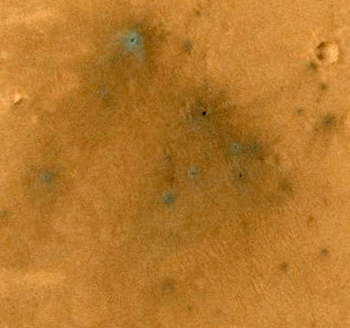
Fresh impacts caused by Curiosity during landing

impacts from Curiosity debris

The image on the right is a cropped close-up of a Mars Reconnaissance Orbiter image taken in early September that shows a fresh cluster of impacts, all smaller than six feet across. Nearby but not visible in this image are four larger craters about 12 to 15 feet in diameter. The impact cluster is located just northwest of Gale Crater and was not present in images taken before Curiosity’s arrival on Mars. The cluster is also in line with other impact craters produced by other debris dropped by Curiosity as it descended onto the Martian surface.

Scientists are at the moment unsure what spacecraft debris caused these impacts.

Assigning each of the impacts to specific pieces of hardware is a challenging puzzle, but it is thought that the four large craters were produced by two large tungsten weights that broke in half to make these four craters, or by pieces of the cruise stage, which was designed to break up in the atmosphere for planetary protection purposes, to kill any Earthly microbes.

The cluster imaged here adds to the mystery, and may have been produced by a piece of the cruise stage that traveled farther through the Martian atmosphere and was therefore more thoroughly fragmented by the time it crashed onto the surface.

Identifying the source of the debris is a challenging engineering problem that also has scientific interest. Knowing what caused the impacts and then studying how the surface was changed by them will tell geologists a great deal about the make up of that surface.

3 comments
1 1,163 1,164 1,165 1,166 1,167 1,328