
“Long-term budget pressures on NASA mount.”

Why SLS will surely die: “Long-term budget pressures on NASA mount.”

Whether the cheaper, more efficient, and competitive commercial space program will survive remains unknown. It could be that our brilliant Congress, which wants SLS, will keep that very expensive program alive just long enough to choke the life out of the commercial space program. Then, with the government part of private space dead from lack of support, they will suddenly be faced with the gigantic bill from the NASA-built SLS and will, as they have done repeatedly during the past four decades, blanch at paying the actually construction and launch costs, and will kill that too.
3 comments

SpaceX’s launch manifest for 2013 included three commercial launches in addition to its cargo flights to ISS.

SpaceX’s launch manifest for 2013 includes three commercial launches in addition to its cargo flights to ISS.

All told, it appears that 2013 will a crucial year for SpaceX. They first need to solve the question of that engine failure from their October Falcon 9 launch. Then they need to begin putting into orbit the long list of private satellites that they have contracts for but have held off launching pending the success of the NASA deal. Once they do that, set to begin next year, they will have proven – beyond a shadow of a doubt — that they are for real.

And on that subject, Elon Musk had some thoughts yesterday about his European competitors: “Europe’s rocket has no chance.”

SpaceX’s Falcon is a new entrant to the launcher market. It has so far made only four flights, but it has a backlog already of more than 40 contracted launches. Its quoted price under $60m per flight is proving highly attractive to satellite operators who have to pay substantially more to get on an Ariane. “Not only can we sustain the prices, but the next version of Falcon 9 is actually able to go to a lower price,” warned Mr Musk. “So if Ariane can’t compete with the current Falcon 9, it sure as hell can’t compete with the next one.”

0 comments

The Russians have repaired the severed cable that had cut off their communications with ISS and space.

The Russians have repaired the severed cable that had cut off their communications with ISS and space.

The article notes that this failure was never a critical problem for ISS, pointing out that there was a back up communications route in the U.S., and that the astronauts on board are trained to work independent of the ground. Though both these points are true, what the article doesn’t mention is that much of the American half of ISS has been built to be run from the American mission control. It is not like Mir, which was designed to be as self-sufficient as possible. The result is that though a communications break in Russia is not really critical, a communications break in the U.S. might be.

0 comments

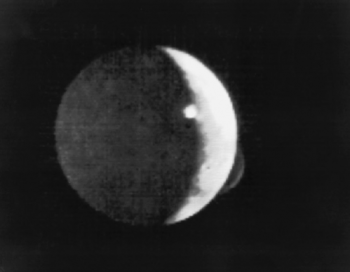
The discovery of volcanoes on Io

discovery image

On March 8, 1979, as Voyager 1 was speeding away from Jupiter after its historic flyby of the gas giant three days earlier, it looked back at the planet and took some navigational images. Linda Morabito, one of the engineers in charge of using these navigational images to make sure the spacecraft was on its planned course, took one look at the image on the right, an overexposed image of the moon Io, and decided that it had captured something very unusual. On the limb of the moon was this strange shape that at first glance looked like another moon partly hidden behind Io. She and her fellow engineers immediately realized that this was not possible, and that the object was probably a plume coming up from the surface of Io. To their glee, they had taken the first image of an eruption of active volcano on another world!

Today, on the astro-ph preprint website, Morabito has published a minute-by-minute account of that discovery. It makes for fascinating reading, partly because the discovery was so exciting and unique, partly because it illustrated starkly the human nature of science research, and partly because of the amazing circumstances of that discovery. Only one week before, scientists has predicted active volcanism on Io in a paper published in the journal Science. To quote her abstract:
» Read more

0 comments
1 1,205 1,206 1,207 1,208 1,209 1,327