It looks like there will be no manned Soyuz missions launched from South America.

It looks like there will be no manned Soyuz missions launched from South America.

An ESA study conducted between 2002 and 2004 found that because the Soyuz has not been designed to land in the sea, a French Guiana launch that had to be aborted would endanger the spacecraft and its crew as it would likely have to ditch in the Atlantic Ocean. The Soyuz spacecraft have always landed on land in the former Soviet territory of Kazakhstan.

0 comments

The Obama administration formally announced today that it is joining Europe in writing an international code of conduct for space.

What could go wrong? The Obama administration formally announced today that it is joining Europe in writing an international code of conduct for space.

The State Department announcement describing the administration’s intentions notes the U.S. will not agree to anything “that in any way constrains our national security-related activities in space or our ability to protect the United States and our allies.” However, it is also so vague about what they will agree to that I wonder what the point is. Either this whole effort is a waste of time, or it carries the risk that our government will agree to a treaty with unintended consequences that cannot be predicted.

In such a circumstances, it seems to me that the wiser thing to do would be to do nothing.

1 comment

The satellite communications company Intelsat has backed out of a deal to have a robot refuel some of itsr orbiting satellites.

Bad news: The satellite communications company Intelsat has backed out of a deal to have a robot refuel some of its orbiting satellites.

Apparently Intelsat would rather rake in the cash by launching new satellites rather than take a risk at a new technology that could save its customers a lot of money.

0 comments

Russia is now claiming that a U.S. military radar might have disabled Phobos-Grunt.

Looking for scapegoats: Russia is now investigating whether a U.S. military radar signal might have disabled Phobos-Grunt.

The state news agency RIA Novosti quoted Yury Koptev, former head of the Russian space agency Roscosmos, as saying investigators will conduct tests to check if a U.S. radar emissions could have impacted the Phobos-Ground space probe, which became stuck in Earth’s obit for two months before crashing down. “The results of the experiment will allow us to prove or dismiss the possibility of the radar’s impact,” said Koptev, who is heading the government commission charged with investigating causes of the probe’s failure.

The current Roscosmos head, Vladimir Popovkin, previously said the craft’s malfunction could have been caused by foreign interference. Deputy Prime Minister Dmitry Rogozin acknowledged U.S. radar interference as a possible cause but said it was too early to make any conclusions. “This version has the right to exist,” Rogozin said Tuesday. “There is evidence indicating that frequent disruptions in the operation of our space technologies occur in that part of the flight path that is not visible to Roscosmos and is beyond its control.”

Though this might be technically possible, it is incredibly unlikely. For Russian politicians to focus on this issue indicates serious problems in both their space engineering community and their political culture.

0 comments

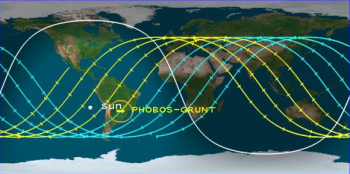
Phobos-Grunt due to crash to Earth anytime in the next ten hours

path of Phobos-Grunt's reentry

Updated and bumped. An updated prediction from Aerospace now calls for Phobos-Grunt to come down sometime between 9 and 3 pm (Eastern). This puts the U.S. now out of danger, though Europe, South America, Africa, Australia, and the southern half of Asia all remain in the spacecraft’s path.

Watch your heads! Phobos-Grunt is due to crash to Earth anytime in the next ten hours. And unfortunately, this new prediction has it flying over both North America and much of Europe and Africa during that time period.

0 comments

NASA is soliciting private aerospace companies to bid on building their designs for rocket upper stage that will send the Orion capsule beyond Earth orbit.

NASA is soliciting private aerospace companies to bid on building their own designs for the rocket upper stage that will send the Orion capsule beyond Earth orbit.

This is good news: Rather than design the upper stage themselves, NASA is behaving like a customer and looking for someone else to provide them the product, much as the agency has been doing in buying from private companies crew and cargo services for ISS. Using this approach the agency is more likely to get its upper stage quickly and at less cost.

0 comments

Engineers have gone to a back up radio system on Cassini after a primary unit did not respond as expected in late December.

Engineers have gone to a back up radio system on Cassini after a primary unit did not respond as expected in late December.

The cause is still under investigation, but age may be a factor. The spacecraft launched in 1997 and has orbited Saturn since 2004. Cassini completed its prime mission in 2008 and has had two additional mission extensions. This is the first time its ultra-stable oscillator has had an issue.

0 comments

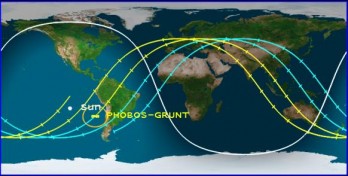
Phobos-Grunt’s reentry this weekend

path of Phobos-Grunt's reentry

Watch your head this weekend: The re-entry of Phobos-Grunt has been refined, and is expected to come down sometime between 5 pm (Eastern), Saturday January 14 and 9 am (Eastern), Monday January 16.

As you can see by the image on the right, there is as yet no way to predict where it will land, though it appears that — except for the tip of Florida — North America is in the clear. The blue lines show its orbital path during the first half of this window, while the yellow lines show its path during the window’s second half.

0 comments

SpaceX outlines its new design goals for Falcon 9

What competition brings: SpaceX outlines its new design goals for Falcon 9 and its Merlin rocket engine.

[U]pcoming upgrades to the engine (Merlin 1D) will provide a vast improvement in performance, reliability and manufacturability – all of which could provide a timely boost to aiding the potential for success for the fully reusable Falcon 9.

Increased reliability: Simplified design by eliminating components and sub-assemblies. Increased fatigue life. Increased chamber and nozzle thermal margins,” noted SpaceX in listing the improvements in work.

Improved Performance: Thrust increased from 95,000 lbf (sea level) to 140,000 lbf (sea level). Added throttle capability for range from 70-100 percent. Currently, it is necessary to shut off two engines during ascent. The Merlin 1D will make it possible to throttle all engines. Structure was removed from the engine to make it lighter.

Improved Manufacturability: Simplified design to use lower cost manufacturing techniques. Reduced touch labor and parts count. Increased in-house production at SpaceX.

That’s just the engine. Most of the article however talks about the company’s effort to make as much of Falcon 9 reusable as possible. Hat tip to Clark Lindsey.

0 comments
1 1,246 1,247 1,248 1,249 1,250 1,327