Phobos-Grunt is now expected to fall to Earth sometime around January 16

It’s official: Phobos-Grunt is now expected to fall to Earth sometime around January 16.

Meanwhile, the head of the Russian space agency is looking for a scapegoat for his country’s recent space failures.

Roskosmos chief Vladimir Popovkin told the Izvestia daily he could not understand why several launches went awry at precisely the moment the spacecraft were travelling through areas invisible to Russian radar. “It is unclear why our setbacks often occur when the vessels are travelling through what for Russia is the ‘dark’ side of the Earth — in areas where we do not see the craft and do not receive its telemetry readings,” he said. “I do not want to blame anyone, but today there are some very powerful countermeasures that can be used against spacecraft whose use we cannot exclude,” Popovkin told the daily.

With leadership like this, Russia might soon join the U.S. as a country unable to get astronauts into space.

0 comments

After 16 years in space, NASA’s Rossi X-ray Timing Explorer (RXTE) has been shut down

After 16 years in space, NASA’s Rossi X-ray Timing Explorer (RXTE) has finally been shut down.

RXTE far exceeded its original science goals and leaves astronomers with a scientific bounty for years to come. Data from the mission have resulted in more than 2,200 papers in refereed journals, 92 doctoral theses, and more than 1,000 rapid notifications alerting astronomers around the globe to new astronomical activity.

“The spacecraft and its instruments had been showing their age, and in the end RXTE had accomplished everything we put it up there to do, and much more,” said Tod Strohmayer, RXTE project scientist at Goddard. The decision to decommission RXTE followed the recommendations of a 2010 review board tasked to evaluate and rank each of NASA’s operating astrophysics missions.

0 comments

Researchers in California have produced a cheap plastic capable of removing large amounts of carbon dioxide from the air.

Researchers in California have produced a cheap plastic capable of removing large amounts of carbon dioxide from the air.

The article focuses on how this could save us from global warming. What I see is a possible tool for making the construction of interplanetary spaceships more practical. On any vessel in space, something has to cleanse the air of carbon dioxide. Finding a cheap way to do this makes building those vessels much easier.

2 comments

Studying the Moon by starlight

The Moon's south pole by starlight

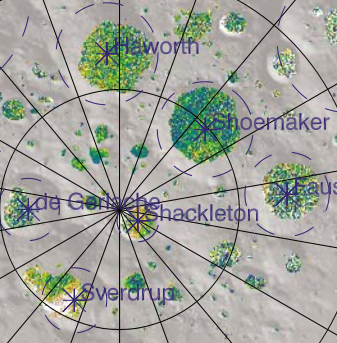
In a paper published today in the Journal for Geophysical Research, Planets, the science team for Lunar Reconnaissance Orbiter describe how they have used starlight to peer into the permanently shadowed craters of the Moon’s north and south poles. Looking only during the lunar night, they measured the dim albedo of the Moon from reflected starlight. From this very weak signal they were able to cull two interesting facts about these very cold and very dark places.

  • The ground at the bottom of these craters is more porous than the surrounding unshadowed terrain.
  • There is evidence in the spectroscopy of 1 to 2% water frost in these craters.

» Read more

0 comments

A fitting memorial

Greeley Haven

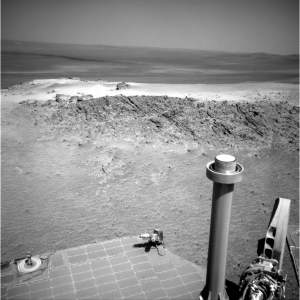
Opportunity has settled into its winter haven.

NASA’s Mars Exploration Rover Opportunity will spend the next few months during the coldest part of Martian winter at Greeley Haven, an outcrop of rock on Mars recently named informally to honor Ronald Greeley, Arizona State University Regents’ professor of planetary geology, who died October 27, 2011.

I met and interviewed Greeley a number of times in writing articles for magazines like Sky & Telescope and Astronomy. For years he was a central figure in the field of planetary geology, and his life effort is one of the prime reasons the United States has dominated this field for most of the past half century, with a fleet of planetary missions presently at Mercury, Mars, Jupiter, Saturn, and Pluto, with many more to come.

The article notes that the International Astronomical Union (IAU) has the job of naming objects in space, and could take years to honor Greeley. I say that if these scientists, the true explorers of Mars, want to name something for him, then they should go ahead, and future generations should honor that choice, regardless of what the IAU says.

0 comments

ArianeSpace will make a profit in 2011, the first time in three years

ArianeSpace will make a profit in 2011, the first time in three years.

Helped by the two Soyuz campaigns, which occurred in October and December, Arianespace in 2011 apparently averted a third consecutive year of losses. Its financial accounts are not finalized until June, but Le Gall said the company expects to report a slight profit on about 985 million euros in revenue.

In other words, it was the addition of the Russian low-cost Soyuz rocket to their fleet that helped avoid another year’s loss. This doesn’t reflect well on the profitability of the Ariane 5 rocket.

0 comments
1 1,247 1,248 1,249 1,250 1,251 1,327