China launches communications orbiter towards the Moon

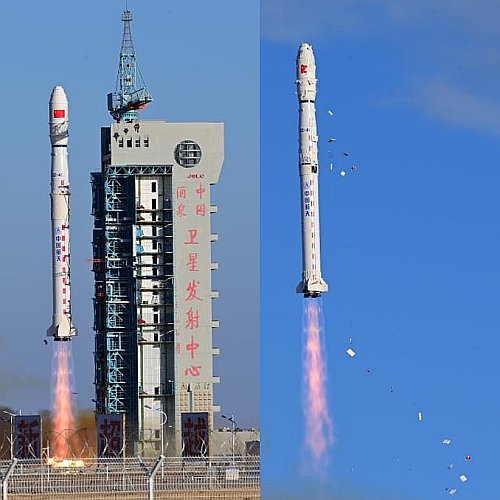
Using its Long March 8 rocket lifting off from its coastal Wenchang spaceport, China today launched its second Quequiao communications satellite to the Moon, designed to relay data from its landers on the far side back to Earth.

The Queqiao 2, or Magpie Bridge 2, satellite was lifted atop a Long March 8 carrier rocket that blasted off at 8:31 am from a coastal launch pad at the Wenchang Space Launch Center in China’s southernmost island province of Hainan.

After a 24-minute flight, the satellite was released from the rocket and then entered into a lunar transfer trajectory. At the same time, the solar wings and communication antennas smoothly unfolded.

This satellite is in preparation for the May launch of China’s Chang’e-6 lunar mission to grab samples from the Moon’s far side and bring them back to Earth. In the meantime it will test its capabilities by relaying data from the Chang’e-4 lander and its Yutu-2 rover, still in operation on the far side after landing there in January 2018.

The leaders in the 2024 launch race:

27 SpaceX
11 China
3 Russia
3 Rocket Lab

American private enterprise still leads the rest of the world combined in successful launches 31 to 20, while SpaceX leads the entire world, including American companies, 27 to 24.

0 comments

Apollo astronaut Tom Stafford passes away at 93

Apollo 10 astronaut Tom Stafford, who also flew two Gemini missions as well as the Apollo-Soyuz mission, passed away yesterday at the age of 93.

Stafford’s first flight was on Gemini 6, which achieved the first rendezvous in space when it maneuvered close to Gemini 7 during its two week mission. He then flew on Gemini 9, which was to attempt the first docking but was stymied when the shroud on the Agena target vehicle failed to release, blocking the docking port. The crew could only rendezvous again.

Stafford then commanded Apollo 10, the dress rehearsal for the lunar landing, flying his lunar module to within about ten miles of the Moon’s surface. His final mission was Apollo-Soyuz, the first joint mission between the United States and the Soviet Union.

Of the 24 Apollo astronauts that flew to the Moon, only seven still live. A truly great generation of Americans, possibly the greatest generation of all, is slowly leaving us.

3 comments

Gehrels Swift space telescope now in safe mode

The Gehrels Swift space telescope, used to get real time observations of gamma ray bursts and other high energy deep space events, is presently in safe mode due to the failure of one of its three gyroscopes.

On March 15, NASAโ€™s Neil Gehrels Swift Observatory entered into safe mode, temporarily suspending science operations due to degrading performance from one of its three gyroscopes (gyros), which are used to point the observatory for making observations. The rest of the spacecraft remains in good health.

Swift is designed to successfully operate without one of its gyros if necessary; however, a software update is required. The team is working on the flight software update that would permit the spacecraft to continue science operations using its two remaining gyros.

The telescope has been operating in orbit for nearly twenty years, far longer than originally planned. Its observations were crucial in discovering that gamma ray bursts occur at vast distances and involve either the core collapse of a star or the merger of two neutron stars.

0 comments

India’s Vikram lander disturbed the lunar surface the least of all landers

According to an analysis of images taking before and after landing, engineers have concluded that India’s Vikram lander disturbed the lunar surface the least of all landers, due to its use of multiple smaller landing engines.

Presenting the new findings at LPSC on Monday, [ISRO scientist Suresh K] attributed the intriguingly short dust plume to the lack of a central engine on the spacecraft, which resulted in a lower engine thrust during descent. Starting its โ€œrough braking phaseโ€ at an orbit of 18.6 miles (30 kilometers) above the lunar surface, when the spacecraft reached 0.4 miles (0.8 kilometers) above its targeted landing area, it switched off two of its four 800-newton engines such that two diagonal engines remained operational all the way until touchdown. The mission used the “least powerful engine till date,” [Suresh] K said. “We’ve observed very less disturbance on the surface.”

You can read their paper here [pdf].

Finding ways to reduce the dust kicked up during landings will be critical for the early missions to the Moon, before landing pads can be constructed. This research suggests that when Starship lands, it should use only its outer engines, and gimbal them sideways, in order to reduce the dust thrown up around it.

2 comments

Scientists: DART impact of Dimorphos changed its orbit and reshaped the asteroid

Dimorphos shape change
Click for original graphic.

According to a new study, the DART impact of Dimorphos in September 2022 not only shortened its orbit around the larger asteroid Didymos, it reshaped the asteroid itself, warping its widest point sideways from its equator.

You can read the paper here.

More important, the scientists found that the changes evolved over time.

Over the following weeks, the asteroidโ€™s orbital period continued to shorten as Dimorphos lost more rocky material to space, finally settling at 11 hours, 22 minutes, and 3 seconds per orbit โ€“ 33 minutes and 15 seconds less time than before impact. This calculation is accurate to within 1 ยฝ seconds, Naidu said. Dimorphos now has a mean orbital distance from Didymos of about 3,780 feet (1,152 meters) โ€“ about 120 feet (37 meters) closer than before impact.

Similarly, the reshaping of the asteroid into its present shape took time. As the scientists noted in their conclusion, “it takes time for a binary system to settle after a kinetic impact event.”

Because of Dimorphus’s rubble pile nature, its shape and orbit should continue to evolve over the coming decades, as more of the ejecta from the impact slowly falls back onto its surface and the asteroid surface adjusts over time. This in turn should also effect the orbit, though by only very tiny amounts.

I continue to wonder if the entire solar orbit of this asteroid binary system was impacted at all by these changes. Any changes would likely be tiny, but it is important to know to see if such an impact can actually do such a thing. To find out will take several more years, as ground telescopes continue to track the asteroid.

In October 2024 the European probe Hera will launch on a mission to this asteroid binary, with its arrival expected in December 2026. At that time we will get a much better look at both asteroids and how the impact affected them.

0 comments

SpaceX launches more Starlink satellites

SpaceX yesterday evening successfully launched another 22 Starlink satellites, its Falcon 9 rocket lifting off from Vandenberg in California.

The first stage completed its tenth flight, landing on a drone ship in the Pacific.

The leaders in the 2024 space race:

27 SpaceX
10 China
3 Russia
3 Rocket Lab

American private enterprise now leads the rest of the world combined in successful launches 31 to 19, while SpaceX leads the entire world, including American companies, 27 to 23.

5 comments

The vast Martian plains of lava

The vast Martian lava fields
Click for original image.

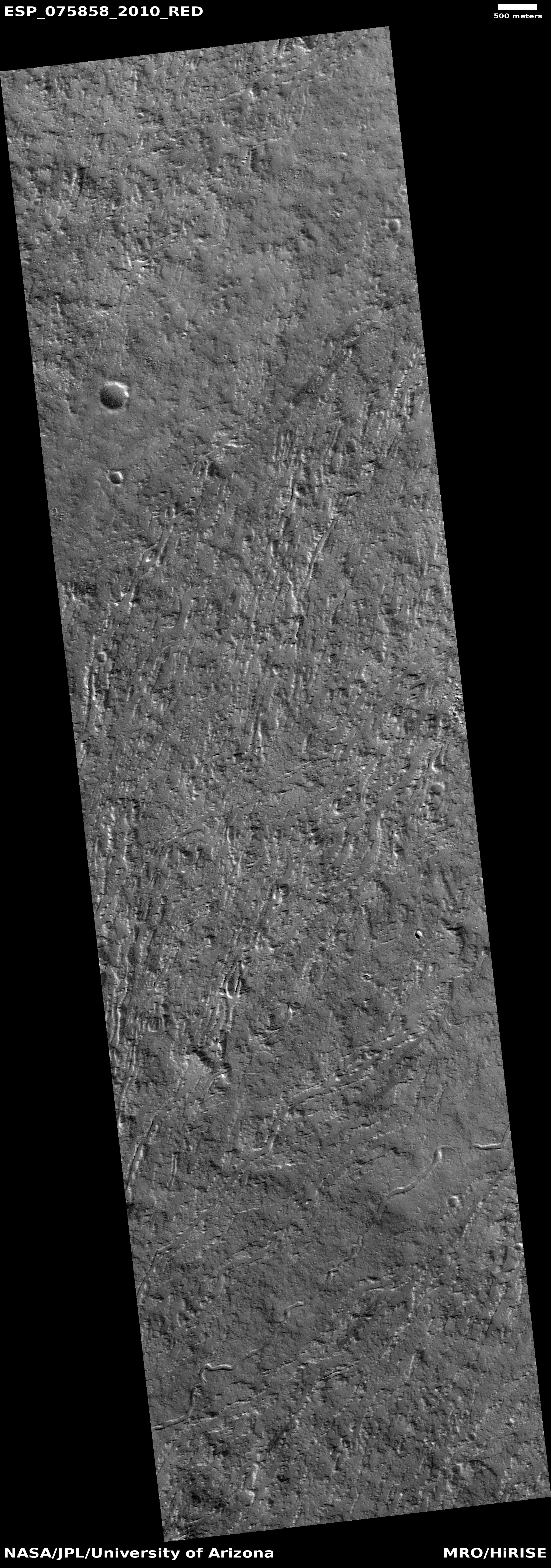
Cool image time! The picture to the right, rotated, cropped, reduced, and sharpened to post here, was taken on January 31, 2024 by the high resolution camera on Mars Reconnaissance Orbiter (MRO). Labeled “Lava Embaying Highlands Ridge”, it shows an alcove along a ridgeline that appears filled with material, in this case solid lava.

If you look closely at the ridgeline, you can see several dark streaks on its southern slopes. These streaks could be one of two unique Martian features that remain unexplained. They could be slope streaks, which occur randomly through the year and fade with time, or recurring slope lineae, which occur seasonally at the same locations. In either case, though the streaks look like avalanches, they don’t change the topography, have no debris piles at their base, and even sometimes flow uphill for short lengths. Though there are a number of theories for their formation, many involving dust, none has been accepted as confirmed.

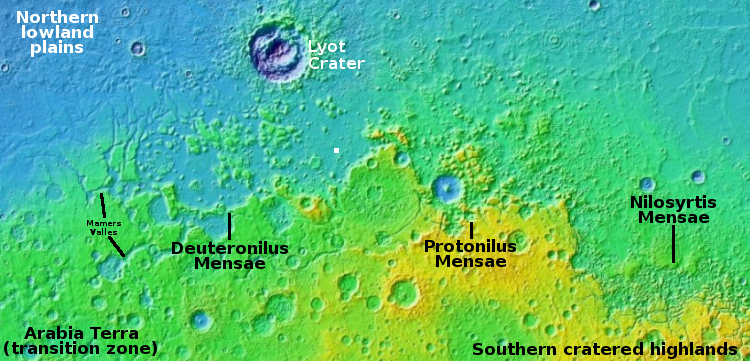
This location and its lava however are the stars of this picture, for a number of reasons, all revealed by the overview map below.
» Read more

1 comment

What to expect on the next few Starship/Superheavy test launches

Superheavy/Starship lifting off on March 14, 2024

As noted last week by Eric Berger after the third orbital test launch of SpaceX’s Superheavy/Starship rocket on March 14, 2024, this rocket is presently only a few short steps to becoming an operational expendable rocket that can put 100 to 150 metric tons into orbit for about the cost of a Falcon Heavy launch.

To completely achieve this status SpaceX will still have to accomplish several additional engineering goals during the next few test flights, beyond what it has been done so far. This is what I predict therefore for the next test flight, number four:

Superheavy

SpaceX will once again attempt to softly bring Superheavy down over the ocean in the Gulf of Mexico, hovering the stage vertically over the surface for a few seconds to demonstrate it could do the same once it eventually comes down next to the launch tower so that the chopsticks can grab it. To do this the company will have to figure out what went wrong on last week’s flight, when the stage began to tumble as it dropped below 100 kilometers altitude. It also appeared to be unable to fire its engines as planned.

An even more important achievement on this third flight however will be a third straight successful hot fire stage separation, sending Starship on its way to orbit as planned. If Superheavy can do this for the third time, it will prove without doubt that the rocket stage is now capable of doing its number one job, launching payloads. Reusability can follow later.

Starship
» Read more

18 comments

SpaceX launches 23 Starlink satellites

The beat goes on! SpaceX today launched another 23 Starlink satellites into orbit, its Falcon 9 rocket lifting off from Cape Canaveral in Florida.

The first stage completed its 19th flight, tying the present record for the most reuses of a Falcon 9 booster. It landed safely on a drone ship in the Atlantic.

The leaders in the 2024 space race:

26 SpaceX
10 China
3 Russia
3 Rocket Lab

American private enterprise now leads the rest of the world combined in successful launches 30 to 19, while SpaceX leads the entire world, including American companies, 26 to 23.

5 comments

The payloads to be carried on the first Ariane-6 launch

With the first Ariane-6 rocket now being stacked for its first test flight sometime in the June-July timeframe, a European Space Agency (ESA) press release today touted the payloads the rocket will carry.

All told, the rocket will carry nine cubesats, two satellite deploy systems, two test re-entry capsules, and five experimental payloads. That only four are government payloads, with the rest from a variety of private companies, once again illustrates ESA’s shift from running everything. It is acting to encourage commercial operations that are establishing capabilities that it once would have demanded it do. Instead it will be the customer for these things in the future.

The two re-entry capsules might be the most interesting payloads of all. Both are private, from ArianeGroup and the French company The Exploration Company. The latter is developing its own Nyx cargo freighter, comparable to Northrop Grumman’s Cygnus capsule, aimed at providing cargo services to the many commercial space stations presently being built. This test flight is apparently designed to prove out some of the company’s re-entry technology.

3 comments

Mapping the layered geology of Mars

Mapping the layers on Mars
Click for original image.

Today’s cool image is an update of a previous cool image from July 2021. Then, I posted a captioned high resolution Mars Reconnaissance Orbiter (MRO) photo of the many terraced layers within a 13-mile-wide crater dubbed Jiji and located in Arabia Terra, the largest transition zone between the Red Planet’s northern lowland plains and the southern cratered highlands. At that time the caption noted that research was on-going to see if the same layers could be identified in two other nearby craters, Banes and Sera, and thus use that data to extrapolate the long term geological history of this region on Mars.

Today’s cool image to the right, rotated, cropped, reduced, and enhanced to post here, was taken on January 4, 2024 as part of this research, and shows the layers in 18-mile-wide Sera crater, located only about ten miles to the east of Jiji crater. The highest mesa near the bottom of the picture is about twenty feet high on its southern side, but about 140 feet high to the north. The difference is because the crater floor under the mesa is sloping downward to its lowest point to the north.
» Read more

0 comments

Betelgeuse dimming again

Betelqeuse
An optical image of Betelgeuse taken in 2017 by a ground-based
telescope, showing its not unusual aspherical shape.
Click for original image.

It appears that the red giant star Betelgeuse is once again dimming, as it did in 2019-2020.

Betelgeuse, located in Orion’s right shoulder, ordinarily shines at magnitude +0.4, a close match to neighboring Procyon in Canis Minor. But since late January it’s lost some of its luster โ€” at least a third of a magnitude’s worth. That may not sound like much especially given the star’s variable nature, but the red supergiant star is currently the faintest it’s been in the past two years.

Betelgeuse is less like a stable star and more like a gasbag in weightlessness, its shape bouncing in and out as convection bubbles from within push their way to the surface. In some cases, as in 2019-2020, a burst of a bubble releases dust and material, which scientists believe acted to block the star’s light at that time. The dimming now could be for the same reason. Or it could be because the star’s brightness is fundamentally variable. For years it reliably pulsed every 400 days, though that variation pattern now seems to have vanished since 2020.

5 comments
1 254 255 256 257 258 1,327