How to land a space shuttle

An evening pause: This talk was given in October 2016, so the speaker, Bret Copeland, readily admits with great humor that he is describing something that no longer happens. Nonetheless, there will come a time when this will be done again, by vehicles better made and more often used. It is important to know how it was done.

Hat tip Edward Thelen.

3 comments

After 7 years Cassini reaches Saturn’s solstice

In 2010 NASA extended the Cassini mission orbiting Saturn for seven years to the planet’s next solstice, so that the spacecraft could observe Saturn, its moons, and its rings, for one full season of its 28 year orbit.

Today, Cassini reached that target.

NASA’s Cassini spacecraft still has a few months to go before it completes its mission in September, but the veteran Saturn explorer reaches a new milestone today. Saturn’s solstice — that is, the longest day of summer in the northern hemisphere and the shortest day of winter in the southern hemisphere — arrives today for the planet and its moons. The Saturnian solstice occurs about every 15 Earth years as the planet and its entourage slowly orbit the sun, with the north and south hemispheres alternating their roles as the summer and winter poles.

The article provides a detailed review of all the changes that have occurred during this long time period.

0 comments

Washington rallies around the Outer Space Treaty

Yesterday Senator Ted Cruz (D-Texas) held the second in what he says will be a series of hearings on the future government regulation of the commercial space industry. The specific focus of this hearing was the 1967 Outer Space Treaty and its effect on private enterprise.

The hearing saw two panels of witnesses, the first three legal experts on the Outer Space Treaty, the second four industry experts from a variety of private space businesses.

Like the first hearing on April 27, the witnesses this time were once again unanimous in their call for a simplification of the present regulatory arrangement. They also emphasized repeatedly that private enterprise should not be required by Congress to get permission to do things in space. Instead, Congress should merely provide regulation that will facilitate private enterprise while helping them avoid interfering with each other.

Unlike the first hearing, however, the atmosphere was decidedly less interested in improving the overall international regulatory framework created under the Outer Space Treaty. Instead, the witnesses in unison were supportive of the treaty and did not want the U.S. to either pull out of it or try to change it. All advocated the position that the treaty as written allowed the U.S. to regulate private businesses in a manner that could protect property rights in space.

As I watched the hearing I was struck by this unity of position. To me, it appeared that the Washington elitist community was circling its wagons in order to protect the status quo.

The witnesses from the business community appeared afraid of the consequences of any effort to change the Outer Space Treaty. As Mike Gold, Vice President of Space Systems Loral, noted,
» Read more

6 comments

Lawsuit by fired SpaceX employee goes to court

The jury trail of a lawsuit by a fired SpaceX employee, claiming that he was dismissed because he complained about bad practices at the company, has now begun.

A Los Angeles state court jury will be asked to decide whether Blasdell had good reason to believe testing documents were falsified and whether his firing was unjustified. “He went up the chain of command as he had learned in the Marines was the proper procedure,” Blasdell’s lawyer, Carney Shegerian, told jurors in his opening statement Tuesday. “He had nothing personal to benefit from this other than to do the right thing.” SpaceX made misrepresentations to the federal government, cut corners in areas where safety was concerned and labeled Blasdell “insubordinate” for pressing his concerns, Shegerian said.

Not surprisingly, the SpaceX lawyer disagreed:

“Jason Blasdell is not a whistle-blower and this is not a whistle-blower case,” SpaceX’s lawyer, Lynne Hermle, said in her opening statement. He never observed or conducted any unlawful testing of rocket parts, never complained about unlawful testing, and never brought any concerns about unlawful testing to federal authorities, Hermle told jurors.

0 comments

California woman arrested for selling space technology to China

A California woman has been arrested for smuggling space communications technology and equipment to China illegally.

Chen, a resident of the Los Angeles suburb of Pomona, is accused of violating the International Emergency Economic Powers Act, which controls the export of certain goods and technology from the United States.

Specifically, the indictment alleges Chen purchased and smuggled sensitive materials to China without obtaining required export licenses, including components commonly used in military communications “jammers.” She also is accused of smuggling devices typically used in space communications applications, and falsifying the paperwork used in shipping those items to list them as worth $500, rather than their true value of more than $100,000.

The exports in question date from March 2013 to December 2015.

How dare they arrest her! All she is doing is supporting international diversity against the white power oppression of the evil United States. Moreover, we must allow her to express her beliefs. Treason is merely an expression of one’s opinion, and must not be oppressed!

1 comment

Spacewalkers successfully replace failed unit on ISS

In a a short spacewalk just under three hours two astronauts today successfully replaced the failed MDM data relay unit on the outside of ISS.

Some additional details about this unit:

The MDM that failed and an identical unit are part of the tier 2 command architecture and relay commands to a variety of critical station systems, including the station’s guidance, navigation and control system, the lab’s stabilizing gyros, the environmental control system, the station’s cooling system and others.

Both tier 2 computers were installed during spacewalks March 30 and March 24 respectively, replacing two older units with models featuring upgraded data processing cards. It is not yet known whether the problem with MDM-1 involved the upgraded components or some other circuitry or software

I suspect this upgraded but failed unit is going to be looked at very carefully.

7 comments

The face of Ceres

The face of Ceres

Cool image time! The image on the right, reduced in resolution to show here, was taken by Dawn on April 29, 2017, when the spacecraft had been positioned between the Sun and the dwarf planet at a moment when its entire surface was lit. They have enhanced the colors to bring out the contrasts.

Images combining these different color filter perspectives reveal fine details of Ceres’ surface. For example, they emphasize the distinct compositions and textures of the material ejected from craters. The brightest region on Ceres, called Cerealia Facula, is highlighted in Occator Crater in the center of this image. Vinalia Faculae, the set of secondary bright spots in the same crater, are located to the right of Cerealia Facula.

One of the darkest regions on Ceres is next to Occator, and represents ejected material from the impact that formed the crater. The ejected material forms a large arc that extends over several hundred kilometers, below the center of Ceres in this image. That material’s distribution is partly determined by Ceres’ rotation.

Be sure to take a close look at the full image. It isn’t super high resolution, but it reveals a lot of interesting details

0 comments

Emergency spacewalk on ISS to replace electronics relay box

Astronauts will perform an emergency spacewalk on May 23 to replace the failed MDM electronics relay box that failed on Saturday.

So, they have a spare on board, which is good. The article does note, however, that the unit that failed had only been installed less than two months ago, on March 30. This is not good. These units should last longer than two months, especially considering how critical they appear to be.

5 comments

Rocket Lab launch delayed

Capitalism in space: Rocket Lab has delayed its first test launch of its Electron rocket because of predicted high winds.

The company has not yet said if they have rescheduled for Tuesday.

This article gives a very detailed overview of the rocket, its engines, and the history of its launch site. It also notes that if successful, the launch will be first orbital flight ever from a commercial company from its own commercial launch site.

3 comments

Primary data relay electronics unit on ISS truss fails

ISS managers are meeting to make a plan to deal with the failure on Saturday of the #1 data relay electronics box on the S0 truss of the station.

The unit, called an MDM, has an identical backup in place so no station operations have so far been effected. However, that backup had failed back in 2014 and required a spacewalk to replace it, so it is not clear to me as yet whether the station has any additional spares available to replace the newly failed unit. If so, it will still require a spacewalk to make the switch.

If there is no spare, they will likely have to ship one up on the next cargo flight, as the MDM is essential for operating the solar panels and radiators as well as the robot arms.

5 comments

The first 3 of a 200 nanosat constellation delivered for launch

Capitalism in space: Sky and Space Global (SAS) has delivered the first three nanosats — of a planned 200 nanosat constellation — to India for launch.

The first three nanosats are to be launched by India on its PSLV rocket, but SAS has contracted Virgin Orbit to use its LauncherOne to put the next 197 up. They had made this first announcement last summer, saying the first three would launch in the second quarter of 2017. It appears that they are holding to that schedule.

They also said that LauncherOne would begin launching the other 197 satellites in 2018. For this I remain far more skeptical, since the track record at Virgin in getting its spacecraft off the ground on schedule has not been good.

0 comments

Rocket Lab gets another contract

Capitalism in space: With its first test launch set for Monday, Rocket Lab today earned a new launch contract, this time from Spaceflight, a company that acts as a charter company putting together launches for smallsat companies.

Spaceflight buys a launch from a rocket company, and then sells slots to smallsat companies that cannot afford to buy the whole launch. This way Spaceflight can tailor each launch to the needs of the different smallsats. Though they have previously purchased launches from India’s PSLV, Russia’s Dnepr, and SpaceX’s Falcon 9, Rocket Lab’s Electron fits this model more perfectly, because — as a small rocket designed for smallsats, it doesn’t require a lot of smallsats to fill its payload. Thus, they can offer the smallsats on board access to orbits not normally available. This will make it relatively easy to find customers for the launch.

5 comments

Cruz to hold hearing on updating Outer Space Treaty

Senator Ted Cruz (R-Texas) revealed today that he plans to hold a hearing next week on reviewing the Outer Space Treaty.

Sen. Ted Cruz (R-Texas) said in an on-stage interview during The Atlantic magazine’s “On the Launchpad” event here that the hearing, scheduled for May 23, would explore modifications to the Outer Space Treaty of 1967 to better enable commercial space activities. “We’ll be hearing testimony both from lawyers who have studied the issues and also from business leaders that want to expand commercial investment in space,” he said, “considering how do we update and modernize the treaty to reflect the realities of the modern world.”

He said he was concerned that the treaty, crafted at the height of the superpower space race of the 1960s, does not reflect the needs and interests of emerging commercial space companies. “The central focus of that treaty was preventing nuclear weapons in space. That’s a very good thing,” he said. “But, 50 years later, we’re in a very different environment.”

Cruz said he didn’t have specific changes to the treaty in mind. “I don’t want to start by making decisions before we hear testimony and before we think through it,” he said. He added he hoped that, like recent space-related legislation that has passed Congress, including the Commercial Space Launch Competitiveness Act of 2015, to win bipartisan agreement to pursue efforts to “modernize it to create the incentives for continued investment.”

I had sensed this might be Cruz’s next move, based on the last hearing, and it is gratifying that he is going to go forward with it.

Update: The list of witnesses can be found here. The committee webpage also says they will be focusing on Article VI of the Outer Space Treaty, which does not discuss the issue of sovereignty (Article II). Instead, Article VI says this:

States Parties to the Treaty shall bear international responsibility for national activities in outer space, including the moon and other celestial bodies, whether such activities are carried on by governmental agencies or by non-governmental entities, and for assuring that national activities are carried out in conformity with the provisions set forth in the present Treaty. The activities of non-governmental entities in outer space, including the moon and other celestial bodies, shall require authorization and continuing supervision by the appropriate State Party to the Treaty. When activities are carried on in outer space, including the moon and other celestial bodies, by an international organization, responsibility for compliance with this Treaty shall be borne both by the international organization and by the States Parties to the Treaty participating in such organization.

I begin to sense the direction this negotiation will head. Rather than claim sovereignty, they will rework this clause to allow each nation’s laws to apply to the activities of their citizens. In a sense, this is an end-around Article II.


2 comments

Mars rover update: May 15, 2017

This update could also be entitled, “Up and down into Martian gullies,” as that is what both rovers, Curiosity and Opportunity, are presently focused on doing.

Curiosity

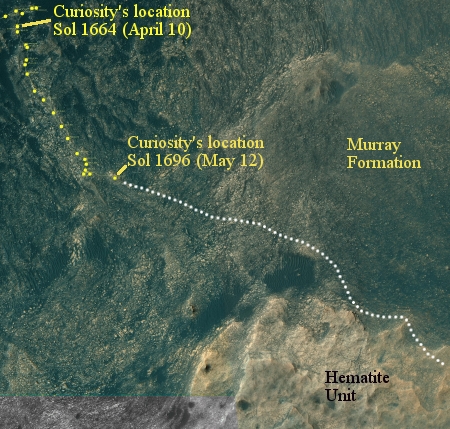
Curiosity's position, Sol 1696 (May 12, 2017)

For the overall context of Curiosity’s travels, see Pinpointing Curiosity’s location in Gale Crater.

In the past month, since my previous April 21, 2017 update, Curiosity has been working its way up the dry wash, frequently stopping to inspect the rocky surface terrain within. As they note,

As we climb up Mount Sharp, recently over slopes of 4-6 degrees, we have seen more varied outcrop structures and chemistries than the rest of the Murray formation, and such changes catch the collective eye of the team.

Only in the last week have they shifted to the east, as planned. Their near term goal is the lighter, yellowish layer of rock, dubbed the Hematite Unit, that sits higher up the slope of Mount Sharp. As they have been traveling on the Murray Formation now for more than a year, since March, 2016, I am certain the science team is even more eager to get to this different layer of geology to find out what it is made of and why it is there.

You can get an overall view of the geology Curiosity is traversing from this October 3, 2016 press release. Below is a version of the traverse map shown at that site that I posted as part of my October 6, 2016 rover update, updated to show Curiosity’s present location. It is apparent that Curiosity is finally moving out of the foothills below Mount Sharp and beginning its climb up the mountain’s actual slopes.
» Read more

5 comments
1 555 556 557 558 559 799