Software error caused Schiaparelli crash

A new ESA report says that the ExoMars 2016 Schiaparelli lander failed because its navigation system thought the lander was on the ground when it was still more than two miles from the surface.

Europe’s Schiaparelli Mars lander crashed last month after a sensor failure caused it to cast away its parachute and turn off braking thrusters more than two miles (3.7 km) above the surface of the planet, as if it had already landed, a report released on Wednesday said.

Figuring out what caused this failure will be helpful for the design of the ExoMars 2020 rover, but the failure here is likely going to make it more difficult for Europe to raise the money needed for that next mission, including a 400 million euro cost overrun.

11 comments

Rocket Lab delays first rocket test flights

Rocket Lab has revealed that it will not conduct its first test flight of its new Electron rocket before the end of the year.

Rocket Lab originally scheduled road closures for test launches between November 17 and December 24. The company is now planning to conduct the first test flight early next year. Rocket Lab media spokeswoman Catherine Moreau-Hammond said the team had worked tirelessly this year, and with the holidays fast approaching they felt it best to allow everyone a decent break. Ms Moreau-Hammond said this would also alleviate some pressure on Mahia, which experiences a considerable population spike through the Christmas holidays.

This is a new company, a new rocket, a new launchpad, in a new country inexperienced in rocket launches. It is therefore not surprising that things have been delayed.

1 comment

SpaceX wins NASA satellite launch contract

The competition heats up: NASA has awarded SpaceX the contract to launch its Earth science satellite, Surface Water and Ocean Topography (SWOT).

This sentence from the press release is puzzling:

The total cost for NASA to launch SWOT is approximately $112 million, which includes the launch service; spacecraft processing; payload integration; and tracking, data and telemetry support.

Since SpaceX touts a launch price for its Falcon 9 rocket as $62 million, I wonder why this launch will cost NASA almost twice as much. Was there so little competition in the bidding that SpaceX could bid higher and thus get more money? Or is NASA so disinterested in saving money that it left itself open to overpaying for something that everyone else gets for far else?

5 comments

An update on the Bigelow inflatable module on ISS

NASA has released an update on the privately built inflatable BEAM module that is presently attached to ISS and is under-going two years of testing.

NASA and Bigelow Aerospace are pleased to report that, overall, BEAM is operating as expected and continues to produce valuable data. Structural engineers at NASA JSC confirmed that BEAM deployment loads upon the space station were very small, and continue to analyze the module’s structural data for comparison with ground tests and models. Researchers at NASA’s Langley Research Center in Hampton, Virginia, have found no evidence of large debris impacts in the DIDS data to date—good news for any spacecraft. And radiation researchers at JSC have found that the dosage due to Galactic Cosmic Rays in BEAM is similar to other space station modules, and continue to analyze local “trapped” radiation particles, particularly from the South Atlantic Anomaly, to help determine additional shielding requirements for long-duration exploration missions.

None of this is a surprise. It seems to me that this testing program is a bit overdone, since NASA never did anything like this in orbit for its own modules. What I think is really happening is that the two-year test of Bigelow’s module was required politically within NASA because there were too many people there opposed to using a privately-built module. I also suspect that NASA got further pressure from the contractors, such as Boeing, who had previously owned this business, and did not want the competition from Bigelow. Thus, despite the fact that Bigelow has already launched two test modules of its own and proved the viability of its designs, it was forced by NASA to do an additional test under NASA’s supervision in order to squelch this opposition.

2 comments

Russia postpones Proton launch again

Originally scheduled for October, International Launch Services (ILS), the Russian company that manages its commercial launches, has once again postponed the next Proton rocket launch.

“The new launch date is December 2016,” the website says. The reasons for the postponement have not yet been announced.

As reported earlier, Russia’s space corporation Roscosmos had rescheduled the launch from October 10 to November 23. It was initially scheduled for late June, then postponed to August 29 and then to October 10.

More significantly, there have been no Proton launches since a June 9 launch were the second stage of the rocket inexplicably shut down prematurely. The Russians have been conducting an investigation, but have released absolutely no information about what they have found

2 comments

Atlas 5 launches NOAA weather satellite

Successfully completing its second launch in 8 days, ULA’s Atlas 5 rocket put a new NOAA weather satellite in orbit on Saturday.

NOAA is giving this new satellite a big PR push, claiming it will revolutionize weather monitoring and forecasting. While the satellite might be state of the art, it is also was very expensive, costing $1 billion. I strongly suspect that the same thing could have been built far cheaper, and quicker, if left to the private sector.

1 comment

UAE sheikh okays next phase in Mars mission

The competition heats up: The Vice President and Prime Minister of the United Arab Emirates and the ruler of Dubai, Sheikh Mohammed bin Rashid Al Maktoum, has approved the start of construction of the prototypes for the UAE’s Mars Mission, dubbed Hope.

Sheikh Mohammed gave the greenlight to start manufacturing the probe’s prototypes, the Arab world’s first Mars probe. The project places the UAE with the nine countries that aim to explore Mars. His Highness said: “UAE ambitions is to explore the outer space. We are investing in our national cadres to lead this project and contribute in expanding our knowledge about Mars. Hope Probe is a qualitative leap for UAE’s scientific efforts, it the first contribution for the Arab world in this regard”.

Sheikh Mohammed’s remarks came while visiting the Mohammed Bin Rashid Space Centre (MBRSC) to open the second phase of the UAE satellite manufacturing and assembly complex, a multitasking facility capable of handling several space projects at a time.

It will be very interesting to see how this top-down mission proceeds, as it is being pushed heavily by the sheikh in a country with almost no experience in building such things.

12 comments

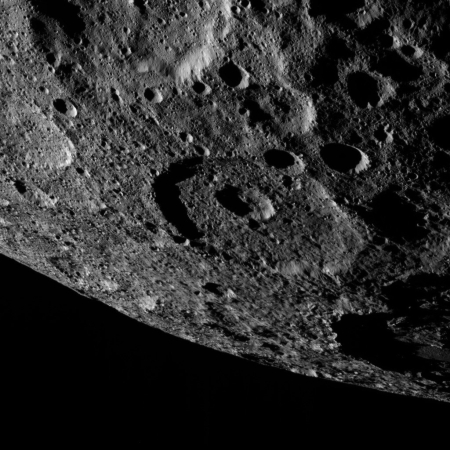
Ceres’ cratered surface

Ceres' crated surface

Cool image time! The picture on the right, reduced to show here, was taken on October 17 and was the tenth image taken by Dawn in its new extended mission in orbit around Ceres.

This image of the limb of dwarf planet Ceres shows a section of the northern hemisphere. A shadowy portion of Occator Crater can be seen at the lower right — its bright “spot” areas are outside of the frame of view. Part of Kaikara Crater (45 miles, 72 kilometers in diameter) is visible at top left.

The image was taken from 920 miles away and has a resolution of about 460 feet per pixel.

0 comments

Boeing files FCC application for 3,000 satellite constellation

The competition heats up: Boeing this week submitted its second application to the FCC for its own 3,000 satellite constellation to provide “a wide range of advanced communications and Internet-based services.”

The second application this week specifically requested permission to launch the first 60 satellites. The whole plan is comparable to the one that SpaceX submitted earlier this week, and puts these two companies in direct competition. If both plans are launched, it will mean that more than 6,000 satellites will need launch services to gain orbit, which also means the launch business could get very busy in the coming years.

5 comments

Boeing and Russia to partner on building lunar space station?

As part of a settlement with Boeing in the Sea Launch lawsuit, the Russians are proposing a partnership with the American company for building a lunar orbiting space station.

A preliminary dispute settlement deal was reached in August. “We are preparing a document which, apart from finalizing the court case, also creates a program for long-term cooperation on a wide range of issues. We are working on projects to cooperate in low earth orbit, create moon infrastructure and explore deep space,” Solntsev told the Russian Izvestia newspaper. The two companies now plan to create nodes and units capable of synchronizing space technologies, including a docking station for a proposed lunar orbiting station. Meanwhile, Sea Launch settlement documents are set to be signed before the end of November, according to Solntsev.

It will be very interesting to see the actual agreement. I also wonder how much Boeing can really do with Russia without U.S. government approval.

6 comments

Explosion at SpaceX test site part of launchpad investigation

An explosion yesterday at SpaceX’s Texas test facility appears to have been planned and is part of the company’s investigation into the September 1 Falcon 9 launchpad explosion.

“The sound heard by residents was actually the result of a pressurization test at the McGregor Rocket R&D facility. These tests take place periodically at the site, and this particular test was part of the ongoing testing being conducted by our Accident Investigation Team,” SpaceX spokesman Phil Larson said in an email response to questions. “The volunteer fire department responded as a matter of procedure, but there was no damage to the site or injuries to any personnel.”

I would guess that they are trying to see if they can precisely duplicate the conditions that produced the September 1st explosion, including triggering new explosions in a reliable manner. If so, they would then know precisely what to avoid doing to trigger future tank failures.

Meanwhile, this story notes the successful first pressure tests of the carbon fiber tank that SpaceX is developing for its interplanetary spaceship. Not much information, though SpaceX has released some cool images of the tank being prepped for the test.

4 comments

SpaceX files FCC application for 4000+ internet satellite constellation

The competition heats up: SpaceX today filed an FCC application for the construction and launch of a 4,425-satellite constellation designed to provide internet access worldwide.

In the technical information that accompanied its application, SpaceX said it would start commercial broadband service with 800 satellites. That service would cover areas of the globe from 15 degrees north to 60 degrees north, and from 15 degrees south to 60 degrees south. That leaves out some portions of Alaska, which would require a temporary waiver from the FCC.

Eventually, the network would grow to 4,425 satellites, transmitting in the Ku and Ka frequency bands. “Once fully deployed, the SpaceX system will pass over virtually all parts of the Earth’s surface and therefore, in principle, have the ability to provide ubiquitous global service,” SpaceX said.

When Musk first proposed this last year, he said it would take about $10 billion and five years to get it built. So, don’t expect these satellites to fly tomorrow. A lot of other things must happen first before this new plan takes flight.

6 comments

Software issues threaten Orion/SLS schedule

Despite having more than a decade to develop the software for SLS and Orion, NASA now faces the possibility that the rocket’s first test flight in 2018 might be delayed because that software is not ready.

Specifically, a NASA advisory board has revealed that Orion’s flight software is behind schedule and might not be ready in time. This, combined with schedule problems for the capsule’s service module, being built by the European Space Agency, threatens the 2018 launch date.

0 comments

Luxembourg establishes its own legal framework for asteroid mining

The competition heats up: Luxembourg on November 11 announced that it is establishing its own legal framework to protect the profits of any private asteroid mining effort.

Because the UN Outer Space Treaty forbids them from claiming any territory in space, this new law essentially says that Luxembourg law will instead be applied specifically to the resources mined. Or to put it in more colloquial terms, “Finders, Keepers,” though it comes with a lot of complex further regulation required to satisfy that treaty.

The draft law also lays down the regulations for the authorization and the supervision of space resources utilization missions, including both the exploration and use of such resources. Whoever intends to undertake a space resources utilization mission will be required to obtain an authorization to do so, for each specific and determined mission. The text sets forth the necessity for a book of obligations for any mission, such as activities to be carried in or out of Luxembourg, to allow government supervision of the activities of operators and regulating their rights and obligations. The legislation is expected to enter into effect in early 2017.

This complexity will cost money unnecessarily, and also require an unnecessary bureaucracy with a great deal of power over the actions of space companies. It illustrates again how really bad the Outer Space Treaty is, and how it will oppress future spacefarers. The sooner the treaty is dumped the better. If we don’t do it here on Earth, I guarantee that the people of space will do it, as soon as they become self-sufficient enough to thumb their noses at the ground-pounders on the mother planet.

1 comment
1 575 576 577 578 579 799