Another update on ISEE-3

Dennis Wingo has written a detailed report on the engineering analysis of ISEE-3, including what they plan to do on Wednesday to troubleshoot the problem and possible fix it.

The bottom line is that there is still a good chance they can get the spacecraft thrusters to fire and change the spacecraft’s trajectory. We will know more tomorrow.

0 comments

More images from Rosetta

67P

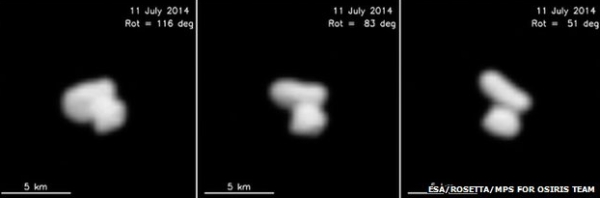
The comet that Rosetta will orbit is getting stranger and stranger, with new images suggesting that it is really two objects stuck together.

The pictures show that 67P/Churyumov-Gerasimenko appears to be not one but two objects joined together. It is what scientists call a “contact binary”. How the comet came to take this form is unknown. It is possible that 67P suffered a major fracture at some point in its past; it is also possible the two parts have totally different origins.

What is clear is that the European Space Agency (Esa) mission team now has additional and unexpected considerations as it plans how to land on the comet later this year – not least, which part of the comet should be chosen for contact?

1 comment

DARPA awards contracts for XS-1 spaceplane

The competition heats up: DARPA has announced contract awards to three companies for the construction of its experimental XS-1 spaceplane, designed to take off and land like a airplane.

The contracts go to Boeing, Northrop Grumman, and Masten Space Systems, and have them each respectively partnered with Blue Origin, XCOR, and Virgin Galactic. More details on the Boeing contract can be found here.

The description of the XS program is quite exciting:
» Read more

6 comments

Great Britain’s proposed suborbital spaceport locations

The competition heats up: More information was released today describing Great Britain’s suggested spaceport locations.

These spaceports are specifically aimed at the suborbital space tourism market, for American companies like Virgin Galactic or XCOR, or for the developing British company Skylon.

It is interesting that 6 of 8 are located in Scotland, which might very well not be part of the United Kingdom after a vote on separation this fall.

1 comment

The next Proton and Angara launches

The competition heats up: Russia has set September 28 as the next launch date for its troubled Proton rocket.

The most interesting detail gleaned from this article however is this:

The Proton-M carrier rocket previously launched on May 16 from Baikonur space center collided with communications satellite Express АМ4R and burned up in the atmosphere above China, leaving Russia without its most powerful telecommunications satellite.

Previous reports had not been very clear about the causes of the May launch failure. All they would say is that “a failed bearing in the steering engine’s turbo pump” had caused the failure about nine minutes into the flight. This report suggests that this failure occurred after separation of the payload and that it then caused the upper stage to collide with the satellite.

Russia is also about to ship its new Angara 5 rocket to the launch site for a planned December launch. This will be the first launch of the Angara configuration that is expected to replace the Proton rocket, and is expected to place a dummy payload into geosynchronous orbit.
» Read more

2 comments

Falcon 9 launch

The competition heats up: SpaceX’s Falcon 9 has successfully launched six Orbcomm commercial satellites into orbit.

The six satellites still must be deployed. We will know if this is successful sometime in the next hour or so. Also, no news yet on SpaceX’s effort to recover the rocket’s first stage after a soft splashdown in the ocean.

Update: All 6 Orbcomm satellites have successfully deployed.

Update 2: From Elon Musk as to the first stage recovery: “Rocket booster reentry, landing burn & leg deploy were good, but lost hull integrity right after splashdown (aka kaboom).”

1 comment

Cygnus launch

All is go for a 12:52 pm launch of Cygnus’s second operational cargo flight to ISS.

If you live on the east coast of the U.S. you should be able to see some part of this launch when it happens.

Cygnus has lifted off.

The main engine has cut off and the first stage has successfully separated.

The second stage has ignited successfully. It has now completed its burn and has separated from the spacecraft. Cygnus is in orbit.

0 comments

Curiosity’s journey continues

After more than a full Martian year, Curiosity has finally traveled beyond the area of its initial landing zone.

The 1-ton Curiosity rover has now cruised out of its landing ellipse, the area — about 4 miles wide by 12 miles long (7 by 20 kilometers) — regarded as safe ground for its August 2012 touchdown within Mars’ huge Gale Crater, NASA officials said.

The interesting factoid from this article is how much smaller this landing zone was for Curiosity compared to all other previous landers, illustrating how the technology has advanced during the last four decades since Viking.

0 comments

Venus Express is coming up for less air

After spending a month dropping down deep into Venus’s atmosphere, engineers are now raising Venus Express’s orbit.

Thus routine science operations concluded on 15 May, and the spacecraft’s altitude was allowed to drop naturally from the effect of gravity, culminating in a month ‘surfing’ between 131 km and 135 km above the surface. Additional small thruster burns were used to drop the spacecraft to lower altitudes, reaching 130.2 km earlier this week. Tomorrow, it is expected to dip to 129.1 km.

After eight years orbiting Venus, the mission is finally ending. They will use the spacecraft’s thrusters to lift it back up to almost 500 kilometers, where they will then allow its orbit to naturally decay, eventually ending the mission when it burns up in the atmosphere. There is also the chance they will run out of fuel during these last burns, ending the mission slightly sooner.

0 comments

Air Force certifies Falcon 9

The competition heats up: The Air Force today certified that SpaceX’s Falcon 9 rocket had completed three successful flights.

This certification is a preliminary okay before the official certification. What it means is that the Air Force is agreeing that the Falcon 9 is capable of launching its satellites, which also means that the official certification is almost certain.

1 comment

India’s space program gets a huge budget boost

The competition heats up: The new budget of India’s new conservative government under Narendra Modi has given its space program a 50 percent increase.

It appears that there were increases across the board, including a gigantic increase for their GSLV rocket as well as their manned program.

It also appears that Modi is following in the path of George Bush, at least when it comes to space. He might be a conservative, pro private enterprise and anti-big government, but his approach to building a space industry is decidedly Soviet in style, pumping funds into government agencies so that they can build the rockets and spacecraft. For the moment at least, private companies will be the servants to India’s government space program, not the masters.

In the U.S. and Russia this approach worked for the first generation of rockets and spacecraft, but then ended up a lead weight for later generations. I suspect we shall see the same history play out in India.

1 comment

Russian Soyuz launches commercial satellites for Arianespace

The competition heats up: A Soyuz rocket successfully launched four communications satellites from French Guiana yesterday.

I know that I repeatedly pound Arianespace for its high costs and lack of profits, but anyone who thinks this European company, in partnership with the Russians, is going to let its competition grab its customers easily is in for a surprise. They are going to fight back, and have the resources to do it.

The battle is on! It should be a lot of fun to watch over the next decade.

0 comments

ISEE-3 reboot team has a solution

The private group trying to resurrect ISEE-3 has come up with a plan of action to get its engine working.

We spent all day yesterday with space propulsion experts. We have identified a series of options including hydrazine tank heating and a long series of pulse attempts to (possibly) clear the lines.

They have not yet said when they will try this, but stay tuned.

0 comments

ISEE-3 might still be saved

It ain’t dead yet: The private group trying to resurrect ISEE-3 has not yet given up.

[T]he reboot team, led by editor Keith Cowing and entrepreneur Dennis Wingo, CEO of California-based Skycorp Incorporated, isn’t quite ready to give up. One of the project volunteers has suggested that perhaps the nitrogen isn’t actually gone. It may in fact still be there, but dissolved in with the hydrazine.

If that’s the case, Wingo says, ISEE-3 could potentially repressurize the propellant by powering up the tank heaters, raising the temperature up perhaps 10 degrees from the roughly 25 degrees C where it stands now. “If [the idea] has any merit, then we could turn the heaters on and drive at least some of the nitrogen out of solution. That would give us more pressure that just heating the tanks themselves,” Wingo says. “It’s not desperation,” he adds. “There is some good physics behind this.”

Their big problem is that they need to know more about how the nitrogen was stored on the spacecraft. They are asking for help from anyone who is willing to research the problem.

2 comments

LightSail to launch on a Falcon Heavy

The Planetary Society announced today that its solar sail experiment, LightSail, will be launched in 2016 on a Falcon Heavy.

It will be a secondary payload on what might be one of Falcon Heavy’s early demo flights. They also say the launch date is scheduled for April 2016, but since the rocket has not yet been tested I wouldn’t take that date too seriously.

1 comment

Bigelow Aerospace hiring

The competition heats up: Bigelow Aerospace hired two former NASA astronauts today as part of a broader expansion of the company in anticipation of .the completion of its first two private space modules in 2017.

Bigelow said the smallest space station his company plans to fly will require two BA330 modules, each of which has 330 cubic meters of internal space. The company expects to finish building the first two BA330s by 2017, Bigelow said.

Ham and Zamka are former military aviators who have piloted and commanded space shuttle missions. Their NASA and military credentials are part of the appeal for Bigelow, who plans to put both former space fliers to work as recruiters. “I would like to see us have half a dozen astronauts onboard by the end of the year,” Bigelow said.

Each Bigelow Aerospace space station would require about a dozen astronauts, including orbital, ground and backup personnel. The 660-cubic-foot stations would host four paying clients, who would be assisted by three company astronauts responsible for day-to-day maintenance, Bigelow said. Initially, clients and crews would cycle in and out of the stations in 90-day shifts, Bigelow said. Eventually, the company hopes to shorten that cycle to 60 days.

The company had laid off many of its workers several years ago and was essential dormant, waiting for the development of some sort of affordable commercial manned spacecraft capability. It now appears they are expecting SpaceX, Boeing, or Sierra Nevada to succeed in providing this service in the next few years.

10 comments
1 671 672 673 674 675 798