
SpaceX’s launch manifest for 2013 included three commercial launches in addition to its cargo flights to ISS.

SpaceX’s launch manifest for 2013 includes three commercial launches in addition to its cargo flights to ISS.

All told, it appears that 2013 will a crucial year for SpaceX. They first need to solve the question of that engine failure from their October Falcon 9 launch. Then they need to begin putting into orbit the long list of private satellites that they have contracts for but have held off launching pending the success of the NASA deal. Once they do that, set to begin next year, they will have proven – beyond a shadow of a doubt — that they are for real.

And on that subject, Elon Musk had some thoughts yesterday about his European competitors: “Europe’s rocket has no chance.”

SpaceX’s Falcon is a new entrant to the launcher market. It has so far made only four flights, but it has a backlog already of more than 40 contracted launches. Its quoted price under $60m per flight is proving highly attractive to satellite operators who have to pay substantially more to get on an Ariane. “Not only can we sustain the prices, but the next version of Falcon 9 is actually able to go to a lower price,” warned Mr Musk. “So if Ariane can’t compete with the current Falcon 9, it sure as hell can’t compete with the next one.”
0 comments

The Russians have repaired the severed cable that had cut off their communications with ISS and space.

The Russians have repaired the severed cable that had cut off their communications with ISS and space.

The article notes that this failure was never a critical problem for ISS, pointing out that there was a back up communications route in the U.S., and that the astronauts on board are trained to work independent of the ground. Though both these points are true, what the article doesn’t mention is that much of the American half of ISS has been built to be run from the American mission control. It is not like Mir, which was designed to be as self-sufficient as possible. The result is that though a communications break in Russia is not really critical, a communications break in the U.S. might be.

0 comments

The discovery of volcanoes on Io

discovery image

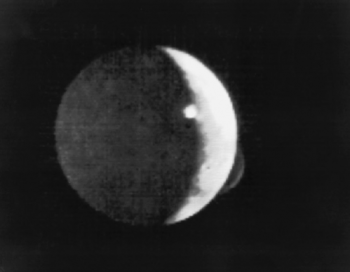
On March 8, 1979, as Voyager 1 was speeding away from Jupiter after its historic flyby of the gas giant three days earlier, it looked back at the planet and took some navigational images. Linda Morabito, one of the engineers in charge of using these navigational images to make sure the spacecraft was on its planned course, took one look at the image on the right, an overexposed image of the moon Io, and decided that it had captured something very unusual. On the limb of the moon was this strange shape that at first glance looked like another moon partly hidden behind Io. She and her fellow engineers immediately realized that this was not possible, and that the object was probably a plume coming up from the surface of Io. To their glee, they had taken the first image of an eruption of active volcano on another world!

Today, on the astro-ph preprint website, Morabito has published a minute-by-minute account of that discovery. It makes for fascinating reading, partly because the discovery was so exciting and unique, partly because it illustrated starkly the human nature of science research, and partly because of the amazing circumstances of that discovery. Only one week before, scientists has predicted active volcanism on Io in a paper published in the journal Science. To quote her abstract:
» Read more

0 comments

Boeing to cut 30 percent of its management ranks.

Boeing to cut 30 percent of its management ranks.

This could be good news for the company. If they do this right, they will reduce their costs without hurting their ability to produce. That they made this announcement today, the day after the election, and that the cuts mostly involve their defense work also suggests it is linked to sequestration, despite the company’s denial.

5 comments

Sierra Nevada is moving its mini-shuttle, Dream Chaser, into its own facility.

Sierra Nevada is moving its mini-shuttle, Dream Chaser, into its own facility.

This article isn’t really as positive as I’d like. For one, they haven’t even signed the lease for the building. Instead, it appears that the company is using this announcement, and the subsequent media coverage, to pressure the local city council to provide them subsidies. For another, the article mentions that drop tests of Dream Chaser will occur next spring, a significant delay from previous announcements. Both points make things appear far more tenuous than they should be.

2 comments

For the second time, a Progress freighter has launched and, after only four orbits, docked with ISS.

For the second time, a Progress freighter has launched and, after only four orbits, docked with ISS.

This was the fourth Progress launched this year, the second to follow an abbreviated four-orbit rendezvous with the space station. Russian flight controllers normally implement two-day rendezvous profiles, but they are perfecting procedures for single-day flights for possible use with manned Soyuz missions to shorten the time crews are forced to spend in the cramped ferry craft.

The Russians have used the leisurely two-day rendezvous path now for almost a half century. So, why are they suddenly trying to shorten the travel time to ISS to six hours? Though there are many good engineering reasons, I also suspect it is because they are now feeling the pressure of competition. The shorter travel time probably lowers their costs at mission control. It also makes using the Soyuz for manned flights more appealing. Dragon for example is presently using the two-day rendezvous path. And Dragon will soon become a direct competitor to Soyuz, when it begins flying humans in the next three to five years.

12 comments
1 724 725 726 727 728 798