
Partial power outage on ISS today delays Dragon cargo mission

A partial power failure on the International Space Station has forced NASA to delay for at least two days the Dragon cargo mission that had been scheduled to launch early tomorrow morning.

The delay will allow time for NASA flight controllers at the Johnson Space Center in Houston to continue troubleshooting an issue with a distribution box in the space station’s electrical power system. Engineers detected an issue with the Main Bus Switching Unit on Monday morning, and ground teams plan to replace the component later this week, ahead of the SpaceX cargo launch. “Teams are working on a plan to robotically replace the failed unit and restore full power to the station system,” NASA said in a statement Tuesday. “The earliest possible launch opportunity is no earlier than Friday, May 3.”

The Main Bus Distribution Unit is one of several that routes power from the space station’s U.S. solar arrays to the research outpost’s electrical channels. The suspect unit distributes power to two of the eight electrical channels on the station, including a power supply for the space station’s robotic arm, which the station astronauts will use to capture the Dragon cargo craft as it approaches the complex.

While the robotic arm remains powered through a separate channel, NASA flight rules require redundant power supplies for the arm during critical operations, such as the grapple of a free-flying spacecraft.

Since the cargo Dragon freighter is berthed to the station using the robot arm, they want to get this fixed before launching Dragon. Right now the new launch date will occur no earlier than the wee hours of Friday, May 3.
0 comments

Settlement reached in lawsuit about private lunar mission

A lawsuit filed in 2017 by a man who had paid Space Adventures a $7 million deposit for a ticket to fly on a Soyuz rocket around the Moon has now been settled

McPike, an Austrian businessman and adventurer who lives in the Bahamas, filed the original suit in May 2017, seeking the return of a $7 million deposit he paid to Space Adventures for a $150 million seat on a Soyuz mission that would go around the moon, and additional damages. The defendants in the suit included Space Adventures; Tom Shelley, the company’s president; and Eric Anderson, the company’s chairman and chief executive.

According to McPike’s suit, he contacted Space Adventures in July 2012 about the possibility of flying on a mission around the moon that the company had been promoting for several years. In March 2013, he signed an agreement committing to participate in such a mission, and paid an initial deposit of $7 million towards the $150 million total price with the expectation that the mission would take place within six years.

McPike was scheduled to make a second deposit of $8 million one year after contract signing, but he postponed that because of concerns he had regarding the limited progress on developing the mission, including lack of information from the Russian companies and agencies that would carry out it. Space Adventures terminated the agreement in March 2015 after McPike failed to make that payment and retained his $7 million deposit.

According to his suit, McPike later contacted the Russian space agency Roscosmos directly, and was informed that, contrary to the contract he signed, there was no formal relationship between the agency and Space Adventures for a circumlunar mission, that that the proposed mission was only in the “preliminary planning phase” along with several other future projects.

The details of the settlement were not released.

The article also provides near the end a nice summary of all recent private attempts to fly humans around the Moon, including SpaceX’s now ongoing plan to fly a Japanese businessman in 2023 using its Starship upper stage.

0 comments

FCC approves SpaceX’s Starlink constellation

Capitalism in space: The FCC has approved SpaceX’s revised plan for its Starlink satellite constellation designed to provide global internet access.

SpaceX already had authorization for 4,425 Starlink satellites that would use Ku- and Ka-band radio spectrum to beam internet data, but last November, the company asked the FCC to sign off on a plan that would put more than a third of the satellites in 550-kilometer-high (340-mile-high) orbits rather than the previously approved 1,150-kilometer (715-mile) orbits.

Eventually, SpaceX plans to add another wave of more than 7,500 satellites in even lower orbits to enhance the constellation’s coverage.

They hope to begin launching their first set of satellites by May, and begin commercial operations as early as 2021.

2 comments

NASA safety panel on SLS schedule, Dragon explosion

NASA’s safety panel held a long scheduled meeting to review NASA’s on-going manned projects, and had the following to say:

The first story describes very little new information about the explosion on April 20th that destroyed the Dragon crew capsule during engine tests, other than it occurred in connection with the firing of the Dragon’s eight SuperDraco engines. I am being vague because they were.

The second story describes the panel’s strong objection to any effort by NASA to trim the test program for SLS in order to meet the Trump administration’s 2024 deadline for returning to the Moon. It also confirms officially for the first time that NASA will not be able to fly the first unmanned mission of SLS in 2020. That flight is now expected in 2021, a decade after NASA began development of SLS, and seventeen years after George Bush Jr first proposed NASA build this heavy-lift rocket.

That’s practically one person’s entire career at NASA. Seems pretty shameful to me.

While I actually agree with the panel’s advice in both of these stories, both stories however do reflect the overall culture of this safety panel: Go slow, take no risks, be patient. This culture is in fact so cautious that it has served to practically make impossible any American exploration of space, on our own rockets.

Based on what I expect now during the investigation of the Dragon explosion, I would not be surprised if the panel successfully delays the first manned Dragon launch another year or two or three.

4 comments

Starliner does first splashdown recovery tests

Capitalism in space: Though Boeing intends to bring its manned Starliner capsule down on land, it has begun water recovery tests of the capsule, working in conjunction with Air Force recovery teams, to prepare for the possibility that it might sometimes have to splashdown in the ocean.

While the article reviews the tests, it also contains this interesting piece of information:

While today’s test was the first in-water practice run for Starliner at sea rescue, it represents a much larger DoD commitment to space crew rescue operations – universal procedures that would be followed for Starliner, Dragon, and Orion.

During ascent for Starliner, Dragon, and Orion, the 304th Rescue Squadron will have two teams stationed along the east coast of the United States, one at Patrick Air Force Base (just South of the Cape) and the other in Charleston, South Carolina.

The Patrick team, Rescue 1, will be responsible for on-pad aborts that place a capsule in the water or for aborts in the first couple minutes of flight that place the capsule within a 200 nautical mile zone from the Cape.

After that distance is exceeded, the Charleston crew (Rescue 2) would be responsible for rescue of a launch-aborting crew vehicle anywhere else across the Atlantic.

The third team, stationed in Hawai’i, (also part of Rescue 2) would be responsible for any after-launch immediate landing need or off-nominal Station return contingency that places a Starliner or Dragon in the Pacific.

It appears that the responsibility for water recovery of American manned spacecraft has been taken over by the Air Force. Up until now SpaceX has performed its own water recovery for its unmanned cargo Dragon capsules.

0 comments

Dragon capsule suffers problem during engine test

Bad news: A SpaceX man-rated Dragon capsule suffered an “anomaly” during an engine test today.

“Earlier today, SpaceX conducted a series of engine tests on a Crew Dragon test vehicle on our test stand at Landing Zone 1 in Cape Canaveral, Florida,” a company spokesperson told Space.com in a statement. “The initial tests completed successfully but the final test resulted in an anomaly on the test stand.”

At the moment we do not have much information. We do not know if this capsule was the one that flew in March and was going to be used in the launch abort test prior to the manned mission, or whether it was another capsule planned for the manned mission itself.

Nor do we know what the problem was, or if it was a SuperDraco thruster that failed.

Regardless, this is going to cause a significant delay in SpaceX’s flight schedule. While they might be able to complete an investigation and resume flying within months, NASA will insist on a NASA-type investigation, drawn out for far longer, possibly years.

15 comments

SpaceX booster damaged on barge but not lost

According to an Associated Press report today, the Falcon Heavy core stage was damaged when it toppled over in heavy seas, but was not entirely lost.

The company confirmed Tuesday that the unsecured core booster toppled onto the platform over the weekend, as waves reached 8 to 10 feet. SpaceX chief Elon Musk says the engines seem OK. There’s no immediate word on how many of the booster pieces remain on board.

Musk says custom devices to secure the booster weren’t ready in time for this second flight of the Falcon Heavy.

From this report it sounds like the engine part of the stage remained on the barge. We shall see. Also, this report might explain the lack of a robot to secure the stage. The robot wasn’t ready, but rather than delay the launch for this reason they went ahead.

8 comments

SpaceX loses Falcon Heavy core stage in rough seas

SpaceX announced today that it lost the Falcon Heavy core stage in rough seas on its way back to port.

“Over the weekend, due to rough sea conditions, SpaceX’s recovery team was unable to secure the center core booster for its return trip to Port Canaveral,” SpaceX spokesman James Gleeson told FLORIDA TODAY. “As conditions worsened with eight- to ten-foot swells, the booster began to shift and ultimately was unable to remain upright.” “While we had hoped to bring the booster back intact, the safety of our team always takes precedence. We do not expect future missions to be impacted,” he said.

While SpaceX does have hardware on its drone ship designed to secure first stages – often referred to as a flat “robot” that holds them in place – it was not used for this mission, which successfully took an Arabsat satellite to orbit last Thursday. The connections between the robot and center core aren’t compatible like they would be with a standard Falcon 9 booster, but SpaceX is expected to upgrade both in the future.

This is unfortunate. At the same time, it illustrates how far ahead of its competitors SpaceX is. While others throw their first stages away, SpaceX is disappointed when it loses one.

24 comments

SpaceX recovers Falcon Heavy fairings and will reuse them

Capitalism in space: In a tweet yesterday Elon Musk said that SpaceX had recovered both fairings from the Falcon Heavy launch and plans to reuse them later this year.

It seems that what the company has found is that catching the fairings is not necessary. Providing them parachutes and a guidance system so they land gently with the open half up, so they float literally like a boat, prevents any serious damage. The guidance system also gets them to land close enough for a quick pickup at sea.

Based on this knowledge, recovering and reusing these fairings was probably always a simple and fairly easy thing to do. No one however had had the smarts or open-mindedness to think of doing it. Moreover, from the article:

Musk told reporters last year that the fairing costs around $6 million. He said the first stage of the Falcon 9 rocket comprises about 60 percent of the cost of a launch, with the upper stage responsible for 20 percent, and the fairing another 10 percent. The remaining 10 percent of the cost of a Falcon 9 mission come from charges stemming from launch operations, propellant and other processing expenses, Musk said last year.

In other words, by recovering both the first stage and the fairings, SpaceX makes their rockets about 70 percent reusable. That’s actually more reusable than the space shuttle ever was.

I must add that the section of the shuttle that was the most reusable was the section of SpaceX’s rockets that they as yet are not reusing, the upper stage. In other words, we have now tested and proven the technology for making an entire orbital rocket reusable, just never in the same vehicle. SpaceX is taking advantage of this knowledge and clearly applying it to their Super Heavy/Starship next generation rocket, which also means the likelihood of getting that to work is actually quite high and not as radical as many think.

8 comments

The Falcon Heavy reported by modern shoddy journalism

Yesterday’s magnificent successful launch of SpaceX’s Falcon Heavy rocket elicited numerous news stories from the general press, most of which were reasonably accurate if very superficial in their coverage. As a space guy who focuses on this stuff, I find that much of the reporting in the mainstream press reads as if the author has just discovered the subject, and is scrambling to come up to speed quickly.

This CNN article is typical. The journalist gets most of her facts right, but her lack of context because she hasn’t been following the subject closely causes her to not understand the reasons why the Falcon Heavy will fly less than the Falcon 9.

Falcon Heavy is not expected to fly nearly as often as its smaller counterpart, which has completed more than 20 missions since last February. Falcon Heavy only has five missions on its manifest so far.

The basic facts in this quote are entirely true, but it somehow implies that the Falcon Heavy is simply not that much in demand, which isn’t true. The reason Falcon Heavy has approximately one quarter of the missions of the Falcon 9 is because it is still new and it hasn’t yet garnered the customers. Also, as a slightly more expensive rocket than the Falcon 9 ($90 million per launch vs $60 million) fewer customers are going to buy it.

Still, the Falcon Heavy has more than five missions upcoming, with contracts for at least seven launches, by my count, and having this many contracts this quickly is remarkable, considering the rocket’s newness. It is more than the Russians are getting for their Proton rocket, around since the 1960s. And it is almost as many contracts as both Arianespace and ULA are each getting on a yearly basis.

Falcon Heavy is clearly becoming a big financial success, and will in the next few years I think routinely fly three to four times per year. There is a lot of demand for it, which will only grow with time.

This flaw in getting the background right by the CNN reporter is not really a big deal, but it does illustrate why it is better for ordinary citizens to get their news not from generalists in the mainstream press but from specialists in each field (such as myself), who understand the details more closely and can get the context right.

However, every once in awhile the mainstream press publishes a story that is so egregious and badly written that I think it necessary to give it a public pan, if only to make others aware of that this kind of bad journalism is not unusual. I also admit that it can be quite entertaining to highlight this pitifully bad journalism.

Yesterday one of Houston’s local television stations, KPRC-TV, published its own quick report on the Falcon Heavy launch. And boy, was that report a facepalm.
» Read more

12 comments

SpaceX gets NASA launch contract

Capitalism in space: One week after dropping its protest for losing the bidding competition for the Lucy asteroid mission, SpaceX has been awarded by NASA the launch contract for its Double Asteroid Redirection Test (DART) mission, set for launch in June 2021.

The $61 million launch price is significantly lower than past NASA contracts for Falcon 9 launches. NASA awarded SpaceX a contract for the Sentinel-6A satellite in October 2017 for a November 2020 launch on a Falcon 9 from Vandenberg at a total cost of $97 million. The Surface Water and Ocean Topography (SWOT) satellite will launch on a Falcon 9 in April 2021 under a contract awarded in November 2016 at a value of $112 million.

This low cost technology test mission, costing a total of $9 million, was initially going to be launch as a secondary payload. That NASA is now going to pay SpaceX for a full launch is most intriguing. It seems to me that there might be a bit of quid pro quo here. NASA wanted that protest dropped, and offered this launch to convince SpaceX to do that, as long as the launch cost was kept low. $60 million is really SpaceX’s standard price for Falcon 9 launch, using new boosters, but for NASA that is the least they’ve paid. How much more this is than what NASA would have paid to launch DART as a secondary payload is the real question.

1 comment

The second Falcon Heavy launch

I have embedded the live stream of Falcon Heavy launch below the fold. It does not go live until just before launch, which is now scheduled for 6;35 pm (Eastern).

The live stream is now live. I will post updates below, so refresh your screen to see them.

This is not a routine SpaceX launch, where we have become nonchalant about the company’s ability to vertically land a first stage. They admit getting the core stage back will be challenging. They also admit that this is essentially a countdown of three rockets, so they are going to be very conservative. If anything pops up during countdown, they will scrub and try another day.

They have launched.

The side boosters have successfully separated.

The center core stage has successfully separated.

Re-entry burns for the two side boosters has been completed.

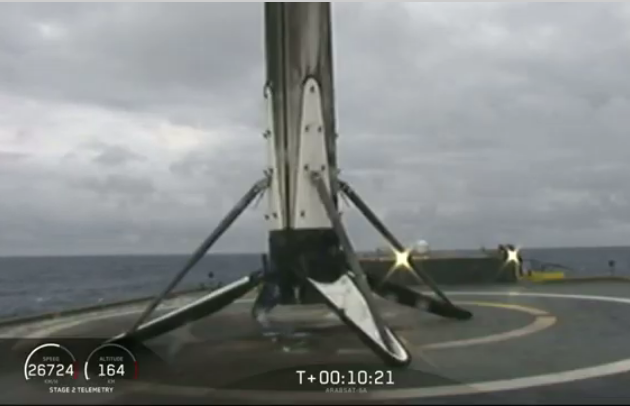
Falcon Heavy core stage on drone ship

Re-entry burn on the core stage has been completed.

Both side boosters have landed.

The payload is in orbit.

The core stage has landed successfully on the drone ship.

Though the satellite has not yet been deployed, the rest of this mission is almost certainly going to go as planned, as it is essentially identical to a normal Falcon 9 launch. Update: payload successfully deployed!

Getting all three stages back is a notable achievement. They intend to recycle the two side cores and use them on the very next Falcon Heavy launch in June. The core stage will likely be reused as well but when has not yet been announced.

The leaders in the 2019 launch race:

4 SpaceX
4 China
4 Europe
3 Russia

The U.S. leads the pack 7 to 4 in the national rankings.

In the heavy lift launch race, SpaceX is by far in the lead in successful launches:

2 SpaceX
1 China
0 SLS (NASA)

I should add that I am being generous to include China’s Long March 5 in this heavy lift list. It really doesn’t qualify, but it remains the only other near competitor.
» Read more

29 comments
1 150 151 152 153 154 234