Orbital ATK and SpaceX win Air Force contracts

The competition heats up: The Air Force has awarded Orbital ATK and SpaceX contracts to develop new rocket engines to help end the U.S.’s reliance on Russian rocket engines.

The Orbital contract is initially worth $47 million, with the company committed to spend $31 million of its own money., according to the Defense Department’s daily digest of major contract awards. Eventually the government could pay the company $180 million. SpaceX’s contract meanwhile was for $33.6 million initially for the development of its new Raptor upper stage engine, with a total government payment to be $61 million.

And that’s not all. Later today NASA will announce the winners in its second ISS cargo contract. The competitors are SpaceX, Orbital ATK, and Sierra Nevada. I am hoping the latter two win, since that would allow the construction of a fourth American spacecraft, Sierra Nevada’s Dream Chaser, capable of lifting cargo and crew into space.

2 comments

The Falcon has landed

SpaceX has produced a short video that recaps its last launch and the successful landing of its first stage. I have embedded it below, because it is worth seeing again as the company is preparing to do it again this weekend. It is also worth watching again to see the joyous celebration of everyone watching at the moment, all of whom know deep down that they have just witnessed a significant event in the history of the human race.

4 comments

Russians to develop Falcon 9-like rocket

The competition heats up: The Russian government has apparently given the go-ahead to the development of a Falcon 9-like modular rocket, original dubbed Soyuz 5 but now called Fenix (Phoenix).

The images at the link show it to be similar in concept to Falcon 9, with its first stage used as a component to produce multiple configurations. With one first stage it would resemble Falcon 9. In its Falcon Heavy configuration it would use three first stages strapped together. Moreover, the article notes that development would begin as expendable, but shift towards re-usability during operation, like Falcon 9. And it does appear that reducing cost is its main driver, since it will involve the development of only one engine and the reuse of it in every stage, like Falcon 9,

If all goes as outlined in the plan (don’t bet on it), the rocket would be operational by 2025, which is the one difference with Falcon 9. SpaceX got its rocket designed and launched in about five years. The Russian governmental system is going to take ten years to do the same..

The article is a detailed explanation of the rocket mentioned by Deputy Prime Minister Dmitri Rogozin during his confusing television briefing on December 30. The irony here is that, while this rocket might be able to compete with the Falcon 9 of 2016, when it becomes operational in 2025 who knows what will be considered competitive.

2 comments

Next Falcon 9 first stage will try to land on barge

The competition heats up: With its January 17 launch from Vandenberg, SpaceX will attempt to land the first stage on a barge in the Pacific.

This will also be the first attempt from the California launch site. If successful, it will give SpaceX greater flexibility on future first stage recoveries, as some launches won’t have the fuel to get the stage back to land but could bring it down on a barge at sea.

0 comments

2015 the busiest launch year for Florida since 2003

The competition heats up: With 17, Florida had more rocket launches in 2015 than it has had in more than a dozen years.

Russia once again had the most launches in the year, with 29 (including 3 failures). Overall, launches worldwide were down, from 92 in 2014 to 87 in 2015. However, the uptick in the U.S., spurred I think by SpaceX, suggests that the U.S. numbers will continue to rise, and in in a few years the U.S.will take the lead.

Note also that when the shuttle was retired many thought that — with the loss of that government operation — it would be the end of the Florida launch business. Competition and private enterprise have instead shown that a dependence on government is not the only way to do things, and is in fact not the best way to do things.

1 comment

Recovered Falcon 9 first stage undamaged

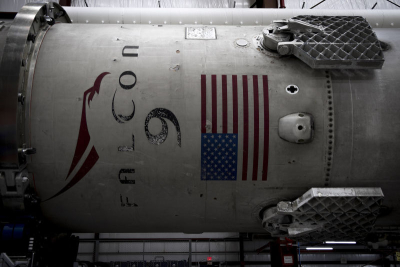
Recovered Falcon 9 first stage

The competition heats up: In an Instagram post, Elon Musk has revealed that the Falcon 9 first stage that successfully landed vertically after launch is in its hanger and is essentially undamaged.

Elon Musk: “Falcon 9 back in the hangar at Cape Canaveral. No damage found, ready to fire again.”

Musk’s post included a higher resolution version of the picture on the right, showing a close-up of the stage near its top. This image reveals that, despite some minor paint damage and dirt, this section of the stage does appear whole and ready to go. Even the landing fins are folded and appear undamaged.

Musk’s post also suggests that the stage is ready for its first post-launch test firing, which underlines how unique this opportunity is. No one has ever had a functioning first stage available for testing after it had been launched and returned to Earth. Past assumptions (an important word) have always said that the stress of launch would damage it enough that it wouldn’t be cost effect to reuse it. SpaceX’s engineers now will have an opportunity to find out if that assumption was true or false. I strongly suspect they will find that this assumption was false, that it was used as a bugaboo by the small-minded to discourage just this kind of effort by SpaceX.

This article notes that Musk has previously said it costs $60 million to build the first stage, but only $200K to refuel it. Since SpaceX says it charges about $70 million per launch, that first stage is most of SpaceX’s cost for each launch. If the stage can reused later, the cost of later launches will thus plummet incredibly. Assume they can only reuse the stage once. Amortized over only two launches the cost is still cut by almost half. More importantly, the ability to reuse will be an incentive for them to build the stage right the first time, so that it can be reused multiple times.

I repeat: The importance of this breakthrough has not yet sunk in. It is going to change the entire aerospace industry and everything we do in space.

Update: I have corrected the post above, which originally incorrectly stated that the picture showed the stage near its base.

12 comments

SpaceX to display recovered first stage

The competition heats up: Rather than re-fly it, Elon Musk suggested today that, after some testing, SpaceX will likely put its first recovered Falcon 9 first stage on display instead.

“[We will] do a static fire at the launch pad there, to confirm that all systems are good and that we are able to do a full thrust hold-down firing of the rocket,” Musk said after the stage landed. The static fire will also test the modifications SpaceX has made to Pad 39A to support its rockets.

After that though, the stage will become a display piece. “I think we will keep this one on the ground for tests that prove it could fly again and then put it somewhere β€” just because it is quite unique,” Musk said.

Since they already have a satellite company, SES, willing to buy that first stage, this only underlines how this last Falcon 9 launch changes everything. Nor do I think this change has sunk in with most people yet. The last launch was not a one-time event. SpaceX’s intends to recover as many of its first stages as it can in all future launches. Their Falcon 9 first stage is no longer expendable. Thus, they can afford to put this first recovered stage on display because they expect all future first stages to fly again.

5 comments

Musk vs Bezos vs Branson

The competition heats up: Two stories today highlight the entertaining and totally beneficial space race that now exists between private American space companies, instigated by SpaceX’s successful vertical landing of its Falcon 9 first stage.

The first is a Popular Mechanics post showing two graphics comparing the flights of Blue Origin’s New Shepard rocket with Falcon 9’s first stage.

As they correctly note,

Both companies did a big thing and deserve accolades for it. The race is on to bring on true reusability, which has the potential to drive down the cost of space launches if done correctly. But Jeff Bezos is working with a rocket barely the size of the engine of the Falcon 9 first stage. For suborbital flight, Bezos did a big thing. For orbital flight, SpaceX did an even bigger thing. In suborbital flight, Bezos may have beat SpaceX’s Grasshopper rocket to a full suborbital flight and return, but he isn’t ready to fly with the Falcon yet.

Blue Origin is posed to become SpaceX’s biggest competitor, but they clearly are behind in the race and will need to do a lot to catch up.

The second article is an excellent essay by Doug Messier at Parabolic Arc noting that at this stage the race isn’t really between Musk and Bezos but between Bezos and Richard Branson.

Messier notes that Bezos’ New Shepard rocket is built to sell tickets to tourists on suborbital flights. He is not competing with SpaceX’s orbital business but with Richard Branson’s space tourism business at Virgin Galactic. And more significantly, it appears that despite a ten year head start, Richard Branson appears to be losing that race, and badly.

Not only that, but while SpaceShipTwo is essentially a deadend, capable only of suborbital tourism, Bezos’s New Shepard was designed to be upgraded to an orbital ship and rocket. Once they chaulk up some suborbital ticket sales and some actual flights, something they seem posed to do in the next two years, they will likely then begin moving into the orbital field. They will then leave Virgin Galactic far behind.

0 comments

The coming bright age

As regular readers of Behind The Black know, I routinely report on the depressing state of western culture, where our intellectual academic community appears more interested in standing with their eyes closed and their fingers in their ears yelling, “La-la-la-la-la-la-la-la!!!” as loud as they can so they can avoid learning new things or hearing facts that might disturb their tiny little bubble of incorrect assumptions. Such behavior is comparable to the close-minded thinking that caused the medieval dark ages, when the search for knowledge died and Roman culture withered. It took a thousand-plus years for western civilization to come out of that shadow and begin to grow again.

The success of SpaceX yesterday to vertically land the first stage of its Falcon 9 rocket while also successfully putting eleven smallsat satellites in orbit however that gives me hope that a dark age is not coming. Despite living in a time when freedom is denigrated, when free speech is squelched, and when oppressive regulation and government control is the answer to every problem, the enduring spirit of the human soul still pushed through to do an amazing thing.

SpaceX’s success is only the beginning. The ability to reuse the engines and first stage will allow them to lower their launch costs significantly, meaning that access to space will now be possible for hundreds if not thousands of new entrepeneurs who previously had ideas about developing the resources of the solar system but could not achieve them because the launch costs were too high. In fact, the launch of Orbcomm’s smallsat constellation by this Falcon 9 demonstrated this. Not only is this company proving the efficiency of smallsats, they now have a launch vehicle, the Falcon 9, that they can afford to use. In the past Orbcomm would have been hard-pressed to finance its satellite constellation using the expensive rockets of older less innovative launch companies like Boeing and Lockheed Martin.

SpaceX however is not alone in revolutioning the launch industry. Blue Origin has also demonstrated some of the same launch capabilities as SpaceX, vertically landing its first stage. In competition these two companies and their armies of brilliant and creative engineers are going to make it possible for the human race to explore and colonize the solar system.

Even as old Earth sinks into increasing regulation, oppressive rule-making, and tyrannical close-mindedness, the explorers of the solar system, led by this new American launch industry, will break away from that morass. Hopefully, the new space-faring societies they create out there amid the stars will, like the settlers of North America in the 1600s, help re-establish freedom for future generations back here on Earth.

5 comments

SpaceX lands the first stage!

The competition heats up: SpaceX has successfully vertically landed its first stage after putting 11 Orbcomm satellites into orbit.

If you go to the SpaceX website they broadcast the whole thing live. And people are going crazy there right now.

I am sure they will post the video at the SpaceX website and youtube channel later today. The link to the full broadcast of the launch and landing is here. The landing sequence begins at about 25 minutes in, a little less than four minutes after launch.

11 comments
1 189 190 191 192 193 234