
The future Nemesis from space

From the American Astronomical Society meeting this week:

A team of astronomers, using the data from the Sloan Digital Sky Survey, calculated the galactic orbits of nearly 40,000 low mass stars. These stars are generally M dwarfs, cool, not very bright, and thus generally somewhat close to the Sun since if they are too far away we would not see them. You can read the abstract here, and download their full poster here [pdf].

For the astronomers, the data told them a great deal about the orbital properties of these stars. Though a majority are in circular orbits between 20 to 30 thousand light years from the galactic center, a small minority are in extremely eccentric orbits that travel far out into the galactic halo, as much 260,000 light years. A few others dive inward, getting within 6000 light years of the galactic center.

What made this poster stand out to me, however, was this quote from the abstract:

In addition, we have identified a number of stars that will pass very close to the Sun within the next [billion years]. These stars form the “Nemesis” family of orbits. Potential encounters with these stars could have a significant impact on orbits of Oort Cloud and Kuiper Belt members as well as the planets. We comment on the probability of a catastrophic encounter within the next [billion years].

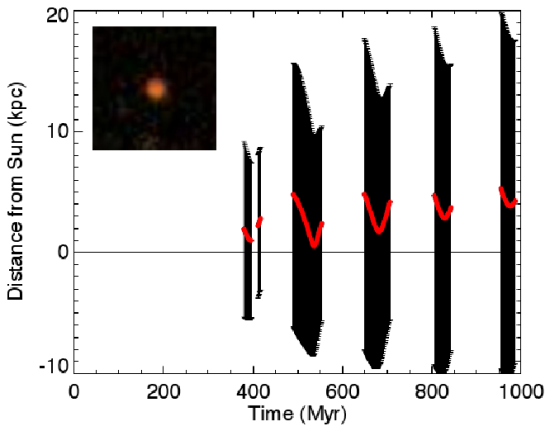
All told, they found that 18 low-mass cool M dwarf stars that will eventually pass close to the Sun. One star, SDSS J112612.07+152517.6, an M3 star that is about 2,300 light years away, is in an orbit that has it moving right towards us at about 90,000 miles per hour. Its mass is less than half that of the Sun, about 0.4 solar masses. This figure from the poster roughly illustrates the star’s position relative to our solar system over the next billion years:
Nemesis star

The star itself is shown in the inset. The red curve shows its calculated distance from the Sun over time, with the black area above and below showing the uncertainties of the calculation. As you can see, every hundred million years or so the distance between this star and the Sun shrinks, with the very very very rare possibility that the distance will sometimes shrink to zero!

With 18 stars each doing this every few 100 million years or so, the average time between close approaches is about 5 million years. These results suggest that another star passes close enough to our solar system frequently enough to not only disturb the comets in the Oort cloud, but also possibly affect the orbits of the planets in the outer solar system and Kuiper belt. One wonders, for example, if such an event had some influence on Pluto’s strange orbit.
0 comments

A plunge in solar activity in December

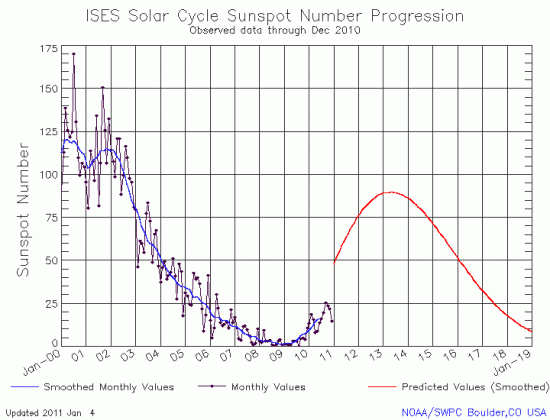
The monthly update of the Sun’s developing sunspot cycle was published tonight by NOAA’s Space Weather Prediction Center. You can see the newest graph below, which shows the slow rise in sunspots (blue/black lines) in comparison with the consensis prediction made by the solar science community in May 2009 (red line).

Not only does the Sun’s generally quiet trend continue, its activity took an additional plunge in December, dropping significantly from the previous month. This drop is probably due to the seven days of no sunspots that took place in mid-December.

All in all, we continue to head for the weakest maximum in two hundred years (see the graph on this page), which in the past meant very cold weather. Though scientists do not yet understand why the Sun does this or how these changes in solar activity influence the climate as much as they do, that this in now happening at a time when we have the technology to truly study it is an opportunity that must not be missed.

The December sunspot graph

0 comments

Heading towards a Maunder Minimum

Though I have been saying that the Sun’s lack of sunspots the last two years suggests the possibility of that we might be facing an extended period without solar activity, I am not a solar scientist. Today, in a paper published today on the Los Alamos astro-ph website, a solar scientist says just that. Key quote:

One method that has yielded predictions consistently in the right range during the past few solar cycles is that of K. Schatten et al., whose approach is mainly based on the polar field precursor. The incipient cycle 24 [on-going right now] will probably mark the end of the Modern Maximum, with the Sun switching to a state of less strong activity.

0 comments

The Sun is no longer blank

After six blank days, the Sun is once again showing spots. As I have mentioned several times in 2010, this might be the last time the Sun is blank for years to come as it ramps up to solar maximum. However, don’t bet on it, as the Sun’s activity has been way below all predictions. The upcoming solar maximum might very well be the first in centuries with blank days interspersed throughout.

0 comments

The sun found to vary in unexpected ways

Recent monitoring of the Sun’s brightness as it went from maximum to minimum in its solar cycle has found that, surprisingly, the changes in brightness across different wavelengths do not necessarily vary in lockstep. Key quote:

SIM suggests that ultraviolet irradiance fell far more than expected between 2004 and 2007 — by ten times as much as the total irradiance did — while irradiance in certain visible and infrared wavelengths surprisingly increased, even as solar activity wound down overall. The steep decrease in the ultraviolet, coupled with the increase in the visible and infrared, does even out to about the same total irradiance change as measured by the TIM during that period, according to the SIM measurements.

The stratosphere absorbs most of the shorter wavelengths of ultraviolet light, but some of the longest ultraviolet rays (UV-A), as well as much of the visible and infrared portions of the spectrum, directly heat Earth’s lower atmosphere and can have a significant impact on the climate. [emphasis mine]

1 comment

The Sun is blank

For the first time since October 10, and only the third time since August, the Earth-facing side of the Sun is blank, showing no sunspots. All told, 2010 has only been blank 13% of the time, for a total of 46 blank days, with only 12 days left in the year. These numbers contrast sharply with 2009, when the Sun was blank 71% of the time, or 260 out of 365 days.

It is very clear that the solar minimum is now over, and that the Sun ramping up to its next maximum. Blank days should soon cease (today might very well be the last for years), and the number of sunspots should continue to increase through approximately 2013, when astronomers now expect the maximum to peak.

It will be a weak maximum, however, likely accompanied with cold weather. At least, this has been the pattern for the last ten centuries, based on the best data that scientists have. When the Sun produces sunspots, the Sun gets hotter, and though that increase in radiation appears slight, it seems enough to warm the Earth’s climate. This is what appears to have happened around the year 1000, during what climate scientists call the Medieval Warm Period.

And when the Sun goes blank, or produces fewer sunspots, the Sun dims, and the Earth’s climate cools. This is what happened in the 1600s and 1700s, when the Little Ice Age gripped much of the Earth. It also happened in the first two decades of the 1800s, the last time the Sun produced as few sunspots as it is now, and when at least one year was called “the year without a summer”. Interestingly, that cold period at the beginning of the 1800s was also a period of intense volcanic activity, which threw a lot of dust and material into the atmosphere and thus helped contribute to the cooling of the Earth.

The last half of the 20th century, however, has not seen that much volcanic activity, which has made the atmosphere today clearer than any time in the past five decades. It has also been a time of increased solar activity, with most of the solar maximums peaking at generally higher numbers. No wonder scientists have detected evidence of a slight warming in the climate.

However, that warming appears to be ending, and it is doing so at the same time the Sun is going spotless. Though we don’t yet fully understand the mechanics of how these two events are linked, it behooves us to pay close attention. No climate prediction or computer model will mean anything if it does not.

Meanwhile, solar scientists remain unclear about the causes behind the solar cycle’s ebbs and flows. They have a reasonable idea that the cycle is caused by the Sun’s magnetic dynamo as it flips from one polarity to another. But why this happens is still subject to debate.

More importantly, it remains a complete unknown how long the next sunspot minimum will be. The Sun could spring back to life, as it did in the 1850s, producing lots of sunspots. Or sunspots might fade out for a few additional decades, as they did in the 1600s.

Sadly, based on the state of our science today, this is a question that probably no one will be able to answer — until we actually see it happen.

2 comments
1 27 28 29 30 31 32