The Sun in April – Steady as she goes!

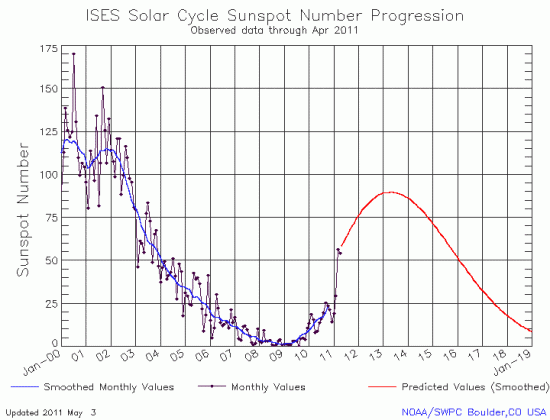
The monthly updated graph for April of the Sun’s solar cycle sunspot activity was posted yesterday by NOAA’s Space Weather Prediction Center. You can see it below.

Though the Sun remained active, you can see that the steep increase in sunspot activity that occurred in March has ceased. At the moment it looks as if the Sun’s sunspot activity is following the most recent scientific prediction, more or less exactly, though the small dip in April puts the numbers slightly below that prediction.

All in all, we still appear to be headed to the weakest solar maximum in two hundred years.
April Sunspot activity

1 comment

Hot time on the ol’ Sun tonight!

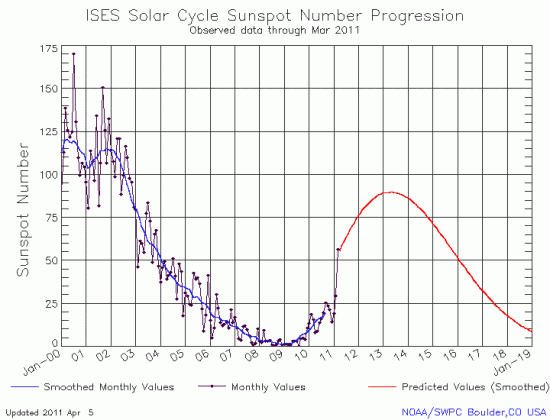
After literally years of inactivity, well below all initial predictions, the Sun truly came to life this past month. Below is the March monthly update of the Sun’s sunspot cycle, published by NOAA’s Space Weather Prediction Center. The red curve is the prediction, while the dotted black line shows the actual activity.

As you can see, the Sun’s sunspot activity shot up precipitously. Though I don’t have the data from past years, the March jump appears to me to probably be one of the fastest monthly rises ever recorded.

Does this mean the newest prediction from the solar scientists at the Marshall Space Flight Center calling for a weak solar maximum in 2013 is wrong? Probably not, though of course in this young field who knows? I would say, however, that the overall trend of the data still suggests the next maximum will be very weak.

Stay tuned! The next few months should finally give us a sense of where the next maximum is heading.

March Sunspot graph

0 comments

More press release journalism,
this time about sunspots

Did you hear the news? Scientists have solved the mystery of the missing sunspots!

You didn’t? Well, here’s some headlines and stories that surely prove it:

The trouble is that every one of these headlines is 100 percent wrong. The research, based on computer models, only found that when the plasma flow from the equator to the poles beneath the Sun’s surface slows down, the number of sunspots declines.
» Read more

1 comment

The Massive February 15, 2011 X Flare on the Sun

An evening pause: On February 15, 2011, the Sun emitted its strongest flare in four years. Though the Sun continues to act relatively wimpy as it ramps up towards solar maximum, this flare was spectacular, mostly because we now have some amazing instruments in space to image and study it. This video does an excellent job explaining what was happening, as it happened. Watch, and enjoy.

And note, as powerful as this flare was, and despite the fact that it was pointed right at the Earth, it represented a relatively minor threat to our technological society, despite what some doomsayers might be claiming. A very active Sun can cause us problems, especially with power systems and electrical grids, but based on past experience during previous solar maximums, most power companies have taken careful steps to protect themselves from this risk. And with the Sun as weakly active as it is, the risks are further reduced. The doomsayers are simply shilling for more government research dollars.

0 comments

The Sun’s continuing wimpiness

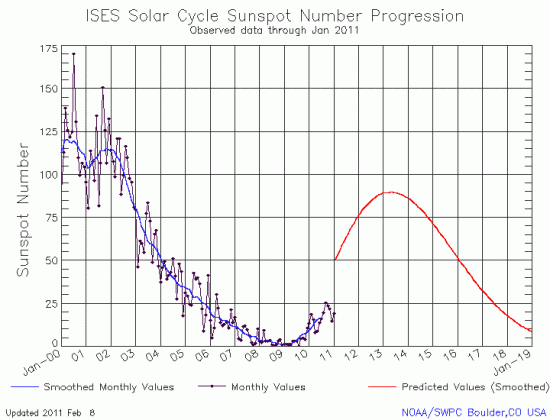
Get those winter coats out of storage! Yesterday NOAA’s Space Weather Prediction Center published its monthly update of the Sun’s sunspot cycle. I’ve posted the newest graph below, showing the continuing slow rise in sunspots (blue/black lines) in comparison with the consensis prediction made by the solar science community in May 2009 (red line).

Though the sunspot count made a slight recovery in January, it was not enough to make up for the plunge in December. Essentially, the Sun continues to act like a sleepy kitten that really doesn’t want to wake up. This suggests that even the newest and wimpiest prediction for the next solar maximum, from solar scientists at the Marshall Space Flight Center, is still overstating the Sun’s upcoming sunspot activity.

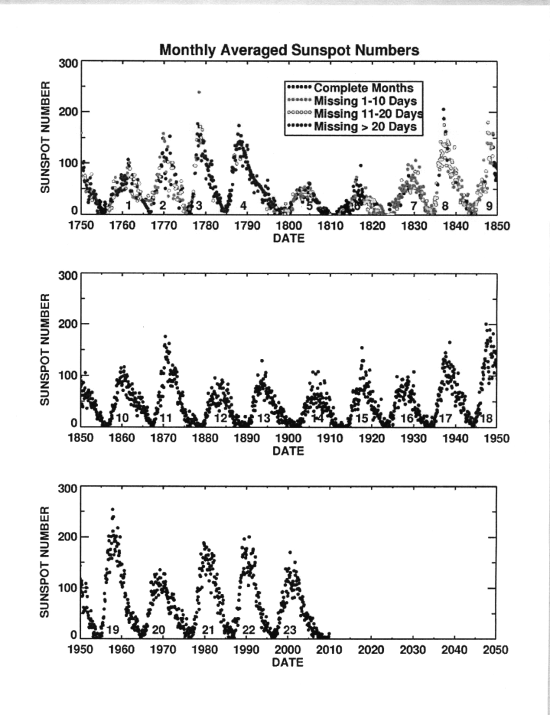
In the past a wimpy Sun has been linked to cold weather, for reasons that scientists as yet don’t quiet understand. And this next solar maximum continues to look like the wimpiest in more than 200 years (see the graph on this page)!

January sunspot graph

0 comments

The solar maximum keep shrinking

Solar scientists at the Marshall Space Flight Center have once again revised downward their prediction for the intensity of the next solar maximum. Key quote:

Current prediction for the next sunspot cycle maximum gives a smoothed sunspot number maximum of about 59 in June/July of 2013. We are currently two years into Cycle 24 and the predicted size continues to fall.

If this prediction holds, the upcoming solar maximum could be the lowest since the cycle came back to life in around 1715 following the Maunder Minimum.

the solar cycle

0 comments
1 26 27 28 29 30 32