
Tag: sun
The November sunspot graph – still low and below expectations
NOAA’s Space Weather Prediction Center today published its monthly update of the Sun’s developing sunspot cycle (see below). The graph shows the slow rise in sunspots (blue/black lines) in comparison with the consensis prediction made by the solar science community in May 2009 (red line).
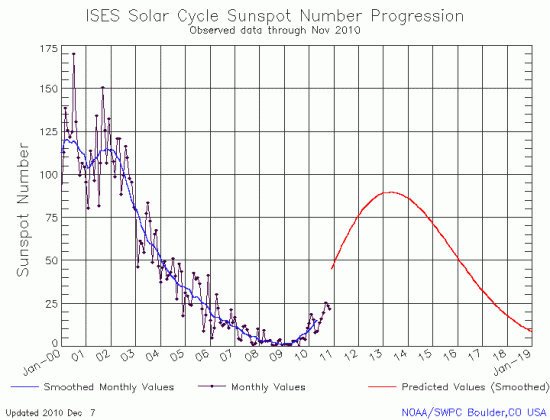
As I noted last month, the rise in sunspots as we ramp up to the next solar maximum has definitely slowed, which indicates clearly that we are heading towards the weakest solar maximum in more than two centuries. And as I have noted repeatedly on this website as well as on the John Batchelor Show, that means very cold weather!
University of Colorado and NASA Research Center to Study Sun’s Effects on Earth’s Climate
Progress! The University of Colorado and the Goddard Space Flight Center are forming a collaborative research center to study the Sun’s effect on the Earth’s Climate.
Spanish woman claims ownership of the Sun
Then again, this is taking land ownership a bit too far: Spanish woman claims ownership of the Sun.
The Making of a Mind-Blowing DIY Sun Photo
A do-it-yourself photo of the Sun that looks as good as any taken from space. And it’s art too!
The updated monthly sunspot graph, as of November 2, 2010
NOAA’s Space Weather Prediction Center today published its monthly update of the Sun’s developing sunspot cycle, showing the slow rise in sunspots in comparison with the consensis prediction made by the solar science community in May 2009.
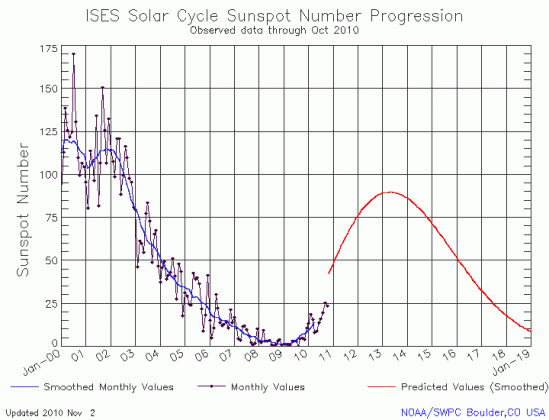
Unlike October graph, which showed a clear jump in sunspot activity, this November update shows that the rise in sunspot numbers has once again slowed down. As I’ve noted repeatedly, these numbers suggest that we are heading for the weakest solar maximum in two hundred years, far below predictions. And when that last happened, around 1810, it was called the Dalton minimum and the Earth experienced one of its coldest periods in many many decades.
Sunspots return to the Sun
After a three day stretch of blankness, a new sunspot has appeared on the Sun. The question remains: Have we now seen the last blank day for the just ending solar minimum?
The Sun was brighter when it was dimmer?
The science is settled? According to one scientist’s data, the Sun actually brightened in visible wavelengths during the ramp down from solar maximum to minimum in 2004-2007 — the exact opposite to what was expected — while dropping in the ultraviolet four times more than predicted.
The October 2010 sunspot graph
Yesterday NOAA’s Space Weather Prediction Center published its October monthly graph, showing the sun’s developing sunspot cycle in comparison with the consensis prediction made by the solar science community in May 2009.
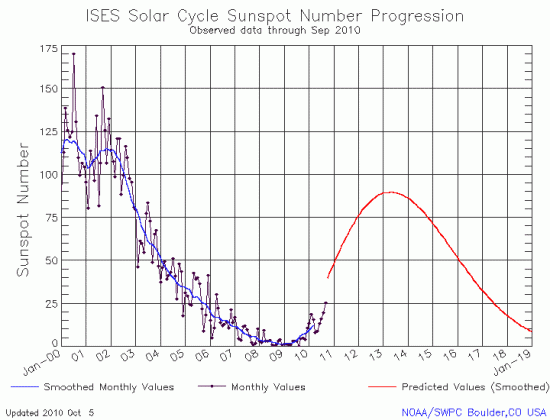
Sunspot activity in September clearly jumped, though it still remains far below predictions. Prepare for the weakest solar maximum since the 1810s!
Note also that today the Sun is blank, with no sunspots, the first time this has happened since August. At that time I speculated that this might “be the last time the Sun will be blank for years as it continues to ramp up to its next solar maximum.” Obviously not. The question now is whether today will be the finale in blankness for this minimum.
The state of the Sun, September 30, 2010
Time to update the state of the Sun, as seen by satellite data (the last update was in July). The graph below, posted today by Physikalisch- Meteorologisches Observatorium Davos (PMOD), shows the variation in the Sun’s Total Solar Irradiance since 1978. I have added a blue horizontal line to show that even now, two years after the Sun reached the lowest point in its most recent solar minimum, it has still not brightened enough to equal the lowest point in the two previous minimums. (Note that if we included the minimum from 1976, the Sun would still be below that as well.)
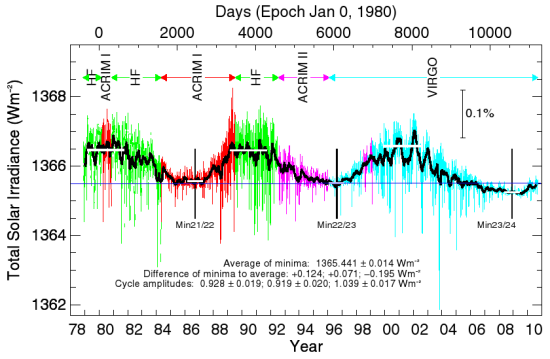
Once again, the evidence is building that the Sun might be heading towards the weakest maximum seen to two centuries. And when that happened, things got very cold on Earth.
Birthplace of the Sun?
In a preprint [pdf] posted today on the astro-ph website, astronomers outline the discovery of a star more like a twin of the Sun than any previously discovered. The star is located in the galactic star cluster M67, 3000 light years away. The similarity is so close that the scientists even speculate that the Sun itself might have formed in this same cluster, 4.5 billion years ago. Key quote from paper:
The similarity of the age and overall composition of the Sun with the corresponding data of M67, and in particular the agreement of the detailed chemical composition of the Sun with that of M67-1194, could suggest that the Sun has formed in this very cluster. According to the numerical simulations by Hurley et al. (2005) the cluster has lost more than 80% of its stars by tidal interaction with the Galaxy, in particular when passing the Galactic plane, and the Sun might be one of those. We note that the orbit of the cluster encloses, within its apocentre and pericentre, the solar orbit. However, the cluster has an orbit extending to much higher Galactic latitudes, presently it is close to its vertical apex at z = 0.41 kpc (Davenport & Sandquist 2010), while the Sun does not reach beyond z = 80 pc (Innanen, Patrick & Duley 1978). Thus, in order for this hypothesis of an M67 origin of the Sun to be valid, it must have been dispersed from the cluster into an orbit precisely in the plane of the Galactic disk, which seems improbable.
The last sentences above refer to the different orbital inclinations of the galactic orbits of both the Sun and M67. M67’s orbital inclination is far steeper. While M67 is presently about 1350 light years (410 parsecs) above the galactic plane, the Sun’s orbit never takes it more than 261 light years above the plane.
One more point of interest: M67 is a well known object to amateur astronomers, located in the constellation Cancer.
The sun influences the climate, admit the powers-that-be
Will wonders never cease? The sun actually does influence the climate, the powers-that-be admit at last.