
Sun unleashes its largest solar flare in years
The sun unleashed its largest solar flare in years on Tuesday.
The sun unleashed its largest solar flare in years on Tuesday.
Stand by for space weather: three coronal mass ejections were released by the sun in the past few days and are aimed directly at the earth. The first hit tonight, without doing much damage.
Though it is important to prepare for these solar storms, don’t expect them to do much harm. Power companies use the warnings to protect their grids. What you can expect is an increased chance of seeing the aurora at lower latitudes.
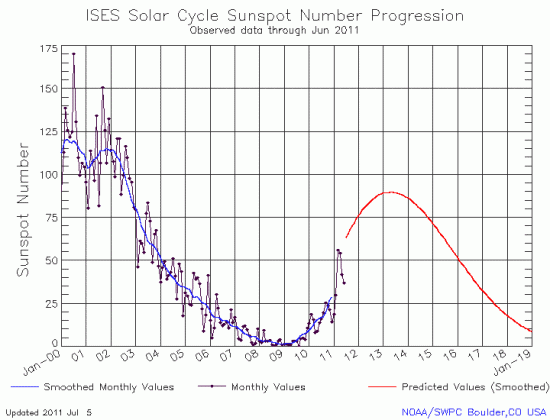
The monthly updated graph of the Sun’s solar cycle sunspot activity was released today by NOAA’s Space Weather Prediction Center. I have posted the June graph below.
For the third month in a row, there was a decline in sunspot activity. Though the sun is producing sunspots quite regularly and there hasn’t been a blank day since January 16, the numbers of sunspots continue to fall far below the predicted level of activity as indicated by the red line.
All this is no longer a surprise or unexpected. As the solar science community noted last month, they have now gathered enough data to convince them that the sun appears to be going quiet, and might even follow this very weak solar maximum — the weakest possibly in 200 years — with a decades-long period of no sunspots at all.
This graph, however, is very intriguing. Even with an expected weak solar minimum, the sun should be producing more sunspots each month, not less, as shown on the graph. This suggests that the most up-to-date predictions for the next solar maximum might still be too high.
It’s that time of year again, buckos. Every June, like clockwork, stories and op-eds like these start to flood the media:
Not surprisingly, these stories always happen about the same time our federal bureaucracy puts together a one day June propaganda event called the Space Weather Enterprise Forum, designed to sell to journalists the idea that we are all gonna die if we don’t spend gazillions of dollars building satellites for tracking the sun’s behavior. Along with this conference come numerous press releases, written by the conference’s backers. Here for example is a quote from a press release emailed to me and many journalists:
Recent activity on the Sun, captured in stunning imagery from the Solar Dynamics Observatory, and the resulting threat of significant radiation storms and radio blackouts here on Earth are vivid reminders of our need to better understand the science, improve our forecasts and warnings, and better prepare ourselves for severe space weather storms as the next solar maximum approaches.
The problem for these fear-mongers, however, is that shortly before their forum the scientists who actually study the sun held another press conference, where they laid out in exquisite detail the sun’s astonishing recent decline in activity, and how the next solar maximum will likely be the weakest in centuries and might very well be the last maximum we will see for decades to come.
In other words, the annual effort by government bureaucrats to drum up funding for more space weather facilities has collided head on with the facts.
That there are science journalists from so many major news organization so easily conned into buying this fear-mongering is pitiful enough. More significant, however, is the fact that this annual effort at crying wolf has not been very successful. For years Congress has not funded any new space weather satellites, and doesn’t appear ready to do so in the future, especially with the present budget crisis.
» Read more
The revelation last week that the sun is very likely about to go into a period of little or no sunspot activity has made a lot of global warming advocates, both scientists and journalists, very nervous. For years these climate activists have declared that the Earth’s climate is getting warmer, and that this warming trend was going to do us great harm. Putting aside whether these claims are based on fact (they are not), the possibility that the Earth might instead become cooler because of a dimming of the sun puts this political agenda under threat, and requires some form of immediate action to defuse that threat. See for example this short podcast (with full transcript) from Scientific American. The key quote:
A cooler sun might mean a drop in global average temperatures of at most 0.3 degree Celsius. But the carbon dioxide already in the atmosphere today will add 0.6 degree Celsius to global average temperatures by the end of the century. And more, since greenhouse gas emissions show no signs of diminishing. So the slightly cooler sun won’t counteract a much hotter Earth.
In order to discredit the threat that solar variation poses to global warming, the journalist here acts to minimize any danger from a dimming sun. Unfortunately, he does so by extrapolating a result (warmer climates) based on a very weak foundation: an unproven theory and our very limited knowledge of the climate.
» Read more
The Roman emperor Hadrian built his country estate with the buildings aligned with the sun.
For centuries, scholars have thought that the more than 30 buildings at Hadrian’s palatial country estate were oriented more or less randomly. But De Franceschini says that during the summer solstice, blades of light pierce two of the villa’s buildings.
In one, the Roccabruna, light from the summer solstice enters through a wedge-shaped slot above the door and illuminates a niche on the opposite side of the interior (see image). And in a temple of the Accademia building, De Franceschini has found that sunlight passes through a series of doors during both the winter and summer solstices.
An evening pause: As it appears these events are likely going to become less and less likely, let’s enjoy them while we can.
Note that the height of this eruption was almost twenty times the diameter of the Earth.
At a press conference today at the 2011 meeting of the Solar Physics Division (SPD) of the American Astronomical Society (AAS) in Las Cruces, New Mexico, solar scientists predicted that not only will the next solar maximum in 2013 be the weakest in centuries, it is very likely that it will be followed by another long Maunder Minimum, a period of decades without sunspots. “The sun may be going into hiatus,” says Dr. Frank Hill, associate director of the NSO’s Solar Synoptic Network. You can read the press releases for this announcement here and here.
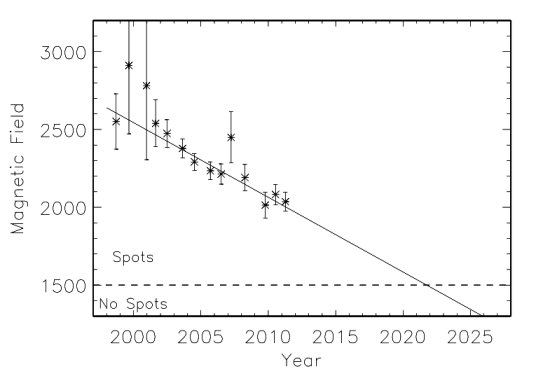
These conclusions are based on three lines of evidence:
Space weather expert downplays threat to Earth from solar flare.
My god, a reporter actually talked to a scientist on this subject, instead of the normal political hacks swilling for bigger budgets, and found out that we aren’t going to die!
Even in its relatively quiet state: The Sun has a blast.
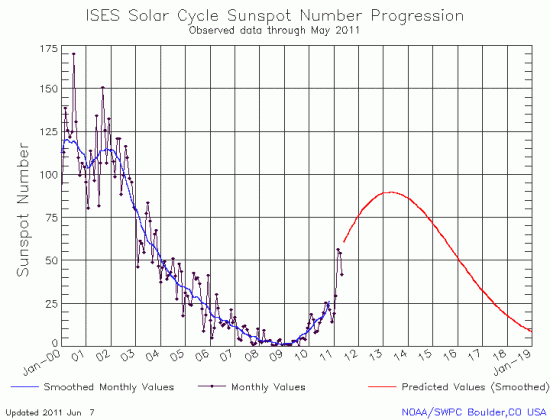
Time again for the monthly updated graph of the Sun’s solar cycle sunspot activity. Posted today by NOAA’s Space Weather Prediction Center, you can see the May results in the graph below.
After a three month steady rise in sunspot activity in January, February, and March, the numbers plummeted during April and May. Though the Sun remains active, with only one blank day since January 16, the pattern of activity as it ramps up to solar maximum continues to suggest that we are looking for the weakest solar maximum in two hundred years, as now predicted by solar scientists at the Marshall Space Flight Center.
Whether this weak maximum foreshadows another Maunder-like minimum, with no sunspots occurring for decades, remains unknown. Only time will tell. However, if such a thing should happen, it will be a marvelous opportunity for scientists to finally pin down precisely the actual influence of the Sun on the Earth’s climate. Up until now they can only guess at how much the Sun varies in brightness. Another Maunder Minimum will tell them.
Did a spotless sun cause the Little Ice Age after all?