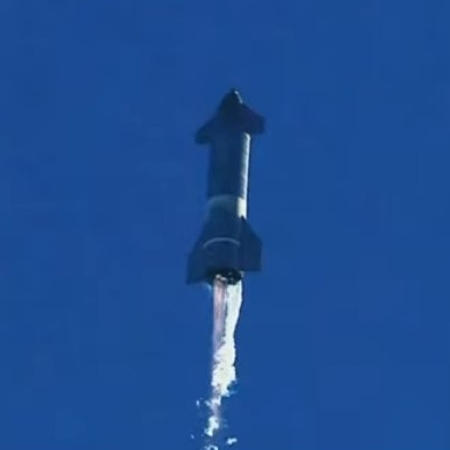
SpaceX in FCC filing outlines first orbital flight plan for Starship

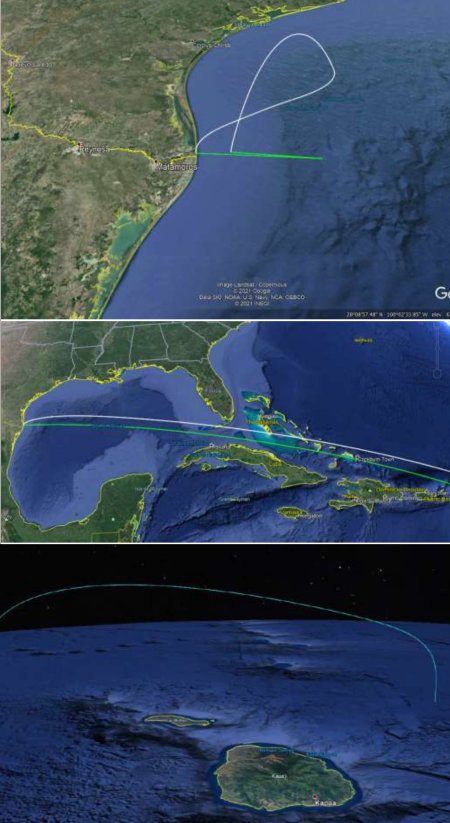
The flight plan for Starship's first orbital flight
Click for full images.

Capitalism in space: This week SpaceX filed the flight plan for the first orbital flight of its Starship/Superheavy rocket, taking off from Boca Chica and landing in the Pacific Ocean near Hawaii.

The images to the right are from the filing, which also states:

The Starship Orbital test flight will originate from Starbase, TX. The Booster stage will separate
approximately 170 seconds into flight. The Booster will then perform a partial return and land in the Gulf of Mexico approximately 20 miles from the shore. The Orbital Starship will continue on flying between the Florida Straits. It will achieve orbit until performing a powered, targeted landing approximately 100km (~62 miles) off the northwest coast of Kauai in a soft ocean landing.

No date is listed as yet, though the filing suggests they are aiming for a launch before the end of the year. It also appears that though both Starship and Superheavy will make controlled vertical landings, both will target locations in the ocean. It could be that SpaceX plans to place its two refurbished oil rigs at both of those locations, but this is not stated in the filing.

Achieving this flight before the end of the year remains a serious hill to climb, though if any company could do it, SpaceX is the most likely.
» Read more

8 comments

SLS core stage arrives in Florida

The core stage of NASA’s SLS rocket has arrived in Florida and has now begun the processing to get it ready for launch anywhere from six to ten months from now.

Approximately six months of work is anticipated to finish assembly and complete a long series of tests and checkouts of SLS and the Orion spacecraft it will send to the Moon, but current forecasts of this first-time integration work estimate closer to ten months to complete the necessary operations. After the vehicle is put together, weeks and weeks of testing to make sure SLS and Orion are properly talking to each other, as well as the EGS ground infrastructure, will follow.

…Recent schedules showed the remainder of work to reach launch readiness extending for ten months once the core stage arrived. That time includes six months of operations to the “work to” launch readiness and four months of “risk factor”. The “work to” launch readiness date, which would still have to synchronize to a lunar launch window, is currently early-November 2021. With risk factored in, a date of early-March 2022 is derived.

NASA has not yet changed that November ’21 target for launch, though all reports strongly suggest it cannot be met.

Regardless, even if they can get this thing launched by November, the long prep time shows once again how cumbersome and inefficient this rocket would be if anyone tried to use it to explore space. NASA says that after this first launch the prep time will be shorter, but even if it is trimmed to three months (the best estimate I’ve seen) it simply isn’t good enough. SpaceX has already demonstrated that is can fly two different Starship prototypes in less than thirty days (with #10 flying March 3rd and #11 flying March 30th). The company’s goal is many flights frequently, and it so far is proving that this goal will be achievable. And it will do it placing more payload in orbit for pennies (compared to the cost of SLS).

I still predict that there is a better than 50% chance that the first orbital launch of Starship/Superheavy will occur before SLS, even though the former began actual hardware development only two years ago.

I also think that we are now in the final stages of the entire SLS program. As with all similar big NASA-led rocket projects started since the mid-1980s, it will die stillborn. The previous projects never even got built after spending billions on blueprints and powerpoint presentations. SLS will likely get at least two flights (assuming nothing goes wrong with the first). After that NASA and the federal government will shut it down because by that time there will be far better and cheaper options available.

2 comments

Starship prototype #15 completes static fire test

Capitalism in space: SpaceX’s fifteenth Starship prototype successfully completed a static fire test yesterday, and the company is now hoping to do its first test flight this week, possibly as early as tomorrow.

Meanwhile, preparations continue for the first test launch of a Superheavy prototype, as well construction at Boca Chica of the orbital launchpad.

The Orbital Launch Site is a hive of activity, with work ranging from the installation of large GSE (Ground Support Equipment) tanks to continued work on the launch mount and launch and integration tower.

The latter has now started to rise into the air next to the mount, which is yet to receive its launch table.

When finished, the tower will be the tallest structure in the region, at nearly 152 meters — towering over the 120 meter tall, fully integrated Starship/Super Heavy stack. The Tower will eventually host a crane and, as crazy as it initially sounded when Elon revealed it, arms designed to catch the returning booster.

It is not yet clear what the test schedule for Superheavy will be leading to that first orbital launch. They will likely fly a prototype on a hop first, then fly it with Starship stacked above. SpaceX however has not said exactly what its plans are, and even if it had, the company has been quite willing to revise those plans should it decide a change is advisable.

0 comments

SpaceX leases bigger space at LA port for processing Falcon 9 boosters after launch

Capitalism in space: According to the mayor of Los Angeles, SpaceX has signed a new lease for more space at the city’s port, taking over the facilities no longer used by Sea Launch’s floating launch platform that is now in Russia.

News of the port lease broke on April 26th with a tweet from the mayor of Long Beach, California after the Port of Long Beach (POLB) Commission voted to approve SpaceX’s 24-month sublease with an effective start date of May 1st, 2021. From 2014 to 2020, a massive floating rocket launch complex and associated service ships once used by SeaLaunch called POLB’s Pier 16 home while mothballed and the company left behind a decent amount of infrastructure when it vacated the facility last year.

That includes a ~5600 square meter (~65,000 sq ft) warehouse and office space formerly used to process SeaLaunch payloads and Ukrainian Zenit rockets, as well as a pier and dock space generally optimized for loading and unloading large rockets from rocket transport ships. In other words, Pier 16 is a perfect fit for SpaceX’s needs.

SpaceX has twice before signed similar leases and then canceled them. Now it appears the deal is more firm, as the company appears to be gearing up for regular Starlink satellite launches from Vandenberg, requiring a bigger need in LA for processing Falcon 9 first stage boosters after launch.

I wonder too if this deal might be in connection with Starship and the two used floating oil rigs that SpaceX now owns and is refitting as Superheavy/Starship launch and landing pads. This LA facility would be ideal for these ocean platforms before and after launch.

8 comments

SpaceX wins competition to build Artemis manned lunar lander, using Starship

Starship prototype #8 on first flight test
Starship prototype #8 on its first flight test,
December 2020

Capitalism in space: NASA has just announced that it has chosen SpaceX to build the Artemis manned lunar lander, using Starship.

The award, a $2.9 billion fixed price contract, also requires SpaceX to complete an unmanned demo lunar landing with Starship that also returns to Earth, before it lands NASA astronauts on the Moon. The contract also still retains the goal to get this to happen by 2024, though NASA official emphasized that they will only launch when ready.

After these flights the agency says it will open bidding again to the entire industry, which means that others are now being challenged to come up with something that can beat SpaceX in the future.

Nonetheless, the contract award was a surprise, as NASA originally intended to pick two teams to provide redundancy and encourage competition. Instead, the agency completely bypassed lunar landers proposed by Dynetics and a team led by Blue Origin that included Lockheed Martin and Draper.

Even more significantly, though NASA explained in the telecon that they still plan to use SLS and Orion to bring astronauts to Gateway, who will then be picked up by Starship for the landing, this decision is a major rejection of the Space Launch System (SLS), since Starship will not use it to get to the Moon, while the other two landers required it.

In fact, this decision practically makes SLS unnecessary in the Artemis program, as NASA has also awarded SpaceX the contract for supplying cargo to the Lunar Gateway station as well as launching its first two modules, using Dragon capsules and Falcon Heavy. SLS is still slated to launch Orion to Gateway, but Starship can replace Orion as well, since Starship is being designed to carry people from Earth to the Moon. This makes SLS and Orion essentially unneeded, easily abandoned once Starship starts flying.

NASA’s decision also means the Biden administration is willing to use its clout to push for Starship over SLS in Congress, which has favored SLS for years because of the pork it brings to their states and congressional districts. They apparently think that Congress is now ready to risk the end of SLS if it comes with a new program that actually accomplishes something. These developments firmly confirm my sense from February that the political winds are bending away from SLS.

This decision is also a major blow to Blue Origin and the older big space companies that Jeff Bezos’ company partnered with. Their dependence on the very costly and cumbersome SLS rocket meant that their ability to launch on a schedule and cost desired by NASA was severely limited. NASA looked at the numbers, and decided the time was right to go with a more radical system. As was noted by one NASA official during the press teleconference, “NASA is now more open to innovation.”

Based on the details announced during the announcement, NASA was especially drawn to Starship’s payload capability to bring a large payload to the Moon, at the same time it brings humans there as well. It also appears SpaceX’s recent track record of success also added weight to their bid.

53 comments

SpaceX raises another $1.16 billion in private capital

Capitalism in space: In a regulatory filing yesterday SpaceX revealed that it raised another $1.16 billion in private investment capital in just the past two months.

This follows two other recent financing rounds since August of last year in which SpaceX raised almost $3 billion. That makes $4 billion raised in eight months. All told, I think this brings the total private investment capital SpaceX has raised in the past two years to approximately $6 billion, all for building both the Starlink satellite constellation and the Starship/Superheavy rocket.

Not only does this give SpaceX ample cash to build both, it signals the growing faith big money investors have in the company’s plans. They have bought into Elon Musk’s dreams because he has proven that his dreams deliver, not only in exciting space ventures but in profits.

This fund-raising success also tells us that even if Starship does not reach orbit before SLS, it will very soon eclipse it entirely. It has the money now to get built, and the way SpaceX builds things, it will get built fast.

0 comments
1 25 26 27