Astronomers confirm Webb galaxies from the early universe

Astronomers using Webb have now confirmed with spectroscopy the age of at least four galaxies from the very very early universe, existing only a short time after the theorized Big Bang.

Four of the galaxies studied are particularly special, as they were revealed to be at an unprecedentedly early epoch. The results provided spectroscopic confirmation that these four galaxies lie at redshifts above 10, including two at redshift 13. This corresponds to a time when the universe was approximately 330 million years old, setting a new frontier in the search for far-flung galaxies. These galaxies are extremely faint because of their great distance from us.

The scientists had aimed Webb at Hubble’s Ultra Deep Field, doing a long infrared exposure lasting 28 hours over three days in order to gather the faintest infrared radiation (that Hubble could not see) and thus the most distant galaxies. The spectrum of individuals stars was then measured, which indicating their redshift and their estimated age.

The astronomers will next aim Webb at the more famous Hubble Deep Field, the first such long exposure that optical telescope took back in the late 1990s.

1 comment

Webb’s infrared view of the Southern Ring Nebula

Two views of Southern Ring Nebula by Webb
Click for original image.

The two images to the left were produced by the Webb Space Telescope, showing in false colors the Southern Ring Nebula as seen by two of Webb’s infrared cameras.

The two images shown here each combine near-infrared and mid-infrared data to isolate different components of the nebula. The image at [top] highlights the very hot gas that surrounds the central stars. The image at [bottom] traces the star’s scattered molecular outflows that have reached farther into the cosmos.

Based on the data, astronomers posit that up the system could have as many as five stars orbiting each other, with three as yet unseen, or the inner ones might no longer exist, having been absorbed by the bigger stars.

It’s possible more than one star interacted with the dimmer of the two central stars, which appears red in this image, before it created this jaw-dropping planetary nebula. The first star that “danced” with the party’s host created a light show, sending out jets of material in opposite directions. Before retiring, it gave the dim star a cloak of dust. Now much smaller, the same dancer might have merged with the dying star – or is now hidden in its glare.

A third partygoer may have gotten close to the central star multiple times. That star stirred up the jets ejected by the first companion, which helped create the wavy shapes we see today at the edges of the gas and dust. Not to be left out, a fourth star with an orbit projected to be much wider, also contributed to the celebration. It circled the scene, further stirring up the gas and dust, and generating the enormous system of rings seen outside the nebula. The fifth star is the best known – it’s the bright white-blue star visible in the images that continues to orbit predictably and calmly.

Much of this remains mere theory, based on the available data. Nonetheless, the data from many such planetary nebula continues to suggest their strange and wonderful shapes are created by multiple stars, acting as a mix-master to churn up the nebula’s dust.

0 comments

Webb and Keck telescopes track clouds on Titan

Clouds on Titan
Click for original image.

Astronomers have used the Webb Space Telescope and the Keck Observatory in Hawaii to take infrared images days apart of the evolving clouds on the Saturn moon Titan.

The false-color infrared images to the right are those observations. From the press release:

As part of their investigation of Titan’s atmosphere and climate, Nixon’s team used JWST’s Near-Infrared Camera (NIRCam) to observe the moon during the first week of November. After seeing the clouds near Kraken Mare, the largest known liquid sea of methane on the surface of Titan, they immediately contacted the Keck Titan Observing Team to request follow-up observations.

“We were concerned that the clouds would be gone when we looked at Titan a day later with Keck, but to our delight there were clouds at the same positions on subsequent observing nights, looking like they had changed in shape,” said Imke de Pater, emeritus professor of astronomy at the University of California, Berkeley, who leads the Keck Titan Observing Team.

Using Keck Observatory’s second generation Near-Infrared Camera (NIRC2) in combination with the Keck II Telescope’s adaptive optics system, de Pater and her team observed one of Titan’s clouds rotating into and another cloud either dissipating or moving out of Earth’s field of view due to Titan’s rotation.

These images only increase my mourning for a Saturn orbiter. Since the end of Cassini’s mission in 2017, we have essentially been blind to the ringed planet and its many moons. These images, while producing excellent data, also illustrate well what we have lost.

0 comments

Webb makes its first detailed survey of an exoplanet’s atmosphere

Astronomers have now completed the first detailed survey of an exoplanet’s atmosphere using the Webb Space Telescope, looking at a gas giant about one third the mass of Jupiter about 700 light years away.

Using three of its instruments, JWST was able to observe light from the planet’s star as it filtered through WASP-39b’s atmosphere, a process known as transmission spectroscopy. This allowed a team of more than 300 astronomers to detect water, carbon monoxide, sodium, potassium and more in the planet’s atmosphere, in addition to the carbon dioxide. The gives the planet a similar composition to Saturn, although it has no detectable rings.

The team were also surprised to detect sulfur dioxide, which had appeared as a mysterious bump in early observation data. Its presence suggests a photochemical reaction is taking place in the atmosphere as light from the star hits it, similar to how our Sun produces ozone in Earth’s atmosphere. In WASP-39b’s case, light from its star, slightly smaller than the Sun, splits water in its atmosphere into hydrogen and hydroxide, which reacts with hydrogen sulfide to produce sulfur dioxide.

The data also suggested the clouds in the atmosphere are patchy, and that the planet’s formation process was not exactly as predicted.

These observations are part of a program to study 70 exoplanets during Webb’s first year of operation, using its infrared capabilities to get spectroscopy not possible in other wavelengths.

0 comments

Webb finding more galaxies in early universe than expected

The uncertainty of science: Astronomers using the Webb Space Telescope are finding in very early universe many more galaxies that are also far more developed then had been predicted.

The Webb observations nudge astronomers toward a consensus that an unusual number of galaxies in the early universe were so much brighter than expected. This will make it easier for Webb to find even more early galaxies in subsequent deep sky surveys, say researchers.

“We’ve nailed something that is incredibly fascinating. These galaxies would have had to have started coming together maybe just 100 million years after the big bang. Nobody expected that the dark ages would have ended so early,” said Garth Illingworth of the University of California at Santa Cruz, a member of the Naidu/Oesch team. “The primal universe would have been just one hundredth its current age. It’s a sliver of time in the 13.8 billion-year-old evolving cosmos.”

Erica Nelson of the University of Colorado in Boulder, a member of the Naidu/Oesch team, noted that “our team was struck by being able to measure the shapes of these first galaxies; their calm, orderly disks question our understanding of how the first galaxies formed in the crowded, chaotic early universe.”

The galaxies are smaller, more compact than present day galaxies, and appear to be forming stars at a tremendous rate. Because their distances, presently estimated, still need to be confirmed by spectroscopy, these conclusions remain somewhat tentative though quite alluring.

We should not be surprised if in the next two years data from Webb will overturn almost all the theories that presently exist about the Big Bang and its immediate aftermath.

2 comments

Webb’s mid-infrared instrument restored to full operations

Engineers have figured out the issue on the mid-infrared instrument on the Webb Space Telescope that was causing increased friction during operations, and are now ready to return it to full operations.

The team concluded the issue is likely caused by increased contact forces between sub-components of the wheel central bearing assembly under certain conditions. Based on this, the team developed and vetted a plan for how to use the affected mechanism during science operations.

An engineering test was executed Wednesday, Nov. 2, that successfully demonstrated predictions for wheel friction. Webb will resume MIRI MRS science observations by Saturday, Nov. 12.

Webb has three other infrared instruments, looking at different infrared wavelengths, so this issue had not prevented the telescope from doing most of its observations. Losing MIRI however would have been a very bad blow, this soon after launch.

0 comments

Rate of micrometeorite impacts on Webb holding as expected

According to this Space.com article, the rate and size of micrometeorite impacts on the main mirror of the Webb Space Telescope has held steady at the rate and size expected, since the first surprisingly large micrometeorite impact in May that slightly dinged one mirror segment.

At this point, JWST has experienced a total of 33 micrometeoroid events, according to Smith’s slides. But the most damaging one came before JWST began science observations; in late May, a particularly large micrometeoroid struck the observatory’s mirror, leaving its mark on one golden hexagon. The team estimates that a strike of that size should occur about once a year, Smith said.

“So we got that at month five,” he said. “We haven’t seen another one yet, so it’s still consistent with the statistics that we expected.”

Smith noted that, at the current impact rate, Webb will still be meeting its five-year performance requirement 10 years into the mission. Scientists estimate that the observatory has enough fuel to operate for 20 years.

Meanwhile, one of Webb’s infrared cameras is not doing spectroscopy as engineers analyze the high levels of friction in a “grating wheel.” At this point it appears they still do not understand the cause of the friction, and thus have not come up with a plan for mitigating it.

0 comments

Webb takes infrared image of Hubble’s Pillars of Creation

The Pillars of Creation, as seen by Hubble and Webb
Click for original image.

Not unexpectedly, astronomers have quickly begun aiming the Webb Space Telescope’s infrared eye at some of the most famous targets previously imaged in optical wavelengths by the Hubble Space Telescope.

The newest example is shown to the right and reduced and labeled to post here. It shows what NASA officials dubbed “The Pillars of Creation” when Hubble first photographed this nebula in 1995, with a later 2014 Hubble optical image at the top and the new 2022 Webb infrared image on the bottom. From this image’s caption:

A new, near-infrared-light view from NASA’s James Webb Space Telescope, at [bottom], helps us peer through more of the dust in this star-forming region. The thick, dusty brown pillars are no longer as opaque and many more red stars that are still forming come into view.

While the pillars of gas and dust seem darker and less penetrable in Hubble’s view [top], they appear more diaphanous in Webb’s. The background of this Hubble image is like a sunrise, beginning in yellows at the bottom, before transitioning to light green and deeper blues at the top. These colors highlight the thickness of the dust all around the pillars, which obscures many more stars in the overall region.

In contrast, the background light in Webb’s image appears in blue hues, which highlights the hydrogen atoms, and reveals an abundance of stars spread across the scene. By penetrating the dusty pillars, Webb also allows us to identify stars that have recently – or are about to – burst free. Near-infrared light can penetrate thick dust clouds, allowing us to learn so much more about this incredible scene.

While the Hubble colors attempt to mimic the colors seen by the human eye, the colors in the Webb image are all false colors, chosen by the scientists to distinguish the different infrared wavelengths produced by different features in the picture.

2 comments

Shells of dust surrounding massive binary star

Webb infrared image of dust shells surrounding binary star system
Click for full image.

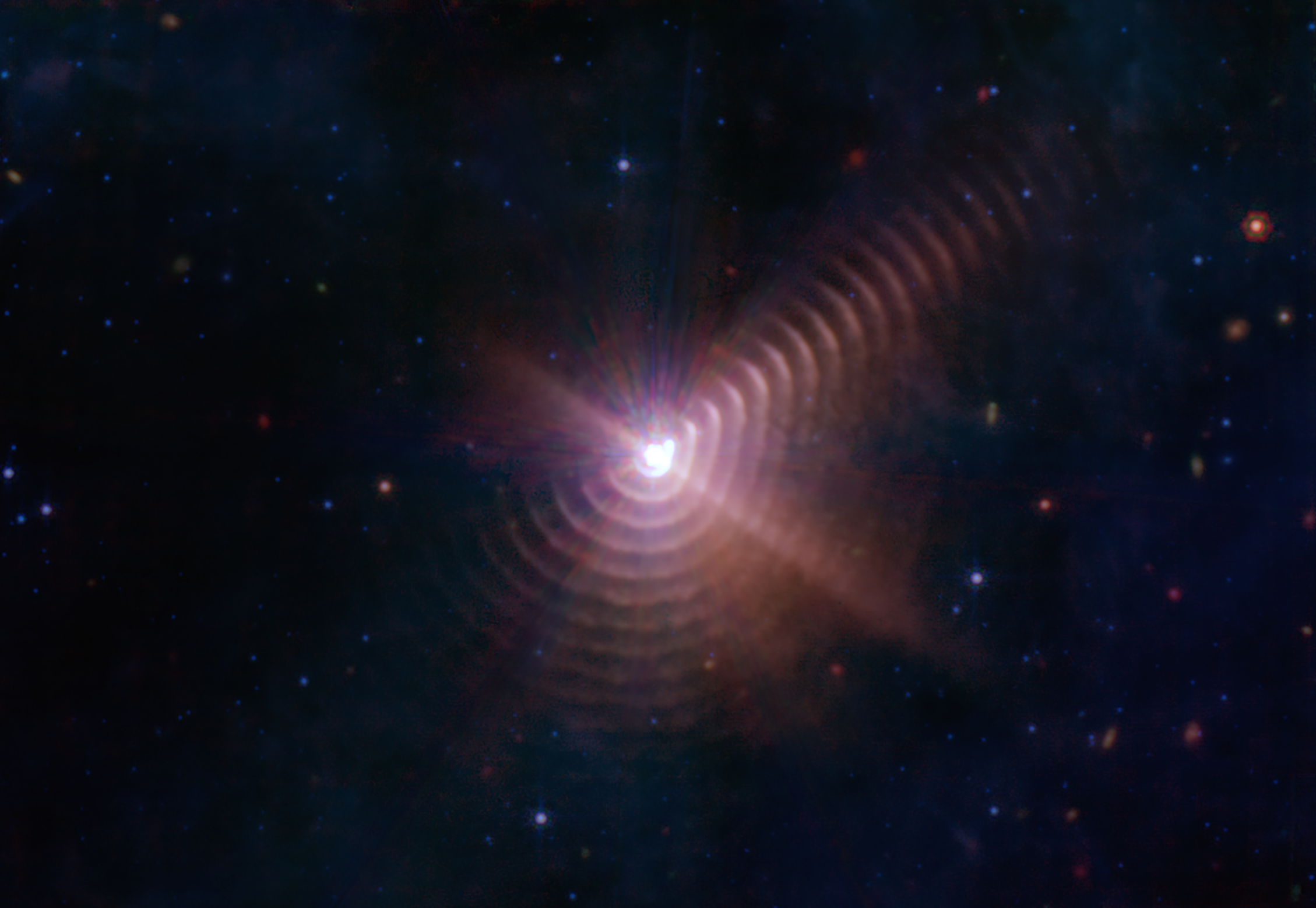
Cool image time! Using the Webb telescope, astronomers have detected a series of concentric shells surrounding the massive binary star dubbed Wolf-Rayet 140.

The infrared image to the right shows these shells quite clearly. As noted by astronomer Ryan Lau:

“On the night that my team’s Early Release Science observations of the dust-forming massive binary star Wolf-Rayet (WR) 140 were taken, I was puzzled by what I saw in the preview images from the Mid-Infrared Instrument (MIRI). There seemed to be a strange-looking diffraction pattern, and I worried that it was a visual effect created by the stars’ extreme brightness. However, as soon as I downloaded the final data I realized that I was not looking at a diffraction pattern, but instead rings of dust surrounding WR 140 – at least 17 of them.

“I was amazed. Although they resemble rings in the image, the true 3D geometry of those semi-circular features is better described as a shell. The shells of dust are formed each time the stars reach a point in their orbit where they are closest to each other and their stellar winds interact. The even spacing between the shells indicates that dust formation events are occurring like clockwork, once in each eight-year orbit. In this case, the 17 shells can be counted like tree rings, showing more than 130 years of dust formation. Our confidence in this interpretation of the image was strengthened by comparing our findings to the geometric dust models by Yinuo Han, a doctoral student at the University of Cambridge, which showed a near-perfect match to our observations.

Furthermore, the spectroscopy from Webb says these dust shells are carbon-enriched, showing that the dust released by these aged massive stars is a significant source of the carbon in the universe, the fundamental atom needed for life.

5 comments

Chandra takes an X-ray look at early Webb infrared observations

Chandra's X-ray vision of the Cartwheel Galaxy
Chandra’s X-ray view of the Cartwheel Galaxy

Webb's view of the Cartwheel Galaxy
Webb’s infrared view of the Cartwheel Galaxy
Click for full image.

Hubble's optical view of the Cartwheel Galaxy
Hubble’s optical view of the Cartwheel Galaxy. Click for original image.

Astronomers have now taken X-ray images using the orbital Chandra X-ray Observatory of four of the first Webb Space Telescope observations. The four targets were the Cartwheel Galaxy, Stephan’s Quintet, galaxy cluster SMACS 0723.3–7327, and the Carina Nebula.

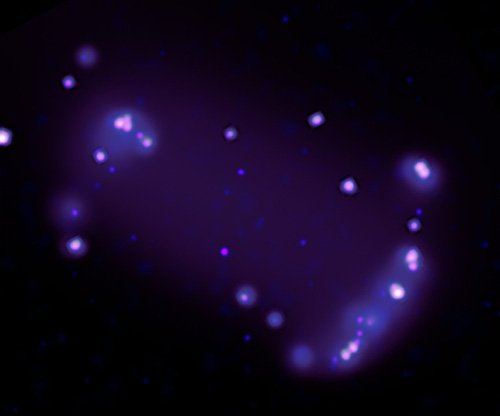
The three images to the right illustrate the importance of studying astronomy across the entire electromagnetic spectrum. Each shows the Cartwheel Galaxy as seen by three of the world’s most important space-based telescopes, each looking at the galaxy in a different wavelength.

The top picture is Chandra’s new X-ray observations. As the press release notes,

Chandra data generally show higher-energy phenomena (like superheated gas and the remnants of exploded stars) than Webb’s infrared view. … X-rays seen by Chandra (blue and purple) come from superheated gas, individual exploded stars, and neutron stars and black holes pulling material from companion stars.

The middle picture was produced by Webb, shortly after the start of its science operations. It looks at the galaxy in the infrared.

In this near- and mid-infrared composite image, MIRI data are colored red while NIRCam data are colored blue, orange, and yellow. Amidst the red swirls of dust, there are many individual blue dots, which represent individual stars or pockets of star formation. NIRCam also defines the difference between the older star populations and dense dust in the core and the younger star populations outside of it.

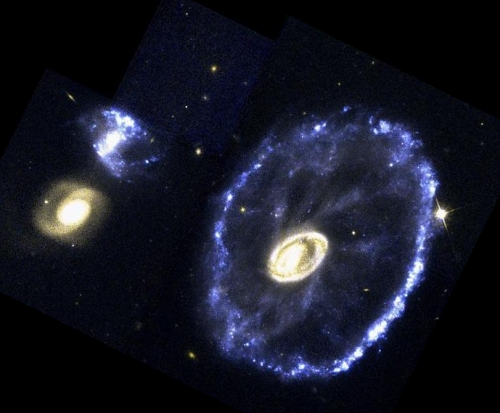
The bottom picture was taken by the Hubble Space Telescope in 1995. I have rotated the image to match the others. It looks at the galaxy in optical wavelengths, the wavelengths that our eyes perceive.

Note how bright the central galactic region is in the infrared and optical, but is invisible in X-rays. Chandra is telling us that all the most active regions in the Cartwheel are located in that outer ring, not in its center.

2 comments

Initial Webb results revised because telescope wasn’t yet fully calibrated

The uncertainty of science: Though it appears that no results will have to be abandoned, the scientists who published some of the very first results from the Webb Space Telescope have been scrambling to adjust and revise their papers because the telescope is only now getting fully calibrated.

“This caused a little bit of panic,” says Nathan Adams, an astronomer at the University of Manchester, UK, who, along with his colleagues, pointed out the problem in a 9 August update to a preprint they had posted in late July3. “For those including myself who had written a paper within the first two weeks, it was a bit of — ‘Oh no, is everything that we’ve done wrong, does it all need to go in the bin?’”

To try to standardize all the measurements, the STScI is working through a detailed plan to point Webb at several types of well-understood star, and observe them with every detector in every mode for every instrument on the telescope4. “It just takes a while,” says Karl Gordon, an astronomer at the STScI who helps lead the effort.

In the meantime, astronomers have been reworking manuscripts that describe distant galaxies on the basis of Webb data. “Everyone’s gone back over and had a second look, and it’s not as bad as we thought,” Adams says. Many of the most exciting distant-galaxy candidates still seem to be at or near the distance originally estimated. But other preliminary studies, such as those that draw conclusions about the early Universe by comparing large numbers of faint galaxies, might not stand the test of time. Other fields of research, such as planetary studies, are not affected as much because they depend less on these preliminary brightness measurements.

Overall, it does not appear the more precise calibrations will change much of signficance, since most of the earliest observations were simply that, observations, not theoretical. Because the distance estimates remain largely unchanged however the theorists are left with the same conundrum: The age and apparent nature of the most distant objects does not seem to fit with what the theories had predicted Webb would see.

1 comment

Hubble & Webb make first coordinated observations, tracking DART impact of Dimorphus

Webb and Hubble together look at DART impact of Dimorphus
Click for full image.

For the first time scientists have used both the Hubble Space Telescope and the James Webb Space Telescope to observe the same astronomical event, in this case the impact of the DART spacecraft on the asteroid Dimorphus on September 26, 2022.

The two images to the right show the asteroid several hours after impact. Both telescopes also captured images before the impact as well. From the press release:

Observations from Webb and Hubble together will allow scientists to gain knowledge about the nature of the surface of Dimorphos, how much material was ejected by the collision, and how fast it was ejected. Additionally, Webb and Hubble captured the impact in different wavelengths of light – Webb in infrared and Hubble in visible. Observing the impact across a wide array of wavelengths will reveal the distribution of particle sizes in the expanding dust cloud, helping to determine whether it threw off lots of big chunks or mostly fine dust. Combining this information, along with ground-based telescope observations, will help scientists to understand how effectively a kinetic impact can modify an asteroid’s orbit.

When Webb was first conceived in the late 1990s, it was exactly for this reason, to combine Hubble’s optical vision with Webb’s infrared view. Though more than a decade late, it has finally happened.

It will be months before scientists begin to decipher the data produced by all the telescopes and spacecraft used to observe the DART impact. What we are seeing now are merely hints at what has been learned.

10 comments
1 5 6 7