The uncertainty of science as proven by the Webb Space Telescope

A long detailed article was released today at Space.com, describing the many contradictions in the data coming back from the Webb Space Telescope that seriously challenge all the theories of cosmologists about the nature of the universe as well as its beginning in a single Big Bang.

The article is definitely worth reading, but be warned that it treats science as a certainty that should never have such contradictions, as illustrated first by its very headline: “After 2 years in space, the James Webb Space Telescope has broken cosmology. Can it be fixed?”

“Science” isn’t broken in the slightest. All Webb has done is provide new data that does not fit the theories. As physicist Richard Feynman once stated bluntly in teaching students the scientific method,

“It doesn’t make a difference how beautiful your guess is, it doesn’t make a difference how smart you are, who made the guess, or what his name is. If it disagrees with experiment, it’s wrong.”

Cosmologists for decades have been guessing in proposing their theories about the Big Bang, the expansion of the universe, and dark matter, based on only a tiny amount of data that had been obtained with enormous assumptions and uncertainties. It is therefore not surprising (nor was it ever surprising) that Webb has blown holes in their theories.

For example, the article spends a lot of time discussing the Hubble constant, describing how observations using different instruments (including Webb) have come up with two conflicting numbers for it — either 67 or 74 kilometers per second per megaparsec. No one can resolve this contradiction. No theory explains it.

To me the irony is that back in the 1990s, when Hubble made its first good measurements of the Hubble constant, these same scientists were certain then that the number Hubble came up with, around 90 kilometers per second per megaparsec, was now correct.

They didn’t really understand reality then, and they don’t yet understand it now.

What cosmologists must do is back away from their theories and recognize the vast areas of ignorance that exist. Once that is done, they might have a chance to resolve the conflict between the data obtained and the theories proposed, and come up with new theories that might work (with great emphasis on the word “might”). Complaining about the paradoxes will accomplish nothing.

7 comments

The nearest star-forming region, as seen in infrared by Webb

The nearest star-forming region, as seen by Webb
Click for original image.

Time for another cool image on this somewhat quiet Monday. The false-color infrared image to the right, reduced and sharpened to post here, was taken by the Webb Space Telescope, and shows the Rho Ophiuchi star-forming region, the nearest to our solar system at a distance of about 460 light years.

It is a relatively small, quiet stellar nursery, but you’d never know it from Webb’s chaotic close-up. Jets bursting from young stars crisscross the image, impacting the surrounding interstellar gas and lighting up molecular hydrogen, shown in red. Some stars display the telltale shadow of a circumstellar disc, the makings of future planetary systems.

The young stars at the centre of many of these discs are similar in mass to the Sun or smaller. The heftiest in this image is the star S1, which appears amid a glowing cave it is carving out with its stellar winds in the lower half of the image. The lighter-coloured gas surrounding S1 consists of polycyclic aromatic hydrocarbons, a family of carbon-based molecules that are among the most common compounds found in space.

There are two features that are most compelling to me in this image. First, the red hydrogen jet that cuts across the entire right half of the image from top to bottom. At the top you can see how that jet is pushing material before it. Second, we have the cave-like structure surround S1, the central star. The yellowish cloud is almost like a hand cupped around that star.

6 comments

Webb takes another infrared image of Uranus

Uranus as seen in infrared by Webb
Click for original image. Go here for Uranus close-up

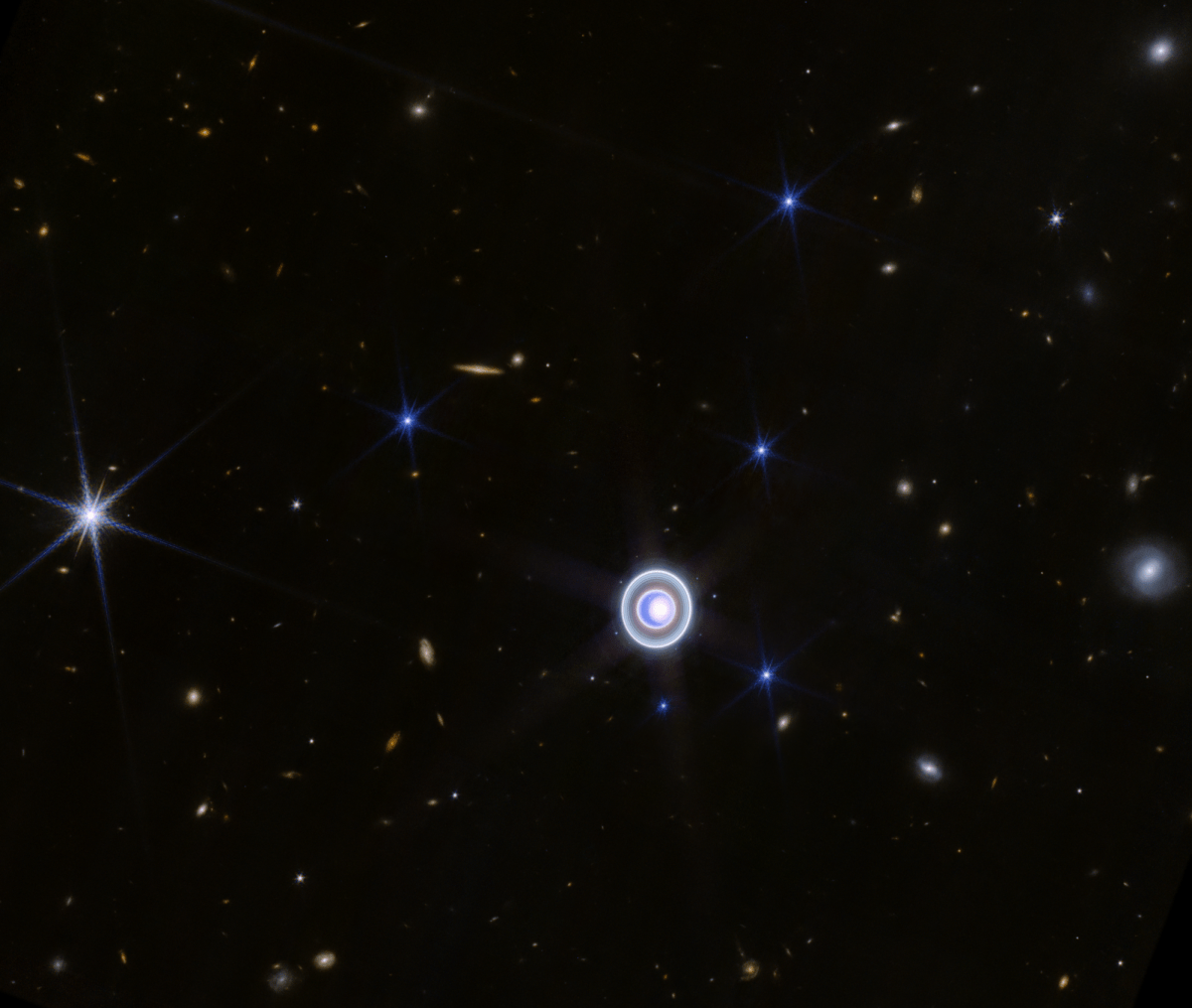
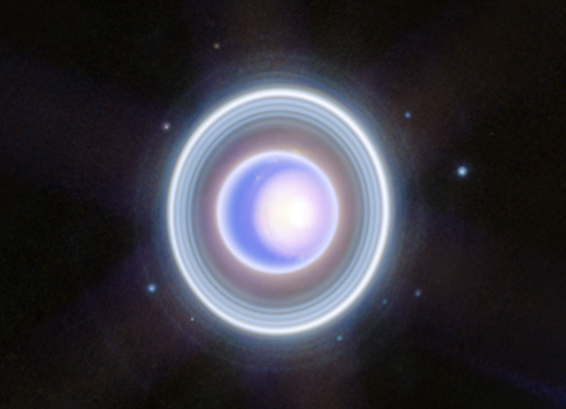
Astronomers have used the Webb Space Telescope to take another infrared image of Uranus, following up on earlier observations with Webb in April.

The new false-color infrared picture is to the right, cropped, reduced, and enhanced to post here. Though the close-up of Uranus is in the left corner, the overall view is somewhat wider than the image I highlighted previously, showing many background galaxies and at least one star. The star is the spiked bright object on the left. In false color the galaxies all been given an orange tint, while the blue objects near Uranus are its moons. Because Uranus’s rotational tilt is so extreme, 98 degrees compared to Earth’s 23 degrees, its north pole is presently facing the Sun directly, and is in the center here.

One of the most striking of these is the planet’s seasonal north polar cloud cap. Compared to the Webb image from earlier this year, some details of the cap are easier to see in these newer images. These include the bright, white, inner cap and the dark lane in the bottom of the polar cap, toward the lower latitudes. Several bright storms can also be seen near and below the southern border of the polar cap. The number of these storms, and how frequently and where they appear in Uranus’s atmosphere, might be due to a combination of seasonal and meteorological effects.

The polar cap appears to become more prominent when the planet’s pole begins to point toward the Sun, as it approaches solstice and receives more sunlight. Uranus reaches its next solstice in 2028, and astronomers are eager to watch any possible changes in the structure of these features. Webb will help disentangle the seasonal and meteorological effects that influence Uranus’s storms, which is critical to help astronomers understand the planet’s complex atmosphere.

If you want to see what Uranus looks like to our eyes, check out the Hubble pictures taken in 2014 and 2022. Though fewer features are visible in optical wavelengths, those two images showed long term seasonal changes.

Webb has now revealed some shorter term changes.

1 comment

Webb takes infrared false-color image of supernova remnant Cassiopeia A

Cass A in infrared
Click for original image.

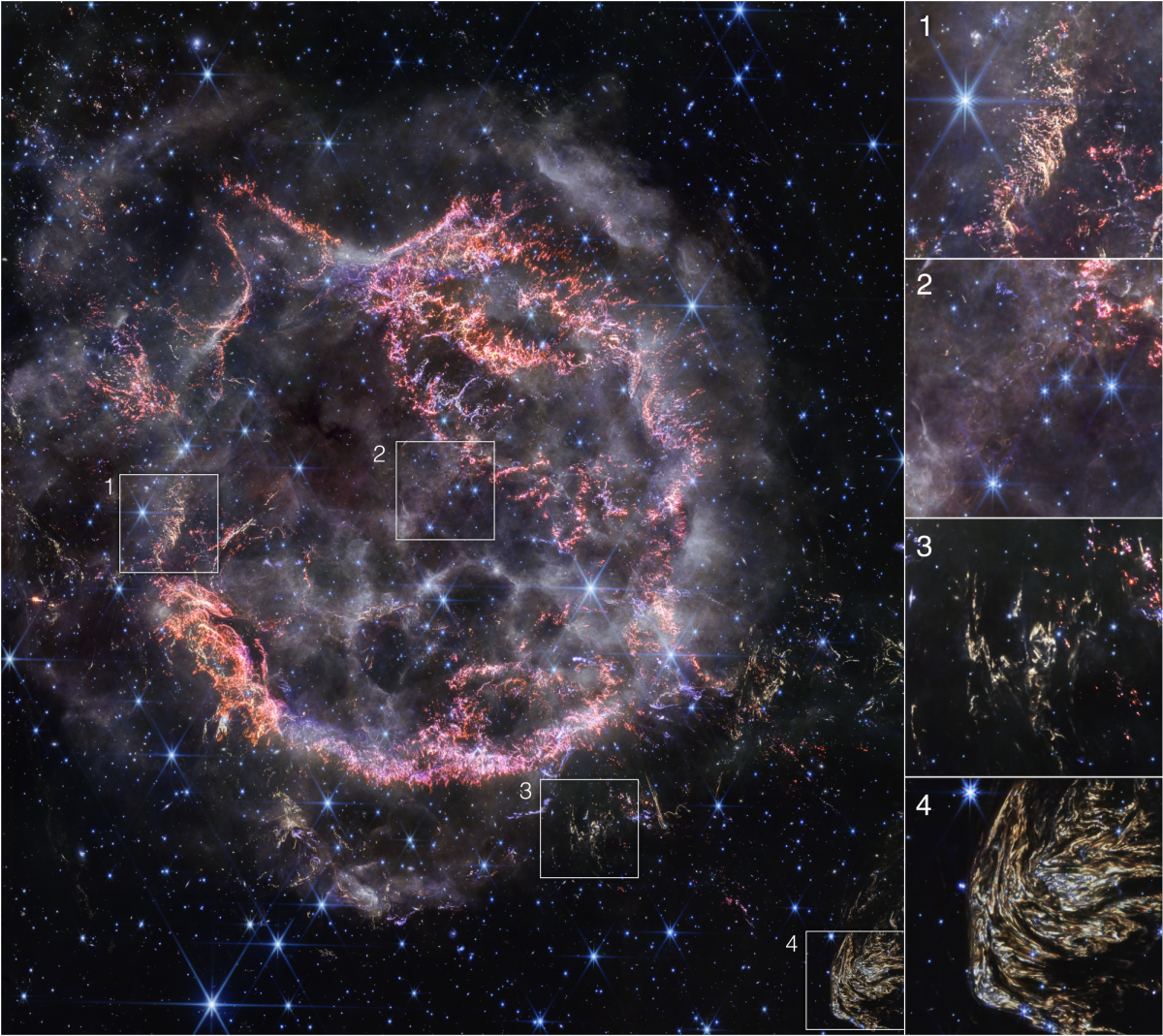
Using the Webb Space Telescope, astronomers have obtained the first wide full infrared view of the supernova remnant Cassiopeia A, the remains of a supernova that occurred about 11,000 years ago. That image is to the right, reduced to post here.

The most noticeable colors in Webb’s newest image are clumps represented in bright orange and light pink that make up the inner shell of the supernova remnant. Webb’s razor-sharp view can detect the tiniest knots of gas, comprised of sulfur, oxygen, argon, and neon from the star itself. Embedded in this gas is a mixture of dust and molecules, which will eventually become components of new stars and planetary systems. Some filaments of debris are too tiny to be resolved by even Webb, meaning they are comparable to or less than 10 billion miles across (around 100 astronomical units). In comparison, the entirety of Cas A spans 10 light-years across, or 60 trillion miles.

…When comparing Webb’s new near-infrared view of Cas A with the mid-infrared view, its inner cavity and outermost shell are curiously devoid of color. The outskirts of the main inner shell, which appeared as a deep orange and red in the MIRI image, now look like smoke from a campfire. This marks where the supernova blast wave is ramming into surrounding circumstellar material. The dust in the circumstellar material is too cool to be detected directly at near-infrared wavelengths, but lights up in the mid-infrared.

The four rectangles mark specific features of particular interest, with #4, dubbed by the scientists Baby Cas, the most intriguing.

This is a light echo, where light from the star’s long-ago explosion has reached and is warming distant dust, which is glowing as it cools down. The intricacy of the dust pattern, and Baby Cas A’s apparent proximity to Cas A itself, are particularly intriguing to researchers. In actuality, Baby Cas A is located about 170 light-years behind the supernova remnant.

By comparing this infrared view with Hubble’s optical and Chandra’s X-ray views, astronomers will be able to better decipher Cas A’s make-up and geometry.

0 comments

Webb: Needles scattered near the center of the Milky Way

Needles in space
Click for original image.

Scientists today released a new false-color infrared image taken by the Webb Space Telescope of a region about 300 light years from the center of the Milky Way, dubbed Sagittarius-C. That picture is to the right, cropped, reduced and sharpened to post here. The blue or cyan regions are ionized hydrogen clouds, and with this image were revealed to be much more extensive than expected. The orange blob near the center is a densely packed cluster of protostars, the starlight blocked by the cloud of material.

The most interesting feature however are the needle-like structures within that ionized hydrogen, oriented in all directions in a manner that looks completely random. Though such needles have been seen previously, the data here is far more detailed, and might eventually help astronomers figure out what the heck these features are and what caused them.

5 comments

An infrared view of the Crab Nebula by Webb

Webb's image of the Crabb compared to Hubble's
Click for original image.

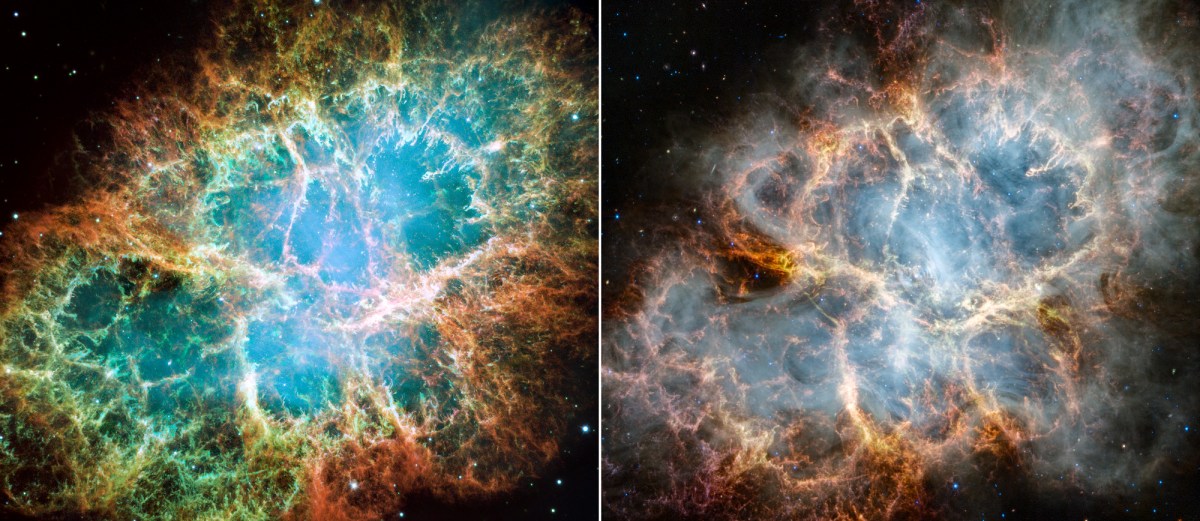
Using the Webb Space Telescope astronomers have taken the first detailed infrared image of the Crab Nebula, the remnant from a supernova that occurred in 1054 AD.

The two pictures on the right compare Webb’s false color infrared view with a natural light Hubble image in optical wavelengths, taken in 2005. From the press release:

The supernova remnant is comprised of several different components, including doubly ionized sulfur (represented in red-orange), ionized iron (blue), dust (yellow-white and green), and synchrotron emission (white). In this image, colors were assigned to different filters from Webb’s NIRCam and MIRI: blue (F162M), light blue (F480M), cyan (F560W), green (F1130W), orange (F1800W), and red (F2100W).

In comparing the images, it appears the scientists chose colors for the Webb image to more or less match those of Hubble’s natural color picture. However, as the press release notes:

Additional aspects of the inner workings of the Crab Nebula become more prominent and are seen in greater detail in the infrared light captured by Webb. In particular, Webb highlights what is known as synchrotron radiation: emission produced from charged particles, like electrons, moving around magnetic field lines at relativistic speeds. The radiation appears here as milky smoke-like material throughout the majority of the Crab Nebula’s interior.

This feature is a product of the nebula’s pulsar, a rapidly rotating neutron star. The pulsar’s strong magnetic field accelerates particles to extremely high speeds and causes them to emit radiation as they wind around magnetic field lines. Though emitted across the electromagnetic spectrum, the synchrotron radiation is seen in unprecedented detail with Webb’s NIRCam instrument.

The release also notes this remarkable but somewhat unfortunate fact:

Scientists will have newer Hubble data to review within the next year or so from the telescope’s reimaging of the supernova remnant. This will mark Hubble’s first look at emission lines from the Crab Nebula in over 20 years, and will enable astronomers to more accurately compare Webb and Hubble’s findings.

In 2005 repeated Hubble images of the Crab revealed that its filaments and radiation were stormy, with constant activity. The scientists actually produced a movie of those changes. It was expected that new images would be taken at regular intervals to track that activity. Apparently it was not, either because no scientist was interested or the committee that assigns time on Hubble decided this wasn’t important enough reseach.

0 comments

Webb detects high altitude jet stream above Jupiter’s equatorial band

Jupiter's newly discovered jet stream
Click for original false-color infrared image.

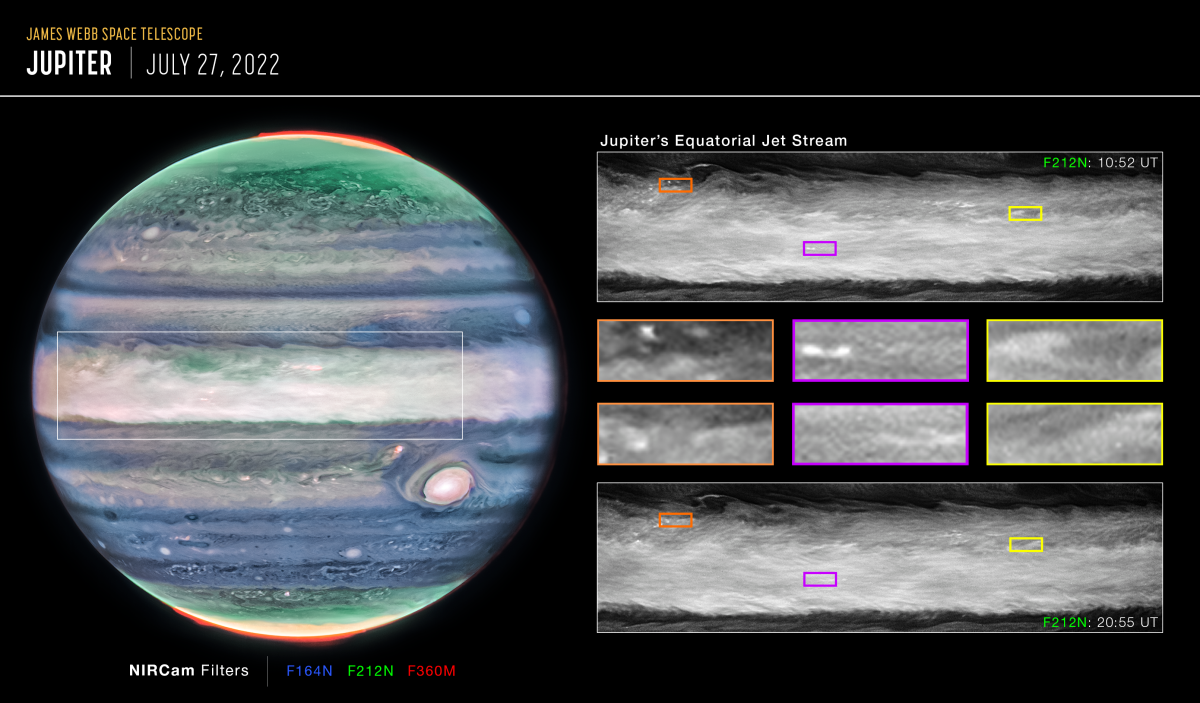
Using the Webb Space Telescope’s infrared capability, scientists have now detected a high altitude jet stream that flows above the equatorial band of Jupiter at speeds estimated to 320 miles per hour.

The false-color infrared image to the right shows evidence of this jetstream in three places by the brightest features seen there. From the caption:

In this image, brightness indicates high altitude. The numerous bright white ‘spots’ and ‘streaks’ are likely very high-altitude cloud tops of condensed convective storms. Auroras, appearing in red in this image, extend to higher altitudes above both the northern and southern poles of the planet. By contrast, dark ribbons north of the equatorial region have little cloud cover. In Webb’s images of Jupiter from July 2022, researchers recently discovered a narrow jet stream traveling 320 miles per hour (515 kilometers per hour) sitting over Jupiter’s equator above the main cloud decks.

These features sit about 25 miles higher than the planet’s previously detected cloudtops.

This discovery only proves what has always been evident, that Jupiter’s atmosphere is very complex with many features earlier optical observations could not see. It also only gives us a hint of that complexity. It will take numerous Jupiter orbiters observing in all wavebands, not just Webb in the infrared millions of miles away, to begin to untangle that complexity. And that untangling will take decades as well, since global weather unfolds over time. You can’t understand it simply by one snapshot. You have to watch the changes from season to season and from year to year. As Jupiter’s year is 12 Earth-years long, this research will take many lifetimes.

1 comment

Astronomers detect nano-sized quartz crystals in atmosphere of exoplanet

Using both the Hubble and Webb space telescopes in space, astronomers have detected nano-sized quartz crystals in the atmosphere of a Jupiter-class exoplanet orbiting its star every 3.7 days.

Silicates (minerals rich in silicon and oxygen) make up the bulk of Earth and the Moon as well as other rocky objects in our solar system, and are extremely common across the galaxy. But the silicate grains previously detected in the atmospheres of exoplanets and brown dwarfs appear to be made of magnesium-rich silicates like olivine and pyroxene, not quartz alone – which is pure SiO2.

The result from this team, which also includes researchers from NASA’s Ames Research Center and NASA’s Goddard Space Flight Center, puts a new spin on our understanding of how exoplanet clouds form and evolve. “We fully expected to see magnesium silicates,” said co-author Hannah Wakeford, also from the University of Bristol. “But what we’re seeing instead are likely the building blocks of those, the tiny ‘seed’ particles needed to form the larger silicate grains we detect in cooler exoplanets and brown dwarfs.”

These tiny quartz crystals are condensing out in the clouds themselves, due to the high temperatures and pressures there. The exoplanet itself is unusual because though its mass is one half that of Jupiter, its volume is seven times larger. This gives it a very large and deep atmosphere, thus providing the environment for crystal formation.

0 comments

Webb takes an infared look at Saturn

Webb's five images of Saturn
Webb’s five images of Saturn. Click for original.

Using the Webb Space Telescope, scientists have obtained five infrared images of Saturn to get a more detailed look at the gas giant’s atmosphere and the molecules within it.

The image to the right is Figure 1 from the paper, showing the location of those five images on Saturn, placed over a much higher resolution Hubble Space Telescope optical image. The graph on the bottom shows the molecules revealed from spectroscopic data obtained by Webb’s infrared view. From the abstract:

We show evidence that a stratospheric circulation pattern detected by Cassini during northern winter has now fully reversed in northern summer, with the low-latitude stratosphere being cool and depleted in aerosols due to summertime upwelling. MIRI [Webb’s mid-infrared instrument] provides access to spectral regions that were not possible with the Cassini spacecraft, particularly in the 5–7 μm region where reflected sunlight and thermal emission blend together. Ammonia and phosphine are enriched at Saturn’s equator, suggesting strong mixing from the deeper troposphere. MIRI’s high sensitivity enables the first identification of previously unseen emission propane bands, along with the first measurements of the distribution of several gaseous species: tropospheric water, and stratospheric ethylene, benzene, methyl, and carbon dioxide.

The paper notes that this work still has uncertainty because when the infrared images were taken engineers were still working out the kinks for using Webb. Nonetheless, the results illustrate the large potential for future planetary discoveries from Webb.

1 comment

Webb infrared data suggests Europa’s C02 comes from within

Europa as seen by Webb's near-infrared camera
Europa as seen by Webb’s near-infrared camera.
Click for original image.

Two different research papers, using infrared data from the Webb Space Telescope, have independently concluded that the carbon dioxide previously detected on the surface of Europa is found concentrated in the same region, and has the earmarks of coming from beneath the surface.

In one study, Samantha Trumbo and Michael Brown used the JWST [Webb] data to map the distribution of CO2 on Europa and found the highest abundance of CO2 is located in Tara Regio – a ~1,800 square kilometer region dominated by “chaos terrain,” geologically disrupted resurfaced materials. According to Tumbo and Brown, the amount of CO2 identified within this recently resurfaced region – some of the youngest terrain on Europa’s surface – indicates that it was derived from an internal source of carbon. This implies that the CO2 formed within Europa’s subsurface ocean and was brought to the surface on a geologically recent timescale. However, the authors say that formation of CO2 on the surface from ocean-derived organics or carbonates cannot be entirely ruled out. In either interpretation, the subsurface ocean contains carbon.

In an independent study of the same JWST data, Geronimo Villanueva and colleagues found that the CO2 on Europa’s surface is mixed with other compounds. Villanueva et al. also find the CO2 is concentrated in Tara Regio and interpret that as demonstrating that the carbon on the moon’s surface was sourced from within. The authors measured the ice’s 12C/13C isotopic ratio, but could not distinguish between an abiotic or biogenic source. Moreover, Villanueva et al. searched for plumes of volatile material breaching moon’s icy crust. Although previous studies have reported evidence of these features, the authors did not detect any plume activity during the JWST observations. They argue that plume activity on Europa could be infrequent, or sometimes does not contain the volatile gasses they included in their search.

As always, these conclusion must be viewed with some skepticism, as the data is somewhat sparse and coarse. Webb’s resolution is not enough to truly pinpoint the source location with great accuracy, and the conclusion that the CO2 comes from underground depends on many assumptions. For example, in the image above, the white area roughly corresponds to Tara Regio, but with very large margins.

1 comment

Webb captures new infrared image of bi-polar jets shooting from baby star

HH 211 as seen by Webb
Click for original image.

Using the Webb Space Telescope, astronomers have taken a new infrared image of the baby star Herbig-Haro 211 (HH 211), known best for the bi-polar jets that shoot out in opposite directions at very great speeds.

That picture is to the right, reduced and sharpened to post here, and has about 5 to 10 times the resolution of previous infrared images.

The image showcases a series of bow shocks to the southeast (lower-left) and northwest (upper-right) as well as the narrow bipolar jet that powers them. …. The inner jet is seen to “wiggle” with mirror symmetry on either side of the central protostar. This is in agreement with observations on smaller scales and suggests that the protostar may in fact be an unresolved binary star.

Earlier observations of HH 211 with ground-based telescopes revealed giant bow shocks moving away from us (northwest) and moving towards us (southeast) and cavity-like structures in shocked hydrogen and carbon monoxide respectively, as well as a knotty and wiggling bipolar jet in silicon monoxide. Researchers have used Webb’s new observations to determine that the object’s outflow is relatively slow in comparison to more evolved protostars with similar types of outflows.

The team measured the velocities of the innermost outflow structures to be roughly 48-60 miles per second (80 to 100 kilometers per second). However, the difference in velocity between these sections of the outflow and the leading material they’re colliding with — the shock wave — is much smaller. The researchers concluded that outflows from the youngest stars, like that in the center of HH 211, are mostly made up of molecules, because the comparatively low shock wave velocities are not energetic enough to break the molecules apart into simpler atoms and ions.

The baby star at the center of these jets, about a 1,000 light years away, is estimated to be only a few ten thousand years old, and presently has a mass less than a tenth of the Sun. With time it will accrete more matter and become a full-sized star.

1 comment

Webb takes infrared image of Supernova SN1987A

Annotated infrared image from Webb
Click for original image.

The Webb Space Telescope has taken its first infrared image of Supernova SN1987A, the closest supernova to Earth in five centuries at a distance of 168,000 light years away in the nearby Large Magellanic Cloud.

The annotated image to the right, cropped, reduced, and sharpened to post here, shows that supernova remnant as Webb sees it. Most of the structures identified here have been observed now for decades as the material from the explosion has been expanding outward. However,

While these structures have been observed to varying degrees
by NASA’s Hubble and Spitzer Space Telescopes and Chandra X-ray Observatory, the unparalleled sensitivity and spatial resolution of Webb revealed a new feature in this supernova remnant – small crescent-like structures. These crescents are thought to be a part of the outer layers of gas shot out from the supernova explosion. Their brightness may be an indication of limb brightening, an optical phenomenon that results from viewing the expanding material in three dimensions. In other words, our viewing angle makes it appear that there is more material in these two crescents than there actually may be. [emphasis mine]

I highlight that one word because it is unnecessary, and is only inserted to punch up Webb’s abilities for public relations purposes. Moreover, the rest of the text of the full press release at the link is even worse. It provides little information about the evolution of this supernova since its discovery more than three decades ago, but instead waxes poetic again and again about how wonderful Webb is.

Though Webb certainly has much higher resolution than the earlier infrared space telescope Spitzer and can do far more, this tendency of NASA press releases to use these superlatives only devalues Webb. The images themselves sell the telescope. No need to oversell it in the text.

Meanwhile, the significance of SN 1987A is not explained. Since the development of the telescope by Galileo in the early 1600s, there has been no supernova inside the Milky Way. SN 1987A has been the closest, so it has been photographed repeatedly in multiple wavelengths to track the evolution of the explosion’s ejecta. Webb now gives us a better look in the infrared, though in truth the small amount of new details is actually somewhat disappointing.

3 comments

Webb confirms galaxy as one of the earliest known in the universe

The uncertainty of science: Using the spectroscopic instrument on the Webb Space Telescope, scientists have confirmed that one of the first galaxies found by Webb, dubbed Maisie’s Galaxy after the daughter of one scientist, is one of the earliest known in the universe, existing only 390 million years after when cosmologies say the Big Bang happened.

The data also showed that another one of these early galaxies spotted by Webb did not exist 250 million years after the Big Bang, but one billion years after, a date that better fits the theories about the early universe, based on the nature of this galaxy.

It turns out that hot gas in CEERS-93316 was emitting so much light in a few narrow frequency bands associated with oxygen and hydrogen that it made the galaxy appear much bluer than it really was. That blue cast mimicked the signature Finkelstein and others expected to see in very early galaxies. This is due to a quirk of the photometric method that happens only for objects with redshifts of about 4.9. Finkelstein says this was a case of bad luck. “This was a kind of weird case,” Finkelstein said. “Of the many tens of high redshift candidates that have been observed spectroscopically, this is the only instance of the true redshift being much less than our initial guess.”

Not only does this galaxy appear unnaturally blue, it also is much brighter than our current models predict for galaxies that formed so early in the universe. “It would have been really challenging to explain how the universe could create such a massive galaxy so soon,” Finkelstein said. “So, I think this was probably always the most likely outcome, because it was so extreme, so bright, at such an apparent high redshift.”

This science team is presently using Webb’s spectroscope to study ten early galaxies in order to better determine their age. Expect more results momentarily.

4 comments

Scientists release infrared image of the Ring nebula, taken by Webb

The Ring Nebula, in false color by Webb
Click for original image.

Scientists yesterday released the first false-color infrared image of the Ring nebula taken by the Webb Telescope. That image, cropped to post here, is to the right. From the press release, which is heavy with platitudes but little information:

Approximately 2,600 lightyears away from Earth, the nebula was born from a dying star that expelled its outer layers into space. What makes these nebulae truly breath-taking is their variety of shapes and patterns, that often include delicate, glowing rings, expanding bubbles or intricate, wispy clouds. These patterns are the consequence of the complex interplay of different physical processes that are not well understood yet. Light from the hot central star now illuminates these layers.

Just like fireworks, different chemical elements in the nebula emit light of specific colours. This then results in exquisite and colourful objects, and furthermore allows astronomers to study the chemical evolution of these objects in detail.

It appears this image was produced using Webb’s near infrared instrument. Further data from its mid-infrared instrument has not yet been released. For a Hubble image of the Ring Nebula, in optical light that the human eye sees, go here.

1 comment

Infrared Webb image of a binary baby star system and its surrounding jets and nebula

Webb infrared image of HH 46/47
Click for original image.

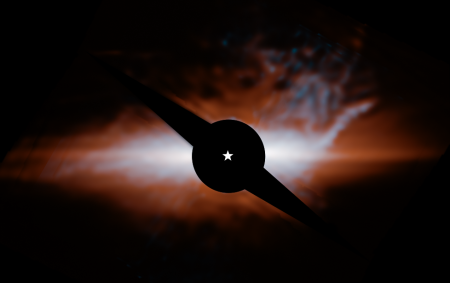
Cool image time! The infrared picture to the right, cropped, reduced, and sharpened to post here, was taken by the Webb Space Telescope of the jets and nebula of the Herbig–Haro object dubbed HH 46/47, thought to contain a pair of baby stars under formation.

The most striking details are the two-sided lobes that fan out from the actively forming central stars, represented in fiery orange. Much of this material was shot out from those stars as they repeatedly ingest and eject the gas and dust that immediately surround them over thousands of years.

When material from more recent ejections runs into older material, it changes the shape of these lobes. This activity is like a large fountain being turned on and off in rapid, but random succession, leading to billowing patterns in the pool below it. Some jets send out more material and others launch at faster speeds. Why? It’s likely related to how much material fell onto the stars at a particular point in time.­­­

The stars’ more recent ejections appear in a thread-like blue. They run just below the red horizontal diffraction spike at 2 o’clock. Along the right side, these ejections make clearer wavy patterns. They are disconnected at points, and end in a remarkable uneven light purple circle in the thickest orange area. Lighter blue, curly lines also emerge on the left, near the central stars, but are sometimes overshadowed by the bright red diffraction spike.

To see optical images of HH 46/47 as well as some further background, go here. It is one of the most studied HH objects, which is why it was given priority in Webb’s early observation schedule.

2 comments

Scientists claim discovery of most distant supermassive black hole yet

The overwhelming uncertainty of some science: Using data from the infrared Webb Space Telescope, scientists are now claiming they have discovered most distant supermassive black hole yet, sitting at the center of an active galaxy only about a half billion years after the Big Bang. From the press release:

The galaxy, CEERS 1019, existed just over 570 million years after the big bang, and its black hole is less massive than any other yet identified in the early universe. Not only that, they’ve easily “shaken out” two more black holes that are also on the smaller side, and existed 1 and 1.1 billion years after the big bang. Webb also identified eleven galaxies that existed when the universe was 470 to 675 million years old. The evidence was provided by Webb’s Cosmic Evolution Early Release Science (CEERS) Survey, led by Steven Finkelstein of the University of Texas at Austin. The program combines Webb’s highly detailed near- and mid-infrared images and data known as spectra, all of which were used to make these discoveries.

CEERS 1019 is not only notable for how long ago it existed, but also how relatively little its black hole weighs. This black hole clocks in at about 9 million solar masses, far less than other black holes that also existed in the early universe and were detected by other telescopes. Those behemoths typically contain more than 1 billion times the mass of the Sun – and they are easier to detect because they are much brighter. (They are actively “eating” matter, which lights up as it swirls toward the black hole.) The black hole within CEERS 1019 is more similar to the black hole at the center of our Milky Way galaxy, which is 4.6 million times the mass of the Sun. This black hole is also not as bright as the more massive behemoths previously detected. Though smaller, this black hole existed so much earlier that it is still difficult to explain how it formed so soon after the universe began.

I have great doubts about this research, especially because the press release makes no effort to explain how the black holes were identified. Black holes emit no light, and were only first confirmed by watching the orbits of stars or objects near them over long periods of time. More distant supermassive black holes in the center of galaxies were later guessed at by what appears to be the relationship between the size of a galaxy’s nucleus and the presence of a black hole. Astronomers also assume that a very active and energetic galaxy (such as a quasar) is a sign a supermassive black hole exists at the center.

These primitive galaxies have only been observed at most a handful of times. They are so distant that they only are at most a few pixels wide. Spectra from these objects can tell us roughly how far away they are, and thus how close to the Big Bang they are thought to be, but it is impossible to say with any certainty that there is a black hole there.

I am made even more skeptical by this press release claim: “Webb’s data are practically overflowing with precise information that makes these confirmations so easy to pull out of the data.” Such language makes me suspicious that there is an underlying effort to justify Webb’s expense with this release by overstating its capabilities.

The press release provides links to the research. Take a look. I’d be glad if someone could clearly show me why I’m wrong to be so doubtful.

5 comments

Galaxies at the dawn of time

Link here. The article takes a quick look at six galaxies found by Webb’s infrared view that all less than 650 million years after the Big Bang is thought to have occurred.

None disprove the Big Bang. All however raise serious questions about the cosmological theories that posit that event and the subsequent evolution of the universe. Take a look. It is worthwhile reading.

1 comment

Webb takes infrared (heat) image of Saturn

Saturn in infrared
Click for original image.

Using the Webb Space Telescope, scientists on June 25, 2023 took the wonderful false color infrared (heat) image of Saturn above, cropped to post here, as part of a research project [pdf] to take a number of long exposures of the ringed planet in order to test Webb’s ability to see its small moons. From the press release:

Saturn itself appears extremely dark at this infrared wavelength observed by the telescope, as methane gas absorbs almost all of the sunlight falling on the atmosphere. However, the icy rings stay relatively bright, leading to the unusual appearance of Saturn in the Webb image.

…This new image of Saturn clearly shows details within the planet’s ring system, along with several of the planet’s moons – Dione, Enceladus, and Tethys. Additional deeper exposures (not shown here) will allow the team to probe some of the planet’s fainter rings, not visible in this image, including the thin G ring and the diffuse E ring. Saturn’s rings are made up of an array of rocky and icy fragments – the particles range in size from smaller than a grain of sand to a few as large as mountains on Earth.

The picture also shows differences between Saturn’s northern and southern hemispheres, caused by the seasonal differences between the two.

1 comment

Host galaxies for two quasars in early universe detected for the first time

Quasar and host galaxy
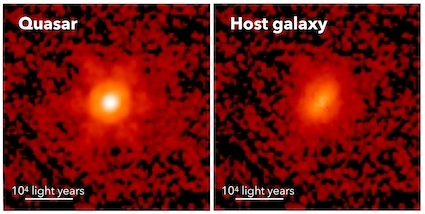
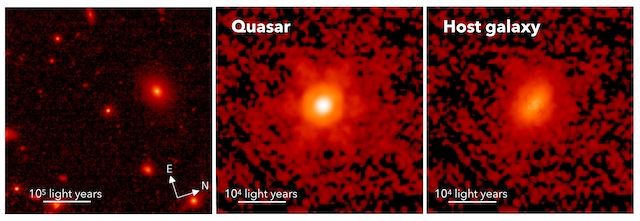
One of the quasars, with its light subtracted on the right,
revealing the host galaxy. Click for original image.

The uncertainty of science: Using data from both the infrared Webb Space Telescope and the Subaru optical telescope in Hawaii, astronomers have observed for the first time the host galaxies of two quasars that formed less than a billion years after the Big Bang.

Just a few months after JWST started regular operations, the team observed two quasars, HSC J2236+0032 and HSC J2255+0251, at redshifts 6.40 and 6.34 when the universe was approximately 860 million years old, both of which were discovered using Subaru Telescope’s deep survey program. The relatively low luminosities of these quasars made them prime targets for measuring the properties of their host galaxies.

The images of the two quasars were taken at infrared wavelengths of 3.56 and 1.50 microns with JWST’s NIRCam instrument, and the host galaxies became apparent after carefully modeling and subtracting glare from the accreting black holes. The stellar signature of the host galaxy was also seen in a spectrum taken by JWST’s NIRSPEC for J2236+0032, further supporting the detection of the host galaxy.

Photometric analyses found that these two quasar host galaxies are massive, measuring 130 and 34 billion times the mass of the Sun, respectively. Measuring the speed of the turbulent gas in the vicinity of the quasars from the NIRSPEC spectra suggests the black holes that power them are also massive, measuring 1.4 and 0.2 billion times the mass of the Sun. The ratio of the black hole to host galaxy mass is similar to those of galaxies in the more recent past, suggesting that the relationship between black holes and their hosts was already in place 860 million years after the Big Bang. [emphasis mine]

Normally, quasars are so bright the host galaxy is obscured. Computer modeling that subtracted the quasar’s light produced the host galaxy image on the right.

The highlighted sentence raises intriguing questions again about the Big Bang. Webb is once again finding evidence that the early universe quickly became like today’s universe, much faster than expected by cosmologists.

3 comments

Webb makes first detection of one particular carbon molecule

The uncertainty of science: Using the Webb Space Telescope, astronomers have made the first detection of methyl cation (pronounced cat-eye-on) (CH3+) in space, located in a baby solar system the star-forming region of the Orion nebula about 1,350 light years away.

While the star in d203-506 is a small red dwarf, the system is bombarded by strong ultraviolet (UV) light from nearby hot, young, massive stars. Scientists believe that most planet-forming disks go through a period of such intense UV radiation, since stars tend to form in groups that often include massive, UV-producing stars.

Typically, UV radiation is expected to destroy complex organic molecules, in which case the discovery of CH3+ might seem to be a surprise. However, the team predicts that UV radiation might actually provide the necessary source of energy for CH3+ to form in the first place. Once formed, it then promotes additional chemical reactions to build more complex carbon molecules.

Broadly, the team notes that the molecules they see in d203-506 are quite different from typical protoplanetary disks. In particular, they could not detect any signs of water. [emphasis mine]

In the next day or so we shall likely see a number of stories in the mainstream press shouting some variation of “Webb finds key element of life!” Webb has done no such thing. It has found a carbon molecule not seen previously, which simply provides scientists another small data point in trying to understand the development of complex solar systems.

The highlighted sentences make clear the uncertainty in this field and the general shallow amount of knowledge. For example, why carbon molecules but no water, which is made up of hydrogen and oxygen, both ubiquitous throughout the universe and found in large amounts in star-forming regions?

5 comments
1 3 4 5 6 7 10