Webb’s first deep field infrared image reveals hundreds of very early galaxies

The uncertainty of science: Using the Webb Space Telescope to take a 32-day-long infrared exposure, scientists have obtained the deepest deep field picture of the universe’s earliest time period, within which they have found more than 700 galaxies, 717 to be exact.

The initial survey of these galaxies appear to reveal several facts.

About a sixth of early galaxies in the JADES sample are in the throes of star formation of a kind we don’t see in the nearby universe, Endsley explains, marked by extremely bright emission at certain wavelengths. “Stars within very early galaxies are forming in these super-compact clumps,” he adds, “forming hundreds, perhaps thousands of these very massive, young stars all at once, basically within the span of a couple millions of years.”

But they weren’t “on” all the time. The low fraction of galaxies with such emission suggests that individual clumps would suddenly light up with new stars and then rest for some time. This “bursty” mode of star formation could explain the unexpectedly bright galaxies announced by other astronomers — they were simply looking at the galaxies fired up with unexpectedly intense star formation.

However, while these findings explain too-bright galaxies, they don’t explain the too-massive galaxies, another early, albeit controversial find from JWST data. Endsley explains that even as hot, massive newborn stars light up their galaxy, they’re not necessarily associated with all that much mass. “We’re not really finding evidence of these over-massive objects within our JADES sample,” he states.

In other words, this data appears to contradict earlier data from Webb that other researchers said revealed galaxies that were too massive and developed to have formed that soon after the Big Bang.

All of this data remains somewhat uncertain, and is based on only tiny tidbits of information, gleaned from mere smudges of red-shifted infrared light. Much more research will be required, some not possible by Webb, before we have any solid answers, and even then there is going to be a lot of uncertainty.

4 comments

Webb detects large water plume released from Saturn’s moon Enceladus

Water vapor plume seen by Webb
Click for original image.

Using the infrared cameras on the Webb Space Telescope, astronomers have detected a surprisingly long and large plume of water vapor erupting from the tiger stripe fractures on Saturn’s moon Enceladus that scientists for years have detected vapor plumes.

The false color image to the right shows that plume.

A water vapor plume from Saturn’s moon Enceladus spanning more than 6,000 miles – nearly the distance from Los Angeles, California to Buenos Aires, Argentina – has been detected by researchers using NASA’s James Webb Space Telescope. Not only is this the first time such a water emission has been seen over such an expansive distance, but Webb is also giving scientists a direct look, for the first time, at how this emission feeds the water supply for the entire system of Saturn and its rings.

…The length of the plume was not the only characteristic that intrigued researchers. The rate at which the water vapor is gushing out, about 79 gallons per second, is also particularly impressive. At this rate, you could fill an Olympic-sized swimming pool in just a couple of hours. In comparison, doing so with a garden hose on Earth would take more than 2 weeks.

Though that rate of release sounds large, we must remember it is being released from a moon 313 miles across. From that perspective the rate of flow is quite reasonable.

2 comments

Webb and Chandra take composite X-ray/infrared images of four famous objects

Composite Chandra/Webb image of M16
Click for original image.

Astronomers have now used the Chandra X-ray Observatory and Webb Space Telescope (working in the infrared) to produce spectacular composite false-color X-ray/infrared images of four famous heavenly objects.

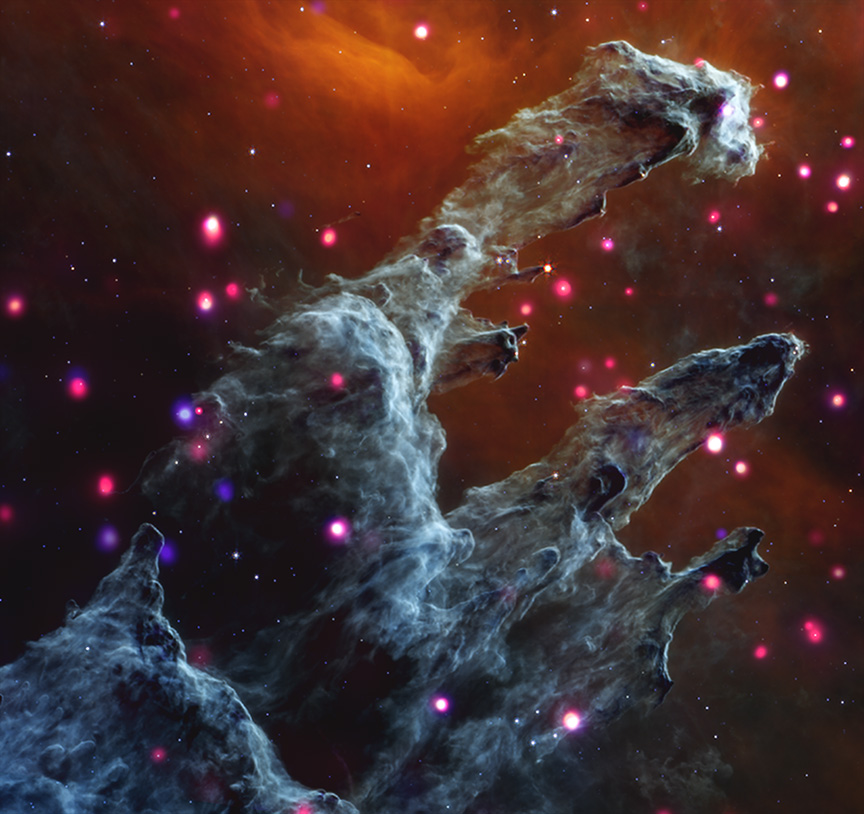
To the right is the composite taken of the Eagle Nebula, also known as Messier 16. It was also dubbed the Pillars of Creation when it was one of the first Hubble images taken after the telescope’s mirror focus was fixed in 1993. From the caption:

The Webb image shows the dark columns of gas and dust shrouding the few remaining fledgling stars just being formed. The Chandra sources, which look like dots, are young stars that give off copious amounts of X-rays. (X-ray: red, blue; infrared: red, green, blue)

The other images include star cluster NGC 346 in a nearby galaxy, the spiral galaxy NGC 1672, and the face-on spiral galaxy Messier 74.

6 comments

Webb takes infrared image of the disk of dust and debris surrounding Fomalhaut

Fomalhaut debris disk as seen in the infrared by Webb
Click for original image.

Using the mid-infrared instrument on the Webb Space Telescope, astronomers have obtained a new high resolution infrared image of the disk of dust and debris that surrounds the star Fomalhaut, and (surprise!) have it to be more complex than they previously believed.

That image is to the right, annotated by the science team.

Overall, there are three nested belts extending out to 14 billion miles (23 billion kilometers) from the star; that’s 150 times the distance of Earth from the Sun. The scale of the outermost belt is roughly twice the scale of our solar system’s Kuiper Belt of small bodies and cold dust beyond Neptune. The inner belts – which had never been seen before – were revealed by Webb for the first time.

The dust cloud identified in the outer ring is possibly left over from a recent collusion of larger bodies.

0 comments

Webb snaps infrared picture of Uranus

Uranus as seen in the infrared by Webb
Click for original Webb false-color image.

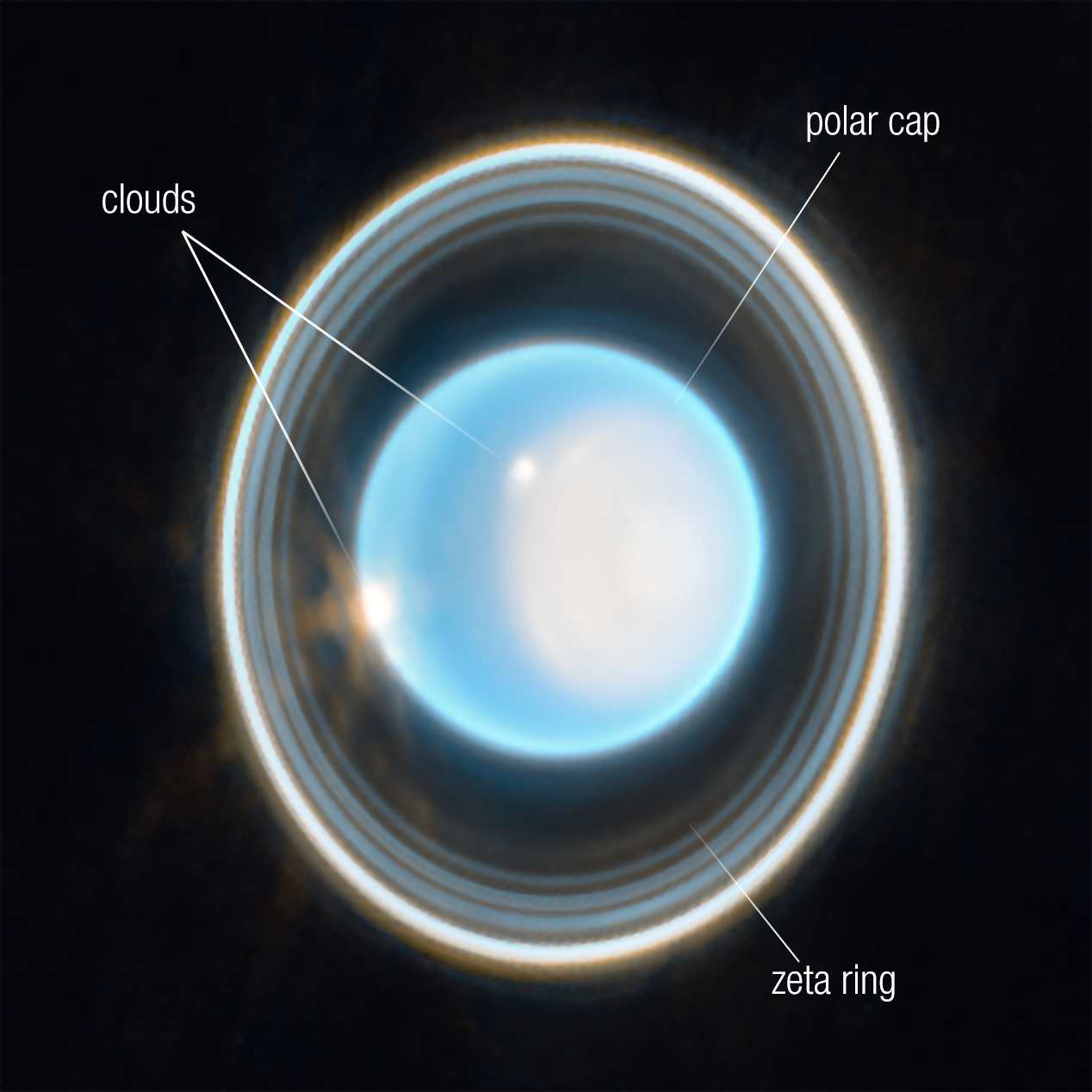
In a follow-up to a recent Hubble Space Telescope optical image of Uranus, scientists have now used the Webb Space Telescope to take a comparable picture in the infrared of the gas giant.

Both pictures are to the right, with the Webb picture at the top including the scientists’ annotations.

On the right side of the planet there’s an area of brightening at the pole facing the Sun, known as a polar cap. This polar cap is unique to Uranus – it seems to appear when the pole enters direct sunlight in the summer and vanish in the fall; these Webb data will help scientists understand the currently mysterious mechanism. Webb revealed a surprising aspect of the polar cap: a subtle enhanced brightening at the center of the cap. The sensitivity and longer wavelengths of Webb’s NIRCam may be why we can see this enhanced Uranus polar feature when it has not been seen as clearly with other powerful telescopes like the Hubble Space Telescope and Keck Observatory.

At the edge of the polar cap lies a bright cloud as well as a few fainter extended features just beyond the cap’s edge, and a second very bright cloud is seen at the planet’s left limb. Such clouds are typical for Uranus in infrared wavelengths, and likely are connected to storm activity.

The Webb image also captures 11 of Uranus’s 13 rings, which appear much brighter in the infrared than in the optical.

Unlike all other planets in the solar system, Uranus’s rotation is tilted so much that it actually rolls as it orbits the Sun, a motion that is obvious by comparing these pictures with Hubble’s 2014 optical picture.

3 comments

Webb finds Earth-sized exoplanet likely too hot to have atmosphere

The uncertainty of science: Using the infrared Webb Space Telescope, scientists have measured the temperature of the Earth-sized exoplanet, dubbed Trappist-1b, and found its temperature is probably too hot to have atmosphere.

The red dwarf star Trappist-1is about 40 light years from Earth, and in 2017 was found to have a solar system of seven exoplanets, all rocky terrestrial planets like the inner planets of our solar system. Trappist-1b is the innermost exoplanet. To measure its temperature, Webb observed the star while the planet was eclipsed by the star as well as when it was not, and measured the tiny difference in infrared light.

The team analyzed data from five separate secondary eclipse observations. “We compared the results to computer models showing what the temperature should be in different scenarios,” explained Ducrot. “The results are almost perfectly consistent with a blackbody made of bare rock and no atmosphere to circulate the heat. We also didn’t see any signs of light being absorbed by carbon dioxide, which would be apparent in these measurements.”

As this was the innermost of the star’s solar system, it is also the one most likely to lack an atmosphere. Webb’s observations of the system continue, so there is a chance that data about the other exoplanets will eventually tell us more about them.

1 comment

Webb detects “hot sand clouds” in atmosphere of exoplanet

Using the Webb Space Telescope, astronomers have detected “hot sand clouds” in atmosphere of exoplanet 40 light years away, along with evidence of water, methane, carbon monoxide, carbon dioxide, sodium, and potassium.

You can read the paper here [pdf]. The exoplanet itself appears to have some features that resemble that of a brown dwarf, or failed star, instead of an exoplanet.

Although VHS 1256 b is more on the heavier side of the known exoplanets, its gravity is relatively low compared to more massive brown dwarfs. Such very low-mass stars can only burn deuterium for a relatively short duration. Consequently, the planet’s silicate clouds can appear and remain higher in its atmosphere, where the JWST can detect them. Another reason its skies are so turbulent is the planet’s age. In astronomical terms, it is pretty young. Only 150 million years have passed since it formed. The planet’s heat stems from the recent formation process – and it will continue to change and cool over billions of years.

The sand clouds are hot, in the range of 1,500 degrees Fahrenheit.

These results were obtained as part of an early-release program from Webb, and illustrate the potential of the infrared space telescope for learning many specific details about brown dwarfs and exoplanets.

0 comments

Webb finds another galaxy in early universe that should not exist

The uncertainty of science: Scientists using the Webb Space Telescope have identified another galaxy about 12 billion light years away and only about 1.7 billion years after the theorized Big Bang that is too rich in chemicals as well as too active in star formation to have had time to form.

SPT0418-SE is believed to have already hosted multiple generations of stars, despite its young age. Both of the galaxies have a mature metallicity — or large amounts of elements like carbon, oxygen and nitrogen that are heavier than hydrogen and helium — which is similar to the sun. However, our sun is 4.5 billion years old and inherited most of its metals from previous generations of stars that were eight billion years old, the researchers said.

In other words, this galaxy somehow obtained complex elements in only 1.7 billion years that in our galaxy took twelve billion years, something that defies all theories of galactic and stellar evolution. Either the Big Bang did not happen when it did, or all theories about the growth and development of galaxies are wrong.

One could reasonably argue that this particular observation might be mistaken, except that it is not the only one from Webb that shows similar data. Webb’s infrared data is challenging the fundamentals of all cosmology, developed by theorists over the past half century.

13 comments

Webb spots massive galaxies in the early universe that should not exist at that time

The uncertainty of science: Astronomers using the Webb Space Telescope have identified six galaxies that are far too massive and evolved to have formed so quickly after the Big Bang.

The research, published today in Nature, could upend our model of the Universe and force a drastic rethink of how the first galaxies formed after the Big Bang. “We’ve never observed galaxies of this colossal size, this early on after the Big Bang,” says lead researcher Associate Professor Ivo Labbé from Swinburne University of Technology.

“The six galaxies we found are more than 12 billion years old, only 500 to 700 million years after the Big Bang, reaching sizes up to 100 billion times the mass of our sun. This is too big to even exist within current models.

You can read the paper here [pdf]. The “current models” Labbé is referring to are all the present theories and data that say the Big Bang occurred 13.7 billion years ago. These galaxies, however, found less than a billion years after that event, would have needed 12 billion years to have accumulated their mass.

If confirmed, these galaxies essentially tell us that the Big Bang is wrong, or very very VERY incomplete, and that all the data found that dates its occurrence 13.7 billion years ago, based on the Hubble constant, must be reanalyzed.

It is also possible these galaxies are actually not galaxies, but a new kind of supermassive black hole able to form very quickly. Expect many scientists who are heavily invested in the Big Bang to push for this explanation. It might be true, but their biases are true also, which means that Webb is presenting us with new data that calls for strong skepticism of all conclusions, across the board.

16 comments

A galaxy’s structure of gas and dust, as seen in the infrared by Webb

NGC 1433 as seen in the infrared
NGC 1433 as seen in the infrared. Click for original image.

Scientists have now released 21 papers on the gas and dust structures in nearby galaxies, based on infrared images from the Webb Space Telescope, used in collaboration with other telescopes looking in other wavelengths.

The largest survey of nearby galaxies in Webb’s first year of science operations is being carried out by the Physics at High Angular resolution in Nearby Galaxies (PHANGS) collaboration, involving more than 100 researchers from around the globe. The Webb observations are led by Janice Lee, Gemini Observatory chief scientist at the National Science Foundation’s NOIRLab and affiliate astronomer at the University of Arizona in Tucson.

The team is studying a diverse sample of 19 spiral galaxies, and in Webb’s first few months of science operations, observations of five of those targets – M74, NGC 7496, IC 5332, NGC 1365, and NGC 1433 – have taken place.

The image to the right is Webb’s infrared image of NGC 1433, estimated to be 46 million light years away. The bright areas extending outward in the spiral arms are believed to be star-forming regions. From the caption:

At the center of the galaxy, a tight, bright core featuring a unique double ring structure shines in exquisite detail with Webb’s extreme resolution. In this case, that ‘double ring’ is actually tightly wrapped spiral arms that wind into an oval shape along the galaxy’s bar.

NGC 1433 is a Seyfert galaxy, which are typically relatively close to Earth and has a supermassive black hole at the center eating material at a high rate. The brightness and lack of dust in the MIRI image of NGC 1433 could hint at a recent collision with another galaxy.

When comparing Webb’s infrared view with Hubble’s optical view, taken in 2014 and found here, the differences are definitely striking. Webb sees the gas and dust that is dark in Hubble’s images, while Hubble sees things at much higher resolution and thus sees more fine detail.

0 comments

Galaxies without end

Webb infrared image of galaxies without end
Click for original image.

Cool image time! The mid-infrared picture to the right, cropped, reduced, and sharpened to post here, was taken by the Webb Space Telescope during its commissioning process last year shortly after launch, and was used to calibrate the Near-InfraRed Imager and Slitless Spectrograph (NIRISS) instrument, the very same instrument that for the past two weeks was not in operation because a cosmic ray had scrambled its software, requiring a reboot to fix it. From the caption:

The large spiral galaxy at the base of this image is accompanied by a profusion of smaller, more distant galaxies which range from fully-fledged spirals to mere bright smudges. Named LEDA 2046648, it is situated a little over a billion light-years from Earth, in the constellation Hercules.

While the large spiral is majestic, the tiny galaxy smudges are actually more important. Astronomers are right now scrambling to determine their distance and age in order to better understand what the universe was like, thirteen-plus billion years ago. So far the Webb data of these very early galaxies suggests that in this early universe there were many more fully formed galaxies, similar to ones we see in our time, than any theory of the Big Bang had predicted.

0 comments

Webb instrument back in operation

Engineers have returned NIRISS, the near infrared spectrograph instrument on the Webb Space Telescope, to full operation after rebooting its software and determining the cause of the problem.

On Jan. 15, NASA’s James Webb Space Telescope’s Near Infrared Imager and Slitless Spectrograph (NIRISS) experienced a communications delay within the science instrument, causing its flight software to time out. Following a full investigation by NASA and Canadian Space Agency (CSA) teams, the cause was determined to likely be a galactic cosmic ray, a form of high-energy radiation from outside our solar system that can sometimes disrupt electrical systems. Encountering cosmic rays is a normal and expected part of operating any spacecraft. This cosmic ray event affected logic in the solid-state circuitry of NIRISS electronics known as the Field Programmable Gate Array. Webb engineers determined that rebooting the instrument would bring it back to full functionality.

After completing the reboot, NIRISS telemetry data demonstrated normal timing, and to fully confirm, the team scheduled a test observation. On Jan. 28, the Webb team sent commands to the instrument to perform the observation, and the results confirmed on Jan. 30 NIRISS is back to full scientific operations.

Engineers actually have a name for such cosmic ray incidents that effect software. They call it a bitflip.

2 comments

Communications issue shuts down one of Webb’s instruments

The near infrared instrument on the Webb Space Telescope, NIRISS, has been unavailable for science observations for more than a week due to a communications issue.

On Sunday, Jan. 15, the James Webb Space Telescope’s Near Infrared Imager and Slitless Spectrograph (NIRISS) experienced a communications delay within the instrument, causing its flight software to time out. The instrument is currently unavailable for science observations while NASA and the Canadian Space Agency (CSA) work together to determine and correct the root cause of the delay.

According to the update, the instrument’s hardware, as well as the rest of the telescope, has been unaffected and remains in good condition.

In November the telescope’s mid-infrared instrument MIRI experienced its own problems with one of its “grating wheels” that allows it to some spectroscopy. Since then the instrument has been in use, but it is unclear if the issue was resolved or observations have had to be adjusted to avoid the problem.

0 comments

First exoplanet confirmed by Webb

Astronomers have used for the first time the Webb Space Telescope to confirm the existence of an exoplanet, previous noted in data from the orbiting TESS telescope.

Formally classified as LHS 475 b, the planet is almost exactly the same size as our own, clocking in at 99% of Earth’s diameter. The research team is led by Kevin Stevenson and Jacob Lustig-Yaeger, both of the Johns Hopkins University Applied Physics Laboratory in Laurel, Maryland.

The team chose to observe this target with Webb after carefully reviewing targets of interest from NASA’s Transiting Exoplanet Survey Satellite (TESS), which hinted at the planet’s existence. Webb’s Near-Infrared Spectrograph (NIRSpec) captured the planet easily and clearly with only two transit observations.

The data is still preliminary, so more analysis is necessary to provide some information about the planet’s atmosphere.

0 comments

Webb finds “wide diversity of galaxies in the early universe”

Webb galaxies in the early universe
Click for full image.

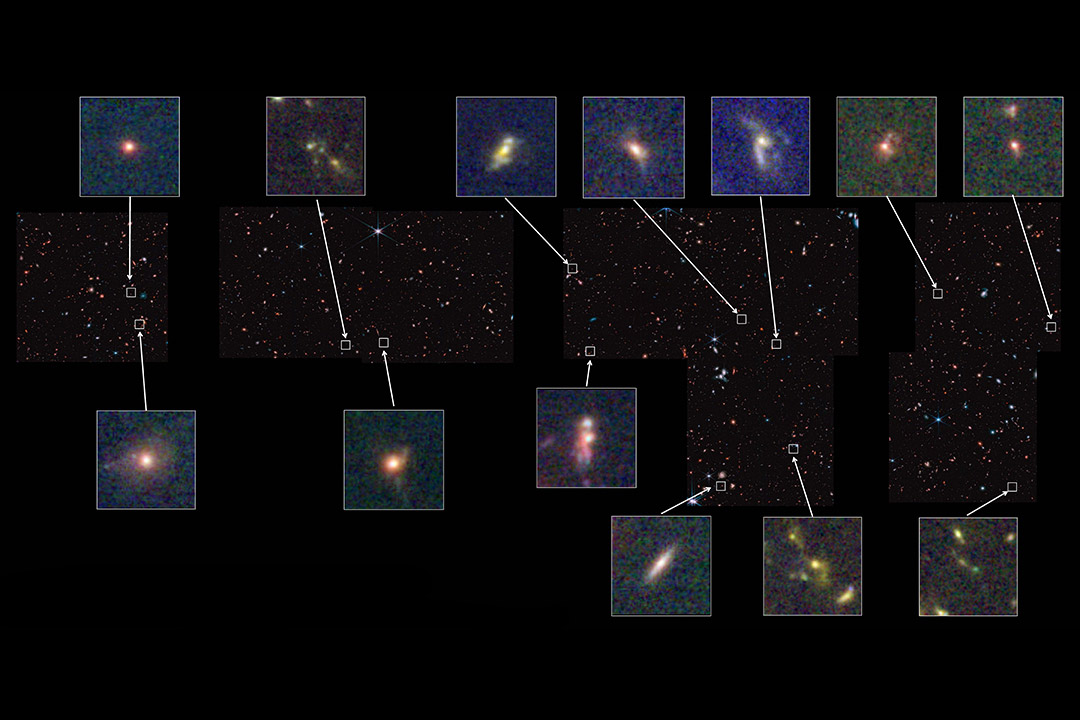
New data from the Webb Space Telescope and presented this week at an astronomy conference has found that galaxies in the early universe exhibit much of the same range of shapes and morphologies seen in the recent universe, a result that was not expected.

The image to the right comes from the press release. You can read the research paper here [pdf].

The study examined 850 galaxies at redshifts of z three through nine, or as they were roughly 11-13 billion years ago. Associate Professor Jeyhan Kartaltepe from Rochester Institute of Technology’s School of Physics and Astronomy said that JWST’s ability to see faint high redshift galaxies in sharper detail than Hubble allowed the team of researchers to resolve more features and see a wide mix of galaxies, including many with mature features such as disks and spheroidal components.

“There have been previous studies emphasizing that we see a lot of galaxies with disks at high redshift, which is true, but in this study we also see a lot of galaxies with other structures, such as spheroids and irregular shapes, as we do at lower redshifts,” said Kartaltepe, lead author on the paper and CEERS co-investigator. “This means that even at these high redshifts, galaxies were already fairly evolved and had a wide range of structures.”

The results of the study, which have been posted to ArXiv and accepted for publication in The Astrophysical Journal, demonstrate JWST’s advances in depth, resolution, and wavelength coverage compared to Hubble. Out of the 850 galaxies used in the study that were previously identified by Hubble, 488 were reclassified with different morphologies after being shown in more detail with JWST. Kartaltepe said scientists are just beginning to reap the benefits of JWST’s impressive capabilities and are excited by what forthcoming data will reveal.

“This tells us that we don’t yet know when the earliest galaxy structures formed,” said Kartaltepe. “We’re not yet seeing the very first galaxies with disks. We’ll have to examine a lot more galaxies at even higher redshifts to really quantify at what point in time features like disks were able to form.”

In other words, it appears galaxies of all shapes, as we see them today, already existed 11-13 billion years ago, shortly after the universe was born. This defies most theories about the formation of the universe, which predict that these early galaxies would be different than today’s.

The data however at this point is sparse. Webb has only begun this work, and as Kartaltepe notes, they need to look a lot more galaxies.

5 comments

Today’s blacklisted American: Black scientist blacklisted for doing good research

Oluseyi Hakeem, blacklisted
Hakeem Oluseyi, Space Science Education Lead
for NASA’s Science Mission Directorate

They’re coming for you next: Today’s blacklist column describes an effort to not only cancel from history the man who led NASA for almost the entire 1960s space race, but to also blackball a scientist for doing good research that proved the campaign was not based on any facts.

Shortly before the launch of the James Webb Space Telescope last year, a petition was instigated to get it renamed because of accusations that Webb had persecuted homosexuals during his term as NASA administrator in the 1960s. As is now typical of our modern bankrupt intellectual class, as soon as this petition was issued more than 1,700 people signed it, all accepting at face value its accusations against Webb without any further research.

One scientist, who happened to be black, took a more detailed look at those accusations however and found them to be spurious. As Hakeem Oluseyi wrote:
» Read more

9 comments

Webb in safe mode intermittently during the past two weeks

According to a short update today from the science team, the Webb Space Telescope went into safe mode on December 7, 2022 and was in that state “intermittently” through December 20, 2022 because of a software issue.

The James Webb Space Telescope resumed science operations Dec. 20, after Webb’s instruments intermittently went into safe mode beginning Dec. 7 due to a software fault triggered in the attitude control system, which controls the pointing of the observatory. During a safe mode, the observatory’s nonessential systems are automatically turned off, placing it in a protected state until the problem can be fixed. This event resulted in several pauses to science operations totaling a few days over that time period. Science proceeded otherwise during that time. The Webb team adjusted the commanding system, and science has now fully resumed.

It would be nice to have a more detailed description of that “software fault”, and how it affected the attitude control system. Such things can be very trivial, or they can be disastrous. NASA has a responsibility to tell the public which.

0 comments

Astronomers confirm Webb galaxies from the early universe

Astronomers using Webb have now confirmed with spectroscopy the age of at least four galaxies from the very very early universe, existing only a short time after the theorized Big Bang.

Four of the galaxies studied are particularly special, as they were revealed to be at an unprecedentedly early epoch. The results provided spectroscopic confirmation that these four galaxies lie at redshifts above 10, including two at redshift 13. This corresponds to a time when the universe was approximately 330 million years old, setting a new frontier in the search for far-flung galaxies. These galaxies are extremely faint because of their great distance from us.

The scientists had aimed Webb at Hubble’s Ultra Deep Field, doing a long infrared exposure lasting 28 hours over three days in order to gather the faintest infrared radiation (that Hubble could not see) and thus the most distant galaxies. The spectrum of individuals stars was then measured, which indicating their redshift and their estimated age.

The astronomers will next aim Webb at the more famous Hubble Deep Field, the first such long exposure that optical telescope took back in the late 1990s.

1 comment

Webb’s infrared view of the Southern Ring Nebula

Two views of Southern Ring Nebula by Webb
Click for original image.

The two images to the left were produced by the Webb Space Telescope, showing in false colors the Southern Ring Nebula as seen by two of Webb’s infrared cameras.

The two images shown here each combine near-infrared and mid-infrared data to isolate different components of the nebula. The image at [top] highlights the very hot gas that surrounds the central stars. The image at [bottom] traces the star’s scattered molecular outflows that have reached farther into the cosmos.

Based on the data, astronomers posit that up the system could have as many as five stars orbiting each other, with three as yet unseen, or the inner ones might no longer exist, having been absorbed by the bigger stars.

It’s possible more than one star interacted with the dimmer of the two central stars, which appears red in this image, before it created this jaw-dropping planetary nebula. The first star that “danced” with the party’s host created a light show, sending out jets of material in opposite directions. Before retiring, it gave the dim star a cloak of dust. Now much smaller, the same dancer might have merged with the dying star – or is now hidden in its glare.

A third partygoer may have gotten close to the central star multiple times. That star stirred up the jets ejected by the first companion, which helped create the wavy shapes we see today at the edges of the gas and dust. Not to be left out, a fourth star with an orbit projected to be much wider, also contributed to the celebration. It circled the scene, further stirring up the gas and dust, and generating the enormous system of rings seen outside the nebula. The fifth star is the best known – it’s the bright white-blue star visible in the images that continues to orbit predictably and calmly.

Much of this remains mere theory, based on the available data. Nonetheless, the data from many such planetary nebula continues to suggest their strange and wonderful shapes are created by multiple stars, acting as a mix-master to churn up the nebula’s dust.

0 comments

Webb and Keck telescopes track clouds on Titan

Clouds on Titan
Click for original image.

Astronomers have used the Webb Space Telescope and the Keck Observatory in Hawaii to take infrared images days apart of the evolving clouds on the Saturn moon Titan.

The false-color infrared images to the right are those observations. From the press release:

As part of their investigation of Titan’s atmosphere and climate, Nixon’s team used JWST’s Near-Infrared Camera (NIRCam) to observe the moon during the first week of November. After seeing the clouds near Kraken Mare, the largest known liquid sea of methane on the surface of Titan, they immediately contacted the Keck Titan Observing Team to request follow-up observations.

“We were concerned that the clouds would be gone when we looked at Titan a day later with Keck, but to our delight there were clouds at the same positions on subsequent observing nights, looking like they had changed in shape,” said Imke de Pater, emeritus professor of astronomy at the University of California, Berkeley, who leads the Keck Titan Observing Team.

Using Keck Observatory’s second generation Near-Infrared Camera (NIRC2) in combination with the Keck II Telescope’s adaptive optics system, de Pater and her team observed one of Titan’s clouds rotating into and another cloud either dissipating or moving out of Earth’s field of view due to Titan’s rotation.

These images only increase my mourning for a Saturn orbiter. Since the end of Cassini’s mission in 2017, we have essentially been blind to the ringed planet and its many moons. These images, while producing excellent data, also illustrate well what we have lost.

0 comments
1 4 5 6 7 8 10