Webb makes its first detailed survey of an exoplanet’s atmosphere

Astronomers have now completed the first detailed survey of an exoplanet’s atmosphere using the Webb Space Telescope, looking at a gas giant about one third the mass of Jupiter about 700 light years away.

Using three of its instruments, JWST was able to observe light from the planet’s star as it filtered through WASP-39b’s atmosphere, a process known as transmission spectroscopy. This allowed a team of more than 300 astronomers to detect water, carbon monoxide, sodium, potassium and more in the planet’s atmosphere, in addition to the carbon dioxide. The gives the planet a similar composition to Saturn, although it has no detectable rings.

The team were also surprised to detect sulfur dioxide, which had appeared as a mysterious bump in early observation data. Its presence suggests a photochemical reaction is taking place in the atmosphere as light from the star hits it, similar to how our Sun produces ozone in Earth’s atmosphere. In WASP-39b’s case, light from its star, slightly smaller than the Sun, splits water in its atmosphere into hydrogen and hydroxide, which reacts with hydrogen sulfide to produce sulfur dioxide.

The data also suggested the clouds in the atmosphere are patchy, and that the planet’s formation process was not exactly as predicted.

These observations are part of a program to study 70 exoplanets during Webb’s first year of operation, using its infrared capabilities to get spectroscopy not possible in other wavelengths.

0 comments

Webb finding more galaxies in early universe than expected

The uncertainty of science: Astronomers using the Webb Space Telescope are finding in very early universe many more galaxies that are also far more developed then had been predicted.

The Webb observations nudge astronomers toward a consensus that an unusual number of galaxies in the early universe were so much brighter than expected. This will make it easier for Webb to find even more early galaxies in subsequent deep sky surveys, say researchers.

“We’ve nailed something that is incredibly fascinating. These galaxies would have had to have started coming together maybe just 100 million years after the big bang. Nobody expected that the dark ages would have ended so early,” said Garth Illingworth of the University of California at Santa Cruz, a member of the Naidu/Oesch team. “The primal universe would have been just one hundredth its current age. It’s a sliver of time in the 13.8 billion-year-old evolving cosmos.”

Erica Nelson of the University of Colorado in Boulder, a member of the Naidu/Oesch team, noted that “our team was struck by being able to measure the shapes of these first galaxies; their calm, orderly disks question our understanding of how the first galaxies formed in the crowded, chaotic early universe.”

The galaxies are smaller, more compact than present day galaxies, and appear to be forming stars at a tremendous rate. Because their distances, presently estimated, still need to be confirmed by spectroscopy, these conclusions remain somewhat tentative though quite alluring.

We should not be surprised if in the next two years data from Webb will overturn almost all the theories that presently exist about the Big Bang and its immediate aftermath.

2 comments

A hidden baby star, seen in infrared

A hidden baby star, seen in infrared
Click for original image.

Using the Webb Space Telescope, astronomers have obtained a new high resolution infrared false color view of the bi-polar jets of a new solar system and star, hidden within its dark cloud of dust.

That image is the photo to the right, reduced and sharpened to post here. From the press release:

NASA’s James Webb Space Telescope has revealed the once-hidden features of the protostar within the dark cloud L1527, providing insight into the beginnings of a new star. These blazing clouds within the Taurus star-forming region are only visible in infrared light, making it an ideal target for Webb’s Near-Infrared Camera (NIRCam).

The protostar itself is hidden from view within the “neck” of this hourglass shape. An edge-on protoplanetary disk is seen as a dark line across the middle of the neck. Light from the protostar leaks above and below this disk, illuminating cavities within the surrounding gas and dust.

The region’s most prevalent features, the clouds colored blue and orange in this representative-color infrared image, outline cavities created as material shoots away from the protostar and collides with surrounding matter. The colors themselves are due to layers of dust between Webb and the clouds. The blue areas are where the dust is thinnest. The thicker the layer of dust, the less blue light is able to escape, creating pockets of orange.

Scientists estimate this star is only about 100,000 years old, and is in its earliest stage of formation. That protoplanetary disk is estimated to be about the size of our solar system.

0 comments

Webb’s mid-infrared instrument restored to full operations

Engineers have figured out the issue on the mid-infrared instrument on the Webb Space Telescope that was causing increased friction during operations, and are now ready to return it to full operations.

The team concluded the issue is likely caused by increased contact forces between sub-components of the wheel central bearing assembly under certain conditions. Based on this, the team developed and vetted a plan for how to use the affected mechanism during science operations.

An engineering test was executed Wednesday, Nov. 2, that successfully demonstrated predictions for wheel friction. Webb will resume MIRI MRS science observations by Saturday, Nov. 12.

Webb has three other infrared instruments, looking at different infrared wavelengths, so this issue had not prevented the telescope from doing most of its observations. Losing MIRI however would have been a very bad blow, this soon after launch.

0 comments

Rate of micrometeorite impacts on Webb holding as expected

According to this Space.com article, the rate and size of micrometeorite impacts on the main mirror of the Webb Space Telescope has held steady at the rate and size expected, since the first surprisingly large micrometeorite impact in May that slightly dinged one mirror segment.

At this point, JWST has experienced a total of 33 micrometeoroid events, according to Smith’s slides. But the most damaging one came before JWST began science observations; in late May, a particularly large micrometeoroid struck the observatory’s mirror, leaving its mark on one golden hexagon. The team estimates that a strike of that size should occur about once a year, Smith said.

“So we got that at month five,” he said. “We haven’t seen another one yet, so it’s still consistent with the statistics that we expected.”

Smith noted that, at the current impact rate, Webb will still be meeting its five-year performance requirement 10 years into the mission. Scientists estimate that the observatory has enough fuel to operate for 20 years.

Meanwhile, one of Webb’s infrared cameras is not doing spectroscopy as engineers analyze the high levels of friction in a “grating wheel.” At this point it appears they still do not understand the cause of the friction, and thus have not come up with a plan for mitigating it.

0 comments

Webb takes infrared image of Hubble’s Pillars of Creation

The Pillars of Creation, as seen by Hubble and Webb
Click for original image.

Not unexpectedly, astronomers have quickly begun aiming the Webb Space Telescope’s infrared eye at some of the most famous targets previously imaged in optical wavelengths by the Hubble Space Telescope.

The newest example is shown to the right and reduced and labeled to post here. It shows what NASA officials dubbed “The Pillars of Creation” when Hubble first photographed this nebula in 1995, with a later 2014 Hubble optical image at the top and the new 2022 Webb infrared image on the bottom. From this image’s caption:

A new, near-infrared-light view from NASA’s James Webb Space Telescope, at [bottom], helps us peer through more of the dust in this star-forming region. The thick, dusty brown pillars are no longer as opaque and many more red stars that are still forming come into view.

While the pillars of gas and dust seem darker and less penetrable in Hubble’s view [top], they appear more diaphanous in Webb’s. The background of this Hubble image is like a sunrise, beginning in yellows at the bottom, before transitioning to light green and deeper blues at the top. These colors highlight the thickness of the dust all around the pillars, which obscures many more stars in the overall region.

In contrast, the background light in Webb’s image appears in blue hues, which highlights the hydrogen atoms, and reveals an abundance of stars spread across the scene. By penetrating the dusty pillars, Webb also allows us to identify stars that have recently – or are about to – burst free. Near-infrared light can penetrate thick dust clouds, allowing us to learn so much more about this incredible scene.

While the Hubble colors attempt to mimic the colors seen by the human eye, the colors in the Webb image are all false colors, chosen by the scientists to distinguish the different infrared wavelengths produced by different features in the picture.

2 comments

Shells of dust surrounding massive binary star

Webb infrared image of dust shells surrounding binary star system
Click for full image.

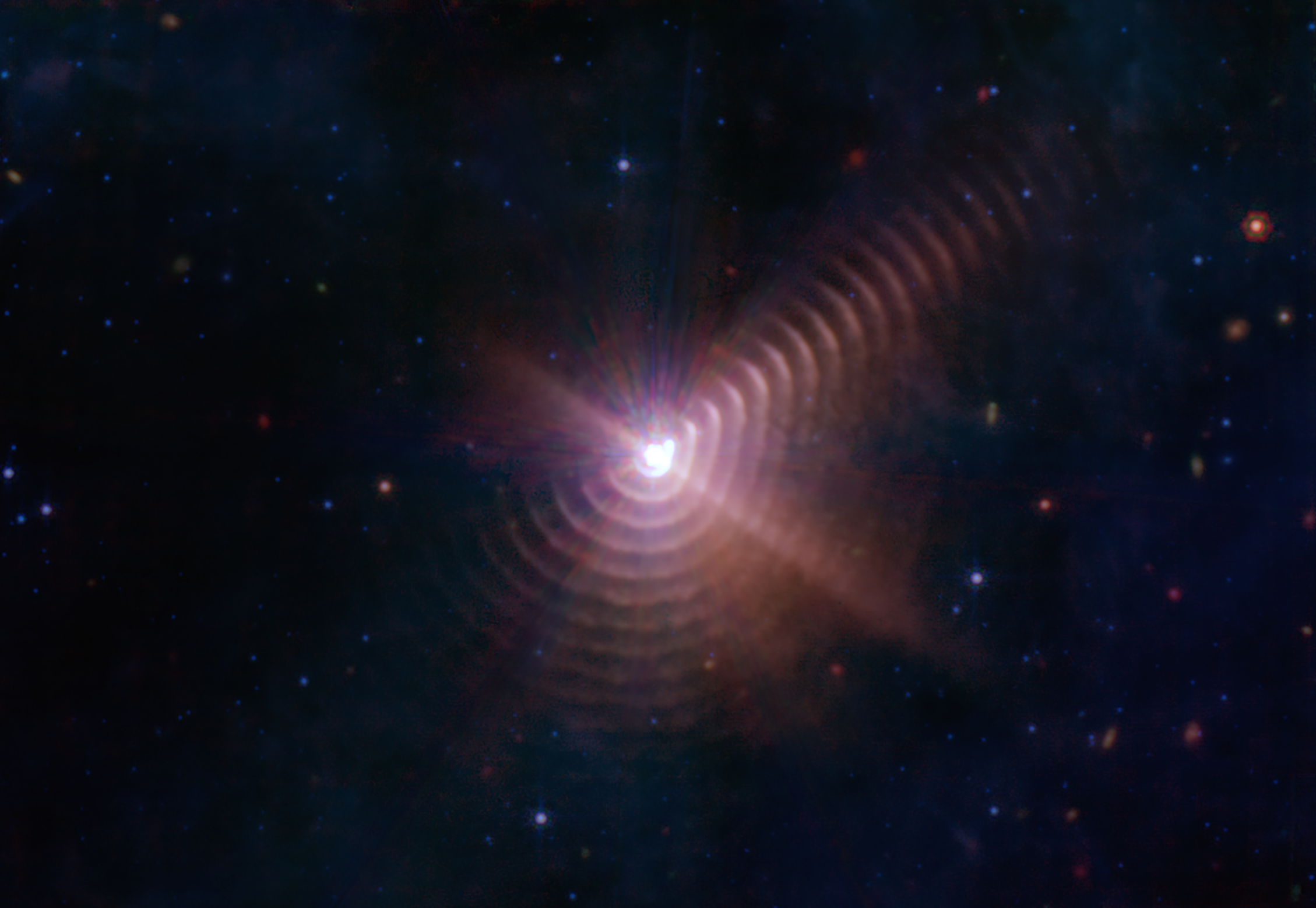
Cool image time! Using the Webb telescope, astronomers have detected a series of concentric shells surrounding the massive binary star dubbed Wolf-Rayet 140.

The infrared image to the right shows these shells quite clearly. As noted by astronomer Ryan Lau:

“On the night that my team’s Early Release Science observations of the dust-forming massive binary star Wolf-Rayet (WR) 140 were taken, I was puzzled by what I saw in the preview images from the Mid-Infrared Instrument (MIRI). There seemed to be a strange-looking diffraction pattern, and I worried that it was a visual effect created by the stars’ extreme brightness. However, as soon as I downloaded the final data I realized that I was not looking at a diffraction pattern, but instead rings of dust surrounding WR 140 – at least 17 of them.

“I was amazed. Although they resemble rings in the image, the true 3D geometry of those semi-circular features is better described as a shell. The shells of dust are formed each time the stars reach a point in their orbit where they are closest to each other and their stellar winds interact. The even spacing between the shells indicates that dust formation events are occurring like clockwork, once in each eight-year orbit. In this case, the 17 shells can be counted like tree rings, showing more than 130 years of dust formation. Our confidence in this interpretation of the image was strengthened by comparing our findings to the geometric dust models by Yinuo Han, a doctoral student at the University of Cambridge, which showed a near-perfect match to our observations.

Furthermore, the spectroscopy from Webb says these dust shells are carbon-enriched, showing that the dust released by these aged massive stars is a significant source of the carbon in the universe, the fundamental atom needed for life.

5 comments

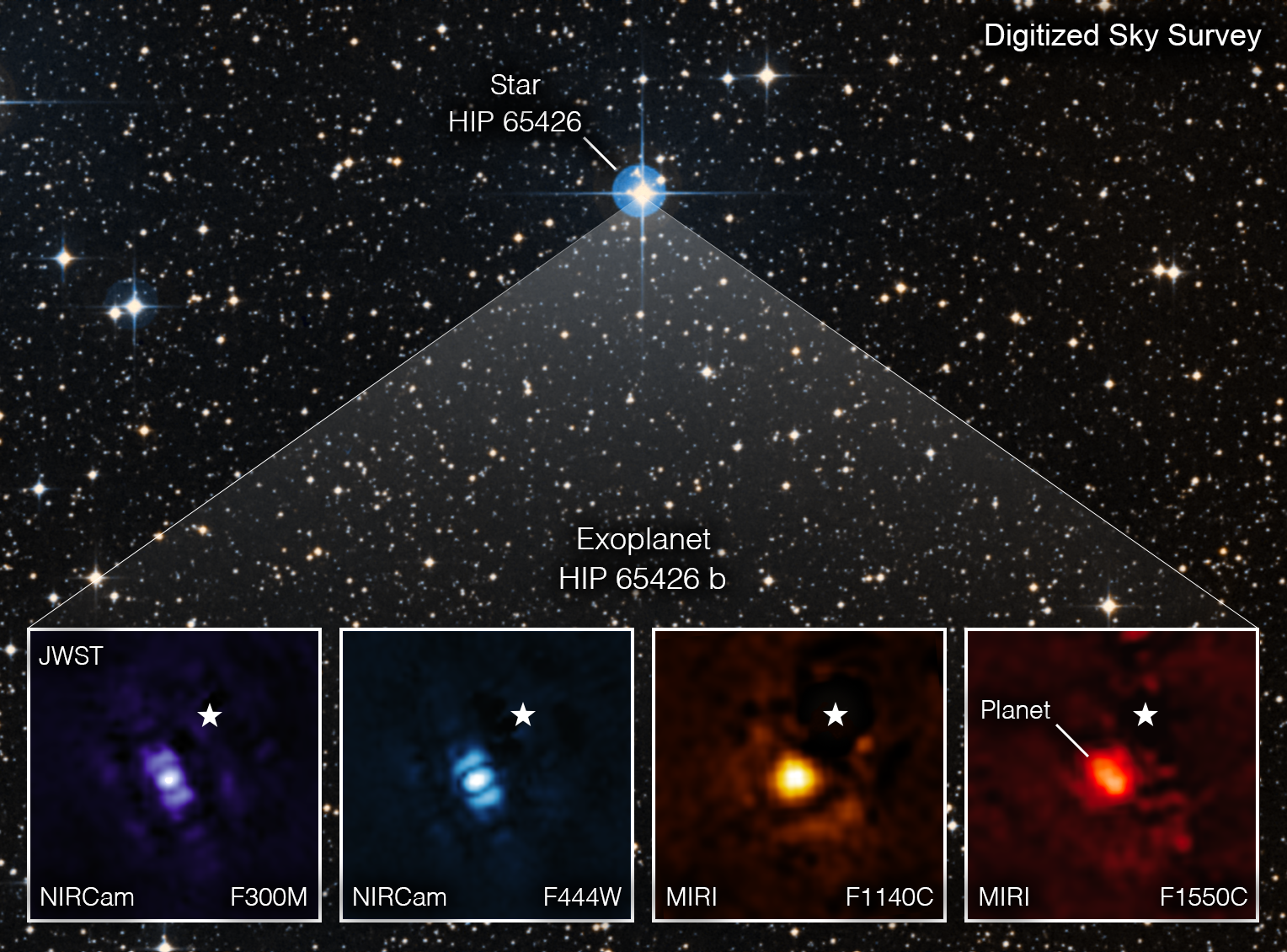
Webb gets first direct infrared image of exoplanet

Exoplanet as seen in the infrared by Webb

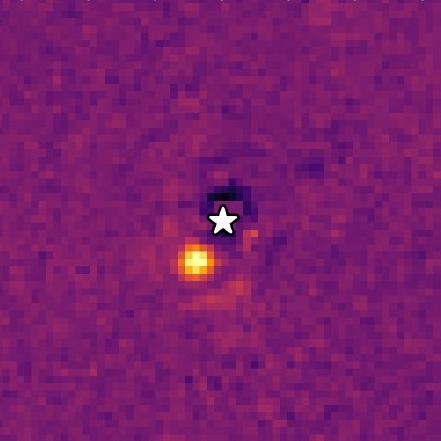
Using the Webb Space Telescope, scientists have obtained that telescope’s first direct infrared image of an exoplanet, covering four different wavelengths.

The image to the right is from the wavelength image with the least distortion (formed by Webb’s own optics and the shape of its mirror and indicated by the faint ring surrounding the planet). The star indicates the masked location of the star itself.

The planet is about seven times the mass of Jupiter and lies more than 100 times farther from its star than Earth sits from the sun, direct observations of exoplanet HIP 65426 b show. It’s also young, about 10 million or 20 million years old, compared with the more than 4-billion-year-old Earth.

You can download the full research paper here.

1 comment

Chandra takes an X-ray look at early Webb infrared observations

Chandra's X-ray vision of the Cartwheel Galaxy
Chandra’s X-ray view of the Cartwheel Galaxy

Webb's view of the Cartwheel Galaxy
Webb’s infrared view of the Cartwheel Galaxy
Click for full image.

Hubble's optical view of the Cartwheel Galaxy
Hubble’s optical view of the Cartwheel Galaxy. Click for original image.

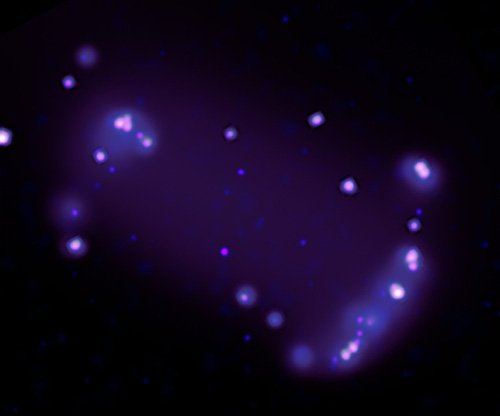
Astronomers have now taken X-ray images using the orbital Chandra X-ray Observatory of four of the first Webb Space Telescope observations. The four targets were the Cartwheel Galaxy, Stephan’s Quintet, galaxy cluster SMACS 0723.3–7327, and the Carina Nebula.

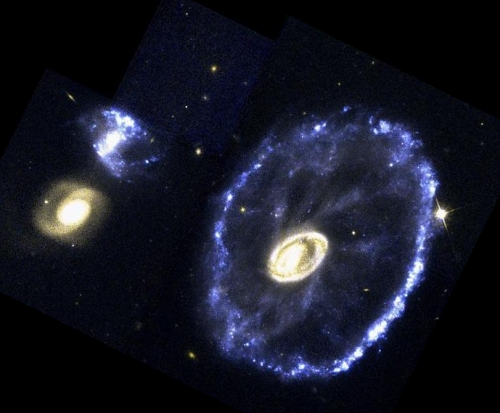
The three images to the right illustrate the importance of studying astronomy across the entire electromagnetic spectrum. Each shows the Cartwheel Galaxy as seen by three of the world’s most important space-based telescopes, each looking at the galaxy in a different wavelength.

The top picture is Chandra’s new X-ray observations. As the press release notes,

Chandra data generally show higher-energy phenomena (like superheated gas and the remnants of exploded stars) than Webb’s infrared view. … X-rays seen by Chandra (blue and purple) come from superheated gas, individual exploded stars, and neutron stars and black holes pulling material from companion stars.

The middle picture was produced by Webb, shortly after the start of its science operations. It looks at the galaxy in the infrared.

In this near- and mid-infrared composite image, MIRI data are colored red while NIRCam data are colored blue, orange, and yellow. Amidst the red swirls of dust, there are many individual blue dots, which represent individual stars or pockets of star formation. NIRCam also defines the difference between the older star populations and dense dust in the core and the younger star populations outside of it.

The bottom picture was taken by the Hubble Space Telescope in 1995. I have rotated the image to match the others. It looks at the galaxy in optical wavelengths, the wavelengths that our eyes perceive.

Note how bright the central galactic region is in the infrared and optical, but is invisible in X-rays. Chandra is telling us that all the most active regions in the Cartwheel are located in that outer ring, not in its center.

2 comments

Initial Webb results revised because telescope wasn’t yet fully calibrated

The uncertainty of science: Though it appears that no results will have to be abandoned, the scientists who published some of the very first results from the Webb Space Telescope have been scrambling to adjust and revise their papers because the telescope is only now getting fully calibrated.

“This caused a little bit of panic,” says Nathan Adams, an astronomer at the University of Manchester, UK, who, along with his colleagues, pointed out the problem in a 9 August update to a preprint they had posted in late July3. “For those including myself who had written a paper within the first two weeks, it was a bit of — ‘Oh no, is everything that we’ve done wrong, does it all need to go in the bin?’”

To try to standardize all the measurements, the STScI is working through a detailed plan to point Webb at several types of well-understood star, and observe them with every detector in every mode for every instrument on the telescope4. “It just takes a while,” says Karl Gordon, an astronomer at the STScI who helps lead the effort.

In the meantime, astronomers have been reworking manuscripts that describe distant galaxies on the basis of Webb data. “Everyone’s gone back over and had a second look, and it’s not as bad as we thought,” Adams says. Many of the most exciting distant-galaxy candidates still seem to be at or near the distance originally estimated. But other preliminary studies, such as those that draw conclusions about the early Universe by comparing large numbers of faint galaxies, might not stand the test of time. Other fields of research, such as planetary studies, are not affected as much because they depend less on these preliminary brightness measurements.

Overall, it does not appear the more precise calibrations will change much of signficance, since most of the earliest observations were simply that, observations, not theoretical. Because the distance estimates remain largely unchanged however the theorists are left with the same conundrum: The age and apparent nature of the most distant objects does not seem to fit with what the theories had predicted Webb would see.

1 comment

Hubble & Webb make first coordinated observations, tracking DART impact of Dimorphus

Webb and Hubble together look at DART impact of Dimorphus
Click for full image.

For the first time scientists have used both the Hubble Space Telescope and the James Webb Space Telescope to observe the same astronomical event, in this case the impact of the DART spacecraft on the asteroid Dimorphus on September 26, 2022.

The two images to the right show the asteroid several hours after impact. Both telescopes also captured images before the impact as well. From the press release:

Observations from Webb and Hubble together will allow scientists to gain knowledge about the nature of the surface of Dimorphos, how much material was ejected by the collision, and how fast it was ejected. Additionally, Webb and Hubble captured the impact in different wavelengths of light – Webb in infrared and Hubble in visible. Observing the impact across a wide array of wavelengths will reveal the distribution of particle sizes in the expanding dust cloud, helping to determine whether it threw off lots of big chunks or mostly fine dust. Combining this information, along with ground-based telescope observations, will help scientists to understand how effectively a kinetic impact can modify an asteroid’s orbit.

When Webb was first conceived in the late 1990s, it was exactly for this reason, to combine Hubble’s optical vision with Webb’s infrared view. Though more than a decade late, it has finally happened.

It will be months before scientists begin to decipher the data produced by all the telescopes and spacecraft used to observe the DART impact. What we are seeing now are merely hints at what has been learned.

10 comments

Webb’s first infrared image of Neptune

Webb's infrared view of Neptune
Click for full image.

The science team for the James Webb Space Telescope today released that telescope’s first infrared image of Neptune.

That image is to the right, cropped and reduced slightly to post here. It is, as the press release touts, the best view in decades of Neptune’s rings. From the caption:

The most prominent features of Neptune’s atmosphere in this image are a series of bright patches in the planet’s southern hemisphere that represent high-altitude methane-ice clouds. More subtly, a thin line of brightness circling the planet’s equator could be a visual signature of global atmospheric circulation that powers Neptune’s winds and storms. Additionally, for the first time, Webb has teased out a continuous band of high-latitude clouds surrounding a previously-known vortex at Neptune’s southern pole.

The dots around the gas giant are the heat signatures of seven of its fourteen moons.

1 comment

Webb instrument has technical issue partly preventing its use

Because a an issue with the mid-infrared instrument (MIRI) on the James Webb Space Telescope, the telescope’s engineering team has paused use of that instrument while it reviews the situation.

On Aug. 24, a mechanism that supports one of these modes, known as medium-resolution spectroscopy (MRS), exhibited what appears to be increased friction during setup for a science observation. This mechanism is a grating wheel that allows scientists to select between short, medium, and longer wavelengths when making observations using the MRS mode. Following preliminary health checks and investigations into the issue, an anomaly review board was convened Sept. 6 to assess the best path forward.

The Webb team has paused in scheduling observations using this particular observing mode while they continue to analyze its behavior and are currently developing strategies to resume MRS observations as soon as possible. The observatory is in good health, and MIRI’s other three observing modes – imaging, low-resolution spectroscopy, and coronagraphy – are operating normally and remain available for science observations.

I am quoting almost entirely NASA’s short announcement. The announcement is vague, confusing, and (quite typically) written to minimize the reality of the issue. I can’t figure out how MIRI’s other observing modes are available if they have paused use of a mechanism that allows them to choose modes.

Regardless, Webb is awful young to have this kind of problem.

0 comments

Webb takes its first infrared image of Mars

Webb's first infrared image of Mars
Click for full image.

Astronomers have now released the the James Webb Space Telescope’s first infrared image of Mars, taken on September 5, 2022.

The image to the right, cropped and reduced to post here, shows some of the data obtained. Because Mars is so close, it is actually too bright for Webb’s instruments. To get any data, the exposures were very very short, and still the brightest areas — as indicated by large areas of yellow — are overexposed. The cause of the different brightness of Hellas Basin, however, is not simply because the basin — the deepest point on Mars — is cooler.

As light emitted by the planet passes through Mars’ atmosphere, some gets absorbed by carbon dioxide (CO2) molecules. The Hellas Basin – which is the largest well-preserved impact structure on Mars, spanning more than 1,200 miles (2,000 kilometers) – appears darker than the surroundings because of this effect. “This is actually not a thermal effect at Hellas,” explained the principal investigator, Geronimo Villanueva of NASA’s Goddard Space Flight Center, who designed these Webb observations. “The Hellas Basin is a lower altitude, and thus experiences higher air pressure. That higher pressure leads to a suppression of the thermal emission at this particular wavelength range [4.1-4.4 microns] due to an effect called pressure broadening. It will be very interesting to tease apart these competing effects in these data.”

The NASA press release says the scientists are preparing a paper analyzing the spectral data and what it revealed about “dust, icy clouds, what kind of rocks are on the planet’s surface, and the composition of the atmosphere,” I suspect however that Webb’s capabilities for studying Mars are much more limited than implied, and that it will over time take much fewer images of the red planet, compared to Hubble.

0 comments

Webb’s infrared view of the Tarantula Nebula

Two views of the Tarantula Nebula by Webb
Click for original image.

The two images to the right, reduced and annotated to post here, were released today by the science team of the James Webb Space Telescope, and show two different views of the Tarantula Nebula, located 161,000 light years away in the Large Magellanic Cloud.

It is home to the hottest, most massive stars known. Astronomers focused three of Webb’s high-resolution infrared instruments on the Tarantula. Viewed with Webb’s Near-Infrared Camera (NIRCam) [top], the region resembles a burrowing tarantula’s home, lined with its silk. The nebula’s cavity centered in the NIRCam image has been hollowed out by blistering radiation from a cluster of massive young stars, which sparkle pale blue in the image. Only the densest surrounding areas of the nebula resist erosion by these stars’ powerful stellar winds, forming pillars that appear to point back toward the cluster. These pillars contain forming protostars, which will eventually emerge from their dusty cocoons and take their turn shaping the nebula.

…The region takes on a different appearance when viewed in the longer infrared wavelengths detected by Webb’s Mid-infrared Instrument (MIRI) [bottom]. The hot stars fade, and the cooler gas and dust glow. Within the stellar nursery clouds, points of light indicate embedded protostars, still gaining mass. While shorter wavelengths of light are absorbed or scattered by dust grains in the nebula, and therefore never reach Webb to be detected, longer mid-infrared wavelengths penetrate that dust, ultimately revealing a previously unseen cosmic environment.

As with all images from Webb, these are false color, as the telescope views the infrared heat produced by stars and galaxies and interstellar clouds, not the optical light our eyes see. Thus, the scientists assign different colors to the range of wavelengths each instrument on Webb captures.

These photos once again illustrate Webb’s value. It will provide a new layer of data to supplement the basic visual information provided by the Hubble Space Telescope, allowing scientists to better understand the puzzles we see in the optical.

8 comments

Webb obtains first direct infrared images of exoplanet

Webb's first infrared images of an exoplanet
Click for original image.

Using four different infrared instruments on the James Webb Space Telescope, astronomers have obtained the first infrared images of a gas giant with a mass about six to twelve times larger than Jupiter and circling about 100 times farther from its sun.

The montage to the right shows these four images. The white star marks the location of this star, the light of which was blocked out to make the planet’s dim light visible. The bar shapes on either side of the planet in the NIRCam images are artifacts from the instrument’s optics, not objects surrounding the planet.

This is not the first direct image of an exoplanet, as the Hubble Space Telescope has already done so, and done it in the visible spectrum that humans use to see. However, Webb’s infrared images provide a great deal of additional detail about this planet and its immediate surroundings that optical images would not. For example, the MIRI images appear to show us the outer atmosphere of this gas giant.

1 comment

Webb’s infrared view of a face-on spiral galaxy

M74, as seen by Webb and Hubble combined
Click for original image.

Using the James Webb Space Telescope, astronomers have produced a false-color infrared view of M74, a face-on spiral galaxy located 32 million light years away.

The montage above shows that image to the right, with a Hubble optical image to the left. In the center both images are combined.

The addition of crystal-clear Webb observations at longer wavelengths will allow astronomers to pinpoint star-forming regions in the galaxies, accurately measure the masses and ages of star clusters, and gain insights into the nature of the small grains of dust drifting in interstellar space.

Because infrared can see through cold dust, it provides a much sharper view of this galaxy’s central regions.

7 comments

Webb detects carbon dioxide in atmosphere of exoplanet

Scientists using the James Webb Space Telescope have detected carbon dioxide in the atmosphere of a hot gas giant exoplanet about 700 light years away.

WASP-39 b is a hot gas-giant with a mass roughly one-quarter that of Jupiter (about the same as Saturn) and a diameter 1.3 times greater than Jupiter. Its extreme puffiness is partly related to its high temperature (about 900° Celsius or 1170 Kelvin). Unlike the cooler, more compact gas giants in our solar system, WASP-39 b orbits very close to its star – only about one-eighth the distance between the Sun and Mercury – completing one circuit in just over four Earth-days. The planet’s discovery, reported in 2011, was made based on ground-based detections of the subtle, periodic dimming of light from its host star as the planet transits or passes in front of the star.

Previous observations from other telescopes, including the Hubble and Spitzer space telescopes, revealed the presence of water vapour, sodium, and potassium in the planet’s atmosphere. Webb’s unmatched infrared sensitivity has now confirmed the presence of carbon dioxide on this planet as well.

This is only the beginning. Astronomers have told me repeatedly that the most important area of research in astronomy in the next few decades will be the study of known exoplanets and their make-up. Webb is now a new tool in that effort. Combined with other telescopes looking at other wavelengths scientists will be able to identify a whole range of molecules in the atmospheres of these transiting exoplanets. We will begin to get our first glimpse into what other solar systems are like.

1 comment

Another Webb infrared image of Jupiter released

Jupiter as seen in the infrared by Webb
Click for original image.

The science team for the James Webb Space Telescope today released another infrared false-color image of Jupiter, this time processed for science instead of calibration of the telescope after launch.

That image is to the right, reduced to post here. From the caption:

Several exposures in three different filters were assembled to create this mosaic, after being corrected for the rotation of the planet. The combination of filters yields an image whose colors denote the height of the clouds and the intensity of auroral emissions.

The F360M filter (mapped to the red-orange colors) is sensitive to light reflected from the lower clouds and upper hazes. The red features in the polar regions are auroral emissions, caused by ions excited through collisions with charged particles at altitudes up to 1000 km above the cloud level. Auroral emission in red is evident in the northern and southern polar regions and reaches high above the limb of the planet. In the F212N filter (mapped to yellow-green colors), the gaseous methane in Jupiter’s atmosphere absorbs light; the greenish areas around the polar regions come from stratospheric hazes 100-200 km above the cloud level. The stratospheric haze that appears green in this composite is also concentrated in the polar regions, but extends down to equatorial latitudes and can also be seen along the limbs (edges) of the planet. The cyan channel holds the F150W2 filter, which is primarily sensitive to reflected light from the Jupiter’s deeper main cloud level at about one bar.

The Great Red Spot, the hazy equatorial region and myriad small storm systems appear white (or reddish-white) in this false-color image. Regions with little cloud cover appear as dark ribbons north of the equatorial region. Some dark regions — for example, those next to the Great Red Spot and in cyclonic features in the southern hemisphere — are also dark-colored when observed in visible wavelengths.

This image is part of the telescope’s early release science program.

7 comments

First Webb infrared image of Cartwheel Galaxy

Webb's view of the Cartwheel Galaxy
Click for full image.

Scientists today have released a new infrared image of the Cartwheel Galaxy, taken by two instruments on the James Webb Space Telescope. That image is to the right, reduced to post here. From the caption:

In this near- and mid-infrared composite image, MIRI data are colored red while NIRCam data are colored blue, orange, and yellow. Amidst the red swirls of dust, there are many individual blue dots, which represent individual stars or pockets of star formation. NIRCam also defines the difference between the older star populations and dense dust in the core and the younger star populations outside of it.

The galaxy, located about a half billion light years away, is one of the more well known astronomical objects due to its unusual shape, believed caused by a collision with a smaller galaxy sometime in the past. Earlier this year for example astronomers discovered a supernovae had exploded in the galaxy sometime in 2021. To see a 1995 Hubble optical image, go here.

This Webb image reveals many new details previously obscured by dust.

2 comments
1 5 6 7 8 9 10