First images from Lucy’s fly-by of asteroid Donaldjohanson

Asteroid Donaldjohanson
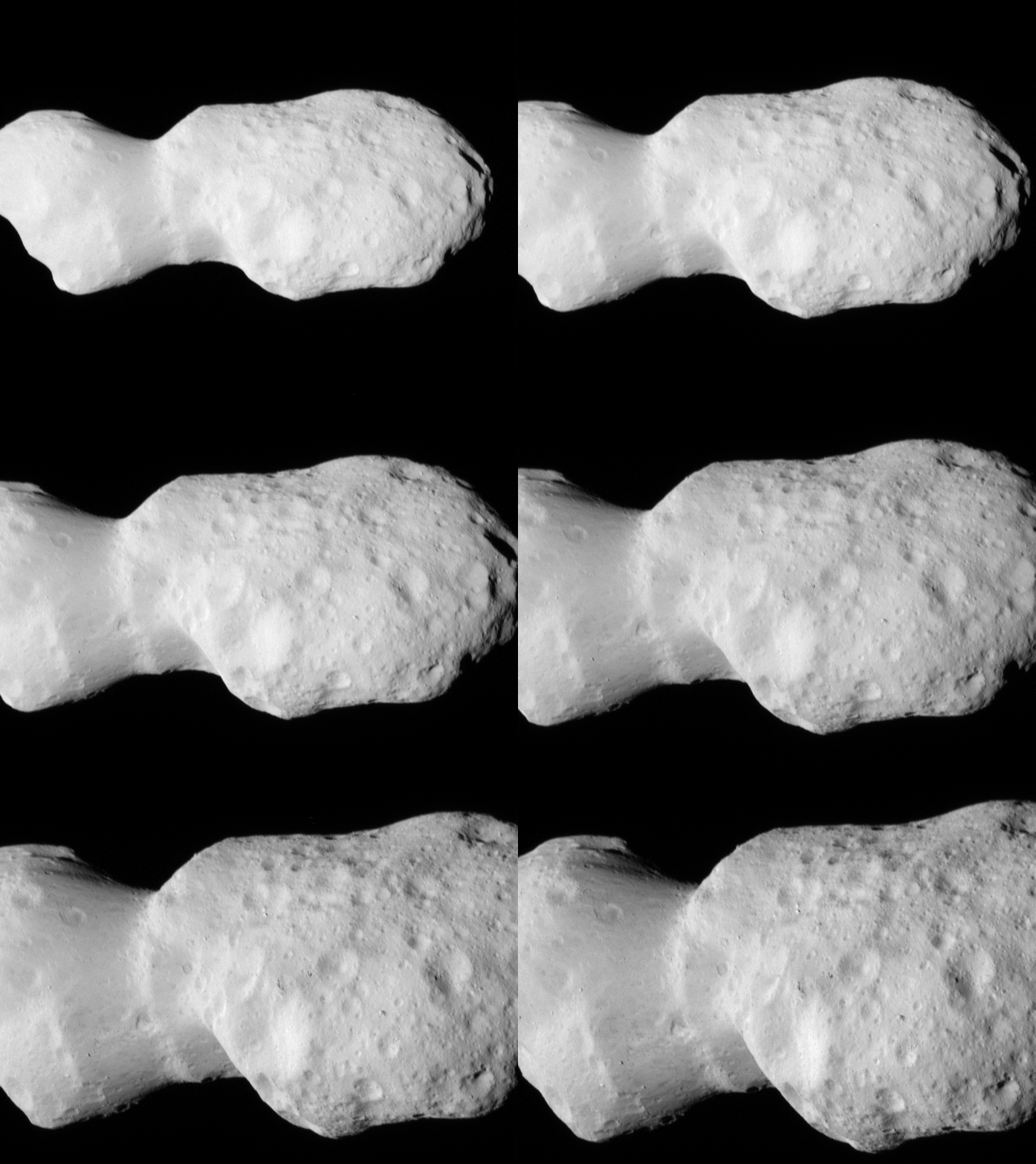
Closest view of asteroid DonaldJohanson.
Click for movie.

The science team for the asteroid probe Lucy today released the pictures taken by the spacecraft as it approached the asteroid Donaldjohanson on April 20, 2025, compiled into a short movie.

The asteroid was previously observed to have large brightness variations over a 10-day period, so some of Lucy team members’ expectations were confirmed when the first images showed what appeared to be an elongated contact binary (an object formed when two smaller bodies collide). However, the team was surprised by the odd shape of the narrow neck connecting the two lobes, which looks like two nested ice cream cones.

…From a preliminary analysis of the first available images collected by the spacecraft’s L’LORRI imager, the asteroid appears to be larger than originally estimated, about 5 miles (8 km) long and 2 miles (3.5 km) wide at the widest point. In this first set of high-resolution images returned from the spacecraft, the full asteroid is not visible as the asteroid is larger than the imager’s field of view. It will take up to a week for the team to downlink the remainder of the encounter data from the spacecraft; this dataset will give a more complete picture of the asteroid’s overall shape.

Lucy is now on its way to the orbit of Jupiter, where it will get close-up views of five different Trojan asteroids in 2027, followed by a later visit to another group of Trojans in 2033.

2 comments

Japan’s Hayabusa-2 asteroid probe in safe mode

Japan’s Hayabusa-2 asteroid probe, which had successfully dropped off samples from the rubble-pile asteroid Ryugu in 2020 and then was sent on a long journey to visit two more asteroids, has suffered an unknown anomaly and shifted into safe mode to protect its instruments.

Communications between Earth and the spacecraft were stable, however, and teams were investigating the situation and its impact on the extended mission, a machine translation of the post read. JAXA has yet to provide a new update since posting about the anomaly.

If engineers can identify the problem and bring the spacecraft back into full operations, the hope is that it will fly past another asteroid in 2026 on its way to a third in 2031, where it will remain for a period of time doing more detailed observations.

0 comments

Lucy’s next asteroid fly-by on April 20, 2025

Lucy's future route through the solar system
Lucy’s route to the asteroids, with its first picture
of Donaldjohanson in lower right, taken in February.
Click for original blink animation.

The science team operating the probe Lucy are now preparing for the spacecraft’s second asteroid fly-by, set of April 20, 2025, and passing within 600 miles of the surface of asteroid Donaldjohanson.

Lucy’s closest approach to Donaldjohanson will occur at 1:51pm EDT on April 20, at a distance of 596 miles (960 km). About 30 minutes before closest approach, Lucy will orient itself to track the asteroid, during which its high-gain antenna will turn away from Earth, suspending communication. Guided by its terminal tracking system, Lucy will autonomously rotate to keep Donaldjohanson in view. As it does this, Lucy will carry out a more complicated observing sequence than was used at Dinkinesh [the first asteroid that Lucy saw up close in 2023]. All three science instruments – the high-resolution greyscale imager called L’LORRI, the color imager and infrared spectrometer called L’Ralph, and the far infrared spectrometer called L’TES – will carry out observation sequences very similar to the ones that will occur at the Trojan asteroids.

However, unlike with Dinkinesh, Lucy will stop tracking Donaldjohanson 40 seconds before the closest approach to protect its sensitive instruments from intense sunlight.

“If you were sitting on the asteroid watching the Lucy spacecraft approaching, you would have to shield your eyes staring at the Sun while waiting for Lucy to emerge from the glare. After Lucy passes the asteroid, the positions will be reversed, so we have to shield the instruments in the same way,” said encounter phase lead Michael Vincent of Southwest Research Institute (SwRI) in Boulder, Colorado. “These instruments are designed to photograph objects illuminated by sunlight 25 times dimmer than at Earth, so looking toward the Sun could damage our cameras.”

Unlike most of the Trojan asteroids Lucy will study, Donaldjohanson is a main belt asteroid. It is thought to be only 150 million years old, but its history would be expected to be very different than those Trojan asteroids.

0 comments

Astronomers: Potentially dangerous asteroid 2024 YR4 originally came from main asteroid belt

Using new data from ground-based telescopes, astronomers now believe that the potentially dangerous asteroid 2024 YR4 originally came from main asteroid belt and is a stony solid body, not a rubble pile.

The study reveals YR4 is a solid, stony type that likely originated from an asteroid family in the central Main Belt between Mars and Jupiter, a region not previously known to produce Earth-crossing asteroids. “YR4 spins once every 20 minutes, rotates in a retrograde direction, has a flattened, irregular shape, and is the density of solid rock,” said Bryce Bolin, research scientist with Eureka Scientific and lead author of the study.

You can read the paper here [pdf].

At present calculations suggest it has an almost zero chance of hitting the Earth in 2032, though during that close approach the chances of it hitting the Moon range from 2% to 4%, depending on which scientist you ask.

6 comments

Europe’s Hera asteroid probe sends back data from Mars fly-by

Deimos and Mars as seen by Hera
Click to see full movie.

The European Space Agency (ESA) Hera probe, on its way to study the Didymos/Dimorphos asteroid binary, has successfully sent back images and data obtained during its close-by of Mars yesterday.

The infrared image to the right, a screen capture from a short movie assembled from Hera’s first images, shows the Martian moon Deimos with Mars in the background. The mission scientists have compiled all of these first images taken by Hera to create a short movie, that I have embedded below. From the movie’s caption:

The car-sized Hera spacecraft was about 1000 km away from Deimos as these images were acquired. Deimos orbits approximately 23 500 km from the surface of Mars and is tidally locked, so that this side of the moon is rarely seen. Hera’s TIRI – supplied to the mission by the Japan Aerospace Exploration Agency, JAXA – sees in mid-infrared spectral bands to chart surface temperature. Because Deimos lacks an atmosphere, the side of the moon being illuminated by the Sun is considerably warmer than the planet beneath it.

Although it appears as if Deimos is passing in front of Mars from south to north, the image was actually taken as Hera passed very close to Deimos from north to south at high speed.

Deimos appears brighter than Mars. This means that the surface of airless Deimos is hotter than the surface of Mars. The material covering the surface of Deimos has low reflectivity and is pitch black. This allows it to absorb sunlight well and become hotter. In contrast, the surface of Mars is highly reflective, and its atmosphere transports heat from the warm daytime side to the cooler nighttime side. This is why there is a large temperature difference between Mars and Deimos.

These infrared images also tell us the excellent quality of the camera. Note how detailed the features are on the Martian surface. When Hera gets to Didymos/Dimorphos in December 2026 it is going to be able to document those two asteroids in remarkable detail, including the results of the Dart impact on Dimorphos in September 2022.
» Read more

0 comments

Europe’s Hera probe to fly past Mars tomorrow

As part of its journey to the binary asteroid Didymos/Dimorphos, the European Space Agency’s (ESA) Hera probe will slingshot past Mars tomorrow, obtaining images and data of both the red planet and its moon Deimos.

Three instruments will gather data, a navigational camera, and infrared camera, and a spectral camera, with the goal mostly to calibrate the instruments and make sure they are working as designed. The data won’t be available until the next day, when the ESA will hold a webcast unveiling the images.

0 comments

Psyche captures Jupiter and Mars on its way to asteroid Psyche

Jupiter and Mars as seen by Psyche
Click for original image.

As part of routine maintenance and calibration, engineers on January 30, 2025 used the cameras on the Psyche asteroid probe to photograph Jupiter, Mars, and several stars, proving all is well with the spacecraft.

Scientists on the imaging team, led by Arizona State University, also took images of the bright stars Vega and Canopus, which have served as standard calibration sources for astronomers for decades. The team is also using the data to assess the effects of minor wiggles or “jitter” in the spacecraft’s pointing system as it points the cameras to different places in the sky. The observations of Jupiter and Mars also help the team determine how the cameras respond to solar system objects that shine by reflected sunlight, just like the Psyche asteroid.

The starfield pictures shown here are long-exposure (five-second) images captured by each camera. By over-exposing Jupiter to bring out some of the background stars in the Taurus constellation, the imagers were able to capture Jupiter’s fainter Galilean moons as well.

The picture to the right, cropped and reduced to post here, might not be much to look at, but it clearly demonstrates the cameras work and the spacecraft can point accurately, and will work as planned when it arrives at the metal asteroid Psyche in August 2029.

2 comments

Astroforge’s Odin spacecraft tumbling and probably be lost

According to a video update by the company’s founder, Matt Gialich, Astroforge’s Odin spacecraft is slowly tumbling, and is likely going to be lost.

Gialich noted that they still have one more possibility to save the spacecraft, but “hope is fading.”

The goal had been to make the first fly-by of an asteroid by a private company, getting data on the M-type asteroid 2022 OB5, thought to be made up largely of nickel-iron which would make it extremely valuable.

4 comments

Lucy takes first picture of its next target asteroid

Lucy's future route through the solar system
Lucy’s route to the asteroids. Click for original blink animation.

The asteroid probe Lucy, on its way to the orbit of Jupiter to study numerous Trojan asteroids, has taken its first picture of the the main asteroid belt asteroid Donaldjohanson, which it will pass within 600 miles on April 20, 2025.

The map to the right shows the spacecraft’s looping route to get to the Trojans, with that image of Donaldjohanson in the lower right. Though the asteroid is about two miles side, it will remain an unresolved point of light until the day of the fly-by. This image was taken from a distance of 45 million miles. As for the asteroid’s name:

Asteroid Donaldjohanson is named for anthropologist Donald Johanson, who discovered the fossilized skeleton — called “Lucy” — of a human ancestor. NASA’s Lucy mission is named for the fossil.

After this encounter, Lucy will head to the Trojans, where it will visit its first six asteroids (including two binaries) in 2027-2028.

0 comments

New calculations now say asteroid 2024 YR4 will almost certainly not hit the Earth in 2032

According to an announcement from NASA yesterday, the chances of asteroid 2024 YR4 hitting the Earth in 2032 is now reduced to 0.004%, meaning that it almost certainly not a threat at that time.

There remains a 1.7% chance it will instead impact the Moon in 2032.

These refined calculations were likely achieved by looking not at the asteroid itself (it is now too far away), but at places where it might have been visible to ground-based telescopes in the past, assuming it had an orbit that will hit the Earth in 2032. Since those past observations did not see it, those orbits are thus eliminated, and the threat goes down.

Of course, the uncertainty remains. It also remains important that we obtain more detailed information about this asteroid, because it is still a potential threat to the Earth.

0 comments

New observations reduce odds of asteroid 2024 YR4’s 2032 Earth impact to practically zero

The uncertainty of science: According to a short update from NASA late yesterday, new ground-based observations have now reduced the odds that asteroid 2024 YR4’s will hit the Earth in 2032 to only 0.28 percent.

Observations made overnight on Feb. 19 – 20 of asteroid 2024 YR4 have further decreased its chance of Earth impact on Dec. 22, 2032, to 0.28%. NASA’s planetary defense teams will continue to monitor the asteroid to improve our predictions of the asteroid’s trajectory. With this new data, the chance of an impact with the Moon increased slightly to 1%.

Expect these numbers to change again in March, when the Webb telescope tracks the asteroid. And do not assume Webb will confirm these numbers. There remains great uncertainty in all these calculations, especially because there is great uncertainty about the size, mass, and make-up of 2024 YR4. It could be anywhere from 130 feet to 320 feet in diameter, and that difference makes these calculations uncertain.

In other words, it remains essential that work should begin on putting together a mission to visit and study this asteroid, now. Though it isn’t large enough to cause a worldwide extinction, it is big enough to do very significant damage, depending on where it hits.

5 comments

The uncertainty of science: Astronomers keep changing the odds of asteroid 2024 YR4 hitting the Earth in 2032

In the past three days three different reports from both NASA and the European Space Agency have given three different percentages for the chances that asteroid 2024 YR4 will hit the Earth in 2032.

On Tuesday, NASA calculated that the space rock had a 3.1% chance of hitting Earth in 2032, while the European Space Agency’s risk assessment sits at 2.8%.

The narrow difference is due to the two agencies’ use of different tools for determining the asteroid’s orbit and modeling its potential impact. But both percentages rise above the 2.7% chance of collision once associated with an asteroid discovered in 2004 called Apophis, making 2024 YR4 the most significant space rock to be spotted within the past two decades.

However, another update shared by NASA on Wednesday showed that 2024 YR4 has a 1.5% chance of colliding with Earth in December 2032, based on new observations now that the full moon has passed. Astronomers have anticipated that such fluctuations are possible as they gather more observational data.

While the media has generally focused mostly on the higher numbers in their knee-jerk “We’re all gonna die” approach to everything, all these different numbers simply illustrate is the generally limited nature of our data about the asteroid’s orbit and its future path. For example because such asteroids are so small, it isn’t just gravity that influences their flight path through the solar system. The Sun’s light pressure can actually have an impact, but to determine how much you need to know the exact size, shape, and rotation of the object. Right now 2024 YR4’s size is estimated to range from 130 to 320 feet in width, determining this effect is presently impossible. Nor is this the only such variable.

At the same time, the data continues to suggest that the chances of this asteroid hitting the Earth are not trivial. The sooner we can find out everything about it the better. Getting a mission to it quickly would be the best way, but so far I have heard little from NASA or anyone about such an idea.

3 comments

New calculations raise odds from 1.2% to 2.3% that asteroid will impact Earth in ’32

New calculations have increased the chances that the recently discovered asteroid 2024 YR4 will hit the Earth in 2032 from 1.2% to 2.3%.

Ongoing observations from ground-based telescopes involved with the International Asteroid Warning Network will continue while the asteroid is still visible through April, after which it will be too faint to observe until around June 2028.

NASA’s James Webb Space Telescope will also observe the asteroid in March 2025 to better assess the asteroid’s size. Currently the asteroid is estimated to be 130-300 feet across.

There remains great uncertainty in these numbers. We will really not know for certain if the asteroid will hit us until its orbit is studied for the next few years. Moreover, its size and make-up is also not known precisely yet. It could be as large as 320 feet, or as small as 130 feet. If the larger size, it poses a much greater risk, though that risk shrinks again if it is a rubble-pile asteroid that will simply break apart upon hitting the atmosphere.

This is not something to take lightly. Though the asteroid is not a world-destroyer, it does have the ability to cause significant damage, depending on where it hits. As its arrival is not for eight years, there is even time to quickly put together an unmanned mission to study it. (In the past I would never said this, but the domination of private enterprise in our present competitive space industry makes many things possible that were impossible when NASA and the government ran everything.)

21 comments

Samples from the asteroid Bennu reshape entirely our understanding of the solar system’s early make-up

Nightingale landing site on Bennu
The sample site on Bennu, with OSIRIS-REx
superimposed for scale. Click for full image.

First, I hope my readers will notice that — unlike NASA and the entire press — I make no mention in my headline above of the discovery of a “mix of life’s ingredients” or “the key building blocks of life” from the samples brought back by the probe OSIRIS-REx from the asteroid Bennu.

This is the game NASA does all the time, to hint at the discovery of life when this is not the real discovery. NASA does it because it knows that if you hint at such a discovery, the press will go crazy and give you lots of press.

The real news from the two papers published this week, available here and here, however, is more fundamental. Before the samples from Bennu and Ryugu (brought back by the Japanese probe Hayabusa-2) had arrived, our understanding of the make-up and chemistry of the early solar system was very incomplete and badly biased. The only asteroid samples we had of carbonaceous chondrite asteroids, the most primitive and fragile carbon-rich asteroids in the solar system, had came from meteorites that had survived the journey through the Earth’s atmosphere. Thus, the only material that survived was robust enough to do so. The more fragile molecules however were always destroyed and thus missing from meteorites, even though it was very clear from spectroscopy of these asteroids in the solar system that such molecules did exist, and likely formed the majority of these asteroids’ make-up.

Thus, though carbonaceous chondrite asteroids represent the early solar system, our understanding of them was warped and very incomplete. The whole point of both missions to Bennu and Ryugu was to fill in this data, to get a more complete census of the real make-up of the early solar system.

The two papers published this week have given us that. That’s their real discovery.
» Read more

3 comments

Astroforge names the target asteroid for its first commercial interplanetary mission

The asteroid mining startup Astroforge today finally named the asteroid that its first commercial interplanetary mission will do a close fly-by, set to launch as a secondary payload on a SpaceX Falcon 9 on February 26, 2025.

The mining startup is headed to asteroid 2022 OB5 as soon as Feb. 26, launching alongside Intuitive Machines’ second lunar mission. CEO Matt Gialich told Payload that they picked that asteroid for the initial mission for a few reasons:

  • It’s under a kilometer wide.
  • It could be a high-value, metal-filled M-type asteroid.
  • AstroForge’s spacecraft will fly by the asteroid when it’s close to Earth, so imagery can be sent back quickly.

This will be Astroforge’s second mission, the first being an Earth-orbit demo flight to prove out its systems. The spacecraft, dubbed Odin, was quickly prepped when the planned satellite satellite failed vibration testing. The company quickly replaced it with the cubesat intended for the third mission.

The company is also proud that the entire cost for this asteroid mission is just $6.5 million. “Hopefully we’re going to show the world that NASA doesn’t need to be funded for $5B missions when we can do it for much less,” said Gialich. The company also announced it has signed a multi-launch contract with the rocket startup Stoke Space, though no specifics were released.

Hat tip BtB’s stringer Jay.

5 comments

200-foot-wide asteroid has a 1-in-83 chance of hitting the Earth in 2032

New data that has refined the solar orbit of 200-foot-wide asteroid discovered in 2024, dubbed 2024 YR4, suggests it has a 1-in-83 chance of hitting the Earth on December 22, 2032.

“Odds have slightly increased to 1 in 83,” Catalina Sky Survey engineer and asteroid hunter David Rankin wrote on BlueSky. “This is one of the highest probabilities of an impact from a significantly sized rock ever.”

Amateur astronomer Tony Dunn shared a simulation of the asteroid approach on his X feed. “Recently-discovered #asteroid 2024 YR4 may make a very close approach to Earth in 8 years. It is thought to be 40-100 meters wide. Uncertainty is still high and more and more observations are needed confirm this.”

The asteroid is rated three on the Torino risk scale, which indicates a close encounter that warrants close attention from astronomers and an over 1% chance of impact.

Though most reports say the asteroid is about 200 feet across, there is great uncertainty in that number. It could also be as large as 320 feet, or as small as 130 feet.

At the moment the risk of impact is still small. If it does occur, there is a chance it could either cause a major airburst similar to the Chelyabinsk meteor impact in 2013 that injured more than 400 people, or even impact the ground or ocean. If it hits the ocean there is a considerable risk of tsunamis. At the moment it appears its path will cross from South America to Africa in the southern hemisphere, but this data remains very uncertain at this time.

Though there will be doom-sayers, overall this is not a world destroyer. It carries some risk, but we have eight years to refine our knowledge significantly, especially when it will make a close approach of five million miles in 2028. At that time scientists should be able to better measure its size as well as its future orbit, determining more precisely whether it will even hit the Earth in 2032.

2 comments

Engineers confirm OSIRIS-APEX successfully completed its second of six close fly-bys of the Sun

Engineers have now confirmed that the asteroid probe OSIRIS-APEX successfully completed its second of six close fly-bys of the Sun in September, using its solar panels to shield its instruments from the Sun’s heat and light.

On Jan. 23 the mission team completed its review of all the data recorded by the spacecraft and its instruments during the solar pass [about 46 million miles from the Sun]. “There were no surprises, and the spacecraft is operating well,” said Mike Moreau, OSIRIS-APEX deputy project manager at NASA’s Goddard Space Flight Center in Greenbelt, Maryland.

As planned, on Sept. 2, 2024, OSIRIS-APEX passed through perihelion — the phase of its orbit closest to the Sun. The trajectory to Apophis takes the spacecraft much closer to the Sun than it was originally designed for. Between Aug. 1 and Oct. 13, the spacecraft was configured in a special orientation that uses one of the solar arrays to shade the most heat-sensitive components, keeping them within safe operating temperatures.

Because of the improvised orientation during the close approach, full data communications was not possible until months afterward. Only now have engineers completed their analysis.

OSIRIS-APEX original mission was to visit the asteroid Bennu and return samples from it to Earth. Once that mission was successfully completed, the probe was repurposed to go to the potentially dangerous asteroid Apophis when it makes its next close approach to the Earth in April 2029.

I have embedded below a short video showing the spacecraft’s journey to get to Apophis.
» Read more

3 comments

Lucy about to do close fly-by of Earth in order to slingshot it towards the orbit of Jupiter

Lucy's future route through the solar system
Lucy’s route to the asteroids. Click for original image.

On December 12, 2024 the asteroid probe Lucy will do a very close fly-by of Earth, dipping to only 220 miles of the ground and thus giving it the velocity to fly through asteroid belt between Mars and Jupiter and on to the Trojan asteroids that orbit with Jupiter.

During the gravity assist, the Lucy spacecraft, from Earth’s perspective, will approach from the direction of the Sun. This means that observers on Earth will not be able to see Lucy approaching, as it will be lost in the Sun’s glare. Lucy’s trajectory will bring the spacecraft very close to the Earth, even lower in altitude than the International Space Station. To ensure the safety of the spacecraft as it passes through this region full of Earth-orbiting satellites and debris, NASA has procedures to anticipate and avoid potential collisions. If needed, the spacecraft will execute a small trajectory correction maneuver 12 hours before closest approach to alter the time of closest approach by 1 or 2 seconds — enough to avoid a potential collision.

Shortly after sunset, keen observers in the Hawaiian Islands may be able to catch a glimpse of Lucy as the spacecraft approaches Earth before it passes into Earth’s shadow at 6:14 p.m. HST. Lucy will speed over the continental U.S. in darkness, travelling over 33,000 miles per hour (14.8 kilometers per second), and emerge from Earth’s shadow 20 minutes later at 11:34 p.m. EST. At that time, Lucy may be visible to observers with a telescope in the western regions of Africa and the eastern regions of South America as sunlight reflects off the spacecraft’s large solar panels (observers in the eastern United States will be looking at the much dimmer “back” side of the solar panels, making Lucy harder to see

No imagery is planned for this flyby in order to protect the spacecraft’s science instruments.

After the fly-by, Lucy’s next target will be the main belt asteroid Donaldjohanson in April 2025. Its arrival in Jupiter orbit will follow in 2027.

0 comments

Reanalysis of Webb data discovers more than a hundred very small main-belt asteroids

Portrait of all 138 new asteroids
Click for original image.

Using data from the Webb Space Telescope in an unexpected way, astronomers have discovered 138 asteroids in the main asteroid belt, most of which are the smallest so far detected.

The picture to the right shows all 138 asteroids. The researchers had originally used Webb to study the atmospheres of the exoplanets that orbit the star TRAPPIST-1. They then thought, why not see if their data also showed the existence of asteroids in our own solar system. By blinking between multiple images they might spot the movement of solar system objects moving across the field of view. From the press release:

The team applied this approach to more than 10 000 [Webb] images of the TRAPPIST-1 field, which were originally obtained to search for signs of atmospheres around the system’s inner planets. By chance TRAPPIST-1 is located right on the ecliptic, the plane of the solar system where all planets and most asteroids lie and orbit around the Sun. After processing the images, the researchers were able to spot eight known asteroids in the main belt. They then looked further and discovered 138 new asteroids, all within tens of meters in diameter — the smallest main belt asteroids detected to date. They suspect a few asteroids are on their way to becoming near-Earth objects, while one is likely a Trojan — an asteroid that trails Jupiter.

The data is insufficient for most of these objects to chart their orbits precisely. Based on this one single study, however, it suggests that pointing Webb along the ecliptic in almost any direction will detect more such objects. Do this enough and astronomers might actually be able to get a rough census of the asteroid belt’s population.

1 comment
1 2 3 4 5 47