
Buses vs high speed trains: the buses win
Buses vs high speed trains: the buses win.
Buses vs high speed trains: the buses win.
An evening pause: How about some tornadoes?
Blue Origin, one of the four commercial companies NASA hopes to use to get crew up and down from ISS, plans to do a test flight tomorrow. Hat tip to SpaceRef.
This company, founded by Jeff Bezos of amazon.com, has generally released very little information about their effort.
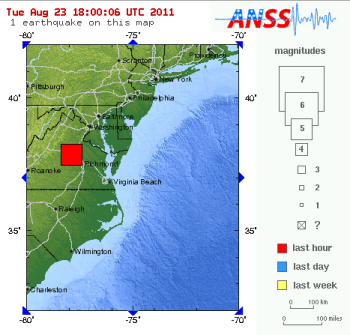
A 5.9 magnitude earthquake hit Virginia at about 1:51 pm (Eastern).
I am in Maryland, just outside the beltway, and felt something like an earthquake about five minutes ago. The house started to shake, then settled, then shook again. Quite startling. I opened the front door the same time a neighbor did. She had felt the same thing.
The above quake was more than 90 miles away. I wonder how bad it is there, considering the eastern U.S. rarely experiences quakes and has made no preparations for such a thing.
For updates:
» Read more
Bigelow Aerospace is in negotiations with both NASA and Japan to supply ISS with privately-built modules
The module could be rented out as an ISS storage unit, making the station less dependent on frequent resupply flights, says Hiroshi Kikuchi of JAMSS. To show that the modules are capable of safe, crewed operation, Bigelow is also negotiating with NASA to attach one to a US-owned ISS module.
.
Crime rate drops in Virginia bars and restaurants serving alcohol after concealed carry guns are allowed.
The religion of peace: Egyptians protest outside the Israeli embassy with swastika sign that says “The gas chambers are ready.”
In a new paper published yesterday, climate scientists described a newly discovered deep, cold current flowing off Iceland’s coast that appears to make the ocean conveyor belt that warms the northern Atlantic less sensitive to climate change than previously thought.
In other words, another one of Al Gore’s doomsday predictions has proven false.
More significantly, scientists now have no understanding why the ocean conveyor belt shut down during past ice ages, as their most favored theory now appears insufficient.
» Read more
Just remember, it is never his fault: The federal debt increased $4 trillion under Obama, the most by any president.
An evening pause: Why I never get my information from television news.
A super-Earth has been identified orbiting its star on the edge of the habitable zone.
Some good regulatory news: The FCC finally killed off the fairness doctrine today.
Below the fold are two images released today, one from Dawn at Vesta and the other from Messenger at Mercury. What makes them interesting to me is that, though the surfaces of both Vesta and Mercury are crater-packed, there are definitely distinct differences between them that one can spot if you look closely, all highlighting the fundamentally different environments of both worlds.
First, the Vesta photograph. The image looks out past the asteroid’s horizon, showing clearly that this dwarf planet is not spherical, with the south pole depression that puzzles scientists just on the planet’s limb. The parallel long deep grooves that are associated with this depression can be seen on the right. Notice also that the inside walls of all the craters slope downward in a very shallow manner. This gives the impression that the impacts that formed these craters smashed into an almost beachlike sandy surface. Note too the that the center of some craters have what appear to be flat small “ponds,” a phenomenon seen by the spacecraft NEAR when it orbited the asteroid Eros. These ponds are not liquid, but are actually made up of fine-grained particles that settle in the hollows of the asteroid.
» Read more
Feeling the pinch: A Florida university has shuttered its manned submersible research program after forty years of operation due to lack of funds.
NASA pushes for funds to save the James Webb Space Telescope.
NASA has announced three awards for technology demonstration space missions, all set to fly within four years. More details here.
The three missions are:
I especially like the solar sail mission because of its long range possibilities, though the other technologies would probably be put to practical use more quickly.
From a Democratic voter in blue-state New York, talking about Obama.
Link fixed. Sorry.
Early hints that scientists had found the Higgs boson at CERN have faded with fresh data.
New data presented today at the Lepton Photon conference in Mumbai, India, show the signal fading. It means that “this excess is probably just a statistical fluctuation”, says Adam Falkowski, a theorist at the University of Paris-South in Orsay, France.