New research suggests that a body-snatching parasitic fly might be the culbrit in the decline of the honeybee population in the U.S.

Alien on Earth: New research suggests that a body-snatching parasitic fly might be the culprit in the decline of the honeybee population in the U.S.

The parasitic fly lays eggs in a bee’s abdomen. Several days later, the parasitized bee bumbles out of the hives—often at night—on a solo mission to nowhere. These bees often fly toward light and wind up unable to control their own bodies. After a bee dies, as many as 13 fly larvae crawl out from the bee’s neck. The bees’ behavior seems similar to that of ants that are parasitized—and then decapitated from within—by other fly larvae from the Apocephalus genus.

1 comment

ArianeSpace will make a profit in 2011, the first time in three years

ArianeSpace will make a profit in 2011, the first time in three years.

Helped by the two Soyuz campaigns, which occurred in October and December, Arianespace in 2011 apparently averted a third consecutive year of losses. Its financial accounts are not finalized until June, but Le Gall said the company expects to report a slight profit on about 985 million euros in revenue.

In other words, it was the addition of the Russian low-cost Soyuz rocket to their fleet that helped avoid another year’s loss. This doesn’t reflect well on the profitability of the Ariane 5 rocket.

0 comments

Is the Senate in recess? The Constitution says no.

Is the Senate in recess? The Constitution says no.

Article One, section Five of the Constitution states: “Neither House, during the Session of Congress, shall, without the Consent of the other, adjourn for more than three days.”

The House has refused to adjourn. The Congress is therefore in session. This kind of gamesmanship has been done many times in the past, but never until now has a President made believe he could simply ignore the plain words of the Constitution.

I know my liberal readers like to make excuses for Democrats when they ignore the law, but the law remains the law. Just because you happen to like what Obama is doing is a bad reason to let this pass. Just remember that if we ignore the law when you’ve got your guy in office, the other side will then have a free pass to ignore the law when they are in office. Sooner or later, we will all pay for that evil.

8 comments

A NASA inquiry into the ownership of a variety of space artifacts, including Jim Lovell’s Apollo 13 checklist, has halted their sale at auction.

Power grab: A NASA inquiry into the ownership of a variety of space artifacts, including Jim Lovell’s Apollo 13 checklist, has halted their sale at auction.

In other words, it appears that NASA management has decided that everything ever built by NASA belongs to NASA, forever, even if NASA would have thrown it away at some point.

1 comment

The Sun calms down in December

It’s that time again! As I do every month, it’s time to post Space Weather Prediction Center’s monthly updated graph showing the Sun’s solar cycle sunspot activity. The graph itself can be seen below the fold.

After five months of quickly increasing sunspot activity, the Sun in December finally took a rest, with the sunspot numbers dropping down to almost exactly the solar activity scientists had expected at this time, according to their May 2009 prediction. Interestingly, this might be the first time since I began tracking the solar cycle in 2008 that the prediction actually matched that month’s activity.
» Read more

3 comments

Democrats regulating the dead

Democrats regulating the dead.

Democrats believe their personal preferences are so noteworthy and have such a significant bearing on the future of society that it’s only fair these indispensible preferences be imposed on the public by force of law.

Which brings us to Democrat Alvin Tillman, a third–term member of the council in Terrebonne Parish, LA, who evidently does not have enough to occupy his time. Tillman is personally offended by the chroma culprits who paint their family tombs anything but white, which is Tillman’s preferred color. “We want to stop this before it gets out of hand,” Tillman was quoted by the Associated Press. “Before you know it you’ll go out there and the cemetery will look like Mardi Gras.”

Since this is Louisiana — where being dead is no bar to exercising the franchise in favor of Democrats on election day — it could be that Tillman is simply responding to the wishes of his electoral base.

2 comments

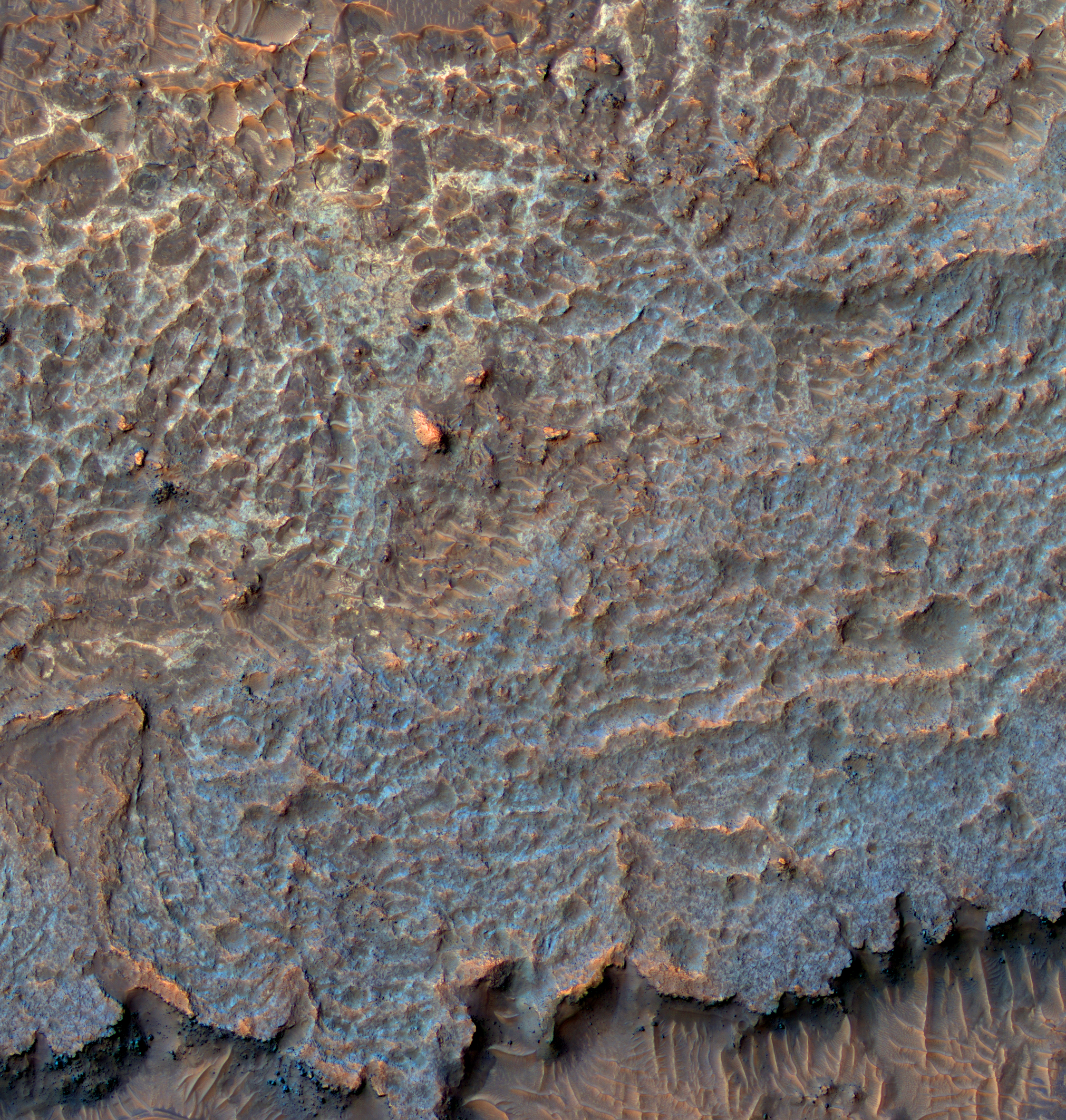
What is this stuff?

What is this stuff?

The uncertainty of science: In this week’s release of images from Mars Reconnaissance Orbiter, the science team posted the image on the right and asked, “What is this stuff?”

Here’s a hypothetical geologic history that might explain this scene: layered sediments were deposited by water or airfall (including volcanic pyroclastics). A crudely polygonal patterned ground was created by stresses in the sediments, and groundwater followed the fractures and deposited minerals that cemented the sediments. This was followed by perhaps billions of years of erosion by the wind, leaving the cemented fractures as high-standing ridges.

Of course, this story is almost certainly incomplete if not totally wrong.

Click here to see the close-up subimage from which I cropped the image on the right.

0 comments

The National Science Foundation has declined until 2020 to commit to funding a giant American-built ground-based telescope

Bad news for American astronomy: The National Science Foundation has declined until 2020 to commit to any funding for either one of the two giant American-built ground-based telescopes.

For nearly a decade now, two university consortia in the United States have been in a race to build two ground-based telescopes that would be several times bigger than today’s biggest optical telescope. One group—led by the University of California—plans to build the Thirty Meter Telescope (TMT) in Hawaii. The other team—led by Carnegie Observatories, the University of Arizona, and other institutions—is developing a 28-meter behemoth named the Giant Magellan Telescope (GMT), which would be built in Chile. Over the past few years, both teams have raised tens of millions of dollars toward the billion-dollar-plus projects in the hope that the U.S. National Science Foundation (NSF) would come up with the balance.

But now, it turns out, neither project has a chance of receiving any significant funding from NSF for at least another decade. In a solicitation posted by NSF last week, the agency indicated that it does not expect to fund the building of any giant segmented mirror telescopes—that is, TMT or GMT—until the beginning of the 2020s. According to the solicitation, all that NSF can provide right now is $1.25 million over 5 years for the development of a public-private partnership plan that could eventually lead to the building of a large telescope, should NSF be in a position to fund such a telescope sometime in the next decade.

I suspect the NSF’s unwillingness to fund this project at this time is directly related to the budget crisis in Washington. Though the NSF got slightly more money in 2012 than in 2011, that money is all accounted for by other projects. There is no margin for anything new that will be as expensive (in the billions) as these giant telescopes will be.


0 comments
1 131 132 133 134