
Orion rollout to launchpad delayed 24 hours because of weather.
The rollout is now scheduled for no earlier than Tuesday evening. The test flight is still scheduled for December 4.
The rollout is now scheduled for no earlier than Tuesday evening. The test flight is still scheduled for December 4.
After initially not switching on as expected, Philae was rebooted and is now powered up, functioning correctly, and ready for its landing on Comet 67P/C-G Wednesday morning.
Six weeks ago one of the two STEREO probes that observe the hemisphere of the Sun that faces away from Earth went dead, and NASA engineers do not know why.
Theft by government: Two men who were detained, their car searched without a warrant, and had more than $100K in cash seized illegally, have now filed suit claiming their constitutional rights were violated.
By the time the encounter was over, the gamblers had been detained for more than two hours. Their car was searched without a warrant. And their cellphones, a computer and $100,020 of their gambling “bankroll” were seized under state civil asset-forfeiture laws. The troopers allowed them to leave, without their money, after issuing a traffic warning and a citation for possession of marijuana paraphernalia that carried a $65 fine, court records show.
Months later, an attorney for the men obtained a video of the stop. It showed that the motorists were detained for a violation they did not commit — a failure to signal during a lane change — and authorities were compelled to return 90 percent of the money.
Now the men are questioning the police tactics in an unusual federal civil rights lawsuit. In the suit, filed Sept. 29, William Barton Davis, 51, and John Newmerzhycky, 43, both from Humboldt County, Calif., claim their constitutional rights against unreasonable searches and seizures were violated. They also contend the stop was part of a pattern connected to the teachings of a private police-training firm that promotes aggressive tactics.
I hope they win big, very big. As far as I can tell, there is nothing legal about this police action. Nothing. It is theft, pure and simple, and thieves are supposed to be punished if caught.
The competition heats up: Angara 5, the most powerful member of the Angara family of rockets, has arrived at the launchpad for its inaugural December test flight.
Russia’s eventually goal is to replace Proton with this rocket. Angara is also designed to be cheaper to launch, which makes it more competitive with SpaceX’s Falcon 9.
The competition heats up: Elon Musk yesterday revealed that he is in negotiations to team-up with a venture that would put in orbit a constellation of 700 satellites to provide low-cost internet access.
The venture was originally linked with Google, but that partnership has faded. Musk meanwhile said that his deal will be announced within the next three months.
The competition heats up: Google subsidiary Planetary Ventures has signed a $1 billion 60-year lease with NASA for use of Moffett Field in California.
An Italian appeals court on Monday overturned the manslaughter convictions of six Italian earthquake scientist for the deaths of over 300 people during the L’Aquila earthquake of 2009.
Only one of the seven experts originally found guilty was convicted today: Bernardo De Bernardinis, who in 2009 was deputy head of Italy’s Civil Protection Department and who will now serve 2 years in jail, pending any further appeals.
De Bernardinis had been the guy who had publicly said that the swarm of tremors prior to the quake had released energy and thus reduced the chance of an earthquake, a claim that geology scientists do not support.
An evening pause: Hat tip Dane.
On Monday the Obama administration declared its desire that the FCC should increase its regulation of the internet, embracing White House proposals for something progressives like to label “net neutrality.”
By backing a policy commonly referred to as Net Neutrality, President Barack Obama is advocating for that the internet to be regulated like any other public utility. “To put these protections in place, I’m asking the [Federal Communications Commission] to reclassifying internet service under Title II of a law known as the Telecommunications Act,” Obama said in a statement on Monday.
Since the issue of “net neutrality” became a hot button progressive issue several years ago, I have tried to figure it out, all to no avail. The issue is so complex that my first instinct is that the government should simply leave well enough alone, since any action the government takes is usually harmful.
Now, however, with Obama putting his brilliant support behind it I have no doubts — these regulatory proposals should be doused with gasoline, burnt to a crisp, then buried in a hole so deep no one will ever be able to dig them up.
I say this not because of any personal hatred of Obama, but because I have seen the disaster of Obama’s biggest regulatory effort, Obamacare. Why should anyone with any brains at all ever trust him again with any future regulatory effort in any area of public policy? No one should. He and the present generation of Democrats proved with Obamacare that their ideas about government regulation are bankrupt. They should quietly sit down and shut up, and let some adults who know how to think run things.
Finding out what’s in it: The Obama administration admitted today that enrollments in Obamacare in 2015 will be 30 percent below their initial predictions.
Federal officials on Monday sought to lower expectations for upcoming enrollment in Obamacare, announcing that they now believe that only between 9 million and 9.9 million people will be enrolled in Affordable Care Act health insurance plans by the end of 2015. That is well below the 13 million people that the Congressional Budget Office has projected for Obamacare enrollment by the end of 2015. Open enrollment for 2015 plans resumes Saturday.
The new projection, more than 30 percent reduced from the CBO estimate, comes from the Health and Human Services Department, which oversees the Obamacare health reform program.
HHS also said it now appears that it will take longer—perhaps quite a bit longer—than 2017 to reach a “steady state” of 25 million Obamacare enrollees that CBO had been projecting for 2017 enrollment. The reduced projection is due to recent data showing “mixed evidence” about how quickly—and how dramatically—people will shift from employer-sponsored health insurance and non-Obamacare plans into insurance plans sold on government-run marketplaces such as HealthCare.gov, according to HHS. [emphasis mine]
The highlighted sentence once again illustrates how blatantly Obama was lying when he said, “If you like your plan you keep your plain. Period.” The goal was always to force people from the plans they had to government-run healthcare.
Speaking of lies, video from 2013 of the man who designed Obamacare for Obama shows that the Democrats knew they were lying when they described Obamacare in 2009 and 2010, and that they were doing so because they consider the American people “stupid.”
Of course, this story should surprise no one. Lying to the public has been the Democratic/leftwing method of operations since Bill Clinton arrived on the political scene. In fact, it amazes me that anyone is surprised by this.
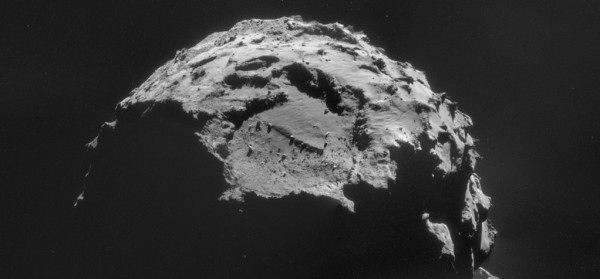
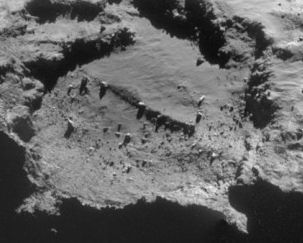
In the preparation to Wednesday’s landing of Philae on Comet 67P/C-G, Rosetta’s science team has released a great image of the landing site, shown above. To the right is a higher resolution inset of the site itself, with the smallest object visible about 8.5 feet across.
Looking at this inset, there are some obvious worries that we all should be aware of prior to the landing attempt. Though the Agilkia landing site is generally more smooth than most of the comet’s surface, it still has significant hazards. The lower part is strewn with boulders and rocks, many of which are quite large. Any one of these could do serious harm to Philae should it land on them.
Even more interesting is the upper part of the landing site. Though very smooth, the image suggests to me that this is a very thick pile of softly packed material. Philae might land there and quickly sink below the surface, where its cameras will be able to see nothing.
Nonetheless, the science team has also released this outline of Philae’s science timeline after landing. The lander will also be taking images of both Rosetta and the comet during its descent, so even if the landing is a failure we will still get some worthwhile data.
Data obtained by the various Mars orbiters during the close fly-by of Comet Siding Spring of Mars has revealed that the comet created a new temporary layer in the planet’s atmosphere.
The European Space Agency’s Mars Express spacecraft detected an increase in electrons in Mars’ upper atmosphere, partly ionising it. This was attributed to fine cometary dust penetrating the atmosphere, which led to a meteor storm of thousands of meteors per hour. The increase in electrons led to the creation of a temporary new layer of charged particles in the ionosphere, which runs from an altitude of 120 kilometres to several hundred kilometres above. This is the first time such an event has been seen, even on Earth the extra density of electrons was measured to be five to ten times higher than normal by NASA’s Mars Reconnaissance Orbiter. Another NASA spacecraft, MAVEN, which also observed the new layer in the ionosphere, will monitor for any long-term events as it goes about its regular duties of studying Mars’ atmosphere.
MAVEN’s Imaging Ultraviolet Spectrograph was able to ascertain the species of ions that flooded into the ionosphere from the comet, the first time a comet that has come direct from the distant Oort Cloud has been sampled in this way. It detected the signal of magnesium, iron and sodium ions following the meteor shower, a signal that dominated Mars’ ultraviolet spectrum for hours afterwards, taking two days to dissipate.
The chemistry that MAVEN detected appears superficially somewhat similar to the chemistry that Rosetta is detecting at Comet 67P/C-G, though there are differences.
This Aviation Week story provides a detailed update on China’s effort to build a new family of Long March rockets that are less expensive to operate and can effectively compete with SpaceX.
Two main take-aways from the article. First, the first flight of the Long March 7, a direct competitor with the Falcon 9, has been seriously delayed. Originally expected to fly in 2013, that first flight has apparently been pushed back to 2015.
Second, even with extensive cost savings, the Long March 7 will still cost a customer more than a Falcon 9, $70 million vs $61 million.
A Soyuz capsule successfully returned three astronauts back from ISS on Monday morning.
A replacement crew is scheduled to launch on November 23.
This story demonstrates why it is becoming essential for every citizen to begin recording their interactions with the police every single time.
Yesterday police were contacted in regard to a video posted online which appeared to show an inappropriate interaction between an on-duty member of the Sheriff’s Office and a civilian, resulting from a suspicious vehicle complaint in the Town of Halfmoon.
The Sheriff’s Office has identified and interviewed all parties involved in the interaction and as a result, the police officer has been suspended without pay effective immediately, pending the outcome of the investigation and possible disciplinary action.
Make sure you watch the video. It is very clear that the officer did not know he was being recorded. It is also clear to me that his behavior in this situation was not unusual, that this police officer is quite used to using violence to get his way, regardless of the law. Had the recording not existed, however, he would not have been suspended, and would not be likely to lose his job.
The recording did exist, however, which has forced the Saratoga police force to take action.
The heat of competition: Orbital Sciences has pinpointed available launch slots and alternative rockets for getting Cygnus into orbit in 2015.
[Orbital CEO David] Thompson said Wednesday the company has narrowed its options to three launch providers which have openings as early as the second quarter — between April 1 and June 30 — of next year. Two of the launch providers are based in the United States. Orbital could also launch Cygnus missions with a European-based company, Thompson said. The contractors under consideration are presumably United Launch Alliance, SpaceX and Arianespace.
Unlike Virgin Galactic’s claims in my previous post, I find Thompson’s prediction here quite likely. His main problem is not technical but political. He has to convince his competitors to help him, and this story is his first shot across the bow in that negotiation. By making these facts public, Thompson applies pressure on these other companies to agree. And though the request is unstated, he is also enlisting NASA’s aid, since the agency is certain to back him in this negotiation and apply its clout in his favor.
The heat of competition: During a press tour of its Mojave facilities this week Virgin Galactic’s CEO revealed that the company expects to begin flying its replacement to SpaceShipTwo by April.
George Whitesides, the company’s chief executive, said construction of the second spaceship is already 65 per cent complete. Like its doomed predecessor, Enterprise, the new spaceship’s name is a tribute to both Nasa and Star Trek. It will be called SS Voyager, the Sunday Times reports.
Whitesides also said that LauncherOne, designed to put very small payloads into orbit, is 18 months away from its first flight.
I hope this predictions are true, but coming from Virgin Galactic I think I can be forgiven if I am very skeptical. Nonetheless, in referring to the new ship I will make it a policy to call it Voyager from here on out to distinguish it from the first ship.
The competition heats up: At an space industry conference this week Sierra Nevada outlined the ability of Dream Chaser to land at almost any airport, including the many financial and safety advantages of that flexibility.
The story notes that because Dream Chaser would not need an unusually long runway, it could land at most airports. Also, because it would have no hazardous materials on board, removing it from the runway after landing would be simple and straightforward. You would simply tow it away. The biggest advantage of this, howevr, is that if the spacecraft was docked at ISS and there was an emergency that required immediate evacuation, bringing Dream Chaser and its passengers home to a runway will be possible any time.
This presentation is part of Sierra Nevada’s sales effort to find new backers for their spacecraft, now that NASA has begged out. I think they make a good sales pitch. I hope someone with money agrees.
This article, about the back room maneuvers by both political parties leading up to last week’s election, has been making the rounds on all the political websites. Called a “must-read, vivid piece”, it reveals all the strategies, mistakes, and childish in-fighting that took place during the campaign, the kind of stuff that makes many people consider politicians such a lower form of life.
I am normally not interested in these smoke-filled backroom stories as I care a lot more about what politicians do when they are in office. This is why I didn’t read the article until today, two days after it was published and after I had seen it quoted in maybe a dozen other political articles about the election.
Having read it I have to agree it is worthwhile reading, but my main take-away is that its focus on the campaign strategies and maneuvers by politicians of both parties epitomizes all that is wrong with modern political journalism as well as the interests too many of its readers. Only once did the article hint at the actual issues crucial to the election, when it summed up the Republican strategy near the beginning of the article:
From the outset of the campaign, Republicans had a simple plan: Don’t make mistakes, and make it all about Obama, Obama, Obama. Every new White House crisis would bring a new Republican ad. And every Democratic incumbent would be attacked relentlessly for voting with the president 97 or 98 or 99 percent of the time.
That’s it. That’s the only hint at real substance in this whole very long and detailed article.
For you see, the election was about Obama and his fumbling incompetence. It was about the policies he and his Democratic supporters in Congress had foisted on the nation. And it was about how those policies have been a disaster for ordinary people all across the nation.
All the games that these politicians play against each other during campaigns really isn’t that important. It might tell you something about their character, but what really matters is what these guys do, when they are in office. Keep that in mind when the next election rolls around, because I guarantee that the politicians and the journalists who write about them are not going to be interested in talking about that. It would be far too embarrassing.