Private company offers to fly packages to Moon

Fly me to the moon! A company building a small lunar rover as part of the Google Lunar X-prize competition is now offering, for a small fee, to include private packages with its lander.

Astrobotic Technology on Thursday (Dec. 11) announced the launch of its new “MoonMail” program, which offers to send heirloom rings, family photos, locks of hair and other small personal items on the company’s first private moon mission set to launch in the next few years. With prices based on the item’s size, MoonMail rates start at $460 for a half-inch wide by 0.125-inch tall (1.27 by 0.3 centimeter) capsule and increase to $25,800 for a one by two-inch (2.54 by 5.08 cm) payload. “You can think of the pricing for it to be very similar to ‘it fits, it ships’ at the post office,” John Thornton, Astrobotic CEO, told collectSPACE.com in a call with reporters. “It is essentially a flat-rate box.”

They hope to launch on a Falcon 9. More interestingly, they want to land and explore one of the Moon’s skylight caves.

The first Griffin is slated to launch on a SpaceX Falcon 9 rocket and land at Lacus Mortis, or the “Lake of Death,” a plain of basaltic lava flows in the northeastern part of the moon as viewed from Earth. “There is a unique feature there called a ‘skylight,'” stated Thornton, adding that only about 300 of these sinkhole-like entrances into subsurface caves have been discovered on the moon. “What’s very unique about the skylight at Lacus Mortis is that its walls have collapsed creating a ramp into the cave. … Caves on the surface of the moon could be our natural shelter,” Thornton explained. “So our first mission goes to one of these caves where we hopefully think someday we could settle on the moon. We think it’s a fantastic location to place MoonMail, which ultimately will be a time capsule of our generation for future moon explorers.”

1 comment

When did humans begin using fire?

A cave in Israel suggests that the human use of fire began around 350,000 years ago.

The researchers examined artifacts previously excavated from the site, which are mostly flint tools for cutting and scraping, and flint debris created in their manufacture. To determine when fire became a routine part of the lives of the cave dwellers, the team looked at flints from about 100 layers of sediments in the lowermost 16 meters of the cave deposits.

In layers older than roughly 350,000 years, almost none of the flints are burned. But in every layer after that, many flints show signs of exposure to fire: red or black coloration, cracking, and small round depressions where fragments known as pot lids flaked off from the stone. Wildfires are rare in caves, so the fires that burned the Tabun flints were probably controlled by ancestral humans, according to the authors. The scientists argue that the jump in the frequency of burnt flints represents the time when ancestral humans learned to control fire, either by kindling it or by keeping it burning between natural wildfires.

There are enormous uncertainties here, but the data also appears to match with what has been found in Europe. The problem however is that this date is long after humans had already migrated to colder climates, which means that they were somehow surviving for a long time in these hostile environments without fire, something that is puzzling.

2 comments

NIH panel recommends cancelling multi-billion dollar study

An government advisory panel has recommended the NIH cancel a controversial nationwide study to track the health of 100,000 children.

The study has already cost one billion, has had two scientists resign because they didn’t like how the study was being run, and has as yet only enrolled 4,000 children.

Update: The NIH officially cancelled the study later the same day the panel’s report was released.

0 comments

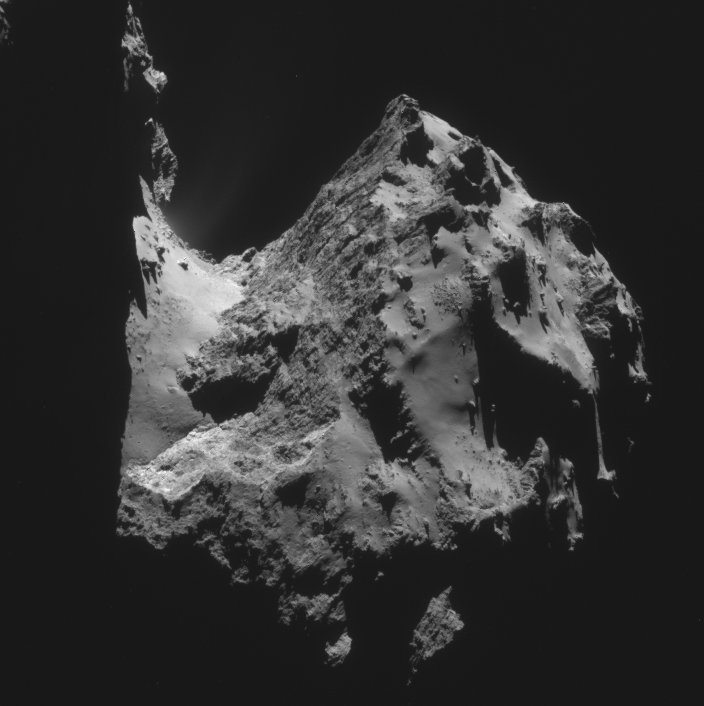
Comet 67P/C-G in color

Comet 67P/C-G in color

You might not believe it, but the image on the right is the first color image taken by Rosetta of Comet 67P/C-G. (Click on the link to see a full image.)

To create an image revealing 67Pโ€™s โ€œtrueโ€ colours, the scientists superposed images taken sequentially through filters centred on red, green, and blue wavelengths. However, as the comet rotated and Rosetta moved during this sequence, the three images are slightly shifted with respect to each other, and are taken from slightly different observing perspectives. Painstaking work is needed to superimpose the images accurately, which is one reason it has taken so long to come up with the first meaningful colour image of 67P/C-G.

As you can see, there really isn’t much color there. Moreover, the comet is so coal-dark that they had to brighten the images to bring out any detail.

0 comments

Global views of six Saturnian moons

Using images collected after ten years in orbit around Saturn, Cassini scientists have released global color maps of six of Saturn’s icy moons, Mimas, Enceladus, Tethys, Dione, Rhea and Iapetus.

These enhanced colour views have yielded several important discoveries about the icy moons. The most obvious are differences in colour and brightness between the two hemispheres of Tethys, Dione and Rhea. The dark reddish colours on the moons’ trailing hemispheres are due to alteration by charged particles and radiation in Saturn’s magnetosphere. The blander leading hemispheres, the sides that always face forward as the moons orbit Saturn, are all coated with icy dust from Saturn’s E-ring, formed from tiny particles erupting from the south pole of Enceladus.

0 comments

“Why the mediaโ€™s fact problems are much bigger than Rolling Stone.”

Link here.

For those who haven’t been following the story, Rolling Stone recently published an expose about a supposed gang-rape at a fraternity at the University of Virginia that they and their reporter used to illustrate the terrible rape culture of today’s universities.

The article has turned out to be largely a fabrication and has instead illustrated the terrible state of modern journalism as well as the corrupt truth-challenged intellectual elite of our society. Mollie Hemingway’s devastating analysis at the link above summarizes this situation nicely, also illustrating why much of what comes out of modern intellectual discussions today is total hogwash.

She doesn’t mention it, but I could not help thinking about global warming as well as the recent Orion test flight (“the spacecraft that will take us to Mars!”). In both cases the press has been seriously challenged to show some justifiable skepticism of official press releases and has failed miserably.

1 comment

The geography of scientific plagiarism

A review of the text of hundreds of thousands of papers submitted by scientists worldwide has revealed the countries from which plagiarism is most likely.

Researchers from countries that submit the lion’s share of arXiv papersโ€”the United States, Canada, and a small number of industrialized countries in Europe and Asiaโ€”tend to plagiarize less often than researchers elsewhere. For example, more than 20% (38 of 186) of authors who submitted papers from Bulgaria were flagged, more than eight times the proportion from New Zealand (five of 207). In Japan, about 6% (269 of 4759) of submitting authors were flagged, compared with over 15% (164 out of 1054) from Iran.

The global map illustrating this geography at the link is quite fascinating to peruse, as it generally shows the cultural roots of plagiarism. Happily, western culture does not appear to be the source.

0 comments

A Russian commercial reusable space shuttle?

A news report from Russia today described a project to build a commercial and reusable space shuttle for putting tourists into space.

The company, KosmoKurs, presently has eight employees and says it will launch by 2020. However, this quote from the article illustrates the difficulties faced by any new private companies in Russia:

Russian rocket and space industry is planned to produce this space shuttle. โ€œWe will talk to the United Rocket and Space Corporation. If we find common language, we will manufacture produce jointly with them,โ€ the KosmoKurs head said. The company also pins hopes on backing of Russian Federal Space Agency and its scientific institutes.

Since Russia has now consolidated its entire aerospace industry into one government-controlled entity called the United Rocket and Space Corporation, any new private effort needs to get the cooperation of that company as well as the agreement of the government officials who control it. Such backing is not so easy to get, especially if the new company is seen as competition and a distraction from government goals.

1 comment

Comet 67P/C-G unveils a scientific surprise

Data from Rosetta of Comet 67P/C-G strongly suggests that the origin of the comets of its class come from a wide range of locations within the early solar system, and that many of these comets might not have delivered the water to Earth as previously believed.

The data also suggests that the Earth’s water came more from asteroids, not comets, something that scientists had not expected.

0 comments
1 6 7 8 9 10 170