
A new net for Mr. Steven

Photos of the ship, Mr. Steven, that SpaceX wants to use to recover its rocket fairings show that the company has installed a new net for catching those fairings.

The article theorizes that this heftier net has actually been installed for eventually catching the Falcon 9’s upper stage.

[T]he newly-installed net is by all appearances magnitudes larger, heavier, and stronger than the minimal mesh specimen it is clearly replacing. Given the fact that SpaceX thus far has self-admittedly failed to catch a gliding fairing half in the net, it seems unlikely that such a drastic upgrade would be necessitated by any field-testing that occurred since Mr. Steven’s debut late last year. Rather, a significantly more capable net seems to more readily fit alongside CEO Elon Musk’s tweet reveal three weeks prior that SpaceX would attempt to close the final major loop of Falcon reusability by recovering the orbital upper stage (S2). Estimated to weigh approximately 4000 kilograms empty, the upper stage is a minimum of four times heavier than Falcon 9’s payload fairing halves, Mr Steven’s current meal of choice.

Judging from the new net’s beefy rigging, broader bars, and general appearance, one could safely argue that it looks at least several times stronger than the mesh net before it. One could also argue that the absolutely massive metal arms installed on Mr. Steven are far larger than what might be required to catch the extremely low mass-to-area ratio payload fairings, with structural heft and bulky netting more reminiscent of safety nets present on naval vessels that are designed to catch aircraft and helicopters weighing five metric tons or more.

This is an interesting theory, but I have my doubts. At the same time, I would not dismiss Musk’s willingness to try daring engineering approaches.
2 comments

House committee boosts NASA budget while micromanaging its projects

A NASA budget proposal released earlier this week by the House Appropriations Committee boosts NASA’s budget to $21.5 billion, while also micro-managing some of NASA’s planetary projects.

The bill, though, does specify funding for some programs. It calls for spending $545 million on the Europa Clipper mission and $195 million for a follow-on lander. NASA requested only $264.7 million for Europa Clipper and nothing for the lander.

NASA said in the budget proposal it was seeking to launch Europa Clipper in 2025 on a commercial vehicle, while the bill calls for the use of the Space Launch System and a launch by 2022. In its budget proposal, NASA estimated needing $565 million in 2019 to keep Europa Clipper on track for a 2022 launch but warned of “potential impacts to the rest of the Science portfolio” if funded at that level.

The bill also included $3.5 billion for SLS/Orion, continuing that boondoggle as it continues to fall behind schedule and go over budget. Also in the bill was a half billion dollars for LOP-G, confirming Congress’s desire to get this new boondoggle running, even though the rocket and capsule necessary to fly it, SLS/Orion, hasn’t even come close to completion after almost two decades of work and almost $40 billion so far in spending.

Overall, this NASA budget proposal illustrates once again why we have Trump. Congress is corrupt, is only interested in distributing money to its corporate buddies, and doesn’t care if that cash ever produces anything. In fact, it appears they prefer that nothing ever get built, as a real space effort would carry risk, and we can’t have that!

3 comments

China launches Earth observation satellite

China’s Long March 4C rocket today launched an Earth observation remote sensing satellite.

I think I need to put together an outline of all of China’s operational rockets. The 4C appears to be similar to the 4B, but knowing how it differs from their other rockets, and why they have each, would be helpful information.

The leaders in the 2018 launch standings:

14 China
8 SpaceX
5 Russia
5 ULA

China has once again pulled ahead of the U.S., 14-13, in the national standings.

5 comments

Putin dumps Rogozin

In a reshuffle of cabinet positions, Putin has replaced Dmitri Rogozin, putting a new man in charge of the Russian defense and space industry.

The new guy, Yuri Borisov, appears to have the title of Vice Prime Minister. I suspect Putin had grown tired of the continuing corruption and loss of market share under Rogozin’s watch during the past decade. I also suspect that Borisov will have little ability to change things. The problem isn’t the person in charge. The problem is Russia’s centralized top-down method of operations. It discourages competition and cost control, while providing no incentives for innovation and quality control.

5 comments

Astronomers find evidence for thousands of black holes near galaxy center

The uncertainty of science: Using data from the Chandra X-Ray Observatory, astronomers have found evidence suggesting that thousands of stellar-mass black holes might exist circling Sagittarius A* (pronounced A-star), the super-massive black hole at the center of the Milky Way.

Essentially, they found a dozen likely black hole candidates in what they think are X-ray binaries system. From this they extrapolate the number of potential stellar-massed black holes at the center of the galaxy. However,

While the authors strongly favor the black hole explanation, they cannot rule out the possibility that up to about half of the observed dozen sources are from a population of millisecond pulsars, i.e., very rapidly rotating neutron stars with strong magnetic fields.

In other words, this conclusion is very uncertain. Nonetheless, even if half of their candidates are not stellar-mass black holes, the results do suggest that there are a very large number of black holes circling Sagittarius A*. Using this information astronomers will be able to better refine their theories on the formation process for such super-massive black holes.

0 comments

Software issue caused self-driving car accident that killed pedestrian

Sources in the investigation of an accident where a self-driving car hit and killed a pedestrian in Arizona in March now say that the car’s programming was at fault.

According to two anonymous sources who talked to Efrati, Uber’s sensors did, in fact, detect Herzberg as she crossed the street with her bicycle. Unfortunately, the software classified her as a “false positive” and decided it didn’t need to stop for her.

Distinguishing between real objects and illusory ones is one of the most basic challenges of developing self-driving car software. Software needs to detect objects like cars, pedestrians, and large rocks in its path and stop or swerve to avoid them. However, there may be other objects—like a plastic bag in the road or a trash can on the sidewalk—that a car can safely ignore. Sensor anomalies may also cause software to detect apparent objects where no objects actually exist.

Software designers face a basic tradeoff here. If the software is programmed to be too cautious, the ride will be slow and jerky, as the car constantly slows down for objects that pose no threat to the car or aren’t there at all. Tuning the software in the opposite direction will produce a smooth ride most of the time—but at the risk that the software will occasionally ignore a real object. According to Efrati, that’s what happened in Tempe in March—and unfortunately the “real object” was a human being.

I honestly do not understand the need for self-driving cars. In the end, I simply cannot see the software ever being capable of handling all the variables created by the presence of the unpredictable life that will surround it. And should it get that good, I wonder if we will then regret it.

21 comments

Trump pulls U.S. from Iran nuclear deal

As he promised during the campaign as well as several times since he became President, Trump today announced that the U.S. is leaving the Iran nuclear treaty that had been negotiated by the Obama administration.

Laying out his case, Trump contended, “If we do nothing, we know exactly what will happen. In just a short period of time, the world’s leading state sponsor of terror will be on the cusp of acquiring the world’s most dangerous weapons.”

The administration said it would re-impose sanctions on Iran immediately but allow grace periods for businesses to wind down activity. Companies and banks doing business with Iran will have to scramble to extricate themselves or run afoul of the U.S. government.

…Trump, who repeatedly criticized the accord during his presidential campaign, said Tuesday that documents recently released by Netanyahu showed Iran had attempted to develop a nuclear bomb in the previous decade, especially before 2003. Although Trump gave no explicit evidence that Iran violated the deal, he said Iran had clearly lied in the past and could not be trusted.

The AP article at the link is a decidedly anti-Trump partisan hit job, less interested in reporting this news story than telling us how terrible Trump’s actions are. Nor should we be surprised, as two of the AP writers who contributed to the story are based in Tehran.

7 comments

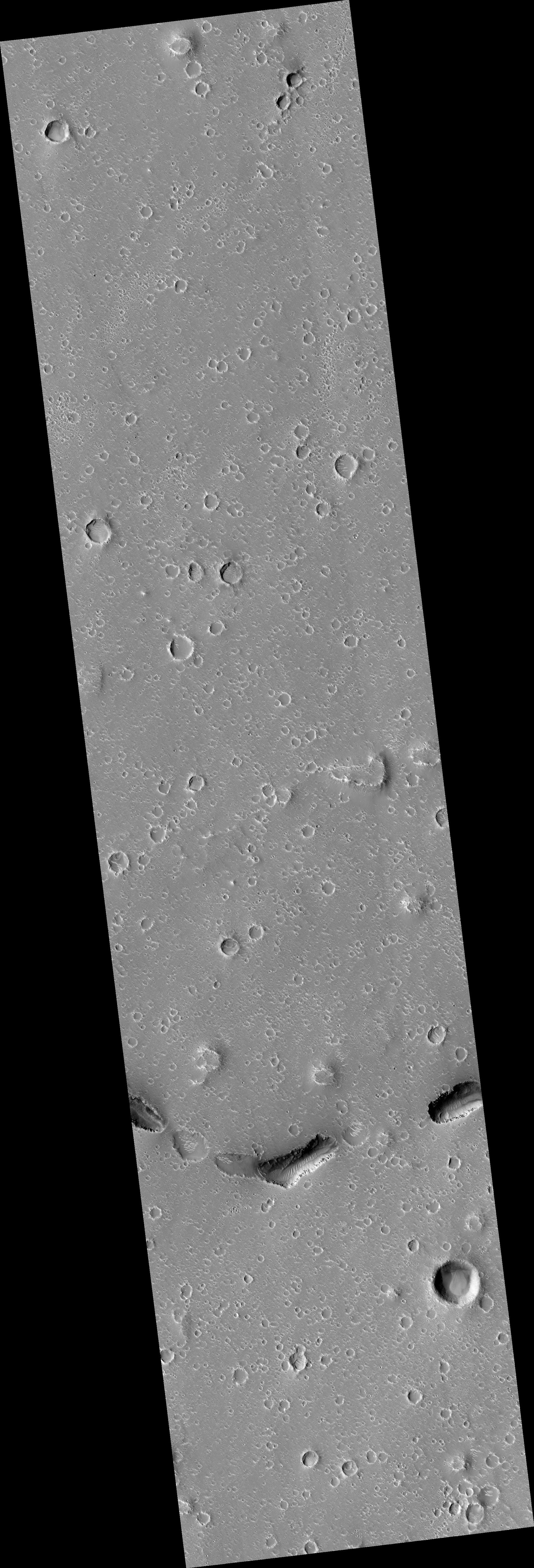
Craters, cones, pits, amid endless plains

Pits, cones, and craters

Cool image time! Buried in the catalog of recent high resolution images from Mars Reconnaissance Orbiter are places on Mars that are inexplicable and fascinating, while also indicative of its vastness. The image on the right, reduced in resolution and cropped to post here, shows us one such place. If you click on the image you can see the full image at high resolution.

The archive posting of this image is titled “Cones near Pits.” As you can see, to the north and east of the pits are some mesas (why they call them cones I do not know).

The pits are unusual, and appear to be some form of collapse. In the larger image several additional mesas can be seen at farther distances, but most of the overall terrain is remarkably flat and featureless, except for numerous small craters that appear either partly buried by dust or significantly eroded.

I am not going to guess at the geology that caused the pits and mesas. What I do want to focus on is the vastness of Mars. This location is on the southern edge of Utopia Basin, the second deepest basin on Mars. It is part of the planet’s endless northern plains, an immense region covering almost half the planet that tends to be at a lower elevation, is relatively smooth, and is thought by some scientists to be evidence of what was once an intermittent ocean. The global map of Mars below indicates the location of the above image with a black cross.
» Read more

16 comments

School lets everyone qualify for cheerleader squad

The coming dark age: Because the parent of one student who did not make the team complained, a New Jersey school has decided that everyone who wants to be part of the cheerleader team will be included, regardless of their talent or skill or training.

Not surprisingly, the students who had trained and worked hard to qualify were not happy.

“All my hard work has been thrown out the window,” seethed cheerleader Stephanie Krueger about the ruling during a Board of Education meeting last week in East Hanover.

…Krueger and several other cheerleaders voiced their anger last Wednesday during a board meeting, according to News 12 New Jersey. “I came up here to state that I did not put in 18 months of work to lead up to this moment, just to be told it didn’t matter anymore,” said sophomore Jada Alcontara.

No matter. Being “inclusive” and catering to those who are lazy or untalented is far more important that encouraging quality and hard work. That’s the modern way, and the future.
» Read more

10 comments

Another company enters the smallsat rocket competition

Capitalism in space: Another new smallsat company, Rocket Crafters, has entered the competition, focusing on the development of 3D-printed rocket engines using hybrid fuels.

The company’s Cidco Road facility is notable for what is not there, Gutierrez said. Unlike a more typical rocket engine site, there are no signs warning of explosive materials, no use of super-cold or toxic propellants, and no engines equipped with turbo pumps.

Instead, the rocket fuel consisted of plastic tubes made from the same base materials as Legos, measuring two feet long and weighing about five pounds, that were stacked on shelves and safe to touch. Combined with nitrous oxide — commonly known as “laughing gas” — the small-scale test engine on Monday generated about 200 pounds of thrust firing at half-power. It was one of more than 20 such firings over the past year at the facility Cocoa officials rezoned to allow the tests, which were deemed safe to the surrounding people and environment.

“We’re not the noisiest neighbor in the area,” joked Robert Fabian, senior vice president of the propulsion division.

Most rockets rely on super-cold or “cryogenic” propellants such as liquid oxygen or liquid hydrogen, or solid fuel like the space shuttle’s twin solid rocket boosters used.

Hybrid motors have suffered from uneven burns producing bumpy rides, Fabian said. But Rocket Crafters believes it has found a low-cost solution providing a smooth, consistent burn: 3-D printed cylinders of fuel formed in ridged and beaded layers.

We shall see. They hope to fly by 2020, at the earliest. They will be joining an increasingly crowded field. If their design works, however, they will certainly carve out a significant market share, as hybrid fuels are so much safer and easier to handle than traditional propellants.

2 comments

Pluto is a planet

In an op-ed today, the principal investigator for the New Horizons’ mission as well as his co-author for the history of that mission explained in detail why the definition for planet as imposed by the International Astronomical Union (IAU) is flawed and unworkable.

In 2006, the International Astronomical Union (IAU) announced an attempted redefinition of the word “planet” that excluded many objects, including Pluto. We think that decision was flawed, and that a logical and useful definition of planet will include many more worlds.

We find ourselves using the word planet to describe the largest “moons” in the solar system. Moon refers to the fact that they orbit around other worlds which themselves orbit our star, but when we discuss a world like Saturn’s Titan, which is larger than the planet Mercury, and has mountains, dunes and canyons, rivers, lakes and clouds, you will find us — in the literature and at our conferences — calling it a planet. This usage is not a mistake or a throwback. It is increasingly common in our profession and it is accurate.

Most essentially, planetary worlds (including planetary moons) are those large enough to have pulled themselves into a ball by the strength of their own gravity. Below a certain size, the strength of ice and rock is enough to resist rounding by gravity, and so the smallest worlds are lumpy. This is how, even before New Horizons arrives, we know that Ultima Thule is not a planet. Among the few facts we’ve been able to ascertain about this body is that it is tiny (just 17 miles across) and distinctly nonspherical. This gives us a natural, physical criterion to separate planets from all the small bodies orbiting in space — boulders, icy comets or rocky and metallic asteroids, all of which are small and lumpy because their gravity is too weak for self-rounding.

They go on to explain the flawed history of the IAU definition, and how it has simply not been accepted by astronomers and planetary scientists alike. The definition makes no sense, and excludes the thousands of exoplanets discovered orbiting other stars. They also point to a proposed new definition that is simple and admits to reality.

A planet is a sub-stellar mass body that has never undergone nuclear fusion and that has sufficient self-gravitation to assume a spheroidal shape adequately described by a triaxial ellipsoid regardless of its orbital parameters.

Whether or not the stuffed shirts at IAU ever officially endorse this definition, it is the one that human beings are using now, and it will be the one they use into the never-ending future.

8 comments
1 103 104 105 106 107 155