
A good health check for Mars Reconnaissance Orbiter

Link here. The article outlines in good detail the spacecraft’s present condition, which is excellent despite being in space since 2005, as well as outlining the measures being taken to keep it operational into the 2020s.

This item is probably the biggest cause for concern:

For example, some HiRISE images taken in 2017 and early 2018 show slight blurring not seen earlier in the mission. The cause is under investigation. The percentage of full-resolution images with blurring peaked at 70 percent last October, at about the time when Mars was at the point in its orbit farthest from the Sun. The percentage has since declined to less than 20 percent. Even before the first blurred images were seen, observations with HiRISE commonly used a technique that covers more ground area at half the resolution. This still provides higher resolution than any other camera orbiting Mars — about 2 feet (60 centimeters) per pixel — and little blurring has appeared in the resulting images.

HiRISE is the spacecraft’s primary instrument, and its most valuable. If it goes, we will lose our best tool right now for looking in detail at the Martian surface.

0 comments

Trump signs two-year budget deal

Big spending wins! The new two-year budget deal, which provides increased spending and eliminates the sequestration budget caps, has been signed into law by President Trump.

I know people might think me insane when I say this, but Trump’s comments upon signing the bill remind me of Ronald Reagan when he signed compromise bills with the Democrats that were not what he really wanted. Trump calls it a victory, but also said this:

“Without more Republicans in Congress, we were forced to increase spending on things we do not like or want in order to finally, after many years of depletion, take care of our Military,” he wrote. “Sadly, we needed some Dem votes for passage. Must elect more Republicans in 2018 Election!”

Trump continued to praise the bill as a victory, because of the big spending boost to the military. He criticized Democrats for “waste” in the bill. “Costs on non-military lines will never come down if we do not elect more Republicans in the 2018 Election, and beyond,” he said. “This Bill is a BIG VICTORY for our Military, but much waste in order to get Dem votes.”

Though I strongly think we have plenty of waste in the military as well, and that the Defense Department didn’t need any increases and could have been cut considerably, in many ways Trump’s comments here reflect reality. For the American public to get its federal government under control, that public is going to have to vote out the people who presently run it in an uncontrollable manner. And while there are many establishment Republicans to which this description applies, the vast majority of the legislators who are pushing out-of-control spending are Democrats.

10 comments

San Francisco area #1 in nation for fleeing residents

Fleeing the communist state: The San Francisco area is now #1 in the nation in the number of residents fleeing for more hospitable regions.

Joint Venture Silicon Valley’s own study of the out-migration says workers are moving to Sacramento, Austin, and Portland due to a number of factors. But topping the list is the high cost of housing. “You can’t even contemplate getting into the housing market here,” Hancock said. “And I don’t mean just service workers, but highly skilled professionals. The tech elite are having a hard time affording reasonable housing in Silicon Valley. That makes it difficult for employers to recruit.”

The article however also cites the politics of the region.

Dabak cites crowding, crime and politics as the reasons for her own exodus. “We don’t like it here anymore. You know, we don’t like this sanctuary state status and just the politics,” she said. She plans to sell her home for about $1 million, buy a much larger place near Nashville for less than half that and retire closer to family and friends.

I am reminded of East Germany in the 1950s. Ruled by the Soviets and the communists they installed (whom today we might call radical leftists), it became the only western nation in the world that had a shrinking population, mostly because of the vast numbers of residents that were fleeing to West Germany, where they were free to make a living as they wished. In East Germany’s communist state they were poor and oppressed. In West Germany’s capitalist state they could be prosperous and free.

To solve this problem, Khrushchev built a wall between East and West Germany, to imprison his citizens. When they continued to flee, using the loophole that existed in Berlin (with half its territory controlled by the western Allies), he then built a wall through the middle of the city. It stopped the population loss, while making the residents of his communist bloc prisoners.

What will the leftist radicals who now run California do? As people flee their bankrupt state, will they then decide to build a wall to keep people in? I wonder.

4 comments

Narwhals love glaciers!

New research tracking fifteen narwhals over four years has revealed that they like to hang out near glaciers that are stable and do not have many calving events.

To better understand what glacier features narwhals prefer, Laidre and her colleagues used data from 15 narwhals outfitted with recorders that tracked each animal’s movements over four years in the 1990s and 2000s in Greenland’s Melville Bay, where narwhals congregate in summer. They combined this data with information about glaciers in Melville Bay over the same time period.

The researchers examined how narwhals behaved at the glaciers and collected information about each glacier’s physical properties to create models of narwhal behavior and tease out the animals’ preferences. “Narwhals like slow-moving, big walls of ice where conditions are still and serene instead of a lot of runoff and disturbance,” Laidre said.

The researchers don’t know why the narwhals prefer these glaciers. They think the freshwater could shock small marine critters that are food for fish, which narwhals eat. Narwhals are also close relatives of beluga whales, which also seek out freshwater in summer to shed their skin, and it is possible there is something similar going on at the glacier front, Laidre said.

This is fascinating research. What is especially refreshing about it is that the press release makes no mention of global warming, a omission that is proper but increasingly rare in the politicized science community.

0 comments

SSL lawsuit against Orbital ATK to move forward

A judge has ruled that a lawsuit brought by SSL against Orbital ATK, two companies competing for satellite servicing work, can go forward.

The case stems a December 2016 incident where NASA officials notified SSL that there had been unauthorized access to SSL documents related to a NASA “Tipping Point” technology development award on a server at the Langley Research Center. SSL had received that award earlier in the year to work on technologies related to in-space satellite servicing.

That unauthorized access was traced to an Orbital ATK employee, who was subsequently fired by the company. However, SSL said in its suit that as many as six Orbital ATK employees viewed the documents. SSL filed the suit in March 2017 seeking an injunction to prevent Orbital ATK from using any of those documents in its own projects, as well as “other and further relief the Court may deem just and appropriate.”

Both companies have satellite servicing missions planned. What I want is for both to succeed, to provide some competition in the field. Though I suspect this is doubtful, this lawsuit has the possibiliity of killing Orbital ATK’s effort.

0 comments

New Horizons takes the most distant pictures from Earth ever taken

Kuiper Belt Object 2012 HE85

The New Horizons science team has released three images taken by the spacecraft from almost 3.8 billion miles from Earth, the most distant images ever taken.

The routine calibration frame of the “Wishing Well” galactic open star cluster, made by the Long Range Reconnaissance Imager (LORRI) on Dec. 5, was taken when New Horizons was 3.79 billion miles (6.12 billion kilometers, or 40.9 astronomical units) from Earth – making it, for a time, the farthest image ever made from Earth.

…LORRI broke its own record just two hours later with images of Kuiper Belt objects 2012 HZ84 and 2012 HE85 – further demonstrating how nothing stands still when you’re covering more than 700,000 miles (1.1 million kilometers) of space each day.

The images themselves are not spectacular to look at, though the two images of two different Kuiper Belt objects are the best ever taken of such objects, and certainly contain data that scientists will be able to use. The image on the right is one of these objects, 2012 HE85. For example, note how it does not appear to be round.

This exercise is in preparation for the January 1, 2019 fly-by of 2014 MU69, where the images will be sharp and detailed, and provide us a good look at such a distant object.

3 comments

NASA approves 2020 launch window for first Dream Chaser flight

Capitalism in space: Sierra Nevada has gotten the okay from NASA to aim for a 2020 launch window for the first flight of its reusable Dream Chaser mini-shuttle.

SNC announced Feb. 7 that it had received “authority to proceed” on that mission using the company’s Dream Chaser vehicle. The mission will launch on a United Launch Alliance Atlas 5 rocket in late 2020. The mission is the first of six in the company’s Commercial Resupply Services (CRS) 2 contract it won in 2016 to transport cargo to and from the ISS. SNC received a CRS-2 contract along with current CRS providers Orbital ATK and SpaceX.

“While we won the contract a couple of years ago, the contract still needed to be validated by a task order,” said Mark Sirangelo, executive vice president of SNC’s Space Systems business area, in a Feb. 7 speech at the Federal Aviation Administration’s Commercial Space Transportation Conference here. That order, he said, is the “biggest step” to date on the program. That flight will be a “full scale, fully operational mission,” he said, even though it will represent the first orbital flight of the Dream Chaser. Orbital ATK and SpaceX, who developed their Cygnus and Dragon spacecraft, respectively, under earlier NASA Space Act Agreements, flew demonstration missions before starting their operational CRS cargo flights.

Do not be surprised if this flight does not launch on schedule. I fully expect that development will push it back into 2021, a delay that would not be unreasonable.

2 comments

Tiangong-1 reentry now estimated between March 25 and April 17

China’s first space station, a test module called Tiangong-1, is now expected to reenter the atmosphere and crash to Earth sometime between March 25 and April 17.

The Tiangong-1 space lab was launched in 2011 to test docking technology and life support by hosting two crews, but loss of control over the spacecraft’s propulsion means it cannot be deorbited in a controlled manner.

The spacecraft’s orbit is decaying due to atmospheric drag and that process is accelerating as Tiangong-1 runs into denser concentrations of particles at lower altitudes.

The station will break-up during reentry, and most of it will burn up. However, some chunks will hit the ground. The article gives details about how they are tracking it in preparation for reentry.

0 comments

Off hunting javelinas again

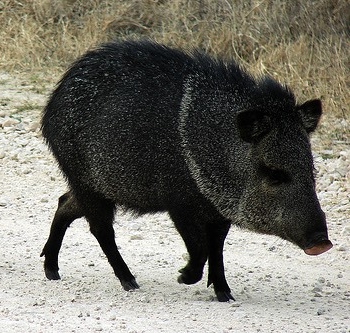
A javelina

Posting on Friday and over this weekend will be nil, as I am leaving tonight, Thursday, and will be in the back country with no phone or internet service on my second javelina hunt. If we bag something early we will be back early, but that can hardly be guaranteed.

For a description of my javelina hunt last February, go here.

Note that there will be an evening pause on Friday night, regardless.

Update: Due to technical issues, I am instead heading out tomorrow afternoon, so posting will resume for the morning hours.

2 comments

Mars rover update: February 8, 2018

Summary: Curiosity remains on Vera Rubin Ridge, though it has begun moving toward the point where it will move down off the ridge. Opportunity remains in Perseverance Valley, though it has finally taken the north fork down.

Before providing today’s update, I have decided it is time to provide links to all previous updates, in chronological order. This will allow my new readers to catch up and have a better understanding of where each rover is, where each is heading, and what fascinating things they have seen in the past year and a half.

These updates began when I decided to figure out the overall context of Curiosity’s travels, which resulted in my March 2016 post, Pinpointing Curiosity’s location in Gale Crater. Then, when Curiosity started to travel through the fascinating and rough Murray Buttes terrain in the summer of 2016, I stated to post regular updates. To understand the press releases from NASA on the rover’s discoveries it is really necessary to understand the larger picture, which is what these updates provide. Soon, I added Opportunity to the updates, with the larger context of its recent travels along the rim of Endeavour Crater explained in my May 15, 2017 rover update.

Now to talk about the most recent news from both rovers!
» Read more

1 comment
1 136 137 138 139 140 155