
Stevie Nicks – Stand Back
A evening pause: Hat tip Edward Thelen.
A evening pause: Hat tip Edward Thelen.
Capitalism in space: SpaceX has just successfully launched its Falcon Heavy into space.
The key to this launch was to get the three first stage boosters to all work in unison, and for the two side boosters to successfully separate. All worked.
As I write this we are waiting for the two side boosters on their way back to land, and the central core heading back to land at sea.
The two side boosters landed like synchronized swimmers. The core stage barge landing remains unconfirmed. Update: SpaceX has confirmed that the core stage failed to land correctly, crashing into the ocean.
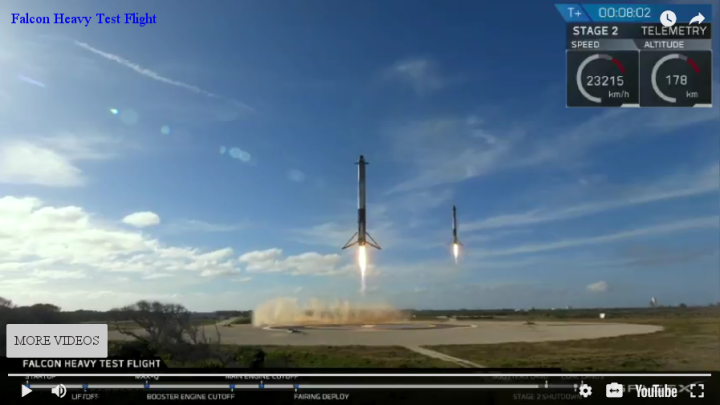
Even so, the upper stage and its payload are in orbit. They will fire its engines in about a half hour, and then again in six hours to put the Tesla into solar orbit. Update: The first firing occurred as scheduled, and Musk has now confirmed that the final burn has placed the Tesla in a solar orbit that reaches out into the asteroid belt.
SpaceX has now started a live stream from the Tesla, showing its mannequin dubbed “Starman” sitting in the driver’s seat.
Even if the core stage failed to land successfully, and even if the upper stage fails to send the Tesla towards Mars, this launch is an unqualified success. SpaceX has demonstrated that the Falcon Heavy works. It is now the most powerful rocket in operation, and only matched or beaten in capability by the Saturn 5, Energia, and the Space Shuttle, none of which exist any longer.
The 2018 launch standings:
6 China
3 SpaceX
2 ULA
2 Japan
A close review of NOAA’s historic temperature data for New York shows that the agency appears to have been adjusting its records to cool past records or warm recent ones, without any explanation.
The author took a look at NOAA’s graph this year showing New York’s average January temperatures going back to 1890, and noticed that, according to that graph, 1943 was 0.9 degrees Fahrenheit warmer than 2014. Yet, a close look at the actual data from 1943 strongly suggested that 1943 was actually 2.7F warmer, not 0.9F. Somehow, NOAA had adjusted the numbers, either in 1943 or in 2014, to make the present warmer or the past colder. Further analysis, removing the one station that appears to have experienced the most heat island influence, thus distorting its long term record, suggested the adjustments might actually be worse.
These results, while certainly not covering all weather stations and years, are still consistent with every other close look at NOAA’s adjustments. Those adjustments always cool the past and warm the present, so as to provide confirmation of the theory of global warming. More important, there is never any explanation for those adjustments.
Of the seven sites, six have remained at the same locations, within a few yards. The station at Auburn has moved by a couple of miles, but is still in similar terrain.
There is no reason then why any major adjustments should have been required at any site.
Apologists for temperature tampering usually say it is all due to TOBS (Time of Observation). Yet the station at Ithaca, based at Cornell University, has used morning readings throughout. With a temperature difference of 2.9C, this is typical of the other sites, suggesting that any bias from TOBS is minor.
Either there is outright fraud going on here in the climate divisions at NOAA, or they are entirely blind to their own confirmation bias. Either way, this data once again illustrates why there is great distrust in their results. Global warming might be happening, and human activity might be causing it, but these strange adjustments in the data leave many in doubt.
This morning there are dozens of stories across the entire media about SpaceX’s first test launch today of its Falcon Heavy rocket, generally pushing out all other space news. Most repeat the same information, about the rocket, the company, the goals, its history, and its consequences, all subjects that I have already covered extensively here at Behind the Black or elsewhere.
One story however is not only fun, and demonstrates the value of freedom and private enterprise. An uber-type car transportation company called Lyft is offering half-price rides from Orlando to watch the Falcon Heavy launch.
The benefits of innovation and competition will be routinely surprising, and come from places unexpected. Lyft is doing this because of the high traffic being generated by SpaceX’s launch. It gives them margin to cut prices while also generating some good PR.
Meanwhile, if you want to watch the launch (launch now delayed to 2:00 pm Eastern), you can either go to SpaceX’s video stream on its website, or on youtube, or you can go to the live feed at Spaceflightnow.
An evening pause: For me personally, this song is perfect, on my birthday. Or as Gordon Dickson wrote in his magnificent science fiction book, Way of the Pilgrim, “He felt the urge to speak like a great hand at his back, pushing him forward, a hand that could not be resisted.”
Our government in action! An audit by the private audit firm Ernst & Young has found that the Pentagon department that handles the logistical needs of the military has lost hundreds of millions of dollars.
Ernst & Young found that the Defense Logistics Agency failed to properly document more than $800 million in construction projects, just one of a series of examples where it lacks a paper trail for millions of dollars in property and equipment. Across the board, its financial management is so weak that its leaders and oversight bodies have no reliable way to track the huge sums it’s responsible for, the firm warned in its initial audit of the massive Pentagon purchasing agent.
…In one part of the audit, completed in mid-December, Ernst & Young found that misstatements in the agency’s books totaled at least $465 million for construction projects it financed for the Army Corps of Engineers and other agencies. For construction projects designated as still “in progress,” meanwhile, it didn’t have sufficient documentation — or any documentation at all — for another $384 million worth of spending.
The agency also couldn’t produce supporting evidence for many items that are documented in some form — including records for $100 million worth of assets in the computer systems that conduct the agency’s day-to-day business.
There’s more. In fact, it goes on and on, listing numerous examples of shoddy accounting. One wonders who is benefiting by this incompetence, assuming it isn’t downright corruption.
The uncertainty of science: A new and very large health study has found that eating a high fat diets is actually healthy, and that the previous government dietary recommendations are seriously flawed.
That’s the conclusion of a massive new study published in Lancet that followed 135,335 people in 18 countries on five continents. The study found that consumption of fat was associated with a lower risk of mortality, while consumption of carbohydrates was associated with a higher risk. It found that the kind of fat didn’t matter when it came to heart disease, and that saturated fat consumption was inversely related to strokes.
The researchers say, ever so politely, that “dietary guidelines should be reconsidered in light of these findings.”
I’m not sure this new study should be trusted that much either. Regardless, it does indicate that the field of diet and health has a great deal of uncertainty, and that we should all consider with great skepticism any recommendations from the government, based on that science.
Astronomers, using ground-based and orbiting telescopes, have obtained more information about the seven Earth-sized exoplanets that orbit the star Trappist-1 forty light years away.
First, a European effort has found that the planets probably all have loads of water.
A new study has found that the seven planets orbiting the nearby ultra-cool dwarf star TRAPPIST-1 are all made mostly of rock, and some could potentially hold more water than Earth. The planets’ densities, now known much more precisely than before, suggest that some of them could have up to 5 percent of their mass in the form of water — about 250 times more than Earth’s oceans. The hotter planets closest to their parent star are likely to have dense steamy atmospheres and the more distant ones probably have icy surfaces. In terms of size, density and the amount of radiation it receives from its star, the fourth planet out is the most similar to Earth. It seems to be the rockiest planet of the seven, and has the potential to host liquid water.
Data from the Hubble Space Telescope has meanwhile found that three of the seven planets do not have hydrogen in their atmospheres, which at first seems to contradict the European data.
The Hubble observations took advantage of the fact that the planets cross in front of their star every few days. Using the Wide Field Camera 3, astronomers made spectroscopic observations in infrared light, looking for the signature of hydrogen that would filter through a puffy, extended atmosphere, if it were present. “The planets are close enough to their host star, and they have very short orbital periods, which means there are lots of opportunities to make observations,” Lewis said.
Although Hubble did not find evidence of hydrogen, the researchers suspect the planetary atmospheres could have contained this lightweight gaseous element when they first formed. The planets may have formed farther away from their parent star in a colder region of the gaseous protostellar disk that once encircled the infant star.
The Hubble results are actually not very significant. They show only that they did not detect hydrogen in the atmospheres of these three exoplanets, which does not mean it isn’t there. Moreover, this Hubble press release appears to have been issued as much to sell the James Webb Space Telescope and to say that Hubble is looking at Trappist-1 also!
I should add that all of these results are very uncertain. We are looking at something that is very small and is also very far away. Any data obtained is certainly not a precise measurement of what is actually there, only a mere hint.
Russia is apparently going to have to delay the launch of its next ISS module, Nauka, into 2019.
Nauka was initially built in the 1990s as a back-up module for one of Russia’s first ISS first modules, Zarya. It has undergone numerous concept changes, and even more numerous delays, including the most recent and worst, where it was discovered that they had to scrub clean the module’s fueling system because they had become contaminated.
Capitalism in space: Several stories today about tomorrow’s long-awaited Falcon Heavy launch, with a launch window opening at 1:30 pm (eastern).
First, the FAA has approved SpaceX’s launch license. This is an example of the absolute irrelevance of government. There was no way this launch license was going to be denied, which means that the FAA’s only purpose here was to simply make work for some bureaucrats.
Second, this story by Bill Harwood provides a nice summary of the context of the launch, including SpaceX’s success at shaking up the launch history in the past decade. The money quote, however, comes when Harwood quotes John Logsdon, founder and now retired director of the Space Policy Institute at George Washington University. For years Logsdon has been the media’s go-to expert on the policy of space, and has consistently expressed unbounded faith and love for NASA projects like SLS. His perspective has always been that of the 1960s, when the space race then established the concept that in order to succeed in space you needed to have a government space program. The idea of a chaotic, competitive effort by private companies has always been inconceivable to him and most liberal policy experts. Thus, when asked about the purpose behind Falcon Heavy as well as Musk’s even bigger proposed rocket, the Big Falcon Rocket (BFR), Logsdon was totally baffled.
“I don’t understand what they’re doing,” Logsdon said. “Elon’s out talking about they’re not going to pursue the Falcon line of rockets, he’s going to put all his efforts into the BFR. So, what is the future of Heavy?”
…Logsdon said he believes it is “good for the country to have two alternative heavy lift vehicles, at least for a little while, to see which one works better.” But he also believes the SLS enjoys enough solid congressional support to “sustain it for some few more years, anyway.”
What Logsdon, being an academic his whole life, has never understood is the concept of profit and efficiency. Unlike the government projects like SLS that Logsdon tends to favor, Falcon Heavy is designed to provide customers a cheap way to get large payloads into orbit. That ability is going to soon provide SpaceX plenty of business, and will make SLS look like a complete waste of money. Furthermore, the BFR is Musk’s declaration that, as the head of a cutting edge private company, he is not going to stand still, but will keep pushing the envelope to provide his customers even better products in the future.
Finally, this CNN article, while typically shallow and not very knowledgeable, does provide one piece of important information, about the launchpad being used.
Because of a special walkway that has been constructed for it, Pad 39A is the only site that can host flights of SpaceX’s new spacecraft, Crew Dragon. That’s the spacecraft the company is developing to help NASA ferry astronauts to and from the International Space Station. Crew Dragon has already faced delays. And destroying the launch pad could mean pushing deadlines back even further, according to U.S. Government Accountability Office Director Cristina Chaplain.
A launch failure on the launchpad would therefore significantly impact the schedule for SpaceX’s private manned capsule. This also explains why Musk has said he would consider this launch a success if the Falcon Heavy simply cleared the launch tower.
Today NOAA posted its monthly update of the solar cycle, covering sunspot activity for January 2018. Below is my annotated version of that graph.
As you can see, the low sunspot activity of the past two months continued in January. November 2017 remains the most inactive month for sunspots since the middle of 2009. January is now the second most inactive month, with December a very close third.
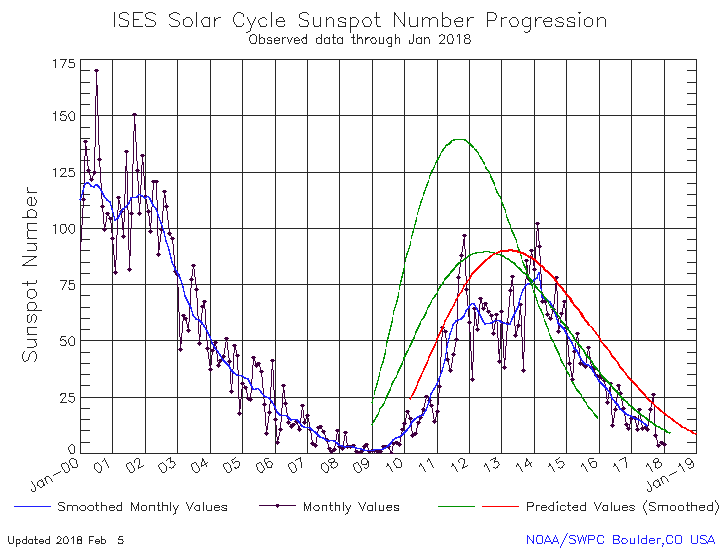
The graph above has been modified to show the predictions of the solar science community. The green curves show the community’s two original predictions from April 2007, with half the scientists predicting a very strong maximum and half predicting a weak one. The red curve is their revised May 2009 prediction.
Though activity continues to track close to but considerably below the 2007 weak prediction, the difference appears to be increasing as the ramp down to solar minimum continues. While I have said in past updates that the trend suggests an early arrival of the solar minimum, a close look at the previous ramp down in 2007 and 2008 shows that when activity became this weak, the ramp down slowed considerably. This previous pattern suggests that we could see another year or two of similarly low activity before the minimum arrives.
Regardless, the low activity, this soon, continues to suggest that the next maximum will also be weak, and might even not come at all, as some solar scientists have proposed. Instead, we might be heading toward another Grand Minimum, with no significant sunspots for decades.
Will that Grand Minimum produce cold weather worldwide, as it appears to have done during the last Grand Minimum in the 1600s? There is circumstantial evidence in the past decade that it might. We will not know, however, until it happens, and that possibility remains very uncertain.
Embedded below the fold in two parts.
» Read more