
Leonard Cohen – The Stranger Song
An evening pause: Performed live on television in 1967.
Hat tip Edward Thelen.
An evening pause: Performed live on television in 1967.
Hat tip Edward Thelen.
The coming dark age: Because of a complaint, Hartford officials have locked all bathrooms on a new train line because half are not ADA compliant.
Restrooms on half of the Hartford Line trains — those operated by the state as opposed to Amtrak — will remain closed until they are made accessible to individuals with disabilities in early 2019, the state Department of Transportation announced Tuesday. The closure comes in response to a reversed decision from the Federal Railroad Administration, which had previously granted the state a temporary exemption from the Americans for Disabilities Act, according to the DOT.
Disability Rights Connecticut, a nonprofit advocacy group for state residents with disabilities, said it filed an ADA complaint with the FRA on June 8 regarding the new commuter line, which is scheduled to open June 16.
In other words, because a small number of people are unhappy, no one can be happy. They rule, and if they don’t get what they want then no one will get anything.
The June release of new images from Mars Reconnaissance Orbiter (MRO) included three images of the two candidate landing sites for Europe’s 2020 ExoMars rover mission. All three images provide us as hint at what that rover might see when it arrives a few years from now.
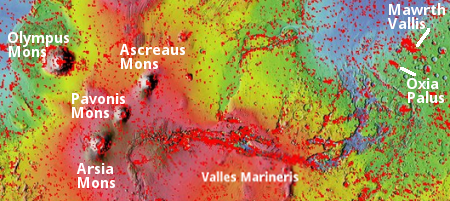
The two candidate sites are locations on Mars dubbed Mawrth Vallis and Oxia Palas. The map to the right shows their general location to the east of Mars’s giant volcanoes and giant canyon Valles Marineris. The red splotches indicate the large number of images taken by MRO of these locations, partly to help the ExoMars science team choose which site to pick and partly to study the geology in these Martian locations. As you can see, both candidate sites are in the transition zone between the northern low plains and the southern highlands.
At first glance Mawrth Vallis seems the more spectacular site. Mawrth (Welsh for Mars) is one of the gigantic drainage canyons near Valles Marineris. Though tiny in comparison to Valles Marineris, on Earth it would easily rival the Grand Canyon in size, and in fact is slightly longer (400 miles versus 300 miles). Unlike the Grand Canyon, however, Mawrth Vallis doesn’t appear to have a distinct or obvious rim. This video, produced by the European Space Agency using images from its Mars Express orbiter, gives a sense of the canyon’s terrain as it flies upstream from the northern lowlands to the canyon’s high point in the southern highlands. The highlands on either side of the canyon more resemble the broken geology of Mars’s chaos regions that are found scattered about in this transition zone than the flat generally level Kaibab plateau that surrounds the Grand Canyon.
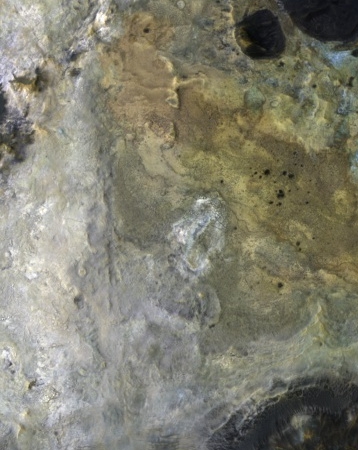
The image on the right is a tiny crop from the most recently released MRO image. The full image shows a strip of the upper plateau south of canyon and near its inlet from the southern highlands. This crop reveals a surface that is a wild mixture of colors and complex geology. In fact, in a 2017 MRO image release showing a different place in Mawrth Vallis, the canyon was dubbed a “painted desert.” To quote that release:
The clay-rich terrain surrounding Mawrth Vallis is one of the most scenic regions of Mars, a future interplanetary park. …The origin of these altered layers is the subject of continued debates, perhaps to be resolved by a future rover on the surface. We do know that these layers are very ancient, dating back to a time when the environment of Mars was wetter and more habitable, if there were any inhabitants.
Other MRO images of Mawrth Vallis here and here emphasize this description.
As for Oxia Palas, the other candidate landing site for ExoMars 2020, in the June MRO image release there were two images.
» Read more
The summit meeting between President Trump and North Korea’s dictator Kim Jong Un took place yesterday with much fanfare, ending with a signed agreement that did little but outline some future negotiating goals.
1. The United States and the DPRK commit to establish new U.S.–DPRK relations in accordance with the desire of the peoples of the two countries for peace and prosperity.
2. The United States and the DPRK will join their efforts to build a lasting and stable peace regime on the Korean Peninsula.
3. Reaffirming the April 27, 2018 Panmunjom Declaration, the DPRK commits to work toward complete denuclearization of the Korean Peninsula.
4. The United States and the DPRK commit to recovering POW/MIA remains, including the immediate repatriation of those already identified.
While Trump’s hard-nosed policies toward North Korea has clearly forced that nation to back away from its former bellicose positions, threatening war with everyone, we will have to wait and see if this summit really forces them to abandon their nuclear weapons and missile programs.
Fascist California: Police raided the home and confiscated the guns of a man who had made a sincere effort to follow new California laws requiring the registration of his AR-15.
The man also now faces a dozen felony charges.
Jeffrey Scott Kirschenmann attempted to register an AR-15 with the California Department of Justice last month but instead found himself in significant legal trouble. The California DOJ accused Kirschenmann of illegally modifying the rifle he attempted to register. Law enforcement officials raided his home in Bakersfield before ultimately confiscating a dozen firearms and a few hundred rounds of ammunition, then charging him with a dozen felonies, KGET reports. Kirschenmann was accused of possession of assault weapons, two silencers, and something referred to as a “multi-burst trigger activator.” He does not appear to have been charged with any violent crimes.
All this does is drive decent ordinary gun-owners underground. It makes them criminals for doing nothing morally wrong, and thus a target that the state can now oppress.
On June 10 Hayabusa-2 took its first photos of Ryugu, the asteroid it will reach later this month.
The Sunday photos were taken when Hayabusa2 was about 930 miles (1,500 kilometers) from Ryugu. Last week, JAXA released a few ONC-T images taken on June 6, when the probe was 1,615 miles (2,600 km) from the space rock.
Hayabusa2, which launched in December 2014, is scheduled to arrive at Ryugu on or around June 27. At that time, the probe will begin orbiting the asteroid at an altitude of about 12 miles (20 km), JAXA officials have said.
Hayabusa2 will then start prepping for a series of complex, up-close studies of the space rock. If all goes according to plan, over the ensuing 12 months, the spacecraft will deploy three rovers and a lander on Ryugu’s surface, gouge out a small crater using an explosives-bearing impactor, and collect samples from the newly created crater.
The spacecraft will depart Ryugu in November or December 2019, and its collected samples will come back to Earth in a special return capsule in late 2020.
The image suggests that the asteroid is “not significantly elongated.”
Japan today successfully launched a military reconnaissance satellite.
This was Japan’s fourth launch in 2018, putting it ahead of India and Europe in total launches this year.
17 China
11 SpaceX
6 Russia
5 ULA
4 Japan
The U.S. and China remain tied in the national standings.
An evening pause: This is silly, but really good nonetheless.
Hat tip Jim Mallamace.
The podcast for my June 8th appearance on Robert Pratt’s Pratt on Texas radio show is now available here.
The discussion was focused on statements by Senator Ted Cruz (R-Texas) in support of continued funding for ISS. For a guy who ran for President under the banner of destroying what he called the “Washington cartel,” his present position lobbying hard for big space projects seems quite hypocritical, and requires some analysis.
New studies of Tabby’s Star suggest that the dust clouds that cause it to fluctuate in brightness in apparently random ways are unusual and baffling in their own right.
[I]t appears that the dimming of Tabby’s star comes not from large objects such as swarms of asteroids, comets, or alien solar collectors, but from drifting bands of dust particles. But like any good mystery, it’s not quite that simple.
Each of the four dimming events observed in 2017 affected red and blue light differently, suggesting that they involved dust particles of different sizes. And the long-term brightness changes appear to be associated with much larger grains. “So the dust cloud is extremely complex,” Bodman says. “Each dip is a different kind of dust … What we’re seeing is different parts of the [dust] cloud as they pass in front of the star.”
A first guess, probably wrong, is that the four dimming events were caused by dust streams orbiting the star at different distances, each a different patchy ring around the star made up of slightly different materials.
And if you accept my guess as right, I also have bridge in Brooklyn I want to sell you. Real cheap too!
The Chinese government has instituted new policies aimed at shutting down corrupt practices in journal peer review and funding that have previously encouraged scientific misconduct.
The country’s most powerful bodies, the Chinese Communist Party and the State Council, introduced a raft of reforms on 30 May aimed at improving integrity across the research spectrum, from funding and job applications to peer-review and publications.
Under the new policy, the Ministry of Science and Technology (MOST) will be responsible for managing investigations and ruling on cases of scientific misconduct, a role previously performed by individual institutions. And for the first time, misconduct cases will be logged in a national database that is currently being designed by MOST.
Inclusion in the list could disqualify researchers from future funding or research positions, and might also affect their ability to get jobs outside academia. The Chinese Academy of Social Sciences will oversee the same process for social scientists. The policy also states that MOST will establish a blacklist of ‘poor quality’ scientific journals, including domestic and international titles. Scientists who publish in these journals will receive a warning, and those papers will not be considered in assessments for promotions, jobs and grants. A couple of such blacklists already exist, but rarely are they run formally by a government agency.
In recent years China has been the source of many examples of blatant scientific misconduct, from faking data in papers to getting them peer reviewed by non-existent reviewers. This policy change is aimed at stopping this misconduct, and is likely happening because much of China’s leadership comes from its space industry, which requires honesty in its work or the rockets will crash.
At the same time, the policy gives the government great power over all scientific work, and we all know what happens eventually when you give the government great power. While the goals here are laudable, and will likely in the near future produce positive results, the long term consequences will likely end up stifling independent research.
Capitalism in space: Smallsat rocket company Vector now plans its first orbital flight this coming October, and also plans to have a commercial payload on board.
The article also states that the company already has launch contracts for almost 400 launches.
This story, consistent with a previous report in March, suggests that their build toward that first orbital launch is holding to its schedule.
Link here. Anyone who wishes to avoid being willfully ignorant about the reasons and background to the second amendment and presently feels lacking in knowledge will find this essay immensely clarifying. Bottom line:
Again, both sides [in the debate over the ratification of the Constitution] not only agreed that the people had a right to be armed, both sides assumed the existence of an armed population as an essential element to preserving liberty. The framers quite clearly had adopted James Harrington’s political theory that the measure of liberty attained and retained was a direct function of an armed citizenry’s ability to claim and hold those rights from domestic and foreign enemies.
And from the conclusion:
English history made two things clear to the American revolutionaries: force of arms was the only effective check on government, and standing armies threatened liberty. Recognition of these premises meant that the force of arms necessary to check government had to be placed in the hands of citizens. The English theorists Blackstone and Harrington advocated these tenants. Because the public purpose of the right to keep arms was to check government, the right necessarily belonged to the individual and, as a matter of theory, was thought to be absolute in that it could not be abrogated by the prevailing rulers.
These views were adopted by the framers, both Federalists and Antifederalists. Neither group trusted government. Both believed the greatest danger to the new republic was tyrannical government and that the ultimate check on tyranny was an armed population. It is beyond dispute that the second amendment right was to serve the same public purpose as advocated by the English theorists. The check on all government, not simply the federal government, was the armed population, the militia. Government would not be accorded the power to create a select militia since such a body would become the government’s instrument. The whole of the population would comprise the militia. As the constitutional debates prove, the framers recognized that the common public purpose of preserving freedom would be served by protecting each individual’s right to arms, thus empowering the people to resist tyranny and preserve the republic. The intent was not to create a right for other governments, the individual states; it was to preserve the people’s right to a free state, just as it says. [emphasis in original]
Read it all. It puts this issue of gun rights into historical and accurate context. That there are Americans today that do not know these facts, and refuse to learn them, speaks very poorly of them. It also suggests their goal is not the prevention of violence but the oppression of others. Such a goal is directly threatened by these historical facts — describing the British and American search for liberty and freedom — which is why they do not wish them known, and often do whatever they can to suppress them.
A growing Martian dust storm has forced the Opportunity science team to suspend science operations and to reconfigure the rover’s operations to increase its chances of surviving the storm.
In a matter of days, the storm had ballooned. It now spans more than 7 million square miles (18 million square kilometers) — an area greater than North America — and includes Opportunity’s current location at Perseverance Valley. More importantly, the swirling dust has raised the atmospheric opacity, or “tau,” in the valley in the past few days. This is comparable to an extremely smoggy day that blots out sunlight. The rover uses solar panels to provide power and to recharge its batteries.
Opportunity’s power levels had dropped significantly by Wednesday, June 6, requiring the rover to shift to minimal operations.
This isn’t Opportunity’s first time hunkering down in bad weather: in 2007, a much larger storm covered the planet. That led to two weeks of minimal operations, including several days with no contact from the rover to save power. The project’s management prepared for the possibility that Opportunity couldn’t balance low levels of power with its energy-intensive survival heaters, which protect its batteries from Mars’ extreme cold. It’s not unlike running a car in the winter so that the cold doesn’t sap its battery charge.There is a risk to the rover if the storm persists for too long and Opportunity gets too cold while waiting for the skies to clear.
In other words, there is a possibility that the rover might not make it through this period of low sunlight. Nonetheless, the rover did send four images down yesterday, though the four images are essentially dust filled, and are likely aimed at the far distance to help gauge the extent of the storm.
A Tennessee woman is proactively suing NASA in order to guarantee the agency will not try to steal a vial of moon dust that Neil Armstrong gave to her in the early 1970s.
Murray Cicco received the small glass vial full of gray moon dust in the early 1970s. The vial came with a note: “To Laura Ann Murray — Best of luck — Neil Armstron Apollo 11.” …Armstrong’s note and signature have been verified and testing has confirmed the contents in the vial he gifted her do include dust from the moon.
Decades after receiving the glass vial of moon dust, Murray Cicco is moving forward with her federal court case in Wichita, even though she lives in Tennessee. The reason for filing the case in Kansas goes back to a previous case in 2016 where a U.S. District Court judge in Wichita ruled in favor of a collector who bought a bag containing moon dust that was mistakenly placed in an online government auction. In that case, the bag was then sold at auction last year for $1.8 million.
While NASA hasn’t demanded Murray Cicco give up the vial of moon dust, Murray Cicco’s attorney has requested a jury trial in Wichita to stay ahead. “There is no law against private persons owning lunar material. Lunar material is not contraband. It is not illegal to own or possess,” the court document detailing the case says. “Therefore, she requests judgment declaring her the rightful and legal owner of the vial and its contents, and vesting title in her name.”
This is a very wise move on her part. NASA has for years made it clear that it thinks it owns all moon material brought back by the Apollo missions, and has had the arrogant policy of demanding the return of any moon dust or rocks that it discovered was in the possession of any private citizen, no matter how small, or how well documented the ownership. This court case acts to block such actions, before NASA can even think of them.
Capitalism in space: According to plans outlined in a draft environmental statement, SpaceX is planning a major mission control and new rocket processing facility at the Kennedy Space Center.
It will be an operational monument to Elon Musk’s vision: a towering SpaceX launch control center, a 133,000-square-foot hangar and a rocket garden rising in the heart of Kennedy Space Center.
According to plans detailed in a draft environmental review published recently by KSC, SpaceX will undertake a major expansion of its facilities at the space center sometime in the not-too-distant future. The review says SpaceX is seeking more room and a bigger presence “in its pursuit of a complete local, efficient, and reusable launch vehicle program.” The expansion would enable SpaceX to store and refurbish large numbers of Falcon rocket boosters and nose cones at the operations center down the road from NASA’s Vehicle Assembly Building.
The most eye-opening detail in this environmental draft is a statement that this SpaceX facility will be designed to support an expectation of up to 63 launches per year. In the first decade of this century that’s about how many launches the entire world accomplished per year. SpaceX’s ambitions here however are not absurd. They instead hearken to the expected upcoming boom in the entire aerospace, mostly fueled by the lower launch costs that SpaceX forced on the launch industry. SpaceX might manage that many launches, but it will be only a part of the entire booming launch market.
The first launch of a Pegasus rocket following the completion of the sale of Orbital ATK to Northrop Grumman has been delayed indefinitely because of “off-nominal data” detected in the rocket.
The payload is a NASA climate research satellite dubbed ICON. The rocket and launch crew were on board the L1011 carrier plane on they way to the Pacific launch area for next week’s launch when they detected the issue and decided to return to California.
This is not the first problem with this particular Pegasus launch.
ICON’s launch has been delayed a year by a pair of concerns with its Pegasus launcher. Engineers wanted more time to inspect the Pegasus rocket motors after they were mishandled during shipment to Vandenberg, officials said. That pushed the launch back from June to December 2017, the next availability in the military-run range at Kwajalein.
Then managers decided to ground the mission to assess the reliability of bolt-cutters used to jettison the Pegasus rocket’s payload fairing and separate the satellite in orbit. Workers installed smaller bolts in the fairing and satellite separation mechanisms, a measure officials said will ensure the cutters do their jobs.
For Northrop Grumman this isn’t the best way to start its new rocket business, but better a delay than a failed launch.
Embedded below the fold in two parts. In the first part the discussion was entirely about Mars and this week’s announcement about the discovery by Curiosity of organics, and how that discovery explains the rover’s recent travels down Mount Sharp.
» Read more
An evening pause: Performed live 1965.
Hat tip Jim Mallamace.
Astronomers using data from Kepler have discovered two stars, both with multiple orbiting Earth-sized planets. One has three planets all almost exactly the mass of Earth.
The first exoplanetary system is located in the star K2-239, characterized by these researchers as a red dwarf type M3V from observations made with the Gran Telescopio Canarias (GTC), at the Roque de los Muchachos Observatory (Garafía, La Palma). It is located in the constellation of the Sextant at 50 parsecs from the Sun (at about 160 light years). It has a compact system of at least three rocky planets of similar size to the Earth (1.1, 1.0 and 1.1 Earth radii) that orbit the star every 5.2, 7.8 and 10.1 days, respectively.
The other red dwarf star called K2-240 has two super-Earth-like planets about twice the size of our planet. Although the atmospheric temperature of red dwarf stars, around which these planets revolve, is 3,450 and 3,800 K respectively, almost half the temperature of our Sun, these researchers estimate that all planets discovered will have temperatures superficial tens of degrees higher than those of the planet Earth due to the strong radiation they receive in these close orbits to their stars.
Knowing more about the surface environments of these very Earthlike exoplanets, as hostile as they might be to life, would teach us a great deal about our own planet and its birth and evolution.