Trump administration cuts $200 million of Palestinian aid

The Trump administration today announced an additional $200 million cut of Palestinian aid.

“At the direction of President Trump, we have undertaken a review of U.S. assistance to the Palestinian Authority and in the West Bank and Gaza to ensure these funds are spent in accordance with U.S. national interests and provide value to the U.S. taxpayer,” the department said. “As a result of that review, at the direction of the president, we will redirect more than $200 million … originally planned for programs in the West Bank and Gaza.”

“This decision takes into account the challenges the international community faces in providing assistance in Gaza, where Hamas control endangers the lives of Gaza’s citizens and degrades an already dire humanitarian and economic situation,” the notice said, without providing additional details.

As long as the terrorist leadership in Gaza and the West Bank refuse to accept the right of Israel to exist, they simply do not deserve any American aid. This is a reasonable position, and it is also one that follows laws that Congress itself has passed.

4 comments

The corruption centered on Mueller and Comey

President Trump might have his ethical issues, but at this point the questions surrounding him don’t hold a candle to the corruption revealed in two stories in the past two days about former FBI director James Comey and Special Council Robert Mueller.

The first story describes in enormous detail the flat-out whitewash that Comey and the FBI did in its investigation of the classified Clinton emails that had been found on an unclassified laptop owned by former Democratic congressman and convicted child molester Anthony Weiner. That whitewash included outright lies by Comey before Comgress.
» Read more

41 comments

Los Angeles leftist groups call for “violence against the enemies of the people.”

They’re coming for you next: Los Angeles antifa leftist groups are now publicly calling for “violence against the enemies of the people” including “militant escalations [in the] defense of their undocumented working-class immigrant communities by any means necessary.”

The article describes a recent demonstration by these groups, describing how they threatened the police as well as innocent bystanders who happened to pass by.

Note also where the loyalties of these fascists lie. They scream support only for illegal immigrants, and are hostile to all Americans, both legal immigrants and native born. This illustrates that they real interest is the destruction of the United States and the idea of freedom for which it stands, not the illegal immigrants they are using as a pawn in this campaign.

If you live in California be aware that you likely no longer have the freedoms of an American. These jackbooted thugs, masked like the KKK, will soon be coming after you if you dare dissent from their agenda. And the Democratic Party government in charge there will likely allow them to get away with whatever violence they do.

8 comments

Volcanic rills and lava tubes on Mars

Rills and lava tubes on Pavonis Mons

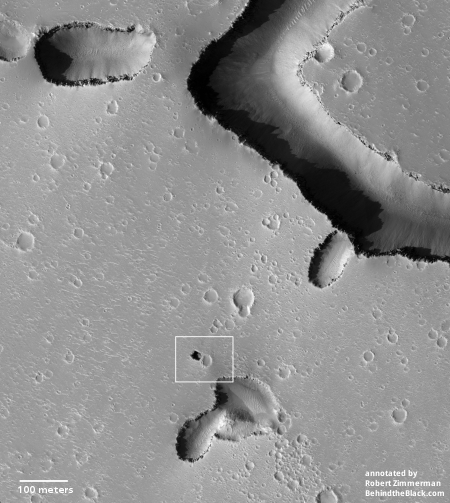
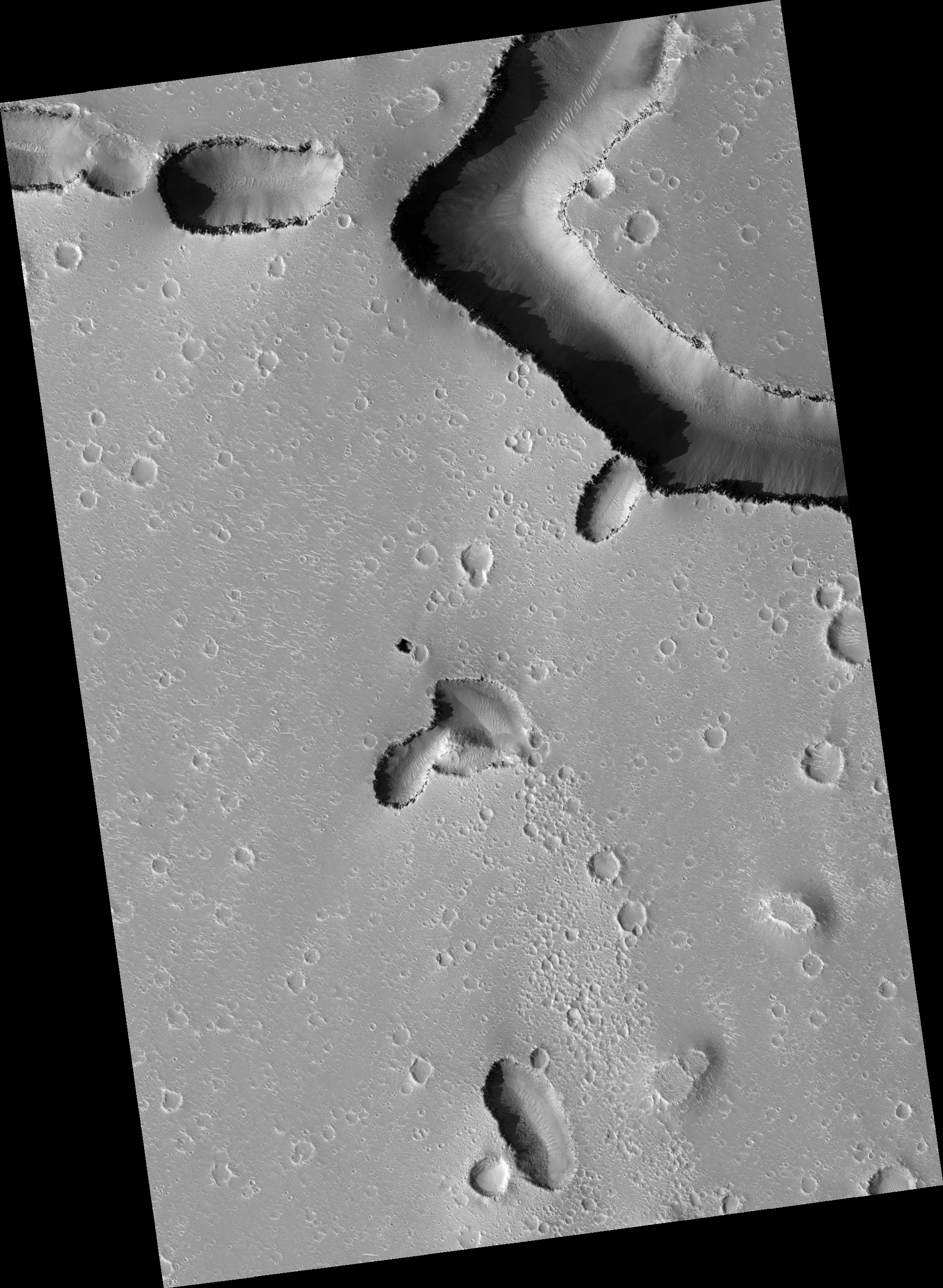
Cool image time! The image on the right, cropped somewhat to show here, was taken by Mars Odyssey of the southwestern slope of Pavonis Mons, the middle volcano of the line of three giant volcanoes located between the biggest volcano in the solar system, Olympus Mons, and the biggest canyon in the solar system, Marineris Valles. The slope goes down to the south, from the top to the bottom of the image. As noted on the image page,

The channel and nearby oval depressions are both related to the flow of lava. Narrow lava flows can create channels. The cooling of the top of the channel will form a roof over the flow, creating a tube beneath the surface. After the lava stops flowing the tube can empty, leaving a subsurface void. The roof will then collapse into the void forming the oval surface features.

I have added arrows to the image to draw your eye to the features that extend south in line with those oval depressions, eventually widening out to resemble a river delta, with the obvious rill probably indicating the lowest point in that delta.

Though the oval depressions are likely sections of a lava tube that collapsed, the features in line with those depressions suggest that the tube itself might still exist below the surface to the south, feeding into that delta where the rill meanders. It is also possible that my desire to find underground voids here, where glacier ice might possibly exist, might be skewing my conclusion. It could also be that the lava tube ended at these depressions, and what the features indicate is a wide surface flow, later embellished by the smaller flow of the meandering rill.

2 comments

China reveals landing site for Chang’e-5 lunar sample return mission

The new colonial movement: In a recent paper Chinese scientists revealed their landing plans for the Chang’e-5 lunar sample return mission, presently scheduled for at 2019 launch.

If all goes according to plan, the robotic Chang’e 5 will land in the Rümker region, which lies within a huge basaltic lunar plain called Oceanus Procellarum (Latin for “Ocean of Storms”).

A recent paper lays out the scientific significance of this site, and what Chang’e 5 may be able to find there. “Recent studies find that the geological features and volcanic history of the moon are far more complex than previously thought, and many of the most interesting areas have been neither explored nor sampled,” states the study, which was led by Yuqi Qian of the School of Earth Sciences at the China University of Geosciences in Wuhan. “One such area is the northern Oceanus Procellarum region, which consists of very young (<2 Ga) [less than 2 billion years old] mare materials and hosts one of the largest volcanic complexes on the moon (Mons Rümker)."
For the study, the research team conducted a detailed geological mapping of the Rümker region using imagery, spectral and altimetry data.

Chang’e-5 should not be confused with Chang’e-4, which is set to launch in the fall to land on the Moon’s far side.

The choice of the volcanic region around the Ocean of Storms is significant, as it indicates that, for at least this mission, China is not focused on the possibly more valuable polar regions where water-ice might be present for future lunar bases. Instead, they are giving a priority to science and geology with this probe. They likely also picked this site because it is near the equator and therefore a bit easier to reach on this first daring sample return mission.

It does appear however that China is taking the long view. The landing choice here suggests to me that they plan many more missions to the Moon, and do not see anyone else in a position to compete with them for territory. The U.S., Russia, and Europe appear to be throwing their eggs into the basket of (F)LOP-G, which will merely orbit the Moon and eat up resources preventing these countries from planning and building any landing missions, for decades. India meanwhile might be a competitor, but at the moment it is far behind.

0 comments

Hayabusa-2 science team lay out Ryugu landing schedule

At a press conference yesterday the Hayabusa-2 science team laid out their landing schedule for the spacecraft and its three tiny landers.

The first lander will be one of its two tiny MINERVA-II probes, and will take place in September. This will be followed by the German/French MASCOT probe in early October, followed in turn in late October by Hayabusa-2 itself.

The landings of the first two probes will help them pick Hayabusa-2’s landing site, as well as the site for last MINERVA lander.

Mission planners faced tough choices because the body almost uniformly strewn with boulders. “Ryugu is beautiful, but challenging,” said Aurélie Moussi, a collaborator from the French space agency CNES in Toulouse, at a press conference in Sagamihara, Japan, on 23 August.

…To minimize risks for MASCOT, mission planners mapped the topography of Ryugu and the distribution and size of the boulders on its surface. They ran computer simulations to produce a shortlist of ten options, and then picked one spot on the asteroid’s southern hemisphere. The choice reflected a number of criteria, including average temperatures on the ground and the materials that MASCOT will analyse with its four on-board instruments. “The other sites would have been just as good, or just as difficult,” says MASCOT payload manager Stephan Ulamec of the German Aerospace Center in Cologne. “Wherever we look, there is a lot of big boulders.”

It does appear that the boulder-strewn surface is posing a problem for the engineers.

0 comments

Trump administration goes all in for LOP-G

The swamp wins! In a speech today Vice President Mike Pence made it clear that the Trump administration is giving its full endorsement to the construction of the Lunar Orbiting Platform-Gateway (LOP-G), as well as SLS and Orion. These big boondoggles, which will trap us in lunar orbit while the Chinese set up lunar bases and take possession of the surface and its resources, are going forward, with both the president’s support as well as Congress’s.

Providing further evidence that the Trump administration has bought into these projects, in his introduction of Pence NASA administrator Jim Bridenstine gave a big public endorsement to the executive secretary of the National Space Council, Scott Pace, a man who has been a big supporter of these projects of the bureaucracy. Pace believes we need these projects, despite the fact that they have been under construction for two decades, have cost an ungodly amount, and have literally flown nowhere.

Pence also said that they intend to have the space force a reality by 2020, and also hinted that the Trump administration is making a careful review on the future of ISS.

Overall, the speech was a big endorsement for government space, in every way, with the private sector designed not to lead as free Americans following their personal dreams but to follow, servants of the desires of the government and its wishes.

If you want to listen to about 30 minutes of pro-government promotion, I expect it will be posted here at some point.

20 comments

Swooping over a lunar cold spot

cold spot crater

Cool image time! The oblique image on the right, reduced and cropped to show here, was taken by Lunar Reconnaissance Orbiter (LRO) of an unnamed crater on the Moon’s far side. (Click on the image to see the full picture.) What makes the crater of particular interest is that it during the long 14-day-long lunar night the area around this young crater quickly cools to a temperature about 10 degrees Fahrenheit colder than the surrounding terrain.

Einthoven cold spot crater, the subject of today’s Featured Image, is 1143 m wide, or about the size of Meteor Crater in Arizona. So far, it has no official name — we call it Einthoven cold spot crater because it is just south of Einthoven crater, which is old, degraded, and, at 69 kilometers in diameter, the largest crater in the neighborhood.

Though craters associated with cold spot anomalies are small, the cold spots themselves are often large. The Einthoven cold spot crater anomaly takes in 2070 square kilometers of terrain and extends up to 50 kilometers from the crater. That’s much too large an area for ejecta from the crater to cover, which eliminates the most obvious cold spot formation hypothesis: that material blasted from the crater during its formation could create the cold spot.

So, how to explain the cold spot anomalies? Some researchers invoke a cascading series of tiny secondary impacts traveling outward from the crater-forming asteroid impact, while others believe that gas produced by the impact flows through the top layer of lunar surface material. Either process might “fluff up” the surface, changing the way heat affects it. Few researchers, however, find these explanations to be 100% convincing.

Though the abstract of one science paper proposes using these cold spots as an easy way to quickly identify young lunar craters, the actual cold area of this particular crater does not correspond perfectly to the crater itself. The temperature map at the link shows that the colder region is not even centered on the crater, and has a very irregular shape. Using these mysteriously cold regions on the Moon to identify young impacts I think will be difficult and will have a very large margin of error.

1 comment

NASA considering purchase of communications services

Capitalism in space: Rather than build its own communications satellites, as it has done in the past, NASA is now considering purchasing these services from private communications satellite companies.

NASA had been studying a next-generation communications system that would ultimately replace the current generation of Tracking and Data Relay Satellite (TDRS) spacecraft in Earth orbit, as well as support missions beyond Earth orbit. That included the possibility of partnerships with the private sector.

“Past networks have been expensive to operate and maintain because they were designed to only serve government customers, which has limited their ability to leverage commercial partnerships,” the agency said in its fiscal year 2019 budget proposal released in February. “The next generation project will engage with commercial industry through mechanisms such as services contracts, hosted payloads, and other public-private-partnerships to allow multiple commercial entities to partner with the Government in order to significantly reduce and eventually eliminate reliance on NASA or NASA contractor run ground systems.”

In a paper presented last year by several NASA officials at the International Astronautical Congress in Adelaide, Australia, the agency said working with both commercial and international partners would be among the elements of its next-generation architecture. “Using open, commercial, and international standards will enable the use of commercial services by specifying required performance and interfaces without specifying provider-specific capabilities,” the paper stated. “Commercial entities will compete based on price, quality, timeliness, support and other factors that maintain a competitive environment.”

That desire to work with the commercial sector, along with harnessing new technologies like optical communications, was a reason cited by NASA a year ago for not exercising an option for an additional TDRS satellite under a contract NASA awarded to Boeing in 2007. The last satellite built under that contract, TDRS-M, launched in August 2017.

Using commercial communications satellites makes perfect sense. It will be faster, provide more redundancy, and will save the taxpayer a lot of money.

7 comments

Arianespace’s Vega launches European satellite to study the Earth’s winds

Arianespace’s Vega rocket has successfully launched a European satellite dubbed Aeolus designed to study the Earth’s winds.

Funded by the European Space Agency and built by Airbus Defense and Space, the 480 million euro ($550 million) Aeolus mission is nearly two decades in the making. Since receiving ESA’s formal go-ahead in 2002, Aeolus has suffered numerous delays as engineers encountered problems with the mission’s laser instrument.

Aeolus will gather the first comprehensive worldwide measurements of wind speed — over oceans and land masses — from Earth’s surface to an altitude of nearly 100,000 feet (30 kilometers).

Data collected by the Aeolus satellite will be fed into numerical weather prediction models, replacing simulated “boundary conditions” in the computers models with near real-time measurements from space.

The updated leader board for the 2018 launch standings:

22 China
15 SpaceX
8 Russia
6 ULA
5 Arianespace

In the national race, the U.S. and China remained tied at 22.

6 comments
1 54 55 56 57 58 155