SpaceX gets NASA launch contract

Capitalism in space: One week after dropping its protest for losing the bidding competition for the Lucy asteroid mission, SpaceX has been awarded by NASA the launch contract for its Double Asteroid Redirection Test (DART) mission, set for launch in June 2021.

The $61 million launch price is significantly lower than past NASA contracts for Falcon 9 launches. NASA awarded SpaceX a contract for the Sentinel-6A satellite in October 2017 for a November 2020 launch on a Falcon 9 from Vandenberg at a total cost of $97 million. The Surface Water and Ocean Topography (SWOT) satellite will launch on a Falcon 9 in April 2021 under a contract awarded in November 2016 at a value of $112 million.

This low cost technology test mission, costing a total of $9 million, was initially going to be launch as a secondary payload. That NASA is now going to pay SpaceX for a full launch is most intriguing. It seems to me that there might be a bit of quid pro quo here. NASA wanted that protest dropped, and offered this launch to convince SpaceX to do that, as long as the launch cost was kept low. $60 million is really SpaceX’s standard price for Falcon 9 launch, using new boosters, but for NASA that is the least they’ve paid. How much more this is than what NASA would have paid to launch DART as a secondary payload is the real question.
1 comment

The second Falcon Heavy launch

I have embedded the live stream of Falcon Heavy launch below the fold. It does not go live until just before launch, which is now scheduled for 6;35 pm (Eastern).

The live stream is now live. I will post updates below, so refresh your screen to see them.

This is not a routine SpaceX launch, where we have become nonchalant about the company’s ability to vertically land a first stage. They admit getting the core stage back will be challenging. They also admit that this is essentially a countdown of three rockets, so they are going to be very conservative. If anything pops up during countdown, they will scrub and try another day.

They have launched.

The side boosters have successfully separated.

The center core stage has successfully separated.

Re-entry burns for the two side boosters has been completed.

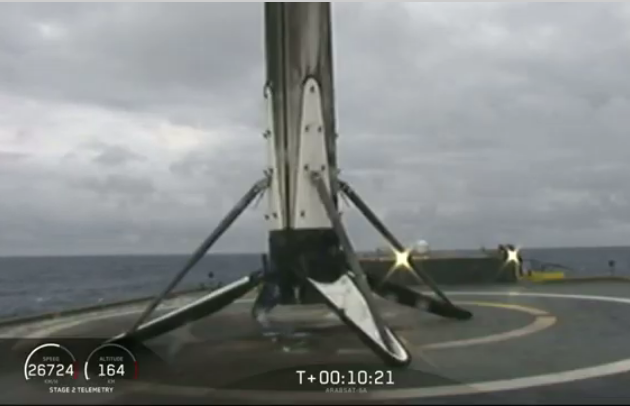
Falcon Heavy core stage on drone ship

Re-entry burn on the core stage has been completed.

Both side boosters have landed.

The payload is in orbit.

The core stage has landed successfully on the drone ship.

Though the satellite has not yet been deployed, the rest of this mission is almost certainly going to go as planned, as it is essentially identical to a normal Falcon 9 launch. Update: payload successfully deployed!

Getting all three stages back is a notable achievement. They intend to recycle the two side cores and use them on the very next Falcon Heavy launch in June. The core stage will likely be reused as well but when has not yet been announced.

The leaders in the 2019 launch race:

4 SpaceX
4 China
4 Europe
3 Russia

The U.S. leads the pack 7 to 4 in the national rankings.

In the heavy lift launch race, SpaceX is by far in the lead in successful launches:

2 SpaceX
1 China
0 SLS (NASA)

I should add that I am being generous to include China’s Long March 5 in this heavy lift list. It really doesn’t qualify, but it remains the only other near competitor.
» Read more

29 comments

Rover update: April 11, 2019

Summary: Curiosity successfully drills into the clay unit. Yutu-2 continues its exploration on the far side of the Moon.

For the updates in 2018 go here. For a full list of updates before February 8, 2018, go here.

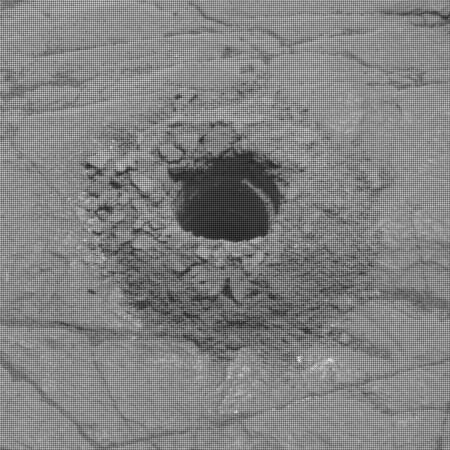
Curiosity drill hole in clay unit on slopes of Mount Sharp

Curiosity

For the overall context of Curiosity’s travels, see my March 2016 post, Pinpointing Curiosityโ€™s location in Gale Crater.

The news this week from Curiosity is that the rover has successfully drilled into the ground in the clay unit valley the rover is presently exploring betweent Vera Rubin Ridge and Mount Sharp’s higher slopes.

The image to the right shows is a close-up of that drill hole.

The rover’s drill chewed easily through the rock, unlike some of the tougher targets it faced nearby on Vera Rubin Ridge. It was so soft, in fact, that the drill didn’t need to use its percussive technique, which is helpful for snagging samples from harder rock. This was the mission’s first sample obtained using only rotation of the drill bit.

Since my last rover update on February 20, 2019, they have been traveling for several weeks to get to a spot where they can do this drilling. The clay unit seems very soft, and almost mudlike, which made finding a good surface to drill somewhat challenging. Most of the terrain seemed too soft to drill into. It almost would be better to have a scoop, as the Viking landers had. Curiosity doesn’t really have this however. It needs to use its drill, which really is a more efficient way to get down deeper into the ground anyway.

The map below shows their recent travels.
» Read more

0 comments

Beresheet landing fails

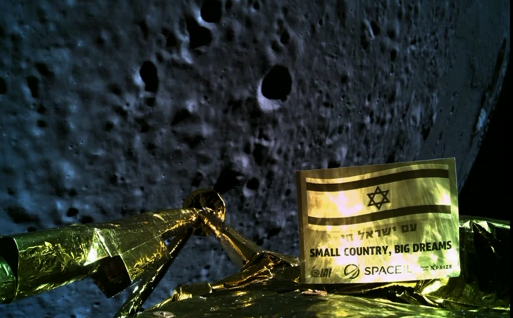
Beresheet's last image

An engine problem during landing has caused Beresheet to crash onto the lunar surface.

The image on the right was the last image beamed back by the spacecraft during the landing sequence. It looks down at the lunar surface from several thousand meters.

As Netanyahu immediately noted, “If at first you don’t succeed, you try again.”

This failure definitely slows down the effort to transition from government-controlled space exploration to a free effort by the independent citizenry of all nations. It does not stop it however. There are other private lunar missions already scheduled, and of course, there is the effort by SpaceX to build its own heavy-lift rocket to make interplanetary space travel affordable for all.

The next decade will see this effort blossom. Beresheet’s failure is an example of those first baby steps, when the ability to stand is uncertain, and sometimes results in a fall. But babies turn into adults. The future is bright indeed.

9 comments

Beresheet landing telecast live streaming now

They have begun the live stream of Beresheet’s landing on the moon, with the arrival of Benjamin Netanyahu in the viewer’s gallery. It is in Hebrew, and will likely mostly involve watching people sitting at computer consoles, and then standing and cheering when the spacecraft lands.

However, I have embedded it below the fold for your viewing pleasure.

UPDATE: They are including English commentary.
» Read more

2 comments

DARPA picks three smallsat rocket companies for launch challenge

Capitalism in space: DARPA has chosen Vector Launch, Virgin Orbit, and a third unnamed company to compete for up to $10 million in prizes in its quick launch competition.

The Defense Advanced Research Projects Agency (DARPA) is giving $400,000 to each of three companies chosen to compete in the โ€œDARPA Launch Challengeโ€ to demonstrate rapid and responsive launch of small payloads. Tucson-based Vector Launch, Virgin Orbit, and a โ€œstealthโ€ startup will now have the opportunity to compete for prizes up to $10 million for successfully proving they can successfully launch twice in a row within a short timeframe from being provided mission parameters, DARPA told reporters here April 10.

First, I wonder why Rocket Lab was not picked. I suspect this is because it is already launching operational missions, and so does not need this developmental boost. Also, its rocket might not meet DARPA’s criteria. The launch systems of both Vector and Virgin Orbit are designed to allow them to quickly transport their rocket to any number of launch sites and go. Rocket Lab’s Electron appears to need a more established launchpad.

Second, I wonder what that third unnamed startup is. There are more than two dozen in development right now, but I can only think of one, Exos Aerospace, that has actually done any successful test flights, albeit suborbital. Whether its reusable SARGE suborbital rocket, being used to incrementally develop an orbital version, fits DARPA’s needs is not clear.

It could also very well be that DARPA has not actually chosen a third company, but has informed several that they can get that third slot, if they can achieve certain goals in a certain time frame. It could be that both DARPA and these companies would rather keep this private competition private. For the companies, they’d rather not advertise their failure to win it. For DARPA, the goal is to help, not hurt, the companies.

0 comments

Iran says it will launch three orbital launches in 2019

The new colonial movement: Despite two launch failures already this year as well as U.S. opposition, Iranian officials earlier this week said that they still have plans to launch three more times in 2019.

I have no idea how seriously we should take this claim. Iranian officials have made a number of claims in recent years that proved nothing by bombast. This might be that, or not.

4 comments
1 107 108 109 110 111 156