The central peaks of Compton Crater

Central peaks of Compton Crater

Cool image time! The Lunar Reconnaissance Orbiter (LRO) science team today released a beautiful oblique image looking of the central peaks of Compton Crater, a far side crater with a floor that is fractured and is one of about 200 hundred such craters.

Today’s Featured Image highlights an floor-fractured crater (FFC) that could tell us much about the lunar crust. An asteroid or comet impact is thought to have excavated 146.6-kilometer-wide Compton crater about 3.85 billion years ago. Igneous intrusion or viscous relaxation โ€” or perhaps both processes โ€” subsequently produced branching fractures and small basalt plains within Compton crater. The latter are darker than their surroundings.

Unlike Copernicus Crater, the surface appears smooth. Go to the link and zoom in to see what I mean. All the fractures appear very large and filled in. Of course, that could be because of the image’s resolution, and that other images might show more details and pits.

I find the central peaks more intriguing, however. It appears that, following their formation they were hit by several bolides, one of which carved a gigantic deep hole into those peaks.

0 comments

Results from Europe’s Trace Gas Orbiter at Mars

The European Space Agency today released the results of more than a year of observations from its Trace Gas Orbiter (TGO), among which were two significant findings.

First, the orbiter detected no methane in Mars’s atmosphere, contradicting recent results from both Curiosity and Mars Express.

The new results from TGO provide the most detailed global analysis yet, finding an upper limit of 0.05 ppbv, that is, 10โ€“100 times less methane than all previous reported detections. The most precise detection limit of 0.012 ppbv was achieved at 3 km altitude. As an upper limit, 0.05 ppbv still corresponds to up to 500 tons of methane emitted over a 300 year predicted lifetime of the molecule when considering atmospheric destruction processes alone, but dispersed over the entire atmosphere, this is extremely low.

…โ€œThe TGOโ€™s high-precision measurements seem to be at odds with previous detections; to reconcile the various datasets and match the fast transition from previously reported plumes to the apparently very low background levels, we need to find a method that efficiently destroys methane close to the surface of the planet.โ€

It appears they think the Curiosity and Mars Express detections were very localized and occurred close to the surface, where TGO could not detect it.

The second significant finding is indicated by the map below, showing a global map of subsurface water distribution on Mars. I have also posted below this map a global elevation map from Mars Reconnaissance Orbiter (MRO), as the similarities and differences are important.
» Read more

0 comments

Attorney General: Spying on Trump occurred; investigation begun

These two stories gleaned from yesterday’s House testimony by Attorney General William Barr at first glance might seem unrelated:

Of course these stories are related. The spying occurred in conjunction with the FBI’s effort to pin the fake Russian collusion accusation on Trump.

If a legitimate investigation occurs here, then a number of people will be facing jail time, for perjury, for abuse of power, for actually conspiring to overturn a legal election. Moreover, it appears the investigation might not be limited to actions by the FBI. According to Barr’s testimony today at a Senate hearing, multiple intelligence agencies are implicated.

While it is important that the top law enforcement in the United States publicly acknowledged that the Obama administration and its intelligence agencies surveilled its domestic political opponents during the heat of a presidential election, it is what [Barr] said next that was most startling: that the CIA and other federal agencies in addition to the FBI may have been involved. โ€œIโ€™m not talking about the FBI necessarily, but intelligence agencies more broadly,โ€ he said.

This whole Russian-collusion scam was corrupt from the get-go. Its only benefit is that it has revealed the depth of corruption in the executive branch of the federal government, which tried to set itself up as an American Praetorian Guard, with the right to anoint its favored political leaders as president, rather than the voters.

More importantly, this investigation is going to find out how much the Democratic Party, and its leader at the time, Barack Obama, were involved in this scam. We know already that the Washington bureaucracy is highly partisan and Democratic. What we don’t know is if that unhealthy partisanship was weaponized by Obama to generate this scam.

Barr might very well find out.

15 comments

Confirmed: Netanyahu wins reelection

It now appears that this week’s election in Israel has once again given Benjamin Netanyahu’s right wing coalition a strong enough majority to form the next Israeli government.

The right-wing bloc is predicted to have around 65 seats, compared with 55 for the centre and left, similar to the make up of the outgoing parliament.

Even before the election, all the smaller right-wing parties had pledged to back Netanyahu for prime minister, meaning his victory was always likely, Zalzberg said. “He demonstrated again his mastery of alliance-building among the different political tribes of Israel — he is unmatched in this.”

The problem for the strongest opposition party, dubbed Blue-and-White, is that though their leadership is moderate and pro-Israel, they cannot form a coalition with the religious parties in Israel, as Netanyahu can. Blue-and-White has forged alliances with the nation’s leftist parties, and Israel’s religious parties cannot participate in coalitions that include those parties.

What is interesting about this particular election is that it reduced the number of parties in the Knesset, Israel’s parliament. It appears the voters are now consolidating their support around fewer factions, which clarifies and simplifies the formation of the next government. It also suggests that Israelis feel more threatened, and are thus looking at larger issues in choosing the parties they support. They no longer feel the luxury of pushing side issues. Survival is becoming more paramount.

2 comments

Astronomers take highest resolution radio image of black hole

shadow of black hole

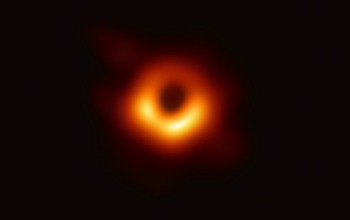
Using a network of ground-based radio telescopes astronomers today released the highest resolution radio image of black hole ever produced.

Before giving more details, I must correct every other news report, as well as all of the press releases about this image. It is not “The first image of a black hole!” as these releases are claiming breathlessly. Radio telescope arrays have taken such images in the past, but their resolution was poor, so the result was not very imagelike. Instead, it showed contour lines in a coarse manner. Moreover, the coarseness of the resolution prevented them from seeing the black hole’s shadow itself.

This image now produced has the highest resolution ever for such a radio image, but believe me, it is still coarse. Nonetheless, it represents a giant technological leap forward. The effort required upgrades to many of these telescopes, along with significantly improved computer analysis. Now for some details:

Black holes are extraordinary cosmic objects with enormous masses but extremely compact sizes. The presence of these objects affects their environment in extreme ways, warping spacetime and super-heating any surrounding material. “If immersed in a bright region, like a disc of glowing gas, we expect a black hole to create a dark region similar to a shadow — something predicted by Einstein’s general relativity that we’ve never seen before,” explained chair of the EHT Science Council Heino Falcke of Radboud University, the Netherlands. “This shadow, caused by the gravitational bending and capture of light by the event horizon, reveals a lot about the nature of these fascinating objects and allowed us to measure the enormous mass of M87’s black hole.”

The image reveals the black hole at the center of Messier 87, a massive galaxy in the nearby Virgo galaxy cluster. This black hole resides 55 million light-years from Earth and has a mass 6.5-billion times that of the Sun.

Multiple calibration and imaging methods have revealed a ring-like structure with a dark central region — the black hole’s shadow — that persisted over multiple independent EHT observations. “Once we were sure we had imaged the shadow, we could compare our observations to extensive computer models that include the physics of warped space, superheated matter and strong magnetic fields. Many of the features of the observed image match our theoretical understanding surprisingly well,” remarks Paul T.P. Ho, EHT Board member and Director of the East Asian Observatory. “This makes us confident about the interpretation of our observations, including our estimation of the black hole’s mass.” [emphasis mine]

Note the highlighted words. To create this image they needed to combine data from numerous radio telescopes. Such work requires extensive calibration. The resulting image is manufactured, though without doubt it is manufactured from real radio data accumulated by multiple telescopes. Because those telescopes are separated by distance, however, there will always be gaps between their images, and it is in the calibration and imaging methods that the gaps are extrapolated away.

I don’t wish to imply that this image is fake. It is not. That the features persisted over multiple observations confirms that they were actually seeing the black hole’s shadow. It also confirms that these new interferometry techniques work.

However, much of the press hyperbole today is an effort to justify the many millions in tax dollars spent on this effort. The effort was absolutely worthwhile scientifically, but government bureaucracies always feel a need to oversell their work. That is partly what is happening here.

5 comments

A dance of dust devils

A dance of dust devils on Mars

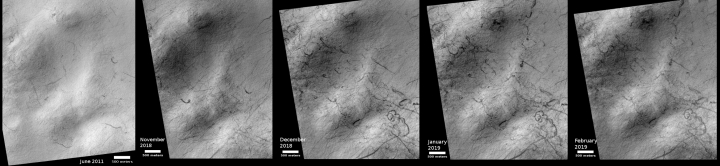
Many of my image posts about Mars have emphasized how slowly things change there. This post will highlight the exact opposite. When it comes to dust devils, it appears they can leave their trace frequently and often, and for some reason they seem to also favor specific locations.

June 2011
Click for full image.

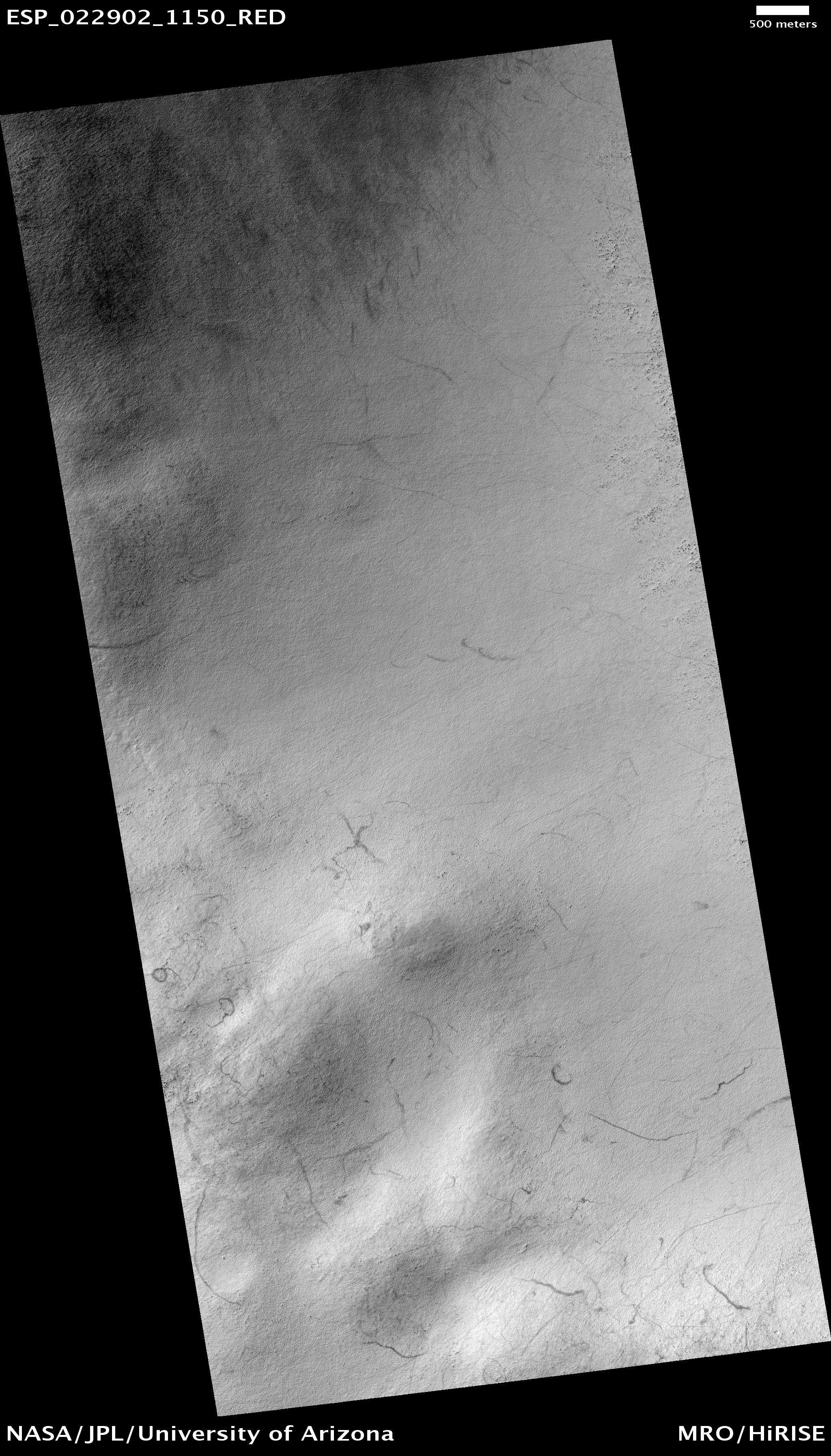
The string of images above are all of the same location in the southern highlands of Mars. All were taken by the high resolution camera of Mars Reconnaissance Orbiter (MRO) and can be found in the camera’s archive. I have cropped them to show the same approximate matching area. The first image in that strip above, shown at higher resolution to the right, was taken in June 2011 and titled “Possible Gully Features” by the MRO science team. This is not surprising, as the rounded hills in this image are actually the southwest rim of a large crater, and the slopes of craters have been found one of the best places to find the gullies where seasonal changes occur, all possibly caused by underground water.

From the title, it appears that the science team might have first hoped to spot either slope streaks or recurring slope lineae, the two most intriguing of these changing features. Instead, that 2011 image showed them a very eroded crater rim with a small scattering of dust devil tracks.

November 2018
Click for full image.

This lack of gullies probably reduced interest in this location. It wasn’t until seven years later, in November 2018, that the MRO team decided to take another image of this location (the second image in the strip above and shown to the right at higher resolution). This time they found a significant increase in the number of dust devil tracks.

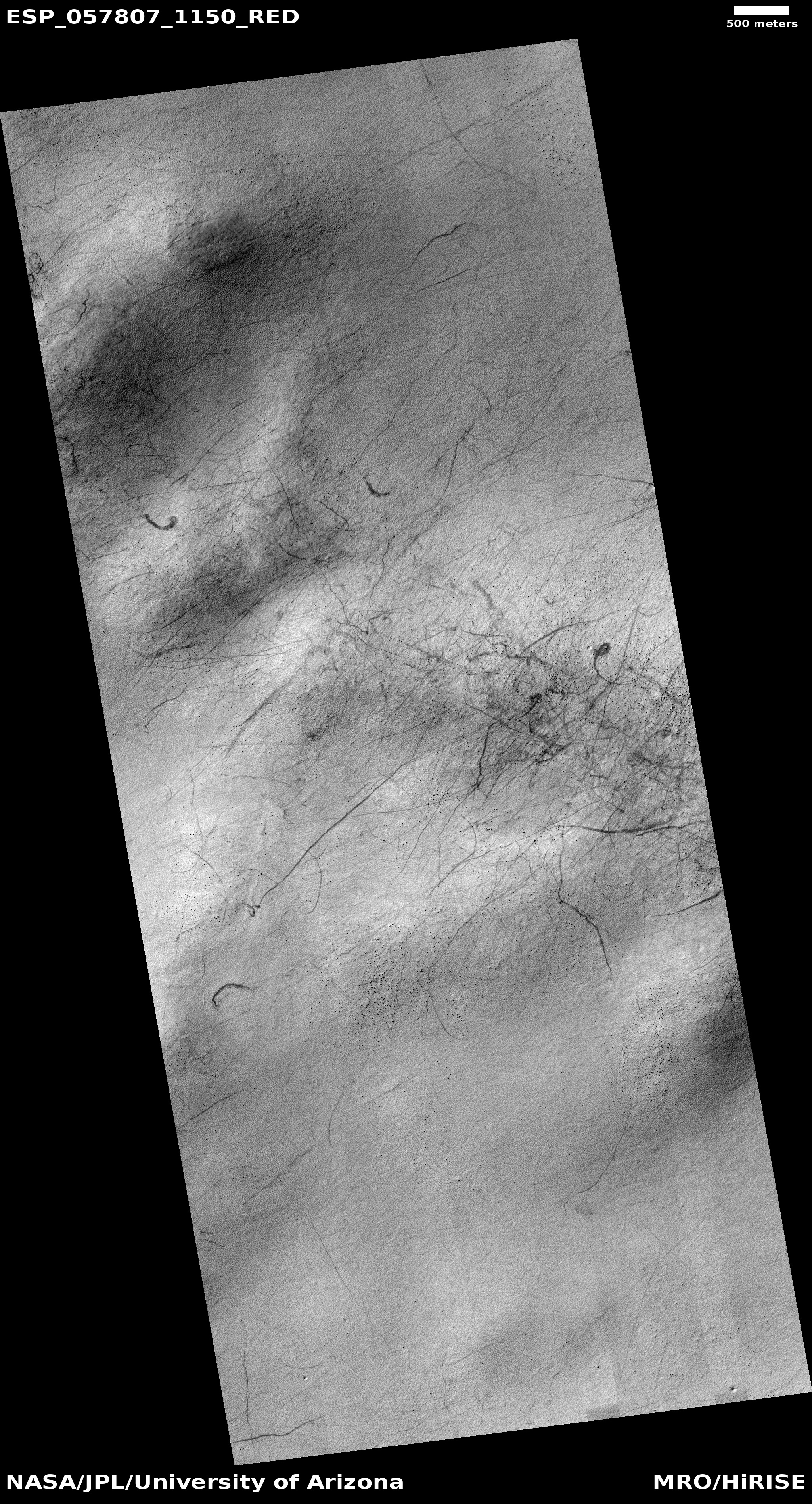
At this point the decision must have been made to take another image of this location a month later in December 2018. I assume the scientists were curious to see if they would spot any additional changes in that one month period. This was dust devil season, so the likelihood of seeing more tracks was not unreasonable.

How many tracks appeared, and whether they were concentrated in any particular place, such as the ridge lines, would help researchers better understand what generates them, which in turn will give them a better understanding of the Martian atmosphere.

The result was astonishing.
» Read more

0 comments

ULA to fly Vulcan components on Atlas 5 flights

Capitalism in space: In order to speed the development of its next generation commercial rocket, the Vulcan Centaur, ULA will fly Vulcan components as they are developed on its Atlas 5 rocket.

The first Vulcan technology to fly on Atlas 5 will be new payload fairings from Swiss supplier Ruag built using an โ€œout-of-autoclaveโ€ production process that enables fairing halves to be produced as one piece, a process Ruag says lowers production time and costs. โ€œThe out-of-autoclave fairings, which are manufactured by Ruag, and now in the U.S. โ€” they are in a factory next to ours in Decatur โ€” thatโ€™s going to fly on Atlas 5 this year,โ€ Louradour said.

Sometime in 2020 they will then fly an Atlas 5 launch using the solid rocket boosters Northrop Grumman is building for Vulcan.

This is not really news. When ULA announced their plans to build Vulcan in 2015, they said then that they intended to transition from Atlas 5 to Vulcan over time, slowly introducing components on Atlas 5 until it was entirely replaced.

Nonetheless, it shows that ULA is adopting some of the the same common sense development procedures used by SpaceX. By taking advantage of launches as they happen, they can speed development. And they need to do this in order to keep pace with SpaceX.

Isn’t competition wonderful?

3 comments

Chandrayaan-2 likely delayed to July

The new colonial movement: The launch of India’s first lunar lander/rover, Chandrayaan-2, will likely be delayed again, from May until July.

This further delay is not confirmed by ISRO, India’s space agency. Nor is any clear reason given in the article above to explain this additional delay.

It would not surprise me however. The head of ISRO, K. Sivan, is a trained engineer. He has shown himself to be very willing to impose delays if he has any doubts about the success of the mission.

0 comments

Rocket Lab now building smallsats also

Capitalism in space: Rocket Lab announced this week that it is now offering satellite manufacture in addition to its launch services.

The โ€œPhotonโ€ satellite platform was developed so that customers would not have to build their own satellite hardware. โ€œSmall satellite operators want to focus on providing data or services from space, but building satellite hardware is a significant barrier to achieving this,โ€ said Rocket Lab founder and chief executive Peter Beck, in a statement. โ€œThe time, resources and expertise required to build hardware can draw small satellite operators away from their core purpose, delaying their path to orbit and revenue. As the turn-key solution for complete small satellite missions, Rocket Lab brings space within easy reach. We enable our customers to focus on their payload and mission โ€“ we look after the rest.โ€

The satellites are designed for a range of Low Earth Orbit missions including technology demonstrations, risk reduction pathfinders, constellations, and hosted payloads, the company said in a statement.

This is not surprising. With their Electron rocket now operational, and about to begin monthly launches, they have the profits and margin to offer a complete launch package to smallsat customers.

0 comments
1 108 109 110 111 112 156