Second orbital launch failure in a month for Iran rocket

According to U.S. officials, Iran has attempted and failed twice in the past month to place satellites in orbit.

Iran’s second try in less than a month to send a satellite into orbit apparently failed shortly after liftoff from a remote desert launch pad under daily surveillance from a fleet of commercial imaging spacecraft, according to U.S. government officials and independent analysts.

Images of the launch pad in north-central Iran taken by orbiting satellites owned by U.S. companies suggest a rocket launch occurred last week, but the U.S. military’s catalog of space objects registered no new spacecraft in orbit. A satellite launch attempt was expected in recent weeks based on statements from Iran’s government and observations of increasing activity at the launch site.

Iran has admitted to a launch failure on January 15, though it denies the failure last week, claiming instead that the February launch succeeded in placing its satellite in orbit, even though no new satellite has been detected.

7 comments

MAVAN shifts priorities to communications

The Mars orbiter MAVAN, designed primarily to study Mars’s atmosphere, is now lowering its orbit as it shifts its primary function from science to communications between the Earth and the rovers on the surface.

A strong telecommunications antenna signal is not the only benefit of a tighter orbit. Coming in nearly 1,000 miles (about 1,500 kilometers) closer also will allow the MAVEN orbiter to circle Mars more frequently – 6.8 orbits per Earth day versus 5.3 previously – and thus communicate with the Mars rovers more frequently. While not conducting relay communications, MAVEN will continue to study the structure and composition of the upper atmosphere of Mars. “We’re planning a vigorous science mission far into the future,” Jakosky said.

In a sense, NASA here is finding a way to replace the Mars communications satellite that it wanted but was not able to get funded.

0 comments

Birthday fund-raiser continues!

To my readers: We are now entering the second week of my February birthday fund-raising campaign. Your support is most desperately needed to keep Behind the Black operating.

Unfortunately, because John Batchelor is presently recovering from an illness (recovering well I must add), he was off the air in the first week of February, and will be off the air again this week. Thus, I do not have his aid in publicizing this fund-raiser, and so his normally very generous listeners are unaware it is happening.

I therefore need the help of my readers all the more. Please consider making a donation, or subscribing, as indicated by the tip jar above. Your support will be appreciated deeply, and will make it possible for me to continue to report on space.

This announcement will stay on the top of the page for the rest of today. Scroll down for new posts.

0 comments

NASA’s political and corrupt safety panel

After spending the last few years complaining about certain specific issues with the manned capsule efforts of SpaceX and Boeing, NASA’s safety panel this past weekend released its annual 2018 report. (You can download the report here [pdf].) Its position now on those certain specific issues can now be summarized as follows:

They make no mention of the parachute issues that forced Boeing to do numerous extra tests, causing probably a year delay in the program, though Boeing has had decades of experience with capsule parachutes and the entire American aerospace industry has never had a parachute failure.

The panel also admits that their concerns about SpaceX’s rocket fueling procedures is really not an issue.

The NESC [NASA Engineering and Safety Center] has independently studied the load and go procedure and provided a thorough report that identifies the hazards and available controls. Based on the NESC report, the CCP [Commercial Crew Program] has decided that the load and go concept is viable if subsequent analysis is adequate and if verifiable controls are identified and implemented for all the credible hazard causes that could potentially result in an emergency situation or worse.

As Emily Litela said, “Never mind!” Their concerns were never credible, as it really doesn’t matter if you fuel the rocket before or after the astronauts board, because in either case they are there when a lot of fuel is present. All the panel did was delay the first Dragon launch by at least a year by pushing this issue.

The panel is still holding onto its concerns about the installation blankets (COPV) used in SpaceX’s internal helium tanks, the location of the problem that caused the September 2016 launchpad explosion. Despite SpaceX’s apparent fixing of this problem, with 40 successful launches since that failure, they are listing further vague requirements:
» Read more

8 comments

IMF announces plan for stealing money from bank accounts

They’re coming for you next: The International Monetary Fund today announced a proposed plan that would allow banks to charge negative interest on any deposited funds, a plan that would essentially allow banks, and governments, to steal money from their customers.

The plan also involves making cash a second-class method of payment, because it is impossible for them to charge negative interest on cash. When banks in Europe have charged negative interest, they have found they have instead created a run on their banks as customers rush to pull their money out.

One option to break through the zero lower bound would be to phase out cash. But that is not straightforward. Cash continues to play a significant role in payments in many countries. To get around this problem, in a recent IMF staff study and previous research, we examine a proposal for central banks to make cash as costly as bank deposits with negative interest rates, thereby making deeply negative interest rates feasible while preserving the role of cash.

The proposal is for a central bank to divide the monetary base into two separate local currencies—cash and electronic money (e-money). E-money would be issued only electronically and would pay the policy rate of interest, and cash would have an exchange rate—the conversion rate—against e-money. This conversion rate is key to the proposal. When setting a negative interest rate on e-money, the central bank would let the conversion rate of cash in terms of e-money depreciate at the same rate as the negative interest rate on e-money. The value of cash would thereby fall in terms of e-money.

To illustrate, suppose your bank announced a negative 3 percent interest rate on your bank deposit of 100 dollars today. Suppose also that the central bank announced that cash-dollars would now become a separate currency that would depreciate against e-dollars by 3 percent per year. The conversion rate of cash-dollars into e-dollars would hence change from 1 to 0.97 over the year. After a year, there would be 97 e-dollars left in your bank account. If you instead took out 100 cash-dollars today and kept it safe at home for a year, exchanging it into e-money after that year would also yield 97 e-dollars. [emphasis mine]

I have highlighted the entire last paragraph because it contains the heart of the matter. You deposit $100, but they only give you $97 at the end of the year, keeping the $3 for their own benefit.

Buried deep in the article is this minor point:

Still, implementing such a system is not without challenges. It would require important modifications of the financial and legal system. In particular, fundamental questions pertaining to monetary law would have to be addressed and consistency with the IMF’s legal framework would need to be ensured. Also, it would require an enormous communication effort.

To put this in plain language, charging negative interest in most western nations would be considered outright theft. To do it they need to get the laws changed, while also running an intense propaganda campaign to convince depositors that having their money stolen is a good thing.

Sadly, I think this might happen. We live in dark times, with many people enamored by foolish ideas.

10 comments

Antifa thug favorite of Democratic politicians

They’re coming for you next: An Antifa thug presently facing assault charges for an attack on two Marines appears to have been a favorite of Democratic politicians, until his indictment.

I could have also subtitled this post, “The brownshirts of the Democratic Party.” This story illustrates the close ties the modern Democratic Party has with the violent Antifa movement.

But while Democratic officials are distancing themselves from Alcoff now, until recently he was a well-connected, aspiring political player in Washington who may have even had a hand in key policy proposals.

His endorsement apparently mattered when several congressional Democrats in February 2018 issued press releases with his quote backing their bill on regulating payday lenders.

As the payday campaign manager for the liberal group Americans for Financial Reform, Alcoff participated in congressional Democratic press conferences, was a guest on a House Democratic podcast and met with senior officials at the Consumer Financial Protection Bureau from 2016 through 2018.

He was also pictured with now-House Financial Services Committee Chairwoman Maxine Waters, D-Calif., and ranking Democrat on the Senate Banking, Housing and Urban Affairs Committee Sen. Sherrod Brown of Ohio. Both committees oversee financial regulatory policies Alcoff was advocating.

Alcoff met with then CFPB Director Richard Cordray and other senior CFPB officials on April 2016, again in March 2017 and a third time in May 2017, as first reported by the Washington Free Beacon.

In essence, violent Antifa groups are the violent wing of the Democratic Party, used by it to physically attack conservatives and any innocent Americans who happen to be at their conservative events.

2 comments

A second Greenland crater discovered?

Scientists are now claiming they have found a second crater buried under Greenland’s icecap.

To confirm his suspicion about the possible presence of a second impact crater, MacGregor studied the raw radar images that are used to map the topography of the bedrock beneath the ice, including those collected by NASA’s Operation IceBridge. What he saw under the ice were several distinctive features of a complex impact crater: a flat, bowl-shaped depression in the bedrock that was surrounded by an elevated rim and centrally located peaks, which form when the crater floor equilibrates post-impact. Though the structure isn’t as clearly circular as the Hiawatha crater, MacGregor estimated the second crater’s diameter at 22.7 miles. Measurements from Operation IceBridge also revealed a negative gravity anomaly over the area, which is characteristic of impact craters.

“The only other circular structure that might approach this size would be a collapsed volcanic caldera,” MacGregor said. “But the areas of known volcanic activity in Greenland are several hundred miles away. Also, a volcano should have a clear positive magnetic anomaly, and we don’t see that at all.”

It must be emphasized that this conclusion remains very uncertain. What they have found is a depression that has features indicative of an impact crater, data that is far from sufficient to definitively prove the crater is real.

0 comments

LRO spots Chinese lunar rover

Yutu-2 and Chang'e-4 on far side of Moon

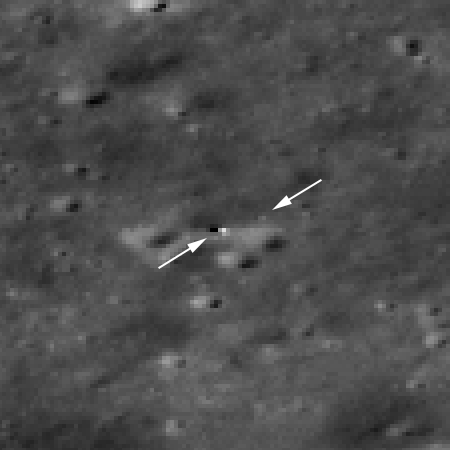
The Lunar Reconnaissance Orbiter (LRO) science team has now released a second and closer image of Chang’e-4’s location on the far side of the Moon, which now also shows the nearby rover Yutu-2.

The two arrows in the image to the right, cropped to post here, show both. The rover is the dot on the right, with the lander to the left, both just beyond the arrow tips. Both are very small, with Yutu-2 for example only two pixels across. Still, with both you can see their shadows, equally small, to the left of both bright dots. With sunlight coming from the right, all the craters, which are recessed, have their shadows on the right. The spacecraft, sticking up from the surface, have shadows going to the the left.

As Yutu-2 continues its travels, LRO will likely take more images, allowing us to track it even if the Chinese provide limited information.

1 comment

SpaceX’s new Raptor engine: The world’s most powerful?

According to a tweet by Elon Musk, SpaceX’s new Raptor rocket engine has achieved during testing a chamber pressure that exceeds that of Russia’s RD-180 engine, which for decades has held the record.

First and foremost, it’s far too early to actually crown Raptor as the new official record-holder for combustion chamber pressure. RD-180 has been reliably flying on ULA’s Atlas V rocket with chamber pressures as high ~257.5 bar (3735 psi) since the year 2000, while Raptor has been performing subscale integrated testing for roughly two years and full-scale integrated testing for less than seven days. As such, the fact that full-scale Raptor has achieved ~269 bar (3900 psi) is an almost unbelievably impressive achievement but probably shouldn’t be used to jump to any conclusions just yet.

Thanks to the 10-20% performance boost supercool liquid methane and oxygen will bring Raptor, currently stuck using propellant just barely cold enough to remain liquid, the engine performing tests could already be made to reach its design specification of 300+ bar (4350+ psi), although Musk cautioned that he wasn’t sure Raptor would be able to survive that power in its current iteration. Nevertheless, 250 bar is apparently more than enough to operate Starship and its Super Heavy booster during most regimes of flight, although maximum thrust (and thus max chamber pressures) is probably desirable for the first minute or so after launch when gravity losses are most significant. [emphasis in original]

If the Raptor meets these goals, it will make most of Musk’s dreams for Startship and Super Heavy very possible.

0 comments

NASA to avoid SLS delays should another shutdown occur

Faced with an impending second government shutdown mere days away, NASA has been moving to avoid any delays in an upcoming planned Orion/SLS launch abort test should another shutdown occur.

What I find most fascinating about this article is how different the attitude seems to be at NASA between this SLS/Orion test flight and SpaceX’s Dragon test flight. With SpaceX, NASA has apparently made no effort to figure out ways for the test to go forward during the shutdown, even though the launch would be run by SpaceX employees on a SpaceX launchpad, and would only require NASA employees who are all considered essential.

With this Orion abort test, however, they have been and are planning to do everything they can to bypass the shutdown. Like SpaceX, the Air Force was free to operate during the shutdown, because its budget had already been approved.

“Then the shutdown kept going so I said ‘boy, let me see what I can do with these Air Force pieces.’ And it was very interesting, I had to work with lawyers here at Kennedy and Johnson [Space Center],” explained [Mark Kirasich, NASA Orion Program Manager.]

“The Air Force was not shut down, it was only NASA. So you had to write the legal justification — ‘hey the Air Force is not shut down, this is important work to do in this building’ and we were eventually able to allow the Air Force to get access to the buildings, if that makes sense.”

“And then the very last piece which was the NASA piece,” he continued. “Now of course NASA was shut down, that was the hardest thing to get exempted and I was working on that piece right when the government on that Friday night signed that continuing resolution, but I was confident I would get that piece going again had the shutdown continued.”

The contrast is most striking. It almost makes you think that NASA is purposely using any excuse to slow-walk SpaceX’s effort.

2 comments

Border wall to divide SpaceX’s Texas spaceport?

According to this article, the proposed location of the border wall in Boca Chica will bisect SpaceX’s spaceport facility there, and Democrats are working a deal to prevent this.

This article is part of the full court press being put on by the Democrats, with blatant media help, to block the wall, in any way possible, as I noted previously. I have very serious doubts the wall will cut across SpaceX’s property in any way that is significant, but if it is threatening to do so, the solution would not be to not build a wall there (which is what the Democrats want), but to work out an arrangement where the wall is built on the edge of their property and thus does them no harm.

If no wall is built here, the property then becomes a target for illegals, and thus will create even worst problems for SpaceX.

19 comments
1 135 136 137 138 139 156