Hawaiian activists say “No!” to smallsat spaceport

The coming dark age: At a meeting to obtain public feedback on a proposed smallsat spaceport in Hawaii, activists were almost all hostile or opposed to the project.

There might be justified reasons to oppose the spaceport, but since the environmental assessment is not yet published, it is unclear at this point what those reasons might be. The reasons cited by these opponents, noise and pollution, don’t seem serious. The spaceport being proposed is for smallsat rockets, rockets that are very small (only a few times larger than the biggest model rockets). Even if they launch weekly these rockets will not cause serious noise or pollution issues.

Thus, what I see here are a bunch of close-minded luddites afraid of new things, and determined to block those new things from happening.

1 comment

Rare asteroid orbiting near Venus discovered

The Zwicky Transient Facility (ZTF), a new sky survey telescope whose main goal is to find Near Earth asteroids, has discovered a rare asteroid orbiting near Venus.

A state-of-the-art sky-surveying camera, the Zwicky Transient Facility, or ZTF, detected the asteroid on January 4, 2019. Designated 2019 AQ3, the object has the shortest “year” of any recorded asteroid, with an orbital period of just 165 days. It also appears to be an unusually big asteroidal specimen. “We have found an extraordinary object whose orbit barely strays beyond Venus’ orbit—that’s a big deal,” said Quanzhi Ye, a postdoctoral scholar at IPAC, a data and science center for astronomy at Caltech. Ye called 2019 AQ3 a “very rare species,” further noting that “there might be many more undiscovered asteroids out there like it.”

…The orbit, as it turns out, is angled vertically, taking 2019 AQ3 above and below the plane where the planets run their laps around the sun. Over its short year, 2019 AQ3 plunges inside of Mercury, then swings back up just outside of Venus’ orbit.

The telescope, in operation since March 2018, and so far found

nearly 60 new near-Earth asteroids. Two of these were spotted in July 2018 mere hours before they gave Earth quite a close shave. Designated 2018 NW and 2018 NX, the duo of bus-sized asteroids whipped past at a distance of about 70,000 miles, or only a third of the way to the moon. Fortunately, the newfound 2019 AQ3 poses no threat; the closest it ever comes to Earth is about 22 million miles.

1 comment

First SLS launch faces more delays

No surprise here: The scheduled June 2020 first unmanned launch of NASA’s Space System Launch (SLS), already delayed by three years, appears threatened by more delays.

[NASA needs to perform]a similar structural test of the liquid oxygen fuel tank before what is known as a “green run” test. For this exercise, NASA will assemble the two large tanks and then integrate them with the rocket’s four main RS-25 engines. Then, at a test stand in southern Mississippi, the rocket will fire its engines through a standard launch of the rocket.

NASA has yet to formally set a date for this “green run” test, but whenever it does occur will be a key indicator for when we will see the first actual launch of the SLS rocket. If the green run test is conducted late in 2019, there would still be a chance for a 2020 launch. However, the agency and its prime contractor for the core stage, Boeing, are on a tight timeline that has little margin for technical problems that might occur during the structural tests of the tank or the green run tests. Historically, during this integration and test process with other large rocket programs, major problems have often occurred.

It is not clear how deeply the shutdown affected the SLS timeline, even though core stage work did proceed. “The shutdown impacted at least day for day,” one source said of the schedule. “But I am sure it was more than that.”

NASA originally planned to launch the SLS rocket on its maiden flight in November 2017, so the rocket will now be at least three years later than originally anticipated. The program’s budget is more than $2 billion a year, so these delays have cost the agency considerably.

The article also outlines the problems NASA is having developing the rocket’s upper stage.

I predict that the June 2020 launch will slip, maybe as much as six months, into 2021. This means the first manned flight will also be delayed into 2024, at the earliest.

That means it will have taken NASA more than twenty years and more than $60 billion to build and fly a single manned mission. Moreover, the cost and difficulty of operating SLS will make it impossible to get the second manned flight off the ground any earlier than three to four years later, at the earliest.

There is no chance the U.S. will put new footprints on the Moon if it continues to rely on this boondoggle. Worse, a continued reliance on SLS will force the government, for political reasons, to use its power to squelch competing private efforts, something we are seeing with the endless delays NASA has imposed on the commercial crew program.

3 comments

Auditor condemns Ariane 6

Capitalism in space: France’s independent government auditor has issued a new report that badly slams Arianespace’s next generation rocket, Ariane 6, accusing its design as being too cautious and too expensive, thus guaranteeing it will fail to compete with the reusable rockets now in use as well as being developed in the U.S.

This is the scathing assessment of France’s independent state auditor in a report that picked apart the flawed economic model behind Ariane 6, the next generation of rocket-launchers set to start operating in 2020.

It made the point that Europeans, who have taken part in developing the launcher, went for a “cautious” approach and invested in the kind of controlled technology that potential clients in the continent had no faith in, even back in 2014. This means that Ariane 6 is stuck in the past and “risks not being competitive over the long term.” Its U.S. rivals are way ahead and already testing future disruptive technologies. [emphasis mine]

The highlighted text is proven by the apparent unwillingness of Arianespace’s European partners to sign contracts for Ariane 6.

This isn’t really news. See for example this February 13, 2018 report on Behind the Black. Or this one from September 2017, where ArianeGroup first outlined the prices they expected to charge for Ariane 6. Then, I predicted what France’s auditor has only now realized:

Will these prices be competitive in 2020s? I have my doubts. I estimate, based on news reports, that SpaceX is charging about $40 million today for a launch with a reused first stage, and $62 million for a launch with an entirely new rocket. Give them another five years of development and I expect those prices to drop significantly, especially as they shift to entirely reused first stages for almost every launch and begin to demonstrate a routine launch cadence of more than one launch per month.

This quote…explains how ArianeGroup really intends to stay alive in the launch market: “The price targets assume that European governments — the European Space Agency, the European Commission, Eumetsat and individual EU nations — agree to guarantee the equivalent of five Ariane 62 missions per year, plus at least two missions for the light-lift Vega rocket.”

In other words, ArianeGroup really doesn’t wish to compete for business. It wants to use government coercion to force European space agencies and businesses to buy its product. They might get that, but the long term result will be a weak European presence in space, as everyone else finds cheaper and more efficient ways to do things. [emphasis mine]

Based on recent stories, it seems that ArianeGroup has been unable to force European space agencies to buy Ariane 6. Thus, the rocket faces failure, before it even launches.

3 comments

A look at SpaceX’s upcoming launch schedule

Link here. It appears that the launch dates for both Falcon Heavy launches depend entirely on when the first Falcon 9 manned Dragon test flight takes place.

With Demo-1 having priority, the final preparations for Arabsat [using Falcon Heavy] will not be able to begin until the Demo-1 launch has occurred as there is only so much space in the Pad 39A hangar. With that in mind, Arabsat 6A will likely occur in the second half of March at the earliest, as NASA announced on Wednesday that Demo-1 is now targeting no earlier than March 2nd, 2019.

While the March 2nd launch date for Demo-1 is still tentative, it is understood that the Space Station’s Visiting Vehicle Schedule does have availability for a launch on that date should the NASA and SpaceX teams be ready.

Once Demo-1 and Arabsat are out of the way, Pad 39A will not be done supporting high profile missions. SpaceX will work to quickly turnaround the first stage boosters from the Arabsat 6A flight in order to reuse them for the STP-2 mission – the second Falcon Heavy launch of the year. STP-2 is a mission for the U.S. Air Force which will feature several technology demonstration payloads. According to FCC filings, the launch is currently scheduled for no earlier than April 30th, 2019. However, since this mission requires boosters from the Arabsat 6A launch, SpaceX will require several weeks between the two flights to refurbish the cores.

Therefore, STP-2 is directly connected to the launch schedule for Arabsat 6A which is in turn connected to Demo-1’s schedule. Consequently, the odds of a slip with STP-2’s date are high, as two major dominos currently stand in front of it.

In addition, the date for SpaceX’s launch abort test of Dragon depends entirely on the completion of the Demo-1 flight, since they plan to use that same capsule in the abort test.

Though there are a handful of other launches described in the article through April, but much of SpaceX’s schedule for the spring depends entirely on whether NASA can get off its duff and allow the Dragon test mission to fly. If NASA continues to drag its feet, everything else will get delayed. It would seem that at some point SpaceX might even have the right to demand financial compensation from NASA for the loss of income NASA is causing it. They don’t get paid for any of these launches until they fly, and thus NASA is preventing them from earning money from other customers.

0 comments

New Hubble images of Uranus and Neptune

Uranus (top) and Neptune

The Hubble Space Telescope’s new annual images of Uranus (top) and Neptune (bottom) has revealed new atmospheric features for both, a giant north pole cloud cap on Uranus and a new dark storm developing on Neptune.

For Neptune:

The new Hubble view of Neptune shows the dark storm, seen at top center. Appearing during the planet’s southern summer, the feature is the fourth and latest mysterious dark vortex captured by Hubble since 1993. Two other dark storms were discovered by the Voyager 2 spacecraft in 1989 as it flew by the remote planet. Since then, only Hubble has had the sensitivity in blue light to track these elusive features, which have appeared and faded quickly. A study led by University of California, Berkeley, undergraduate student Andrew Hsu estimated that the dark spots appear every four to six years at different latitudes and disappear after about two years.

Hubble uncovered the latest storm in September 2018 in Neptune’s northern hemisphere. The feature is roughly 6,800 miles across.

For Uranus:

The snapshot of Uranus, like the image of Neptune, reveals a dominant feature: a vast bright cloud cap across the north pole.

Scientists believe this feature is a result of Uranus’ unique rotation. Unlike every other planet in the solar system, Uranus is tipped over almost onto its side. Because of this extreme tilt, during the planet’s summer the Sun shines almost directly onto the north pole and never sets. Uranus is now approaching the middle of its summer season, and the polar-cap region is becoming more prominent. This polar hood may have formed by seasonal changes in atmospheric flow.

The images are part of an annual program that monitors both planets with images every year when the Earth is best placed to view them. This allows scientists to track atmospheric changes over time.

The sharpness of both images matches that of previous Hubble images, so these photographs do not show any decline in the telescope’s image capability. However, when they lose that next gyroscope and shift to one gyroscope mode, I believe it will be very difficult to get images even this sharp of the outer planets. In fact, I suspect this monitoring program will likely have to end, or will be badly crippled.

1 comment

UK names rover for 2020 ExMars mission

The United Kingdom has named its rover for 2020 ExMars mission in honor of Rosalind Franklin, one of the scientists who contributed to the discovery of the helix structure of DNA.

Franklin is best known for her work on the X-ray diffraction images of DNA. Her data was a part of the data used to formulate Crick and Watson’s 1953 hypothesis regarding the structure of DNA. Unpublished drafts of her papers show that she had determined the overall B-form of the DNA helix. Her work supported the hypothesis of Watson and Crick and was published third in the series of three DNA Nature articles. After finishing her portion of the DNA work, Franklin led pioneering work on the tobacco mosaic and polio viruses. Franklin died from ovarian cancer at the age of 37, four years before Crick, Watson and Wilkins were awarded the Nobel Prize in 1962 for their work on DNA.

Though this isn’t entire clear from the press release, it appears that they will refer to the rover as either “Rosalind Franklin” or “Rosalind.”

1 comment

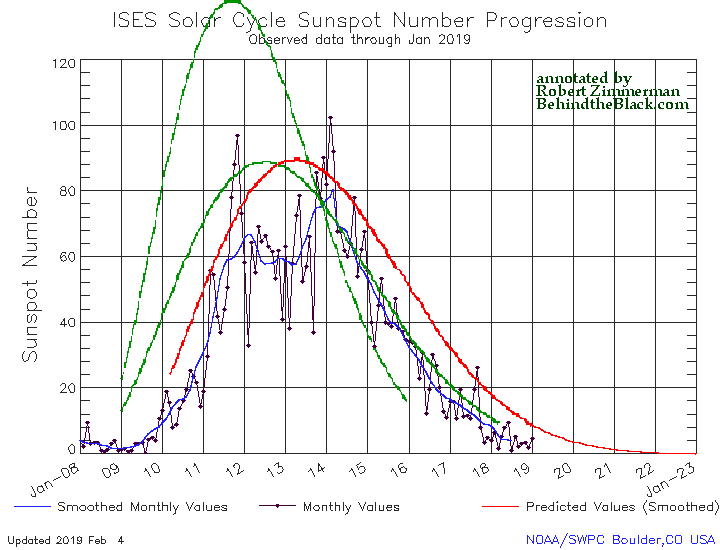
Sunspot update January 2019: The early solar minimum

As I have done every month since 2011, I am now posting NOAA’s the monthly update of the solar cycle, covering sunspot activity for January 2019. They posted this update on Monday, and I am posting it below, annotated to give it some context.
January 2019 sunspot activity

The graph above has been modified to show the predictions of the solar science community. The green curves show the community’s two original predictions from April 2007, with half the scientists predicting a very strong maximum and half predicting a weak one. The red curve is their revised May 2009 prediction.

January saw a slight uptick in sunspot activity, but the overall activity remains comparable to mid-2008, when the last prolonged solar minimum began. If you go to my October 2018 update, you can see the graph when it included data going back to 2000 and see the entire last minimum.

That last minimum started in the last half of 2007, and lasted until mid-2009, a full two years. If you look at the red line prediction of the solar science community, it appears that they are expecting this coming minimum to last far longer, almost forever. I expect this is not really true, but that they have simply not agreed on a prediction for the next cycle. Some in that solar science community have hypothesized that we are about to enter a grand minimum, with no sunspots for decades and thus no solar maximum. Others do not agree.

Since neither faction really understands the mechanism that causes these sunspot cycles, there is no way now to determine what will happen, until it does so. What we do know from climate data is that the Earth cools when the Sun is inactive. Why remains unclear, though there is at least one theory, with some evidence, that attempts to explain it.

And despite the untrustworthy claims of NOAA and NASA scientists that the last few years have been hot, experience on the ground disputes this. Their data has been adjusted (tampered if one wants to be more blunt) to make it fit their global warming theory. The raw unadjusted data suggests things have instead cooled, which better fits with the brutal winters Americans experienced for the past decade or so.

If the Sun does enter a grand minimum in the coming decades, I suspect it will become increasingly difficult for NOAA and NASA to continue their temperature adjustments and continue claiming things are getting warmer. At a minimum, we will learn something about the Sun and its behavior and its influence on the climate that we never knew before.


6 comments

NASA confirms new Dragon launch date

Confirmed: NASA today announced a new launch date, March 2, for the first unmanned test flight of SpaceX’s manned Dragon capsule.

The agency now is targeting March 2 for launch of SpaceX’s Crew Dragon on its uncrewed Demo-1 test flight. Boeing’s uncrewed Orbital Flight Test is targeted for launch no earlier than April.

These adjustments allow for completion of necessary hardware testing, data verification, remaining NASA and provider reviews, as well as training of flight controllers and mission managers.

This is actually the first time that NASA itself has specified a launch date, which suggests to me that they finally have admitted that they cannot hold things up any longer. Based on this announcement and assuming the weather and everything else cooperates, the launch will likely happen then, which will also allow time for SpaceX to get the launchpad reconfigured for its Falcon Heavy launch a week later.

The announcement also listed the remaining test schedule for commercial crew, as it stands now:

  • SpaceX Demo-1 (uncrewed): March 2, 2019
  • Boeing Orbital Flight Test (uncrewed): NET April 2019
  • Boeing Pad Abort Test: NET May 2019
  • SpaceX In-Flight Abort Test: June 2019
  • SpaceX Demo-2 (crewed): July 2019
  • Boeing Crew Flight Test (crewed): NET August 2019

The manned flights have not been pushed back significantly from the dates that NASA announced in October, June for SpaceX and August for Boeing. I would expect that the delays now will force these dates to get delayed as well.

2 comments

One smallsat satellite company hires another

Capitalism in space: One smallsat satellite company, Exolaunch, has hired another smallsat company, Momentus, to provide it with in-space transportation capabilities.

Exolaunch, the German launch services provider formerly known as ECM Space, signed a contract to pay in-space transportation startup Momentus more than $6 million to move satellites in low Earth orbit in 2020 with a service called Vigoride and from low Earth to geosynchronous orbit in 2021 with Vigoride Extended.

With Vigoride, Exolaunch will send “cubesat and microsatellite constellations to multiple orbits, giving clients an unprecedented flexibility of satellite deployment, reducing the price of launch, and giving access to orbits not typical for ridesharing vehicles,” Dmitriy Bogdanov, Exolaunch chief executive, said in a statement. “We also plan to deliver smallsats to geosynchronous orbit using the Vigoride Extended service. Momentus will enable us to service a larger segment of the market by enabling our customers to reach custom orbits in an efficient and cost-effective manner.”

Essentially, Momentus is building a cubesat-sized rocket engine that can be used to transport other cubesats from one orbit to another. The engine apparently uses water as the fuel in a ion-type engine, and will be tested in space for the first time in the next few months.

Momentus’s business plan seems quite clever. Up until now smallsats, especially those launched as secondary payloads, have not had a way to change their orbits, once deployed from their rocket. Momentus is offering this capability, at the very moment we are about to see a boom in the number of smallsats launched.

1 comment

Hayabusa-2 to attempt asteroid landing on February 22

JAXA, Japan’s space agency, today announced that Hayabusa-2 will attempt a landing on the asteroid Ryugu on February 22.

The landing was delayed from October because of the unexpected roughness of Ryugu’s surface, which literally has no spot smooth enough and large enough for Hayabusa-2, as planned. This landing will therefore be attempted in one of two places that are almost large enough, but not quite. It thus carries some additional risks.

0 comments
1 137 138 139 140 141 156