
Plumbing leak on ISS

During necessary power cabling rearrangement in the U.S. toilet area of ISS, the astronauts needed to disconnect some plumbing, and in doing so sprung a leak.

“While demating the QD (Quick Disconnect) that supplies potable water to WHC [toilet] at the rack the crew reported a sticky QD that caused potable water to leak into the cabin,” noted L2 ISS Status Information.

“Initial troubleshooting of the QD leak did not resolve the issue and the crew ultimately remated the QD, however not before ~11 L[iters] of water was leaked. The crew was able to clean up the water using a significant number of towels, and after isolating the potable bus at the PWD [?] the crew demated the QD at the outlet.” [emphasis mine]

Isn’t it lovely how NASA uses acronyms to make everything clear? Seriously, in plain language what appears to have happened is that, in order to prepare the toilet for the future arrival of a new urine recycling unit, they needed to reroute a power cable, and to do that they needed to disconnect the toilet from its plumbing. When they did that disconnect, however, water poured out. The highlighted and very vague language above is designed to disguise what appears to have been a very dumb error that caused the leak: They forgot to shut off the water before doing this, what I think is the “potable bus at the PWD”.

The report also says “It is not believed that any significant amount of water made its way behind any of the racks during the cleanup.” This might be true, but I bet that astronauts are going to finding tiny blobs of water in all kinds of nooks and crannies for quite a while. I hope these blobs don’t cause other problems, such as mold (a constant concern on space stations), corrosion, or electrical issues.
6 comments

The Milky Way is warped?

The uncertainty of science: Distance data of more than 1,300 Cepheid variable stars gathered by the Wide-field Infrared Explorer (WISE) space telescope now suggests to astronomers that the disk of the Milky Way galaxy is warped.

Trying to determine the real shape of our galaxy is like standing in a Sydney garden and trying to determine the shape of Australia. But, for the past 50 years there have been indications that the hydrogen clouds in the Milky Way are warped. The new map shows that the warped Milky Way disc also contains young stars. It confirms that the warped spiral pattern is caused by torque from the spinning of the Milky Way’s massive inner disc of stars.

This research is good and helpful in getting us closer to a real picture of our Milky Way galaxy. However, need I say that this result carries with it a great deal of uncertainty? Or should I let my kind readers outline for me the many aspects of this research that leave me with doubts?

I think I want to do the latter. Where do you think the uncertainties are in this research? What assumptions are they making? Where is their data sparse or weak? Feel free to list them in the comments.

5 comments

Birthday fund-raising time again!

As I do every year during my February birthday month, I ask my readers to please consider donating to Behind the Black.

I admit that I really find it distasteful begging like this, but I really have no choice if I am to continue doing what I love. Moreover, it seems that your direct contribution is sorely needed. In the past year I have discovered that Facebook apparently does not want its users to plug my writing. Every time the number of hits from Facebook begins to rise to a large number, they are suddenly cut off, dropping instantly to zero.

If the drop was smooth and gradual, it could be argued that it is natural, the result of a short decline of interest until I post something new that sparks another wave of hits. This is not what happens. The hits rise steadily, for months, and then suddenly, they vanish, as if someone at Facebook has blocked any reference to past posts at Behind the Black. As new posts appear, however, and ordinary Facebook readers begin to see and pass them along, the hits slowly begin to rise again, until after several months they are once again suddenly cut off.

This pattern could be entirely innocent, but the track record of large corporate and liberally-dominated sites like Facebook suggests otherwise.

So, I am compelled to ask again for your help and support, either by giving either a one-time contribution or a regular subscription, as outlined in the tip jar above and to the right. Or you could consider buying one of my books, something I heartily recommend. All deal with the first half century of the history of space exploration, and all provide a clear window into why we are where we are today in this epic story.

In either case, your continuing support will make it possible for me to continue to do what I have done for the past twenty-five years, freely writing about science and culture, uninfluenced by outside pressure and able to say exactly what I think must be said, at the exact moment such words are most necessary.

0 comments

Oh no! Trump’s wall to block butterflies!

The bankruptcy of our modern intellectual culture, including its increasingly insane hatred of anything-Trump, might best be illustrated by this story today in the San-Antonio Express-News: First signs of border wall construction spotted at National Butterfly Center.

The full article might be behind a paywall, but let me quote from the teaser text:

A gigantic yellow earth mover arrived on National Butterfly Center land Sunday afternoon, the first sign of the beginnings of border wall construction in that protected habitat.

The steel-and-concrete levee wall is expected to slice through the center, placing 70 of the sanctuary’s 100 acres of land south of it.

Oh my! Isn’t Trump evil! This wall will prevent the illegal immigration of butterflies!

First, any sane rational person will immediately recognize that putting a wall through a butterfly sanctuary is going to do nothing to interfere with the butterflies that use that sanctuary. Butterflies are smarter than the average news reporter, and know that they can simply fly over a wall.

Second, the use of hyperbole in the article’s text reveals the reporter’s bias. The wall will “slice” through the center. And the earth mover is “gigantic” (which anyone can clearly see it is not, simply by looking at the picture at the top of the story). The writer used these absurd emotionally charged words to accentuate the disaster of this “slicing” by the “gigantic” earth mover.

Finally, the article’s timing also reveals the author’s biases. She is acting as a PR agent for Democratic congressman Henry Cuellar (D-Texas), who last week introduced amendments to the Democratic house budget bill that would have forbid any wall from being built inside or around this or other Texas border parks.

Cuellar’s proposal, however, is clearly not meant to protect the park, but to prevent the border patrol from protecting the U.S. border, as it is constitutionally required to do. It might make sense to require any border wall to skirt the southern edge of these parks in order to prevent harm to the parks, but Cuellar’s proposal specifically outlaws any wall “within, south of, or north of the National Butterfly Center,” essentially making this park a guaranteed gap in the wall which in turn could very well attract illegals in great numbers. Based on what I have seen of illegal trash in federal lands here in southern Arizona, that intrusion would do far more harm to the park than a simple wall.

7 comments

Strange fernlike ridges on Mars

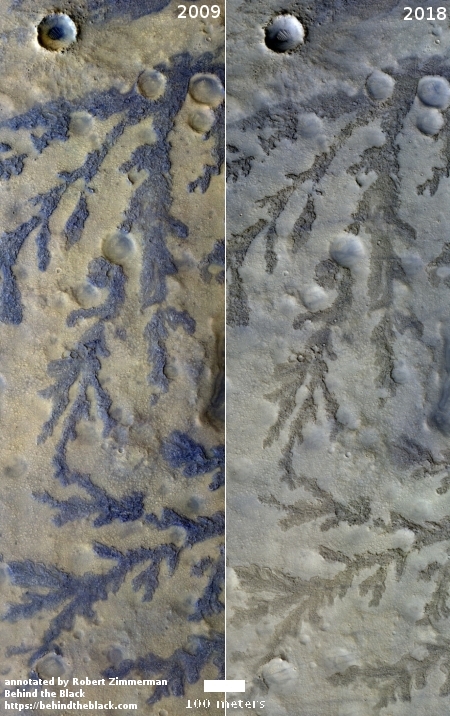
Fernlike ridges on Mars

Cool image time! The two images on the right, cropped, rotated, and reduced in resolution to post here, were both taken by the high resolution camera on Mars Reconnaissance Orbiter (MRO). To see the full resolution version of each, go to the 2009 and 2018 releases.

The 2009 release was a captioned release, whereby scientist Alfred McEwen of the science team provided his explanation of these strange features.

The dark branched features in the floor of Antoniadi Crater look like giant ferns, or fern casts. However, these ferns would be several miles in size and are composed of rough rocky materials.

A more likely hypothesis is that this represents a channel network that now stands in inverted relief. The channels may have been lined or filled by indurated materials, making the channel fill more resistant to erosion by the wind than surrounding materials. After probably billions of years of wind erosion the resistant channels are now relatively high-standing. The material between the branched ridges has a fracture pattern and color similar to deposits elsewhere on Mars that are known to be rich in hydrated minerals such as clays.

These strange fernlike features do not appear to be very common on Mars. In fact, I suspect that while Mars does have many inverted channels like this, the fernlike nature of these particular channels is unique on Mars. They are located on the floor of Antoniadi Crater, a large 240-mile-wide very ancient and eroded crater located in the Martian southern highlands but near the edge down to the northern lowlands.

In seeing the new 2018 image, I was immediately compelled to place it side by side with 2009 image to see if anything had changed in the ensuring near-decade. There are color differences, but I suspect these are mostly caused by different lighting conditions or post-processing differences. Still, the dark center to the crater in the upper left of both images suggests a change in the dust dunes there, with the possibility that some of the dust has been blown from the crater over time. Also, you can see two horizontal tracks cutting across the center of the 2018 image, which I would guess are dust devil tracks, with one more pronounced.

I can imagine some planetary geologists have spent the last few months, since the second image was taken, pouring over both photographs, and have might even located other interesting changes. And if they find no significant changes, that in itself is revealing, as it gives us a sense of the pace at which the Martian surfaces evolves.

3 comments

InSight’s seismometer now fully operational

The InSight science team has completed the deployment of the spacecraft’s seismometer by the placement of its protective domed shield over it.

The Wind and Thermal Shield helps protect the supersensitive instrument from being shaken by passing winds, which can add “noise” to its data. The dome’s aerodynamic shape causes the wind to press it toward the planet’s surface, ensuring it won’t flip over. A skirt made of chain mail and thermal blankets rings the bottom, allowing it to settle easily over any rocks, though there are few at InSight’s location.

The shield also helps protect the instrument from temperature changes.

With this deployment completed they will next deploy the heat flow package to the surface, where it will begin to drill its probe sixteen feet into the ground.

0 comments

On the radio

Tonight and tomorrow I will be doing two long radio interviews, for those interested. Tonight I will appear for an hour once again on WCCO-AM in Minnesota with Steve Thompson. Tomorrow I will do one of my regular long appearances on The Space Show with David Livingston. In the second case, I encourage my readers to call in to ask questions and raise new issues. It enlivens the show to have callers to talk to.

3 comments

We are all fundamentalist now

Link here. This is a superb essay about the strange similarities between the motives and aims of both fundamental Christians and the modern leftist social justice warriors.

For me the heart of the essay is this quote:

The modern campus culture is a religious culture, but it’s a religion without God, and consequently it is a religion without grace. Many students would probably hear my story about growing up in conservative Evangelicalism and conclude that I have been violently oppressed. What if, though, we have more in common than they think? What if SJWism and religious fundamentalism are both expressions of a dissatisfaction with the decadence of modernity: its mindless consumerism, its divorce of virtue from culture, and its kowtowing to profit and power?

The crucial difference, of course, is that Christians and many other religious conservatives have a coherent theological narrative. Because we retain the language of sin and guilt, we have the categories necessary to confront cultural decadence with more than outrage. The militant, shame-them-out-of-existence character of much social-justice activism is a frustrated attempt to articulate truths that students indoctrinated in secularism feel intuitively but deny intellectually.

To my mind, as a secular humanist, the issue isn’t the lack of God, but the unwillingness of the leftist fundamentals of academia and the leftist social justice movement to admit to the wisdom of religious thought on the subject of right and wrong. Religions worldwide are all attempts to articulate in detail the human framework for good behavior while outlining what behaviors lead to disaster and injustice. Our modern bankrupt intellectual culture that now dominates academia has rejected those attempts, despite their depth and complex, intellectual, and very long-lived research into the subject. Thus we have a shallow fundamentalist culture in modern academia, longing for justice and righteous behavior, with little framework or knowledge to find it.

The result? Fascism, illustrated by a rising string of intolerant and shallow attacks on anyone who disagrees with them.

Hat tip to Robert W. Pratt of Pratt on Texas.

33 comments
1 139 140 141 142 143 156