
Gateway dropped from NASA lunar landing plans

According to the head of NASA’s manned program, the agency has revised its 2024 lunar landing plans so that the Lunar Gateway space station is no longer needed.

In a conversation with the NASA Advisory Council’s science committee March 13, Doug Loverro, NASA associate administrator for human exploration and operations, said he had been working to “de-risk” the Artemis program to focus primarily on the mandatory activities needed to achieve the 2024 landing goal.

…Later in the half-hour session, he said that means taking the lunar Gateway off the critical path for the 2024 landing. That was in part because of what he deemed a “high possibility” of it falling behind schedule since it will use high-power solar electric propulsion in its first module, the Power and Propulsion Element. “From a physics perspective, I can guarantee you we do not need it for this launch,” he said of the Gateway.

Loverro added that he wasn’t cutting Gateway, only pushing it back in order to prioritize their effort in getting to the lunar surface more quickly.

The Trump administration has been slowly easing NASA away from Gateway, probably doing so slowly in order to avoid upsetting some people in Congress (Hi there Senator Shelby!). They have probably looked at the budget numbers, the schedule, and the technical obstacles that are all created by Gateway, and have realized that they either can go to the Moon, or build a dead-end space station in lunar orbit. They have chosen the former.

Someday a Gateway station will be needed and built. This is not the time. I pray the Trump administration can force this decision through Congress.

18 comments

China on track for Mars launch in July?

Two stories today, one from Nature and the second from space.com, pushed the idea that China’s Mars orbiter/lander/rover mission is still on schedule to meet the July launch window.

A close read of both stories however revealed very little information to support that idea.

The Nature article provided some details about how the project is working around travel restrictions put in place because of the COVID-19 virus epidemic. For example, it told a story about how employees drove six scientific instruments by car to the assembly point rather than fly or take a train, thereby avoiding crowds.

What struck me however was that this supposedly occurred “several days ago,” and involved six science payloads that had not yet been installed on the spacecraft. To be installing such instrumentation at this date, only four months from launch, does not inspire confidence. It leaves them almost no time for thermal and vibration testing of the spacecraft.

The article also provided little information about the status of the entire project.

The space.com article was similar. Lots of information about how China’s space program is dealing with the epidemic, but little concrete information about the mission itself, noting “the lack of official comment on the mission.” Even more puzzling was the statement in this article that the rover “underwent its space environment testing in late January.”

I wonder how that is possible if those six instruments above had not yet been installed. Maybe the instruments were for the lander or orbiter, but if so that means the entire package is not yet assembled and has not been thoroughly tested as a unit. Very worrisome.

Posting today has been light because I was up most of the night dealing with a family health issue, meaning that I ended up sleeping for several hours during the day. All is well, nothing serious (it is NOT coronavirus), but it has left my brain and schedule very confused. Will likely take a good night’s sleep to get back to normal.

6 comments

Black dunes and weird hills on Mars

Black dunes and weird hills on Mars
Click for full image.

Cool image time! Or I should say a bunch of cool images! The photo on the right, rotated, cropped, reduced, and annotated by me, was taken by the high resolution camera on Mars Reconnaissance Orbiter (MRO) on February 3, 2020. An uncaptioned image, it was entitled “Arabia Terra with Stair-Stepped Hills and Dark Dunes.” Arabia Terra is one of the largest regions of the transition zone on Mars between the northern lowland plains and the southern cratered highlands. It is also where Opportunity landed, and where Europe’s Rosalind Franklin rover will land, in 2022.

This image has so many weird and strange features, I decided to show them all, Below are the three areas indicated by the white boxes, at full resolution. One shows the black dunes, almost certainly made up of sand ground from volcanic ash spewed from a long ago volcanic eruption on Mars.
» Read more

1 comment

Sunspot update: The flatline resumes

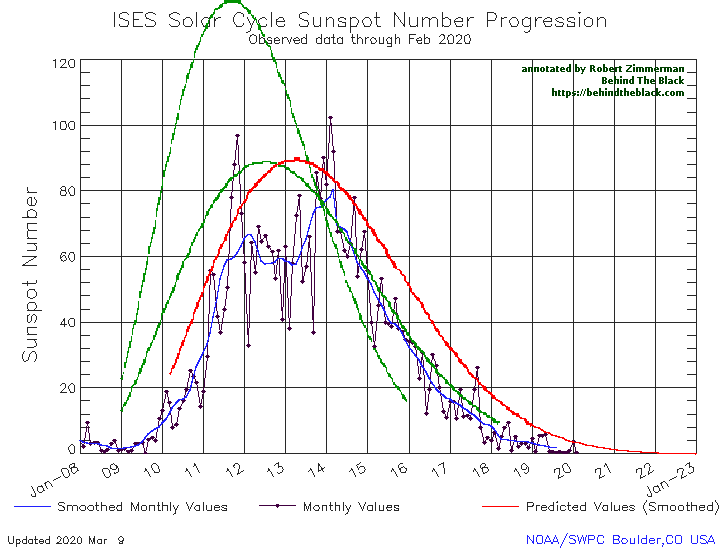
NOAA this week released its February update of its monthly graph showing the long term sunspot activity of the Sun. Below is my monthly version, annotated as I have done every month since 2011.

After a tiny uptick in sunspot activity in January, the Sun resumed the unprecedented flatlining of sunspot activity that began last June. Since then, the Sun has produced practically no sunspots, a drought that as far as I can tell has never happened since the 11-year sunspot cycle resumed in the 1700s (after the grand minimum in the 1600s) and astronomers began counting sunspots.

February 2020 sunspot activity
The graph above has been modified to show the predictions of the solar science community for the previous solar maximum. The green curves show the community’s two original predictions from April 2007, with half the scientists predicting a very strong maximum and half predicting a weak one. The red curve is their revised May 2009 prediction, extended in November 2018 four years into the future.

February saw only one sunspot, and it belonged to the old solar cycle. It also occurred at the beginning of the month, and was followed by 33-day streak of blankness, into the middle of March, when a sunspot from the new cycle appeared and quickly faded.

The continuing overall lack of sunspots, from either the old or new cycle, does not mean that we are entering a new grand minimum, with no sunspots for decades (though some scientists believe we are). It does suggest however that the next solar maximum will be weak, and very likely weaker than the very weak maximum that just ended.

Why the Sun does this remains a mystery. Scientists really have no fundamental understanding of the magnetic processes that produce the Sun’s sunspot cycles. And since that cycle appears to have some effect on the Earth’s climate, it also means scientists do not yet have a fundamental understanding of the climate either.

Not that this lack of knowledge matters anymore. We are in an age of panic and certainty, based on emotion and feelings. All that matters is that many people feel they understand the climate and how the Sun works, just as everyone is sure that COVID-19 will destroy the world if we don’t shut down all human activity.

They are certain, and any additional data that illustrates that certainty is unwarranted is irrelevant and must be ignored.

Certainty however is a very dangerous thing. The universe is always more complicated than we know, and to assume we now understand all without doubt leaves us very vulnerable to some bad surprises, as well as the chance we will take actions that are foolish, inappropriate, and even downright evil.

14 comments

First launch of ULA’s Vulcan on schedule for 2021

Capitalism in space: According to ULA’s CEO, Tory Bruno, the company is on track to transition as planned from its Atlas 5 and Delta rockets to its new Vulcan rocket.

Just five Delta IV Heavy launches remain on the manifest, all NRO launches procured under the block buy Phase 1 methodology. Bruno expects the final Delta launch to occur in 2023 or 2024.

The workhorse of the ULA fleet, Atlas V, is expected to retire on a similar timeframe. Bruno says the launcher could be “done as early as 2022, or as late as 2024.” Atlas V will have to continue operations until its replacement, Vulcan, can be human-rated to launch the Boeing Starliner spacecraft.

…The first flight of Vulcan Centaur is on track for early 2021, with the first flight vehicle under construction, and more vehicles in flow, in ULA’s factory in Decatur, Alabama. Vulcan’s debut launch will carry the Astrobotic Peregrine lander to the moon for NASA’s Commercial Lunar Payload Services (CLPS) program. A second launch is currently planned for later that year, which will satisfy the Air Force certification requirement for Vulcan to launch military missions.

Bruno’s report is also good news for Blue Origin’s New Glenn rocket, since both will use Blue Origin’s BE-4 engine in their first stage. If ULA is on schedule, than Blue Origin also likely to be on schedule, meaning that come 2021 or so the U.S. will have at least three companies (including SpaceX) capable of putting large payloads into orbit. Moreover, Northrop Grumman is developing its OmegA rocket, which will compete for the same business.

The article also talks about the military’s launch procurement program, which supposedly will pick two of these launch companies to provide all military launches through the 2020s. That program however is certain to fail, as it will blacklist all other viable companies from bidding on military launches. I expect those companies will successfully sue and force the Space Force to accept bids from more than two companies.

And that is as it should be. Why the military wishes to limit bidding makes no sense, and is probably illegal anyway. As long as a company has a qualified rocket, its bids should be welcome.

13 comments

Manned Dragon mission targeted for May

Capitalism in space: According to one SpaceX official, they are now aiming for a May target date for their first manned Dragon mission to ISS, even as they will maintain a launch pace of one to two launches per month.

SpaceX president and chief operating officer Gwynne Shotwell [said] that she expects at least one to two launches per month in the near future, whether they be for customers or for SpaceX’s own internet-satellite constellation, Starlink. “And we are looking at a May timeframe to launch crew for the first time,” Shotwell continued. That launch, called Demo-2, will send NASA astronauts Bob Behnken and Doug Hurley to and from the International Space Station (ISS) aboard SpaceX’s Crew Dragon capsule.

At that pace SpaceX will complete between 12 to 24 launches for the year. They had predicted they would complete 21, so this is in line with that prediction.

1 comment

An exoplanet where it rains iron

Astronomers have discovered an exoplanet 640 light years away hot enough for iron to be vapor in the atmosphere and to condense out as rain.

The high-resolution spectrum reveals lots of iron vapor within the sliver of atmosphere undergoing the transition from day to night. However, this iron vapor signature is missing from the sliver of atmosphere transitioning from night to day. The astronomers think this happens because strong winds push iron vapor to the nightside, where it cools and condenses into clouds.

“This planet has a twilight zone at a temperature close to the iron condensation temperature,” Ehrenreich explains, “so the change in atmospheric composition (with iron vs. without iron) is occurring right where we are able to observe.”

Because the planet is a gas giant, there’s no surface onto which the droplets can fall, says coauthor Nuno Santos (University of Porto, Portugal). But the planet’s gravity likely pulls the clouds downward, enveloping the nightside in iron fog. The global winds then push the clouds and fog onto the dayside, where the vaporization-condensation cycle repeats again.

Very exotic, and alien, and I guarantee it is probably far more alien than we so far can guess.

You can find out more in this second more detailed article.

5 comments

ExoMars2020 rover delayed until 2022

The European Space Agency (ESA) today announced that they are delaying the launch of their ExoMars2020 rover mission until the next launch window in 2022

The press release says this will give them the time “necessary to make all components of the spacecraft fit for the Mars adventure.” Considering that the spacecraft’s parachutes have yet to have a successful high altitude test, that the entire spacecraft is not yet assembled, and that when they did the first thermal test of the rover the glue for the solar panel hinges failed, this seems that they need to do a lot of testing.

Overall the decision is smart. Better to give them the time to get this right then launch on time and have a failure.

At the same time, there appears to be something fundamentally wrong within the management of this project at ESA. This project was first proposed in 2001, and has gone through repeated restructurings and redesigns. Moreover, they began planning the rover for this 2020 launch in 2011, and after ten years were not ready for launch.

0 comments
1 138 139 140 141 142 169