Martian badlands

The Tyrrhena Terra badlands
Click for full image.

The photo to the right is a small section cropped from an image taken by the high resolution camera on Mars Reconnaissance Orbiter (MRO) on January 2, 2020. It shows the rough, cratered southern highlands dubbed Tyrrhena Terra that lie between the low Isidis Basin to the north and Mars’ deepest basin, Hellas, to the south.

The image was taken not because any specific scientific request, but because MRO was doing spectroscopy over this area and it made sense to also take a photograph. Comparing the photograph with the spectroscopic data allows scientists to better understand that spectroscopy.

The white cross in the map below shows the location of this image. The map itself covers latitudes from 40 degrees north to 55 degrees south.
» Read more

5 comments

Earth’s day was half hour shorter 70 million years ago

Using data from an ancient fossil shell, scientists have determined that 70 million years ago the Earth’s day was about 30 minutes shorter, and that a year comprised 372 days.

This result is not a surprise, as scientists have known for a long time that the day has been growing longer as the Moon’s gravity, producing tides, wears away at the Earth’s rotation. This data however is the most precise yet, and will allow scientists to better constrain not only the Earth’s changing rotation over time but the Moon’s orbit. As it slows the Earth’s rotation its own orbit around the Earth gets longer, pushing it farther away.

3 comments

China launches another GPS-type satellite

China today successfully launched another of its Beidou GPS-type satellites, using its Long March 3B rocket.

I found this data point from the link interesting:

Real-time, stand-alone Beidou horizontal positioning accuracy was classed as better than 6 meters (95 percent) and with a vertical accuracy better than 10 meters (95 percent). …[However, t]he system will be dual-use, based on a civilian service that will provide an accuracy of 10 meters in the user position, 0.2 m/s on the user velocity and 50 nanoseconds in time accuracy; and the military and authorized user’s service, providing higher accuracies.

New commercial GPS units will eventually add the Beidou constellation, and when combined with data from the U.S, Russian, European, and Indian systems, will likely get accuracies even higher.

The leaders in the the 2020 launch race:

5 China
4 SpaceX
2 Arianespace (Europe)
2 Russia

The U.S. still leads China 7 to 5 in the national rankings.

0 comments

Thank you!

Readers!

I want to thank everyone who contributed in the past month as part of my now-completed annual February birthday fund-raising drive. This was the best February campaign ever. For my readers to so generously give their hard-earned money for something that I offer for free humbles me greatly. Thank you! I will try to live up to your expectations.

For those who have not yet contributed, you can still do so, by checking out the options as outlined in the tip jar either in the right column (near the top) or at the bottom of the page (on mobile phones).

This thank you announcement will remain at the top of the page for the next week. Scroll down for today’s newest posts.

0 comments

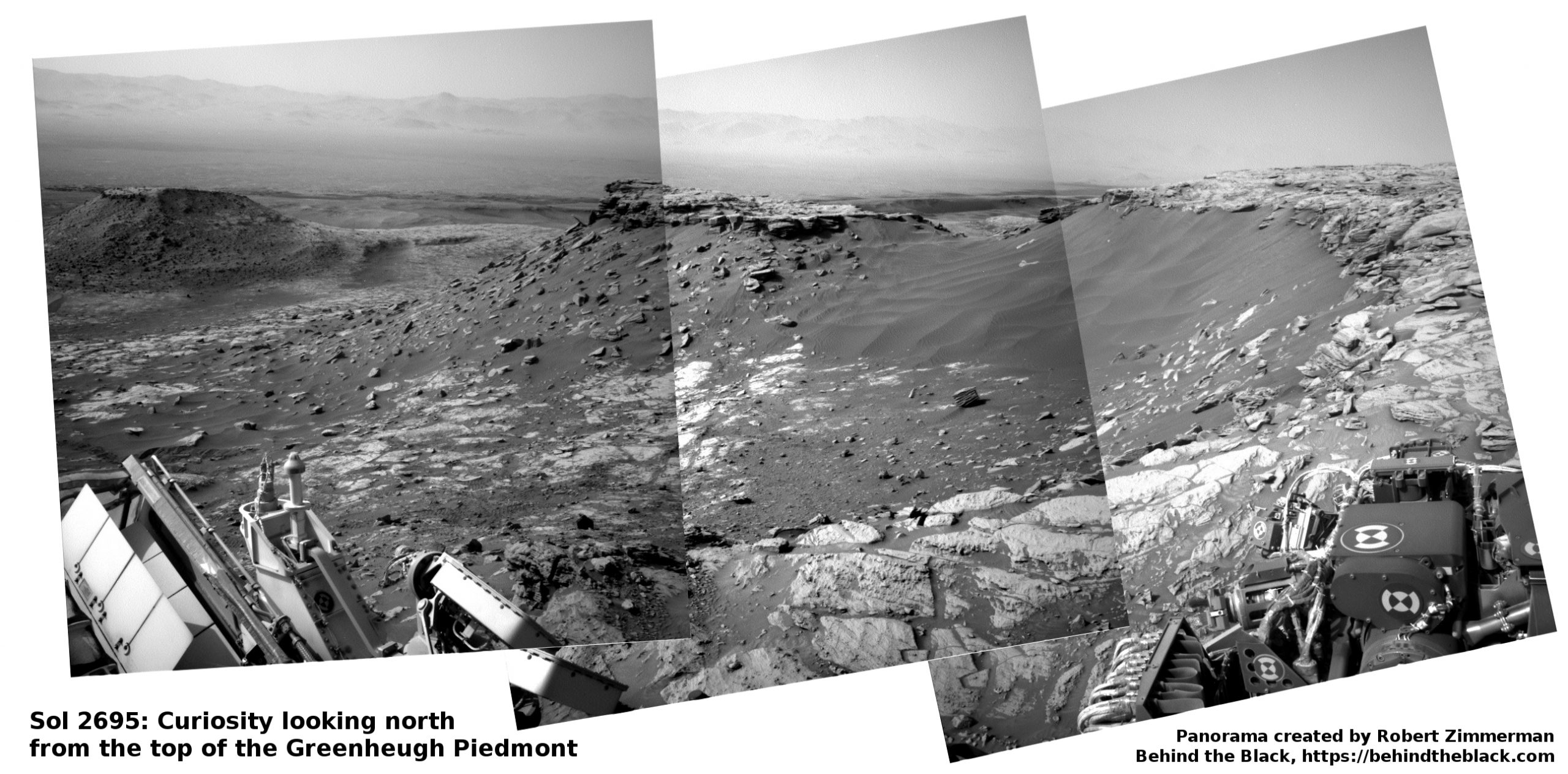
Curiosity reaches highest point yet on Mars

Curiosity looking north across Gale Crater
Click for full resolution version.

Time for some more cool images! The panorama above, cropped and reduced to post here, was assembled from images taken by Curiosity on March 6, 2020 by its left navigation camera, just after it topped the slope and settled on the very rocky plateau of what the scientists have dubbed the Greenheugh Piedmont, the highest point on Mars that Curiosity has so far traveled. It looks north, across Gale Crater to its far rim, about thirty miles away. That rim rises about a mile higher than where Curiosity sits today.

To quote Michelle Minitti, the planetary geologist who wrote the update describing this achievement:

Kudos to our rover drivers for making it up the steep, sandy slope below the “Greenheugh pediment” (visible in the [right] side of the above image) and delivering us to a stretch of geology we had our eyes on even before we landed in Gale crater!

The panorama below is also assembled from photos taken by the left navigation camera, but this time it looks south, across the piedmont toward Mt. Sharp. Its view of the the piedmont’s very very rough terrain I think proves that once the scientists have gathered their data from this point, the rover will descend back down and resume its original route, circling the piedmont to skirt its southern edge where orbital data suggests the going will be smoother.
» Read more

1 comment

SpaceX successfully launches cargo Dragon to ISS

Capitalism in space: SpaceX tonight successfully launched a cargo Dragon freighter to ISS.

This is the third flight for this Dragon capsule. It was also the last flight of the company’s first generation Dragon capsules. The company also successfully landed the first stage, which was on its second flight. This was the fiftieth time they have successfully done this. I have embedded the launch video below the fold.

The leaders in the 2020 launch race:

4 China
4 SpaceX
2 Arianespace (Europe)
2 Russia

The U.S. now leads China 7 to 4 in the national rankings.
» Read more

4 comments

What Happens When an 18 Year Old Buys a Mainframe

An evening pause: This is a bit long for an evening pause, and I myself did not understand a good portion of the terminology, but it is still fascinating and worth watching nonetheless, if only to give you hope for the future. As the last questioner at the end said, “I think you’ve raised the bar on what all of us should expect from our kids now.”

Hat tip Diane Wilson.

5 comments

Rolling boulders on Mars

Boulder tracks on Mars
Click for full image.

Cool image time! The photo to the left, cropped to post here, was taken by the high resolution camera on Mars Reconnaissance Orbiter (MRO) on January 21, 2020, and shows several boulders at the bottom of a slope, along with the tracks those boulders made as they rolled downhill sometime in the far past.

Uphill is to the south. We know the dark spots at the end of these tracks are large boulders partly because of the wind streaks emanating away from them to the north. As the wind goes around each rock it produces eddies that produce the tracks. Based on the scale and the image resolution (about 10 inches per pixel), these boulders range in size from about one to five feet in diameter.

This image has two points of interest. First, the tracks left by the boulders seem to have a repeating pattern. My guess is that the pattern most likely formed because the boulders are not spherical in shape, and as they rolled each roll repeated a certain pattern reflecting that shape. This theory is reinforced by a close look at each boulder. Though the resolution is insufficient to resolve the boulders themselves, the pixel distribution for each strongly suggests an asymmetric shape.

Second, this image, when compared with an earlier MRO image of the same spot, taken fourteen years ago in December 2006, shows no obvious change. These tracks, and their boulders, have therefore probably sat here, as we see them, for a long time. Since there appear to be two sets of tracks, with one overlying the other, this suggests that two separate events (an earthquake or nearby impact) each time caused a bunch of boulders to break free and roll downward together, with the second set of boulder tracks crossing over the earlier set.

Establishing when those two events occurred, however, will require some on-site data, something that will likely not occur until humans roam the surface of Mars in large numbers.


0 comments

Axiom and SpaceX sign deal for flying commercial tourists to ISS

Capitalism in space: Axiom, the commercial company that already has an agreement with NASA to build its own commercial modules for ISS, has signed an agreement with SpaceX to use its crew Dragon capsule to ferry one professional and three tourists to ISS, as soon as the second half of 2021.

The private crew members will spend at least eight days on the orbiting research platform, allowing them to enjoy “microgravity and views of Earth that can only be fully appreciated in the large, venerable station,” Axiom said in a statement.

Axiom said Thursday it has signed a contract with SpaceX to transport a commander “professionally trained” by Axiom and three private astronauts to the space station on a Crew Dragon spacecraft. The mission could take off as soon as the second half of 2021, Axiom said.

This is SpaceX’s second commercial customer for its Dragon capsule. Two weeks ago it signed a deal with Space Adventures to fly four tourists on a crew Dragon for up to five days.

3 comments

Bucky Covington – Different World

A evening pause: Performed live in 2014.

Hat tip Mike Nelson, who notes that the song probably “resonates far more to you and me than the performer. The lyrics trigger vibrant memories of my life as a kid in the 1960s going to Redeemer Lutheran grade school.” I agree, as someone who also grew up in the 1960s going to public school in Brooklyn, New York. Yet, I also suspect that Covington’s childhood, born in 1977 in North Carolina and growing up in the 1980s, was not that much different. No computers, and as a kid you played outside.

And most important of all, you grew up with a mother and a father, who were committed to staying together to raise their kids. That time is sadly long gone, and the children since have suffered terribly because of it.

.

115 comments

NASA dubs next Mars rover “Perseverance”

NASA today announced that they have named their next Mars rover, due to launch in July, “Perseverance.”

The name was announced Thursday by Thomas Zurbuchen, associate administrator of the Science Mission Directorate, during a celebration at Lake Braddock Secondary School in Burke, Virginia. Zurbuchen was at the school to congratulate seventh grader Alexander Mather, who submitted the winning entry to the agency’s “Name the Rover” essay contest, which received 28,000 entries fromK-12 students from every U.S. state and territory.

“Alex’s entry captured the spirit of exploration,” said Zurbuchen. “Like every exploration mission before, our rover is going to face challenges, and it’s going to make amazing discoveries. It’s already surmounted many obstacles to get us to the point where we are today – processing for launch. Alex and his classmates are the Artemis Generation, and they’re going to be taking the next steps into space that lead to Mars. That inspiring work will always require perseverance. We can’t wait to see that nameplate on Mars.”

I truly hope that the rover is well-named, and lives a very long life on Mars, long enough that it is still in use the day an human arrives to touch it again.

6 comments
1 140 141 142 143 144 169