November 5, 2020 Zimmerman Space Show podcast

The podcast of my two-hour appearance on The Space Show yesterday is now available here.

As always it was a fun show, with David Livingston starting out by asking me to give my sense of the consequences of the election (no matter who wins) on the aerospace industry. Things went all over the place after that, from Mars exploration to China’s space program to Elon Musk.

2 comments

NASA offers public chance to experience next manned mission virtually

NASA is now offering the general public the opportunity to virtually experience the next manned Dragon flight to ISS, set to launch on November 14th.

“Members of the public can attend the launch virtually, receiving mission updates and opportunities normally reserved for on-site guests,” NASA officials wrote in a statement on Tuesday (Nov. 3). “NASA’s virtual launch experience for Crew-1 includes curated launch resources, a digital boarding pass, notifications about NASA social interactions and the opportunity for a virtual launch passport stamp following a successful launch,” the agency added.

While much of this will be fun to do, much of it is also pure hype, designed to sell NASA to the public, even though the mission is being launched and run almost entirely by the private commercial company SpaceX, not NASA.

5 comments

Company defends its satellite constellation from NASA criticism

The founder of AST & Science, the company that wishes to launch a constellation of 243 communications satellites, has defended its effort from criticisms expressed by NASA in a comment to the FCC.

“We’re not a bunch of cowboys launching satellites,” said Abel Avellan, founder of AST & Science, in an interview. “This is a serious, well-funded project.” … Avellan said the “SpaceMobile” satellites do indeed have a very large cross-sectional area perpendicular to the ground, as this is the only way to deliver direct satellite-to-broadband signals. “There is no magic,” he said. “If you want something to connect directly to a handset, it’s not going to be a CubeSat.”

Each of the satellites will include a large antenna, comprising an area as large as 900 meters squared. However, Avellan said the satellites will fly edge-on, “like a frisbee, but without the spinning.” He said the satellites’ cross-section along the direction of motion is only about 3 meters squared. The company has calculated that the probability of a collision occurring at random—assuming no avoidance maneuver—to be only about 1-in-5,000 over its lifetime, or 1-in-20 across the entire constellation.

It appears that neither the company nor NASA has as yet begun direct discussions about these issues. NASA’s concerns however could seriously hamper the company’s future.

8 comments

United Arab Emirates announce plans for lunar rover mission

The new colonial movement: The United Arab Emirates (UAE) has announced plans to launch its first unmanned probe to the Moon, a small rover dubbed Rashid with a target launch date in 2024.

The Mohammed Bin Rashid Space Centre (MBRSC) in Dubai says its in-house teams will develop, build and operate the 10-kilogram rover, which is named after the late Sheikh Rashid bin Saeed Al Maktoum, who ruled Dubai at the UAE’s creation in 1971.

The team will hire an as-yet unannounced space agency or commercial partner to carry out the launch and landing, the riskiest part of the mission. If successful Rashid would be one of several rovers made by private firms and space agencies that are set to populate the Moon by 2024.

This project is a great opportunity for the various new private aerospace companies in the U.S. developing interplanetary capabilities for sale to others.

0 comments

China launches ten satellites for Argentinian company

China today used its Long March 6 rocket to successfully launch ten satellites for the Argentinian company Satellogic S.A.

The satellites form the beginning of a 25-satellite constellation designed to do Earth resource observations. The Chinese rocket in turn is designed to capture the emerging smallsat market.

The leaders in the 2020 launch race:

28 China
19 SpaceX
12 Russia
4 ULA
4 Europe (Arianespace)
4 Rocket Lab

The U.S. remains ahead of China 30 to 28 in the national rankings.

0 comments

Die Twinnies – Bayernmädels

An evening pause: Hat tip Jim Mallamace, who writes,

Good friends, Astrid Paster and Franziska Pauli, are Die Twinnies. This was the girls’ debut TV performance for the popular Austrian entertainment show, “Musikantenstadl.”

This was recorded in 2009. It is said the career length of a child entertainer is about the same as the lifespan of a pet. That was pretty much true for Die Twinnies. We enjoy such performances while we can.

It might be lip-synched, but so what? Fun stuff.

1 comment

SpaceX launches Space Force GPS satellite

Capitalism in space: SpaceX tonight successfully launched the GPS satellite that on a previous launch had experienced a launch abort at T-2.

This was a completely new Falcon 9 rocket, with two of its original engines replaced after the company had traced the issue that caused the launch abort. The first stage successfully landed on the drone ship in the Atlantic Ocean, and will fly again on the next GPS launch by SpaceX for the Space Force.

The satellite has been deployed successfully, completing the launch.

The leaders in the 2020 launch race:

27 China
19 SpaceX
12 Russia
4 ULA
4 Europe (Arianespace)
4 Rocket Lab

The U.S. now leads China 30 to 27 in the national rankings.

3 comments

Rocket Lab will try to recover 1st stage on next launch

Capitalism in space: Rocket Lab announced today that it will attempt to recover the 1st stage of its Electron rocket on its next launch, using parachutes to slow its descent into the ocean and then fishing from the sea.

On its next mission set for liftoff later this month, Rocket Lab will try to recover the first stage of its Electron small satellite launcher after parachuting into the Pacific Ocean downrange from the company’s privately-run spaceport in New Zealand, officials announced Thursday.

The attempt to retrieve the Electron rocket’s first stage moves Rocket Lab closer to eventually capturing falling boosters in mid-air with a helicopter, then reusing the hardware. The reuse initiative is aimed at increasing Rocket Lab’s flight rate, and could result in cost savings, according to Peter Beck, the company’s founder and CEO.

The flight is presently scheduled for November 15 from New Zealand. It appears the goal with this recovery is not to reuse the 1st stage, but to recover it so they can determine how it fared during re-entry. For re-use they will capture the first stage using a helicopter, before splashdown and is exposed to saltwater.

When they attempt the helicopter capture on an actual launch remains unclear.

0 comments

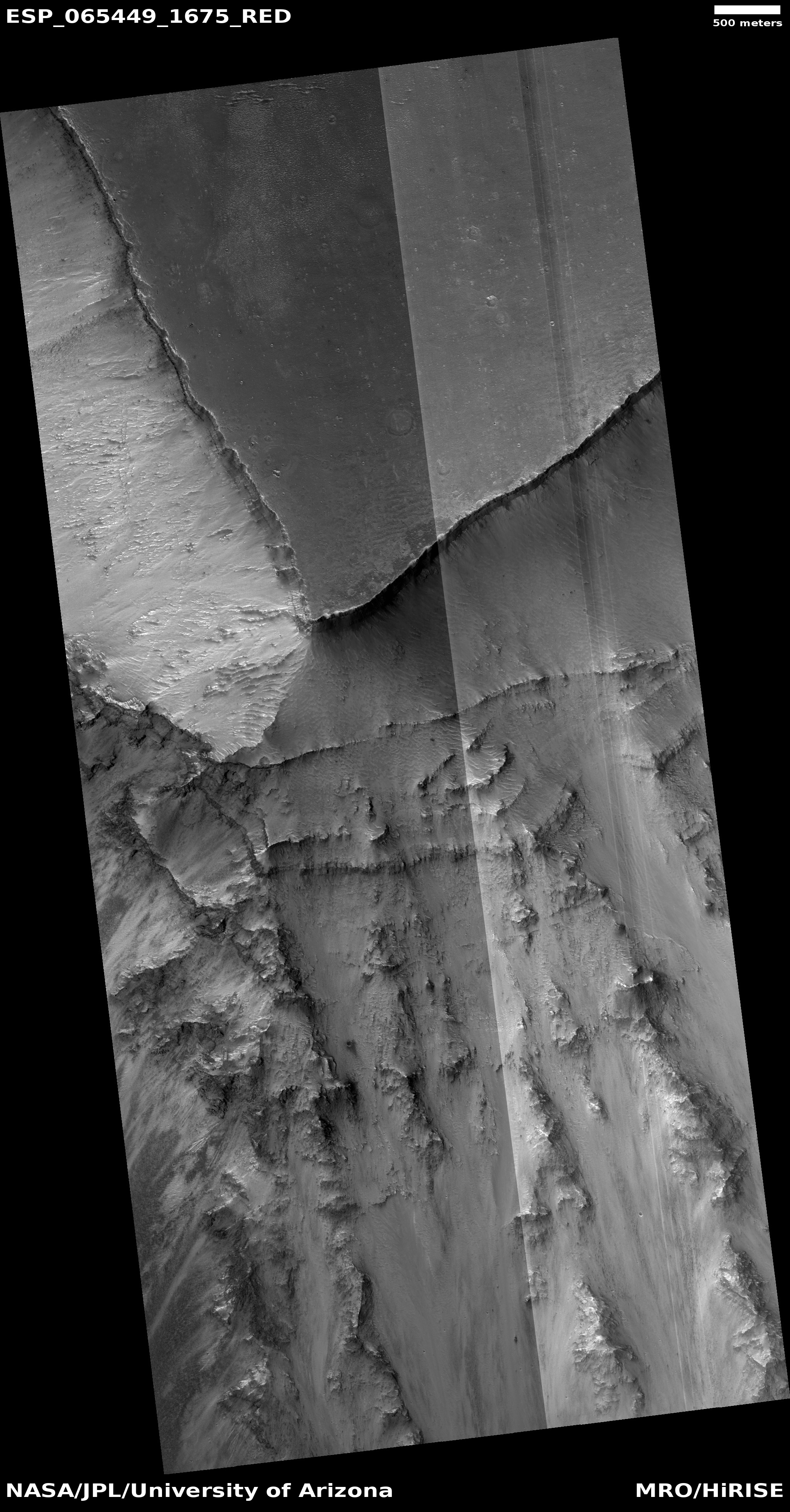
Terraced mesa inside Martian depression

Terraced mesa inside depression
Click for full image.

Cool image time! The photo to the right, cropped and reduced to post here, was taken on July 1, 2020 by the high resolution camera on Mars Reconnaissance Orbiter (MRO). It shows a very puzzling terraced mesa inside an enclosed depression or sinkhole (the western half of which can be seen in the full image).

What caused that mesa? A first scan of the image and the data suggests we are looking at sinkage related to the melting of an underground ice table. The latitude here is 34 degrees south, just far enough away from the equator for glacial activity to be possible. Moreover, the small circular depression in the upper right of the image strongly suggests an impact crater into slushy material. The implication is that this depression is the result of the melting or sublimation of underground ice, leaving behind a mesa that is made of solider stuff.

Another possibility is that the terraced mesa is actually the remains of glacial material. In the full image features inside other nearby depressions are terraced also, but are also much more reminiscent of glacial features found in many craters in the mid-latitudes. The depression is also close to the headwaters of Reull Valles, a meandering canyon where many images have shown glacial features (see for example here, here, and here).

These features however could also have nothing to do with water ice.
» Read more

0 comments
1 26 27 28 29 30 169