UAE hires Japanese company as partner for its ’22 lunar rover mission

Capitalism in space: The United Arab Emirates (UAE) has chosen the private Japanese company Ispace to provide the lander bringing its Rashid rover to the Moon in 2022.

ispace’s 240 kg lander is 2.3 meters tall and 2.6 meters wide. It will be launched by SpaceX, Elon Musk’s rocket company, on a Falcon 9 rocket. Once the iSpace lander is placed in the Earth’s orbit, it will travel to the moon on its own, land and unload the rover.

The lander will use solar panels for power, which will also allow the rover to communicate with Earth. It will also carry a solid-state battery made by NGK Spark Plug, which intends to examine its battery’s lunar performance.

This UAE project is similar but a step up from its Al-Amal Mars orbiter. In that case UAE used its money to have the orbiter mostly built by U.S. universities as they taught UAE’s students how to do it. In this case, UAE engineers appear to be building the rover itself, with the purchased help of others to provide the lander..

0 comments

A lonely dry lava spring on Mars

A lonely dry lava spring on Mars
Click for full image.

Today’s cool image from Mars takes us to the southern flank of the giant volcano Pavonis Mons. The photo to the right, rotated, cropped, and reduced to post here, shows what appears to be a volcanic vent from more than a billion years ago when it is believed Pavonis was actively erupting. The picture was taken on March 2, 2021 by the high resolution camera on Mars Reconnaissance Orbiter (MRO). The grade is mostly downhill to the east and south east.

It is very possible that this is the resurgence of a lava tube, the point where the underground flow either emerged to the surface or got so close to the surface that the ceiling was thin enough to later collapse, creating this depression. No pits or skylights are visible in this high resolution picture, however, so whether there is an underground lava tube here is not known, an unknown that is amplified by the wider MRO context camera image below.
» Read more

0 comments

Today’s blacklisted American: A congresswoman because she speaks her mind

The cancelled Bill of Rights

They’re coming for you next: Since her election in November 2020 Republican Congresswoman Marjorie Taylor Greene (R-Georgia) has repeatedly irritated many people for her strong and very outright conservative opinions on everything from election fraud to religion to Donald Trump and Joe Biden.

As a result she has become the target by many on the left, resulting in her Twitter account being suspended more than once. In one case it was because she had said posted a tweet celebrating Easter and glorifying the resurrection of Jesus. In another case it as because she called for the supporters of Trump to rally against election fraud and the possibility that the 2020 presidential election was stolen. In both cases her account was reinstated by Twitter within twelve hours, with the social media platform claiming the first suspension was a mistake while the second was not (having violated Twitter’s partisan rules that forbid anyone from suggesting that there might have been election tampering that led to Biden’s victory).

These Twitter attacks are ugly and illustrate that platform’s anti-Republican and leftist agenda, but it is still a private company. More important have been the efforts to muzzle Greene in Congress, led by the Democrats.
» Read more

12 comments

New calls for reworking or replacing Outer Space Treaty

Yesterday there were two different public statements calling for the international community to either amend or replace the Outer Space Treaty, one an op-ed in the U.S. and the other a statement by the head of Russia’s space agency.

At first glance these announcements seemed hopeful, especially because the op-ed, written by one of the authors of a just released new study [pdf] by a defense-oriented Washington think tank, made part of its focus the need to encourage commercial activities in space.
» Read more

5 comments

Commerce increases sanctions on Russia impacting space commerce and trade

The Commerce Department last month announced that is increasing the level of sanctions against trade with Russia because it had determined that country had violated international law by using chemical weapons against specific dissidents both in and out of Russia.

On March 4, 2018, the Russia Government deployed a Novichok nerve agent in an attack against former Russian military officer Sergei Skripal and his daughter Yulia Skripal in the United Kingdom. In response, the U.S. Government imposed two sets of sanctions against Russia pursuant to the Chemical and Biological Weapons Control and Warfare Elimination Act of 1991 (CBW Act) in August 2018 and August 2019.

On August 20, 2020, the Russian Government again deployed a Novichok nerve agent, this time against Russian opposition figure Aleksey Navalny, warranting a new determination by the Secretary of State and additional sanctions under the CBW Act.

While this ruling will have a negative impact on any space-related U.S./Russian activities, the full ruling specifically included these waivers:
» Read more

1 comment

Ingenuity requires software update before flying

JPL engineers have determined that they need to upload a software update on Ingenuity in order to solve the issue that caused the first high-speed spin test of its rotary blades to end prematurely.

In an update released late Monday by NASA’s Jet Propulsion Laboratory, mission managers said engineers identified a software fix for the “command sequence issue” that ended the high-speed spin-up test Friday.

Officials at JPL, which manages the Ingenuity helicopter project, did not announce a new target date for the rotorcraft’s first test flight. Ground teams hope to determine a new target date next week for the helicopter’s first flight.

According to the original plans, Ingenuity was to get about a 30 day test period, after which Perseverance would move on to its primary Mars science mission. It is not clear at this moment whether that test period will be extended because of these issues. I suspect they will extend it to get as many flight tests as possible, since Perseverance is functioning like a dream and can wait a few extra weeks before beginning what will be years of Martian roving. How often does one get to flight test a helicopter on another world?

6 comments

Northrop Grumman’s MEV-2 successfully completes docking to commercial satellite

MEV-2 about 50 feet away from satellite

Capitalism in space: Northrop Grumman today announced that its second Mission Extension Vehicle (MEV-2) has successfully docked with an Intelsat geosynchronous communications satellite.

Northrop Grumman is the only provider of flight-proven life extension services for satellites, and this is the second time the company has docked two commercial spacecraft in orbit. The company’s MEV-1 made history when it successfully docked to the Intelsat 901 (IS-901) satellite in February 2020. Unlike MEV-1, which docked above the GEO orbit before moving IS-901 back into service, MEV-2 docked with IS-10-02 directly in its operational GEO orbital location.

…Under the terms of Intelsat’s satellite life-extension servicing contract, MEV-2 will provide five years of service to IS-10-02 before undocking and moving on to provide services for a new mission.

The image, provided by Northrop Grumman, was taken by MEV-2’s infrared wide field of view camera when it was still about 50 feet away from the Intelsat satellite. You can see the Earth in the background. As I understand it, MEV-2 uses the satellite’s own engine nozzle as a docking port, which is the smallest circular feature in the center of the satellite. If you look close you can see the nozzle’s shadow on the right.

10 comments

NASA/Boeing begin prepping SLS core stage for transfer to Florida

NASA & Boeing have now agreed that the static fire test program of the core stage of their SLS rocket has ended successfully, and have begun preparing the stage for its shipment to Florida where it and the entire rocket will be assembled for launch.

While refurbishment activities continue, the team at Stennis has also started disconnecting the stage from the test stand to prepare for departure from Stennis. Weather will be a key factor in when the stage can be put on board the agency’s Pegasus barge to start the waterway tow trip from Stennis to Kennedy, but a late-April arrival at KSC is still possible — with KSC schedules currently forecasting attachment of the Core Stage to the SLS Boosters in the Vehicle Assembly Building in mid-May to prepare for launch of Artemis 1.

Though NASA still has a target of November for launch, NASA engineers estimate that it will take ten months to get the core stage in place and ready for launch. This places launch more likely in the February-March ’22 time frame. This schedule of course does not include any possible additional problems along the way, which may delay the launch further.

Even if all goes now as NASA plans, consider the length of this schedule. Though NASA will not require future SLS launches to do a static fire test, just transporting the stage and getting the rocket assembled will likely always take about this long, give or take a few months. Even if NASA streamlines this operation over time, I can’t see it getting shortened to less than five months. That means it will likely be impossible to launch more than one or maybe two SLS rockets per year, a pace that is not very effective if you really want to achieve anything in space. Moreover, that very very optimistic pace would cost about $3 to $5 billion per year, money that has not been appropriated, though considering Congress’s nonchalant attitude towards printing money these days that might not be a problem.

In the end, this rocket as designed is simply not practical or sustainable. It is a financial house of cards, and as soon as a more effective competitor like Starship (or even New Glenn) arrives that house will fall.

In fact, I still consider the odds of Starship/Super Heavy completing an orbital launch before SLS to be better than 50-50. With a likely spring ’22 SLS launch date and SpaceX aiming for a Starship orbital flight in ’21, the odds of SpaceX winning this race I think has just improved.

7 comments

The start of avalanche season at Mars’ north pole

A narrow ridge with avalanches
Click for full image.

Every spring for the last seven Martian years scientists have eagerly aimed the high resolution camera on Mars Reconnaissance Orbiter (MRO) at the steep 1,500 to 3,000 foot high scarp at the edge of northern polar ice cap in order to capture images of what is Mars’s most spectacular annual event, the occurrence of tens of thousands springtime avalanches along that scarp.

Well, spring has returned to the northern hemisphere on Mars, and the scientists have begun another monitoring campaign. The photo to the right, cropped to post here, was taken on March 7, 2021 by MRO. It shows a particularly dramatic part of that scarp, a place where the scarp separates two curved alcoves and is thus narrowed down to a ridge about 1,000 feet high.

The nose of the ridge is sloping downward to the northwest, so the horizontal bands on its crest are actually evidence of older and older layers exposed as the elevation drops. The blue and black markings on the left slope are likely evidence of this season’s first avalanches, or might even be avalanches occurring as the picture was snapped! As explained to me by Shane Byrne of the Lunar and Planetary Lab University of Arizona during the last Martian avalanche season,

On Mars half of the images we take in the right season contain an avalanche. There’s one image that has four avalanches going off simultaneously at different parts of the scarp. There must be hundreds to thousands of these events each day.”

The overview map below shows the location of this picture, as well as all the other places the scientists have routinely monitored in the fourteen-plus Earth years since MRO reached Mars orbit.
» Read more

0 comments

Today’s blacklisted Americans: Trump supporters blackballed by employers

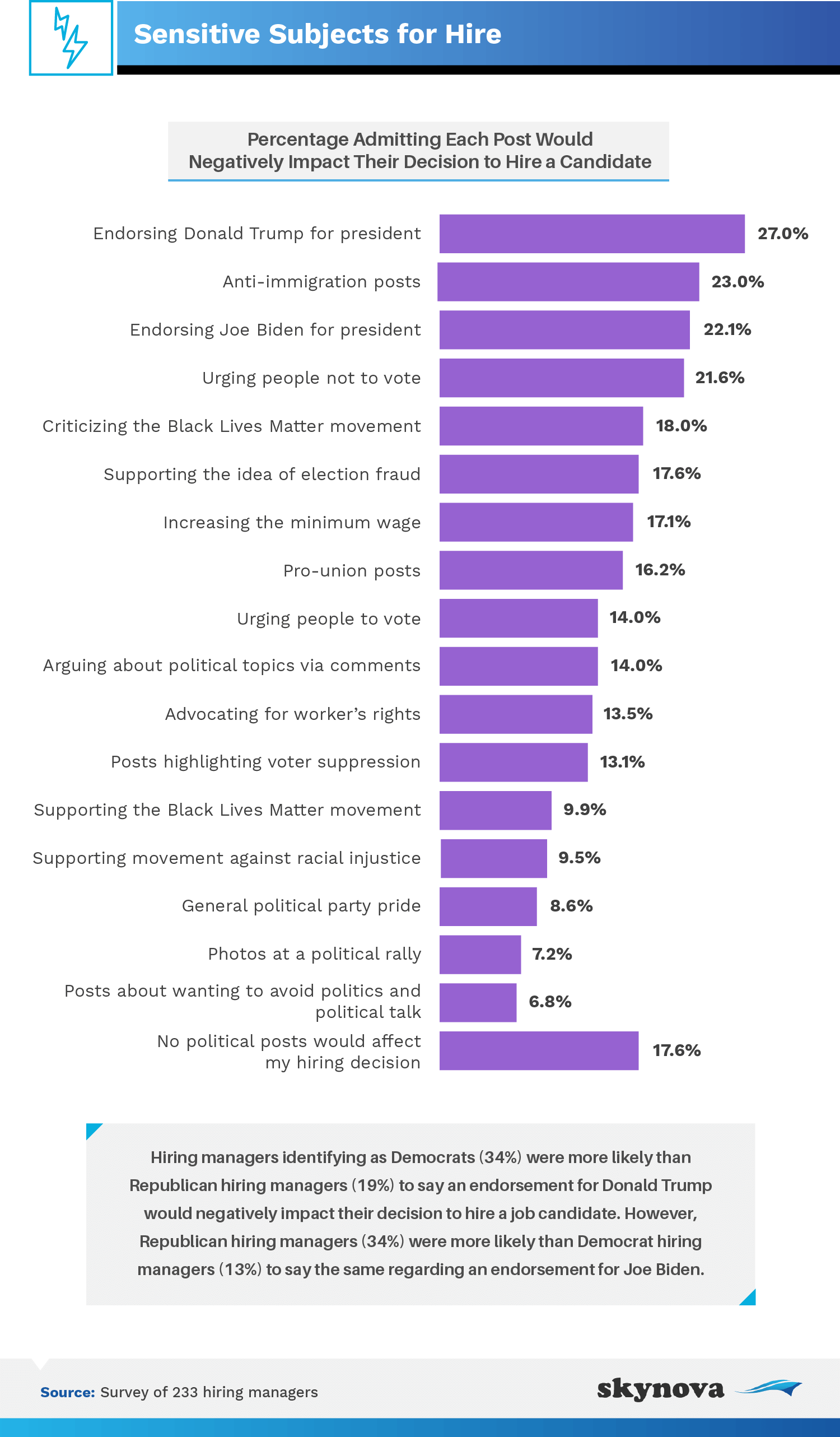
Survey graphic
Click for full image.

Blacklists are back and the Democrats got ’em: According to a new survey, those who publicly supported Trump or expressed conservative opinions on social media are being willingly blackballed by the hiring managers in corporate America.

A new survey of hiring managers provided to Secrets found that backing Trump on social media is the top reason to reject a job applicant.

The apparent reason: Human resources departments want to avoid “tiffs” between employees. “Likely to avoid future office tiffs, a significant portion of hiring managers admitted to negatively judging candidates based on the political content posted. For 27% of hiring managers, social media posts endorsing Donald Trump for president would negatively impact their decision to hire a candidate,” read the analysis of the poll done for Skynova, an online business software company.

While the list of political positions that causes employees heartburn in the graph above also includes some pro-Democratic Party positions — such as endorsing Joe Biden, supporting unions and a minimum wage — the majority are pro-Trump or conservative positions. Though there is a small chance you might be denied a job if you publicly stated your leftist beliefs, you almost certainly will be blackballed if you dared speak out against such beliefs.

Moreover, leftist workers are now eagerly looking for ways to blacklist conservative companies as well. From the survey:
» Read more

36 comments
1 120 121 122 123 124 167